
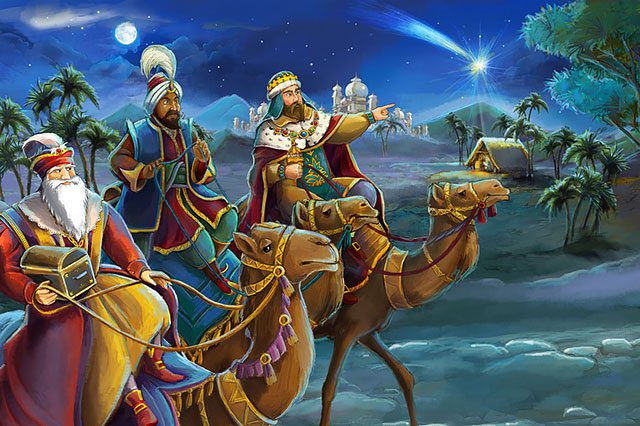
And after Yeshua was born in Beit Lechem, a city of Y’hudah, in the days of Herod the king, behold, there came magi from the east to Yerushalayim,
(Matt. 2:1)
Magi – Aramaic (Old Syriac and Peshitta) מגושא “Magi” (see Strong’s 7248). The Hebrew of DuTillet and Munster have מכשים “magicians.” (See Daniel 2:2, 10). Shem Tob Hebrew has חוזים בכוכבים “star gazers”.
The Quin text has in the margin מהגים “one who murmurs charms” (see b.Sotah 12b in reference to Is. 8:19) (Jastrow p. 331) and אנשים השובים “men of repentance”.
The forefathers of these “magicians” or “magi” of Babylon had seen a vision which had pointed them forward to this coming event. The Midrash Sefer HaYashar (“Book of Jasher”) relates a very similar account regarding the birth of Avram (later called Avraham):
1 And it was in the night that Abram was born, that all the servants of Terah, and all the wise men of Nimrod, and his conjurors came and ate and drank in the house of Terah, and they rejoiced with him on that night.
2 And when all the wise men and conjurors went out from the house of Terah, they lifted up their eyes toward heaven that night to look at the stars, and they saw, and behold one very large star came from the east and ran in the heavens, and he swallowed up the four stars from the four sides of the heavens.
3 And all the wise men of the king and his conjurors were astonished at the sight, and the sages understood this matter, and they knew its import.
4 And they said to each other, This only betokens the child that has been born to Terah this night, who will grow up and be fruitful, and multiply, and possess all the earth, he and his children for ever, and he and his seed will slay great kings, and inherit their lands.
5 And the wise men and conjurors went home that night, and in the morning all these wise men and conjurors rose up early, and assembled in an appointed house.
6 And they spoke and said to each other, Behold the sight that we saw last night is hidden from the king, it has not been made known to him.
7 And should this thing get known to the king in the latter days, he will say to us, Why have you concealed this matter from me, and then we shall all suffer death; therefore, now let us go and tell the king the sight which we saw, and the interpretation thereof, and we shall then remain clear.
8 And they did so, and they all went to the king and bowed down to him to the ground, and they said, May the king live, may the king live.
9 We heard that a son was born to Terah the son of Nahor, the prince of thy host, and we yesternight came to his house, and we ate and drank and rejoiced with him that night.
10 And when thy servants went out from the house of Terah, to go to our respective homes to abide there for the night, we lifted up our eyes to heaven, and we saw a great star coming from the east, and the same star ran with great speed, and swallowed up four great stars, from the four sides of the heavens.
11 And thy servants were astonished at the sight which we saw, and were greatly terrified, and we made our judgment upon the sight, and knew by our wisdom the proper interpretation thereof, that this thing applies to the child that is born to Terah, who will grow up and multiply greatly, and become powerful, and kill all the kings of the earth, and inherit all their lands, he and his seed forever.
12 And now our lord and king, behold we have truly acquainted thee with what we have seen concerning this child.
13 If it seemeth good to the king to give his father value for this child, we will slay him before he shall grow up and increase in the land, and his evil increase against us, that we and our children perish through his evil.
14 And the king heard their words and they seemed good in his sight, and he sent and called for Terah, and Terah came before the king.
(Jasher 8:1-14)
The parallels between this story and the one in Matthew 2 are astounding! In both cases wise men/conjurors are astounded when they see a star in the east which they believe signals the birth of a King and Deliverer. In both cases the wise men and conjurors tell a wicked king what they saw and the wicked king seeks to kill the infant before he can grow up and become a threat. Even if we accept that the Avram story originated later than Matthew 2, there was certainly no reason for Rabbinic Jews to create a fictional story that would make Avram’s birth similar to Yeshua’s. In addition there are also parallels with the birth of Moses.
Moreover the vision recored in the Book of Jasher parallels prophecies and visions given to the prophet Daniel in Daniel Chapters 2 and 7 which point forward to the coming of Messiah.
In Daniel Chapter 2 the King of Babylon has a dream. He calls his “magicians (Mym+rx), enchanters (Myp#)), sorcerers (Myp#km)”. He does not tell them his dream (if he had, they might have connected it to the vision seen by their forefathers in the days of Avraham, and correctly interpreted the vision). In the dream N’vukhadnetzar sees the image of a man, broken down into parts representing four kingdoms. The head of the image is the head of the King of Babylon. In Daniel 2 a stone cut out of a mountain without human hands destroys all four kingdoms and grows itself into a great kingdom.
In Daniel 7 Daniel sees four beasts representing four living beings who are all overcome by the son of man who comes riding upon the clouds.
Both of these visions in the Book of Daniel parallel the vision seen by the Babylonian “wise men and conjurers” in the days of Nimrod. The ultimate fulfiment of the vision in the Book of Jasher would be fulfilled by the Messiah, represented by the “great stat coming from the east” that “swallowed up four great stars”.
The same “star” was prophesied of by another “magician”, Baalam.
“from the mountains of the east” (Num. 23:7) who prophesied:
I see him, but not now; I behold him, but not near; there shall step forth a star out of Ya’akov, and a scepter shall rise out of Yisra’el, and shall smite the corners of Moav, and break down all the sons of Shet.
(Num. 24:17)
The Magicians immediately noticed this star. The first century “church father” Ignatious says of this event:
A star shone forth in the heavens above all the stars; its light was unutterable, and its strangeness caused amazement; and all the rest of the stars, together with the sun and moon, formed themselves into a chorus about the star, but the star itself far outshone them all. From that time forward every sorcery and every spell was dissolved.
And in a citation found in a Commentary on Matthew by Sedulius Scotus we read:
Ita nanque refert evangelium, quod secundum Ebreos1 praetitulatur: `Intuitus Ioseph oculis vidit turbam viatorum comitantium venientium ad speluncam et dixit: Surgam et procedam foras inobviam eis. Cum autem processisset, dixit ad Simonem Joseph: Sic mihi Videntur isti, qui veniunt, augures esse. Ecce enim omni momento respiciunt in caelum et inter se disputant. Sed et peregrini videntur esse, quoniam et habitus eorum differt ab habitu nostro. Nam vestis eorum amplissima est, et color fuscus est eorum densius, et pilea habent in capitibus suis et molles mihi videntur vestes eorum, et in pedibus eorum sunt saraballae. Et ecce steterunt et intendunt in me, et ecce iterum coeperunt hue venientes ambu/lare.’ Quibus verbis liquide ostenditur non tres tantumn viros, sed turbam viatorum venisse ad Dominum, quamvis iuxta quosdam eiusdem turbae praecipui magistri certis nominibus Melchus, Casper, Phadizarda nuncupentur.
For thus the Gospel which is entitled According to the Hebrews
reports:
When Joseph looked out with his eyes, he saw a crowd of pilgrims who were coming in company to the cave, and he said: I will arise and go out to meet them. And when Joseph went out, he said to Simon, “It seems to me as if those coming were soothsayers, for lo, every moment they look up to heaven and confer with one another. But they seem to be strangers, for their appearance differs from ours; for their dress is very rich and their complexion quite dark; they have caps on their heads and their garments seem to be silky, and they have breeches on their legs. And they have halted and are looking at me, and lo, they have halted and are looking at me, and lo, they have again set themselves in motion and are coming here.
From these words it is clear that not merely three men, but a crowd of pilgrims came to the Lord, even if according to some the foremost leaders of this crowd were named with the definite names Melchus, Casper and Phadizarda.
(Sedulius Scotus, Commentary on Matthew; MSS: Berlin, Phillipps 1660, 9th century; fol. 17v; Vienna 740, 9th century, fol. 15 r.v.; cited by Bischoff in Sacris Erudiri VI, 1954, 203f.)
This is clearly an expansion of the account of the visit of the Magi found in Matthew Chapter 2.
TGospel according to the Hebrews refers to the Magi as “soothsayers” (Latin: augures) in a quotation preserved in the writings of Sedulius Scotus (see my recent blog The Nativity Account in the Gospel according to the Hebrews.) The Shem Tob Hebrew version of Matthew (2:7) refers to the Magi as קוסמים which is the word that the Latin Vulgate renders augures “soothsayers” in Deut 18:14.
This fits well with an Assyrian tradition that there were twelve magi. Some commentators identify these “wise men” with the “kings” who bring gifts and pay homage (to Messiah?):
The kings of Tarshish and of the isles shall render tribute; the kings of Sh’va and Seba shall offer gifts. Yes, all kings shall prosrate themselves before him; all nations shall serve him.
(Ps. 72:10-11)
Thus says YHWH, the Redeemer of Yisrael, His Set-apart One, to him who is despised of men, to him who is abhorred of the nation, to a servant of rulers: kings shall see and arise, princes, and they shall prostrate themselves; because of YHWH that is faithful, even HaKadesh of Yisra’el, who has chosen you.
(Is. 49:7)
2:5 for thus it was spoken by the mouth of the prophet – From the context it is difficult to determine whether Micah 5:1 (2) is being cited by the “chief cohenim and scribes” (Mat. 2:4) or by Matthew.
2:6 Beit Lechem – The Chief Cohenim and the Scribes knew well the Aramaic Targum on Micah 5:1 (2) which reads:
And you, O Bethlehem Ephrath, you who were too small to be numbered among the thousands of the house of Judah, from you shall come forth before Me the Messiah,to exercise dominion over Israel, he whose name was mentioned from before, from the days of creation.
(Targum Jonathan; Micah 5:1)
The fact that Messiah was to be born at Beit Lechem is also expressed in this story found in the Midrash Rabbah (as well as in the Jerusalem Talmud):
A man was plowing when one of his oxen lowed. An Arab passed by and asked, ‘What are you?’ He replied, ‘I am a Jew.’ The Arab said to him, ‘Unharness your ox and untie your plow [as a sign of mourning].’ ‘Why?’ ‘Because the Temple of the Jews is destroyed.’ The Jew asked, ‘How do you know this?’ ‘From the lowing of your ox.’ While they were talking the ox lowed again. The Arab said, ‘Harness your ox and tie up your plow, because the deliverer of the Jews is born.’ ‘What is his name?’ ‘His name is Menachem [Comforter].’ ‘What is his father’s name?’ ‘Chizkiyahu.’ ‘Where do they live?’ He answered,’In Birat-‘Arba, in Beit-Lechem of Judea.’ (Midrash Rabbah to Lamentations, Section 51 (on Lamentations 1:16)) (see also j.Ber. 5a)
Beit Lechem had been thr birthplace and home town of King David, and it would become the birthplace of his descendant, the Messiah, heir to David’s throne. Matthew’s quotation of Micah 5:1(2) does not agree exactly with any known version of Micah. In fact the Masoretic Text, Peshitta Tanak and LXX basicly read the same in this passage.
Beit Lechem, Ef’ratah – The DuTillet and Munster Hebrew versions of Matthew agree with the Masoretic Text in this reading. The Aramaic (Old Syriac and Peshitta) and Greek versions of Matthew both have “Beit Lechem of Y’hudah”.
are not to be lightly esteemed – The word “not” is not to be found in any known version of Micah, but it is found in Hebrew, Aramaic and Greek Matthew. Matthew may have paraphrased using this word to indicate that the words of Micah were here intended to be taken as being spoken in ironic sarcasm.
among the thousands of Y’hudah – Again the Hebrew (Du Tillet and Munster) agrees with the Masoretic Text. The Aramaic and Greek versions of Matthew have “among the kings/rulers of Y’hudah”.
my people Israel – All known versions of Micah have only “Israel” but the phrase “my people” appears in Hebrew, Aramaic and Greek Matthew. Matthew may have paraphrased using this word in order to personalize the prophecy and bring it to life.
2:9 the star which they saw in the east – Three interpretations are possible. They may have seen the star while they were in the east, the star itself being in the western sky. Or they may have seen some phenomena in the eastern sky that somehow pointed them towards the west. Finally the phrase “in the east” might actually mean “at its rising”. “star” כוכב not just a “star” as we know it in English, but any celestial body, or even a constellation. In Matt. 2:2 it is called “his star” which may refer to the planet Jupiter which was called by the ancient Hebrews “Tzedek” “righteous” a common euphemism for “Messiah”.
Many explanations have been offered for this “star”. Among these have been a comet, a super nova or some sort of grouping of planets.
The well known astronomer Johannes Kepler proposed a very plausible answer. Kepler was looking through his telescope in Prague on December 17th 1603 observing a conjunction between Saturn and Jupiter in the constellation Pisces at the same longitude. The two planets were so close that they gave the appearance of a single bright star. Amazingly Kepler observed a nova between the two planets outshining both of them. At the time Kepler wrongly believed that the nova was a result of the conjunction of these two planets. This brought to Kepler’s mind that some Jewish astrologers held to a tradition that Messiah would appear at a conjunction of Saturn and Jupiter in the constellation Pisces. This tradition was recorded by Abarbanel, a Jewish commentator of the 15th century, in his commentary on Daniel. Kepler did some calculations and determined that there had in fact been a conjunction of Saturn and Jupiter in Pisces on Dec. 4th of 7 B.C.E. and that the two planets had been in conjunction twice ealier that year on May 29th and October 3rd. In the third conjunction in Pisces, the planet Mars had actually joined Saturn and Jupiter.
Now if a nova did happen to take place in the constellation of Pisces at this same time, it would have been an amazing fulfillment of the event in the skies depicted in the Book of Jasher (see comments to Matt. 2:1). Four “stars” (Pisces, Mars, Jupiter and Saturn) from the “four corners of the sky” (four objects most often found in four different areas of the sky) would have come together and been “swallowed up” by the light of the nova. In his book The Star that Astonished the World, Dr. Ernist Martin favored a theory that the star was a conjunction of Venus and Jupiter in 3 B.C.E..
An elaboration of Martin’s theory is set forth by Avi ben Mordechai in his book Signs in the Heavens (1995). Avi maintains that the “star” was a story being told in the heavens which led the Magi to the Messiah. This theory is based on the idea that the various heavenly bodies were understood by the ancient Hebrews to represent certain Biblical concepts. The story begins on May 19th, 3 BCE with a conjunction of Saturn and Mercury in Taurus. Saturn represents the Sabbath rest, Mercury represents the scribe of Elohim and Taurus represents atonement for the nations. Then on June 12th a conjunction of Saturn and Venus in Taurus. Venus represents brightness and spender. The next scene in the story took place on August 12th with a conjunction of Venus and Jupiter near the bright star Regulus in Leo. Jupiter represents the Messiah while Leo represents kingship. Then on August 22nd a conjunction of Jupiter, Venus and Mercury near Regulus in Leo. On September 4th Mercury and Venus have moved together into Virgo, the “virgin” while Jupiter and Regulus are so close together that the appear as a single super bright star in Leo. The final scene in the “story” occurs on September 11th with Jupiter and Regulus appearing as a single bright star in Leo while Venus, Mercury and the Sun are in Virgo.
2:14-15 …Out of Egypt have I called my son…
13 And after they had departed, and behold, the angel of YHWH appeared to Yosef in a dream, saying: Arise, take the boy and His mother, and flee you away into Egypt and be there. And there you will stay until I return to you: for Herod is seeking to put the boy to death.
14 And he arose, <and did as the angel had said to him,> and took up the boy and His mother by night, and departed into Egypt,
15 And was there until the death of Herod: to fulfill what was spoken from YHWH by the prophet, who said, From out of Egypt I have called, My Son. (Hosea 11:1)
(Matt. 2:13-15 HRV)
In an attempt to discredit this account, as well as the Messiahship of Yeshua, Tovia Singer and other anti-missionaries have claimed that Matthew quotes this passage of Hosea totally out of context. In reality Matthew’s use of this passage as a Messianic prophecy is perfectly justified, and in fact shows a great deal of Jewish insight.
First off it is important to have a basic understanding of Jewish hermeneutics. In Judaism it is understood that there are four levels of understanding of a passage, which correspond to the four Hebrew letters that spell the Hebrew word PaRDeS (Paradise) The word PRDS is also an acronym (called in Judaism “notarikon”) for:
[P]ashat (Heb. “simple”) The plain, simple, literal level of understanding.
[R]emez (Heb. “hint”) The implied level of understanding.
[D]rash (Heb. “search”) The allegorical, typological or homiletically level of understanding.
[S]od (Heb. “hidden”) The hidden, secret or mystical level of understanding.
These are the four levels of understanding. The Four Gospels each express one of these four levels of understanding of the life of Yeshua.
The Pashat Gospel is Mark. Mark wrote a simple, brief, concise, pashat account of Yeshua’s life for the Goyim (Gentiles) while he was in Babylon with Kefa (1Kefa 5:13). He wrote his Gospel in the Syriac dialect of Aramaic for his Syrian and Assyrian readers in Babylon. Mark thus compiled material from Matthew and Luke and simplified it to create a simple version for Goyim. .
The Remez Gospel is Luke. Luke wrote a more detailed account for the High Priest Theophilus (a Sadducee). The Sadducees were rationalists and sticklers for details.
The Drash Gospel is Matthew. Matthew presents his account of Yeshua’s life as a Midrash to the Pharisees, as a continuing story tied to various passages from the Tanak As a drash level account Matthew also includes a number of parables in his account.
The Sod Gospel is Yochanan (John). Yochanan addresses the Mystical Essene sect and concerns himself with mystical topics like light, life, truth, the way and the Word. Yochanan includes many Sod interpretations in his account. For example Yochanan 1:1 presents a Sod understanding of Gen. 1:1. Yochanan 3:14; 8:28 & 12:32 present a Sod understanding of Num. 21:9 etc.).
Now let us return to Hosea 11:1 where we read:
When Israel was a child, then I loved him,
And out of Egypt I called My son.
This passage draws from the Torah Exodus 4:22-23:
Then you shall say to Pharaoh,
“Thus says YHWH:
‘Israel is my first-born son.
I have said to you, ‘Let My son go,
That he may worship Me,’
Yet you refuse to let him go.
Now I will slay your first-born son.’”
(Sh’mot (Ex.) 4:22-23)
Now if Israel is the first-born son of YHWH spoken of in these passages, then why did Matthew apply this passage (Hoshea 11:1) to the Messiah?
Why in the world does YHWH identify Israel as His first-born son? Why does Matthew identify Messiah as His son? Who in Judaism is the first-born Son of YHWH? Why the apparent confusion? Is Matthew really taking Hoshea 11:1 out of context?
No Matthew is giving a Midrash, a Drash understanding of Hosea 11:1 and Exodus 4:22-23. In order to understand this Midrash it is important to understand the concept of the “firstborn Son of Yah” in Judaism.
The firstborn Son of Yah referenced in the Zohar and is the Middle Pillar of the Godhead which the Zohar identifies as “The Son of Yah”. The Zohar describes the three pillars of the Godhead as follows:
Then Elohim said, “Let thee be light; and there was light.
And Elohim saw that the light was good…
Why, it may be asked, was it necessary to repeat the word “light” in this verse? The answer is that the first “light” refers to the primordial light which is of the Right Hand, and it is destined for the “end of days”; while the second “light” refers to the Left Hand, which issues from the Right.
The next words, “And God saw the light that it was good” (Gen. 1:4), refer to the pillar which, standing midway between them, unites both sides, and therefore when the unity of the three, right, left, and middle, was complete, “it was good”, since there could be no completion until the third had appeared to remove the strife between Right and Left, as it is written, “And God separated between the light and between the darkness.”…
This is the Middle Pillar: Ki Tov (that it was good) threw light above and below and on all other sides, in virtue of YHWH, the name which embraces all sides.
(Zohar 1:16b)
The right and left pillars are assigned as Mother and Father, the middle pillar, which balances the feminine and masculine characteristics from the male and female sides, is identified in the Zohar as “the Son of Yah”. The Zohar says:
Better is a neighbor that is near, than a brother far off.
This neighbor is the Middle Pillar in the Godhead, which is the Son of Yah.
(Zohar 2:115)
In another Passage the Zohar has:
We may also translate, “he who withholds blessings from the Son”, whom the Father and Mother have crowned and blessed with many blessings, and concerning whom they commanded, “Kiss the son lest he be angry” (Ps. II, 12), since he is invested both with judgement (gevurah) and with mercy (chesed).
(Zohar 3:191b)
And elsewhere the Zohar says of the Son:
The Holy One, blessed be He, has a son, whose glory (tifret) shines from one end of the world to another. He is a great and mighty tree, whose head reaches heaven, and whose roots are set in the holy ground, and his name is “Mispar” and his place is in the uppermost heaven… as it is written, “The heavens declare (me-SaPRim) the glory (tifret) of God” (Ps. 19:1). Were it not for this “Mispar” there would be neither hosts nor offspring in any of the worlds.
(Zohar 2:105a)
This is intended to point the reader back to a familiar passage from the Bahir:
Why are they called Sephirot?
Because it is written (Psalm 19:2),
“The heavens declare (me-SaPRim) the glory (tifret) of God.”
(Bahir 125)
According to the Zohar, the Middle Pillar of the Godhead is not only known as the “Son of Yah” but also as “Metatron”:
Better is a neighbor that is near, than a brother far off.
This neighbor is the Middle Pillar in the godhead,
which is the Son of Yah.
(Zohar 2:115)
The Middle Pillar is also known as “Metatron”:
The Middle Pillar [of the godhead] is Metatron,
Who has accomplished peace above,
According to the glorious state there.
(Zohar 3:227)
In the Zohar we are also told that Metatron is “the firstborn”:
“And Abraham said to his oldest servant of his house…” (Gen. 24:2) Who is this of whom it said “his servant?” In what sense must this be understood? Who is this servant? R. Nehori answered:
“It is in no other sense to be understood than expressed in the word “His servant,”
His servant, the servant of Elohim, the chief to His service. And who is he? Metatron, as said. He is appointed to glorify the bodies which are in the grave.
This is the meaning of the words “Abraham said to His servant” that is to the servant of Elohim. The servant is Metatron, the eldest of His [YHWH’s] House, who is the firstborn of all creatures of Elohim, who is the ruler of all He has; because Elohim has committed to Him the government over all His hosts.
(Zohar Midrash Ha-Ne’lam; Parsha Hayyei Sarah 1:126b)
So in Judaism both Israel and “The Son of Yah” are identified as the “first-born Son of YHWH”.
According to the first century Jewish writer Philo, this firstborn Son of Elohim is also known as “The Word:
Philo Writes of the Word (Logos):
For there are, as it seems, two temples belonging to God; one being this world, in which the high priest is the divine word, his own firstborn son. The other is the rational soul, the priest of which is the real true man,
(On Dreams 215)
And if there be not as yet any one who is worthy to be called a son of God, neverthless let him labour earnestly to be adorned according to his Firstborn Word, the eldest of his angels, as the great archangel of many names; for He is called, “the Authority”, and “the Name of God”, and “the Word”, and “man according to God’s image”, and “He who sees Israel”. . . For even if we are not yet suitable to be called the sons of God, still we may deserve to be called the children of his eternal image, of his most sacred Word; for the image of God is his most ancient word.
( On the Confusion of Tongues XXVIII:146-147)
Thus, indeed, being a shepherd is a good thing, so that it is justly attributed, not only to kings, and to wise men, and to souls who are perfectly purified, but also to God, the ruler of all things; and he who confirms this is not any ordinary person, but a prophet, whom it is good to believe, he namely who wrote the psalms; for he speaks thus, “The Lord is my shepherd, and he shall cause me to lack Nothing;” (Ps. 23:1.) and let every one in his turn say the same thing,
for it is very becoming to every man who loves God to study such a song as this, but above all this world should sing it. For God, like a shepherd and a king, governs (as if they were a flock of sheep) the earth, and the water, and the air, and the fire, and all the plants, and living creatures that are in them, whether mortal or divine; and he regulates the nature of the heaven, and the periodical revolutions of the sun and moon, and the variations and harmonious movements of the other stars, ruling them according to law and justice; appointing, as their immediate superintendent, his own right reason, his first-born son, who is to receive the charge of this sacred company, as the lieutenant of the great king; for it is said somewhere, “Behold, I am he! I will send my messenger before thy face, who shall keep thee in the Road.”(Ex. 23:20.)
(On Husbandry 50-51)
Furthermore Philo tells us that “The Word” (Logos) and the Messiah are one and the same:
“The head of all things is the eternal Word (Logos) of the eternal God, under which, as if it were his feet or other limbs, is placed the whole world, over which He passes and firmly stands. Now it is not because Messiah is Lord that He passes and sits over the whole world, for His seat with His Father and God but because for its perfect fullness the world is in need of the care and superintendence of the best ordered dispensation, and for its own complete piety, of the Divine Word (Logos), just as living creatures (need) a head, without which it is impossible to live.”
(Q&A on Exodus, II, 117)
So when YHWH says in Sh’mot (Ex.) 4:22-23 and Hoshea 11:1 that Israel is his first-born son he is speaking allegorically. He is comparing Israel to Messiah.
And when Mattitiyahu quotes Hoshea 11:`1 and applies this sonship to Messiah he is referring to the reality behind the allegory of Hosea 11:1 and Sh’mot 4:22-23. In effect Matthew is saying that Yeshua the Messiah is the figure that later Rabbinic Judaism came to call “The Son of Yah”. Therefore the Torah in Sh’mot 4:22-23 is prompting us that there is an allegorical relationship between Israel and Messiah:
So how is the Messiah allegorically like Israel?
* Both made a major impact on the world.
* Both were born through a biological miracle on their mother’s womb.
* Both were taken into Egypt to save their lives.
* Both are called up out of Egypt.
* Both have been despised and rejected by man.
* Rome attempted to execute each of them.
* Both are resurrected never to die again.
By saying, “Israel is my first-born son”, ELOHIM is saying that by oppressing Israel, it is as if Pharaoh was oppressing the Son of Yah, the Messiah himself.
In fact the Tanya makes use of this same allegory which connects the Son of Yah as spoken of in the Zohar with Israel:
So, allegorically speaking, have the souls of Jews risen in the [Divine] thought, as it is written, “My firstborn son is Israel,” and “Ye are children unto the Lord your G-d”. That is to say, just as a child is derived from his father’s brain, so— to use an anthropomorphism— the soul of each Israelite is derived from G-d’s (blessed be He) thought and wisdom.
(Tanya; Likutei Amarim; Chapter 2)
Similarly is it with the human soul, which is divided in two— sechel (intellect) and middot (emotional attributes). The intellect includes chochmah, binah and da at (ChaBaD), whilst the middot are love of G-d, dread and awe of Him, glorification of Him, and so forth. ChaBaD (the intellectual faculties) are called “mothers” and source of the middot, for the latter are “offspring” of the former.
(Tanya; Likutei Amarim; Chapter 3)
2:18 Rachel weeping for her children – The passage here is quoted from Jer. 31:14 (15). The pashat meaning of this passage in context refers to Rachel weeping for her children who are killed when the Norther Kingdom of Israel was invaded by the Assyrians. Matthew however is writing on a drash level and is making a midrash on Jeremiah 31:14 (15). In Matthew’s allegory, Herod is likened to the Assyrian King, Shalmanser. Rachel’s “children” are likened to the Israelites slaughtered by Shalmanser, and the Messiah is likened to the remnant of Israel who survived (for the basis of this allegorical relationship between Messiah and the remnant of Israel, see comments to Matt. 2:15. The allegory is made even more appropriate by the fact that Rachel’s tomb is just outside of Beit Lechem.
This “massacre of the innocents” as it is often called, echos Pharsaoh’s slaughter of newborns of which Moshe survived (Ex. 1:16-22; 2:1-10) as well as King Nimrod’s attempt to kill the infant Avram as recorded in the Book of Jasher 8:1-14 (see comments to Matt. 2:1).
2:23 to fulfill what was spoken by the mouth of the prophet, for he will be called Natzeret – Anti-missionaries have claimed that there is no such prophecy. However several answers to this problem exist. It may have come from a lost book. Another answer is that the prophecy may refer to Isaiah 11:1 in which the Messiah is referred to as “the branch” netzer (see notes to Mt. 3:16-17).
the prophet – In the Greek this is plural “the prophets” but all of our Hebrew and Aramaic manuscripts have it in the singular.
Under Construction