
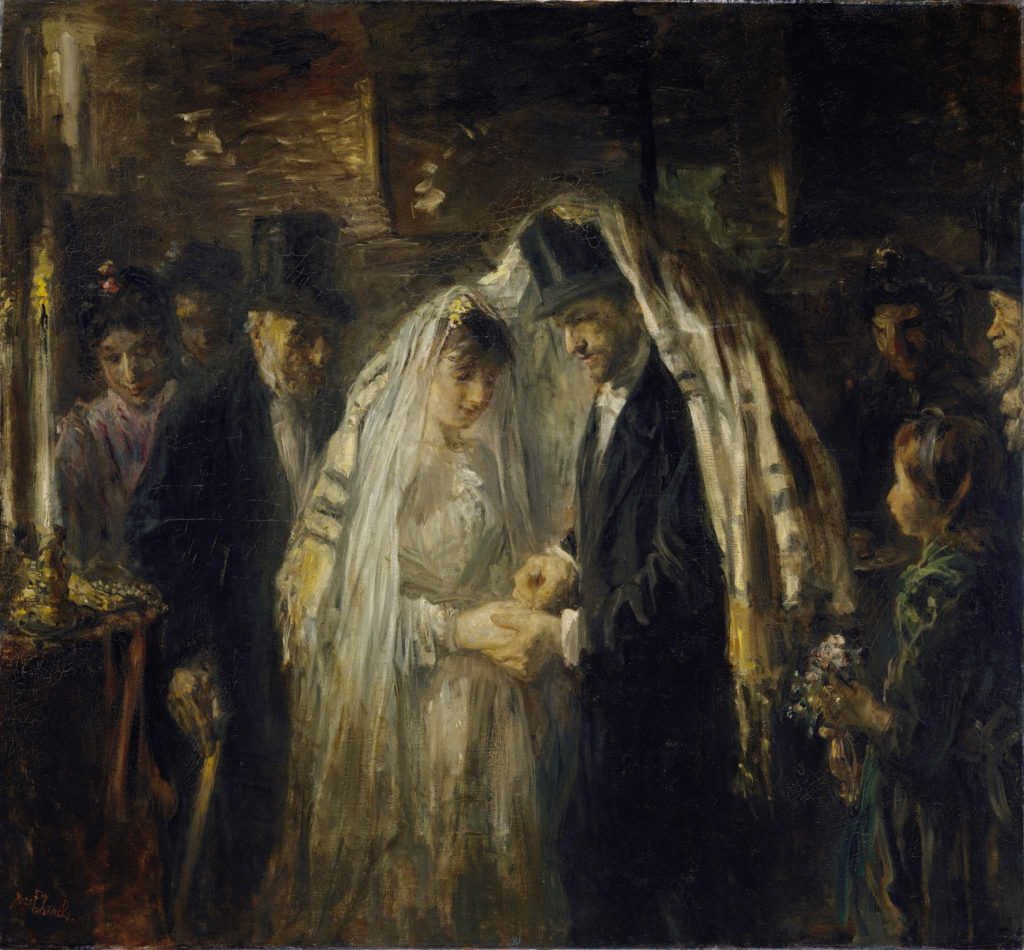
The act of sex alone does not make a couple married. We know this because we read in the Torah that a man who has sex with a virgin who is not betrothed must marry her, or pay a fine (Ex. 22:16-17; Deut. 22:28-29). Since he would marry her subsequent to the sex act, if at all, we know that the sex act did not in and of itself make them married.
We read in the Book of Tobit:
13 Then Reuel called his daughter Sarah, and taking her by the hand he gave her to Tobiyyah to be his wife, saying, “Here she is; take her according to the Torah of Moshe, and take her with you to your father.” And he blessed them.
14 Next he called his wife Edna, and took a scroll and wrote out the contract; and they set their seals to it.
15 Then they began to eat, drink and be merry.
16 And Reuel called his wife Edna and said to her, “Sister, prepare the chamber, and take her into it.”
(Tobit 7:13-16)
Here we see several basic elements of the ancient wedding ceremony:
1. The father gives the bride away to the groom with the words ““Here she is; take her according to the Torah of Moshe, and take her with you to your father.” (This may of necessity be modified).
2. There is a signing of the marriage contract (Ketuvah).
3. A wedding feast.
4. The couple retire to a private “chamber” to consummate the marriage.
(this section is under construction)
Monogamy
One of the halachic principles which distinguished the Essenes from the Pharisees (whom the Essenes termed “Wall Builders”) was a principle the Essenes called “Yesod HaB’riah” (The Principle/Foundation of Creation).
The Pharisees were divided on the issue of divorce. The House of Shammai allowed divorce only in the case of an “unclean matter” (adultery) while the House of Hillel allowed divorce even if the wife only spoiled a dish, and Akiva stretched this to allow a man to divorce his wife because he found a prettier one (m.Gittin 9:10)
The Essenes said the Pharisees had fallen into a trap of Belial saying:
They are caught in…Fornication, by taking two wives in their lifetime although the Principle of Creation (Yesod HaBriah) is “male and female He Created them” (Gen. 1:27) and those who entered the ark “went into the ark two by two” (Gen. 7:9). Concerning the Leaders it is written “he shall not multiply wives to himself” (Dt. 17:17)
(Damascus Document 4,20-5,2)
The Essenes were accusing the Pharisees of effectively practicing polygamy in allowing divorce so easily, and in doing so, violating the Yesod HaBriah.
No doubt Messiah is citing Yesod HaBriah (The Principle of Creation) when he has the following halachic debate with a group of Pharisees:
19:3 And the P’rushim approached him, and tempted him,
saying, “Is it right for a man to put away his wife for every cause?”
19:4 And he answered and said to them:
“Have you not read that he who made man the beginning,
‘made them male and female’ (Gen. 1:27)
19:5 And said,
‘Wherefore shall a man shall leave his father
and his mother, and cleave to his wife, and the two shall become one flesh’ (Gen. 2:24)
19:6 And now then, they are no more two but one flesh
only. What therefore Elohim has joined together man cannot separate.”
19:7 But they said,
“And why then did Moshe then command
to give a bill of divorcement, and to put her away
if she was not pleasing in his sight?” (Deut. 24:1, 3)
19:8 And he answered them and said,
“Because Moshe on account of the hardness of your hearts,
allowed you to put away your wives,
but from the beginning it was not so.
19:9 And I tell you,
every man that has put away, or shall put away his wife,
except it be for fornication, and takes another,
commits adultery. And whoever takes the divorced also
commits adultery.
(Mt. 19:3-9)
Notice that divorce and polygamy equally fall under the violation of the Yesod HaBriah. Neither actually violates the Torah itself, but both violate a halachic principle which is preferred.
Notice that Yeshua treats divorce as a last resort, which YHWH does not forbid, but does discourage. YHWH recognized that divorces happen in society and thus the Torah regulates divorce. The Torah does not encourage divorce, and certainly does not find it a blessing, because it violates the Yesod HaBriah (Principle of Creation).
Polygamy, like divorce, violates the Yesod HaBriah. The Torah does not forbid polygamy, it recognized that polygamy was practiced and thus regulated it. The Torah did not encourage polygamy, and certainly does not find it to be a blessing, because it violates the Yesod HaBriah (Principle of Creation).
Just as divorcing a wife for a prettier woman violates the Yesod HaBriah, so does Polygamy. While polygamy does not violate the Torah, it does violate the Yesod HaBriah.
Paul writes:
2 But it is right, that an elder should be one in whom a blemish is not found, and is the husband of one woman; who [is] of a watchful mind, and sober and orderly, and loving of strangers and able to teach,
(1Tim. 3:2 HRV)
This has it’s parallel in the Dead Sea Scrolls:
They are caught in…Fornication, by taking two wives in their lifetime although the Principle of Creation (Yesod HaBriah) is “male and female He Created them” (Gen. 1:27) and those who entered the ark “went into the ark two by two” (Gen. 7:9). Concerning the Leaders (נשיא) it is written “he shall not multiply wives to himself” (Dt. 17:17)
(Damascus Document 4,20-5,2)
This is a halacha that builds a rule based on the commandment of Deut. 17:7 which says of a king “Neither shall he multiply wives to himself”. Both the Essenes and Paul generalized this to leadership.
Yeshua’s Halacha, was for monogamy and against polygamy, and that therefore, is Nazarene halacha.