
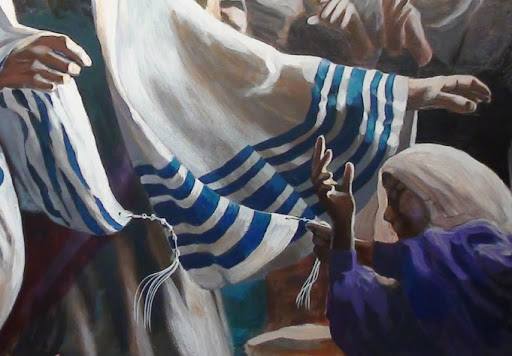
“Thus says YHWH Tzva’ot: In those days it shall come to pass, that ten men shall take hold, out of all the languages of the nations, shall even take hold of the skirt (KANAF), of him that is a Jew, saying, We will go with you, for we have heard that Elohim is with you.”
— Zechariah 8:23 (HRV)
The Plural “You” That Changes Everything
English blurs a key feature of the Hebrew text. In Zech. 8:23 the word “you” is plural. The nations say: “Let us go with you [plural], for we have heard that Elohim is with you [plural].”
This cannot refer merely to a single Jew (not even the Messiah); it refers to the Jewish people, the House of Judah. The prophecy is Ephraim and the nations taking hold of Judah because Elohim is with Judah.
Taking Hold of the Kanaf: Torah in the Hand
The “skirt” is קָנָף (kanaf)—the corner/edge of the garment. That’s exactly where YHWH commanded tzitziyot (fringes) to be attached:
Numbers 15:37–41 (HRV)
“Speak unto the children of Yisra’el … that they make … fringes (tzitziyot) in the corners (kanafot) of their garments … and it shall be unto you for a fringe, that you may look upon it, and remember all the commandments of YHWH, and do them….”
To “take hold of the kanaf of a Jew” is to seize hold of the Torah-sign—the covenantal marker entrusted to Judah.
Ephraimites Taking Hold
So what is Ephraim’s prophetic hope? A separate last-days restoration apart from Judah—or a return to be joined to Judah?
Ezekiel 37: Ephraim Put With Judah
Ezekiel’s “two sticks” is the clearest picture of reunion:
“I will take the stick of Joseph, which is in the hand of Ephraim, and the tribes of Israel his fellows, and put them with the stick of Judah, and make them one stick … and they shall be one in My hand.”
— Ezek. 37:19–20
Note the direction and ordering:
- YHWH takes Ephraim’s stick,
- puts it with Judah’s stick,
- and makes them one in His hand.
This is not two equal halves meeting in the middle. Ephraim is brought over and put with Judah. The unity is real; the ordering is covenantally Judah-ward.
Transition to Romans 11: etz = stick / tree
The Hebrew word עֵץ (etz) means “stick” or “tree.”
Ezekiel’s two etz (two sticks) therefore map naturally to Paul’s two etz (two trees) in Romans 11. The prophetic images are the same picture in two registers:
- Ezekiel 37: two etz (sticks) → one in YHWH’s hand.
- Romans 11: two etz (trees)—cultivated and wild—with the wild branches grafted into the cultivated tree.
Hosea → Romans 9–11: Who Are “Jews” and “Gentiles”?
Paul sets up Romans 11 by quoting Hosea:
- Rom. 9:25–26 cites Hos. 2:25(23); 2:1 (1:10)—the children of Israel who were “not My people” becoming “My people.”
- In Hosea’s context, “children of Israel” (Ephraim) are contrasted with “children of Judah” (Hos. 2:2 [1:11]).
If Paul is reading Hosea in context, then his contrast in Rom. 9:24 (“Jews and Gentiles”) primarily tracks Judah and Ephraim among the nations—not paganism as a rival faith.
Romans 11: Two Trees, One Root
With Hosea’s categories in hand, Romans 11 snaps into focus:
- The cultivated olive tree = Judah.
- The wild olive = Ephraim, scattered in the nations.
Ephraim’s wild branches are broken off their feral stock and grafted into Judah’s cultivated tree, to be nourished by Judah’s root—and warned not to boast against the natural branches:
“Do not boast against the [natural] branches… you are not bearing the root, but the root bears you.”
— Rom. 11:18 (HRV)
This mirrors Ezekiel’s movement: Ephraim is put with Judah; Ephraim is grafted into Judah. The etz (stick) of Ephraim is joined to Judah’s etz (tree)—same Hebrew word, same prophetic logic.
“Salvation Is of the Jews”: Yeshua and an Ephraimite
In John 4, the Samaritan woman identifies with “our father Jacob” (Jn. 4:12)—an Ephraimite claim Yeshua does not challenge. He does, however, correct her worship:
“You worship what you do not know; we worship what we know, because salvation is of the Jews. But the hour is coming, and now is, when the true worshipers shall worship the Father in spirit and truth…”
— Jn. 4:22–23 (HRV)
Ephraim’s path is not a rival mountain. It is taking hold of Judah, through whom salvation and the oracles were entrusted (cf. Rom. 3:2).
Judah’s Fullness: Life from the Dead
Paul presses the hope further:
“If their stumbling became riches for the world… how much more, therefore, their fullness?”
— Rom. 11:12 (HRV)
“If you… were grafted into the good olive tree, how much more they, if they be grafted into their own olive tree?”
— Rom. 11:24 (HRV)
Judah’s restoration is “life from the dead” (Rom. 11:15). Isaiah mapped both the blindness and its cure:
“For YHWH has poured out upon you the spirit of deep sleep, and has closed your eyes…” — Isa. 29:10 (HRV)
“And in that day shall the deaf hear the words of a book, and the eyes of the blind shall see…” — Isa. 29:18 (HRV)
The book opens, the root nourishes, the natural branches awaken—on YHWH’s timetable, by YHWH’s hand.
Read Zechariah 8:23 Straight—With Ezekiel and Paul in View
“Ten men from all languages of the nations shall take hold—they shall take hold of the kanaf of a Jew—saying, ‘Let us go with you [pl.], for we have heard that Elohim is with you [pl.].’”
- “Ten men” → the Ten Tribes (Ephraim) in dispersion.
- “From all languages” → Ephraim assimilated among the nations.
- “Take hold of the kanaf” → seize the tzitzit, the Torah-sign Judah bears.
- “You [pl.]” → Judah, the House of Judah—not a solitary figure.
Set alongside Ezekiel 37 and Romans 11, the line reads plainly:
“Let us [Ephraim] go with you [Judah], for we [Ephraim] have heard that YHWH is with you [Judah].”
Ephraim is not the root, trunk, or standard. Ephraim is taken, put with, and grafted into Judah’s living covenantal tree, to be fed by the root and to walk in the Torah Judah bears.
Are You Boasting—or Taking Hold?
The last-days picture is consistent:
- Ephraim and the nations awaken to the reality that Elohim is with Judah.
- They take hold of Judah’s kanaf—Torah—and are grafted into Judah’s cultivated tree.
- They do not boast against the natural branches, and they do not demand that Judah take hold of them.
So test yourself:
- Are you expecting Judah to be grafted into your system?
- Or are you humbling yourself to take hold of Judah and be fed by the root of the Jewish olive tree?
The sticks are being joined—and the branches are being grafted—exactly in the order the prophets gave. The faithful response is simple and hard: take hold.
Support NazareneSpace
Friends, our community space makes this work possible—but our rent is due today and we must raise at least $200 to cover it. If the teachings and resources we share have blessed you, would you prayerfully consider supporting us?
You can send a gift securely via PayPal to donations@wnae.org or give online here: nazarenespace.com/blog/donate
Every contribution, no matter the size, helps us keep this work going. Thank you for standing with us in restoring the ancient faith of the Nazarenes!


