
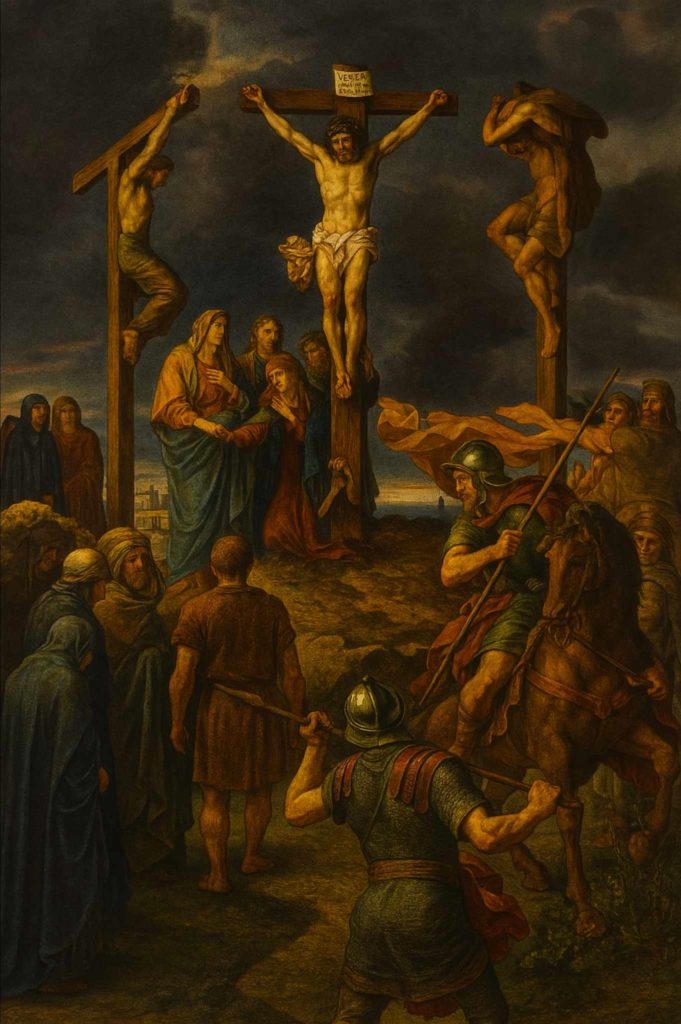
For nearly two millennia, believers have debated the precise timing of Yeshua’s death, burial, and resurrection. Many are familiar with the traditional “Good Friday” view. Others advocate for a Wednesday crucifixion to make room for “three days and three nights in the heart of the earth.” But when we examine the Hebrew and Aramaic texts, Second Temple halacha, and astronomical data together, a clearer picture emerges—one that powerfully supports a Thursday crucifixion on April 6, 30 CE.
❗ The Problem with Traditional Timelines
1. Friday Crucifixion?
The most common Christian tradition places the crucifixion on a Friday. However, this creates a numerical conflict: from Friday afternoon to Sunday morning does not equal three days and three nights in any sense—literal or idiomatic.
2. Wednesday Crucifixion?
Some propose a Wednesday crucifixion to accommodate 72 hours, but this introduces other issues:
- It requires four days before Sunday (not three)
- It conflicts with Luke 24:21, which says “today is the third day since these things were done,” spoken on Sunday
📖 What the Scriptures Actually Say
Luke 24:21 — A Clear Chronological Marker
“Today is the third day since these things were done.”
Spoken on Sunday, this verse provides a mathematically precise window for counting backward:
| Day | Description | Count |
|---|---|---|
| Sunday | Resurrection day | 3rd day since |
| Saturday | Weekly Sabbath | 2nd day since |
| Friday | Annual Sabbath (Nisan 15) | 1st day since |
| Thursday | Crucifixion | Day the “things were done” |
No mental gymnastics are needed. Luke 24:21 makes it explicit: the crucifixion took place on Thursday.
Matthew 12:40 — The “Three Days and Three Nights” Dilemma
“For as Jonah was in the belly of the great fish three days and three nights, so shall the Son of Man be in the heart of the earth…”
This phrase, while meaningful, poses complications:
- It does not appear in Luke’s version (Luke 11:29–32)
- Some ancient Greek manuscripts note that the Jewish version of Matthew lacked this phrase: το ιουδαικον ουκ εχει τρεις η [μερας και τρεις νυκτας]
“The Jewish version does not have ‘three days and three nights’ here”
Whether or not the phrase is original, it’s worth noting that in Semitic idiom, “three days and three nights” could still refer to parts of three days, not a literal 72-hour period. (Compare Esther 4:16–5:1.)
📚 Halachic and Linguistic Factors
What Is “Passover”?
- Nisan 14: Day of slaughtering the lambs
- Nisan 15: Begins the Feast of Unleavened Bread (an annual Sabbath)
- The Gospels often call the entire 8-day period “Passover,” creating apparent contradictions that vanish with a Hebraic understanding.
What Is “Evening”?
The Hebrew word ערב (erev) marks a transition, not a time range. Every day has two evenings—at sunset and just before nightfall. This adds complexity to interpreting “evening” events in the Gospels.
🗓️ Astronomical Evidence for 30 CE
Using Crescent-Sighting Calendar (not modern astronomical conjunctions):
- Astronomical New Moon (conjunction): March 22, 30 CE
- Likely Crescent Sighting: Evening of March 24, 30 CE
- Therefore:
➤ Nisan 1 = March 24 at sunset
➤ Nisan 14 = April 6 at sunset, beginning Wednesday night and continuing through Thursday
This timeline places:
- The Last Supper (Seder): Wednesday night (Nisan 14, sectarian reckoning)
- Crucifixion: Thursday afternoon (April 6)
- Annual Sabbath (Nisan 15): Friday, April 7
- Weekly Sabbath: Saturday, April 8
- Resurrection Discovered: Sunday, April 9 (Nisan 17)
This model matches the Gospels exactly when understood in their Second Temple Jewish context.
🛡️ Harmonizing John and the Synoptics
The Synoptic Gospels (Matthew, Mark, Luke)
- Present the Last Supper as a Passover meal
- Use terms like “first day of Unleavened Bread,” reflecting a Pharisaic calendar
The Gospel of John
- States that the crucifixion happened on the day of preparation for Passover (John 19:14)
- Implies that the Temple authorities’ Passover occurred on Friday evening
Resolution:
Multiple calendars were in use.
- Yeshua may have followed a sectarian or Galilean calendar (e.g., Essene or Zealot), celebrating Passover a day earlier.
- The Temple calendar, possibly controlled by Sadducees, had Nisan 14 fall on Friday, hence the slaughter of lambs occurring after Yeshua’s death.
This calendar divergence explains why:
- Yeshua could keep a Passover Seder with his disciples
- Yet also die at the same hour Temple lambs were being slain the following day
✅ Summary: Why April 6, 30 CE Is the Most Plausible Date
| Criteria | April 6, 30 CE |
|---|---|
| Day of Crucifixion | Thursday |
| Fits Luke 24:21 | ✅ Yes |
| Aligns with Temple & sectarian calendars | ✅ Yes |
| Matches lunar visibility data | ✅ Yes |
| Within Pilate’s rule (26–36 CE) | ✅ Yes |
| Allows for both Sabbaths (annual + weekly) before Sunday | ✅ Yes |
🔚 Final Thought
Yeshua did not die in a theological vacuum. He died as Israel’s Passover lamb, within a halachic, calendrical, and liturgical framework rooted in the Torah. Recognizing the Thursday crucifixion on April 6, 30 CE, restores both the historical and Jewish integrity of the Passion narrative.
✡️ And perhaps that is the greatest sign of all:
The Lamb of God was offered at the very time appointed—
Not according to the convenience of later tradition,
But according to the rhythms of God’s moedim.
✡️ Support the Restoration of Nazarene Truth
If this teaching has blessed you or deepened your understanding of Yeshua’s final Passover and crucifixion, I invite you to partner with us in restoring the original faith of the Nazarenes. Your support helps us continue this vital work—publishing in-depth studies, translating ancient texts, and teaching the Torah-based message of the Messiah.
📖 NazareneSpace exists to reconnect believers with the Hebrew roots of their faith and the original teachings of Yeshua and his disciples. This work is made possible by readers like you.
Right now our account is pending $525 in the negative! We must raise at least that amount by the end of the day today to keep our account from plunging into the negative and starting a chain reaction of returned items and fees!
👉 You can donate securely here:
🔗 https://nazarenespace.com/blog/donate/
or send donations by Paypal to donations@wnae.org
Thank you for standing with us in the restoration of all things (Acts 3:21).
בברכת שלום ובשם המשיח,
James Scott Trimm


