
For centuries, scholars have debated what language the books of the New Testament were originally written in. While most academic consensus defaults to Greek, there have always been voices—both ancient and modern—that testify to an original Hebrew Gospel of Matthew.
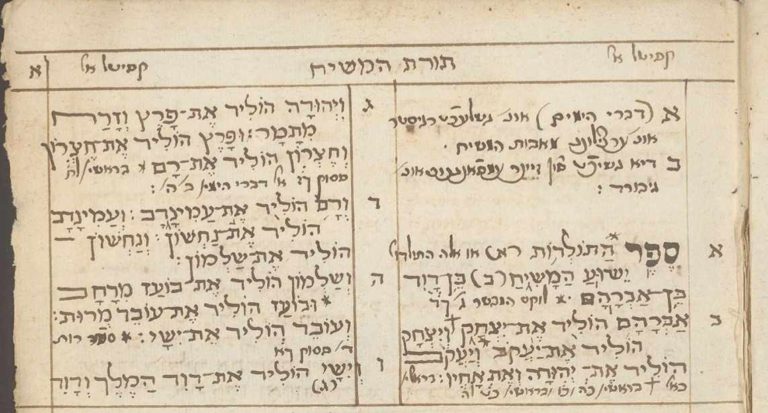
Among the most powerful witnesses to that possibility is the DuTillet Hebrew Matthew, a complete Gospel manuscript confiscated from Jews in Rome in 1553 and preserved today in the Bibliothèque Nationale in Paris. This manuscript is written entirely in Hebrew—not medieval Rabbinic Hebrew, not a translation from Greek, but something linguistically, textually, and theologically rooted in an ancient Semitic world.
Unlike later Christian translations, the DuTillet text preserves names, expressions, and even grammatical structures that echo the Hebrew Bible itself. For example, it includes the missing fourteenth name in Yeshua’s genealogy (Matthew 1:13), uses the Tetragrammaton (יהוה) in place of “Lord,” and aligns frequently with early Gospel traditions such as the Old Syriac, Old Latin, and even the now-lost Gospel according to the Hebrews—used by the earliest followers of Yeshua, who still saw themselves not as Christians, but as Torah-faithful Jews of the “sect of the Nazarenes.”
We are not just talking about a translation curiosity. This is nothing less than a thread of historical DNA linking us to the earliest Gospel as it would have been heard by first-century Jewish ears. Through this Hebrew lens, familiar teachings come alive in ways that are deeper, clearer, and often more faithful to Yeshua’s original voice and intent.
But the DuTillet text is only one strand. Other Hebrew witnesses of this same “Old Hebrew” version include the Munster, Cinquarbres, and Garza-Trimm manuscripts—all preserving different facets of the same Semitic tradition. When we compare them—side by side, word by word—a fuller picture emerges: one that powerfully confirms that the New Testament was not born in Rome or Byzantium, but in Jerusalem, in Hebrew and Aramaic, among the Jewish people.
Why This Work Matters
In our time, we have the technology, the scholarship, and the calling to restore the original Hebrew and Aramaic text of the New Testament—faithfully, verse by verse. But this work is painstaking, and it takes time, dedication, and resources.
We’re not just translating ancient texts. We’re restoring history, healing distortions, and bringing the words of Yeshua back into their original light.
If you’ve ever been moved by the teachings of the Messiah…
If you’ve ever wanted to know what he really said—how he really spoke, taught, prayed, and fulfilled the Torah…
If you believe that the truth is worth preserving…
Then please, partner with us.
The Scripture Restoration Project is committed to recovering, preserving, and publishing the Hebrew and Aramaic texts of the New Testament for generations to come. But we cannot do it alone.
🙏 We need your help.
Your donation supports the research, transcription, translation, and publication of these sacred texts—ensuring that they are never again forgotten, obscured, or dismissed.
▶️ Give today, and be part of restoring the Gospel to its original voice.
Emergency Alert! We must raise at least $425 by the end of the day today, or our account will plunge into the negative and start a chin reaction of returned items and fees.
With gratitude and hope,
James Scott Trimm
Founder, Scripture Restoration Project


