
James Trimm’s Nazarene Commentary on Bereshit Chapter 22
1 And it came to pass after these things, that Elohim did prove Avraham, and said unto him: Avraham. And he said, Here am I.
2 And He said: Take now your son, your only son, whom you love, even Yitz’chak, and get you into the land of Moriah. And offer him there for a burnt-offering upon one of the mountains which I will tell you of.
3 And Avraham rose early in the morning, and saddled his ass, and took two of his young men with him, and Yitz’chak his son. And he cleaved the wood for the burntoffering, and rose up, and went unto the place of which Elohim had told him.
4 On the third day Avraham lifted up his eyes, and saw the place afar off.
5 And Avraham said unto his young men, Abide you here with the ass, and I and the lad will go yonder: and we will worship, and come back to you.
6 And Avraham took the wood of the burnt-offering, and laid it upon Yitz’chak his son. And he took in his hand the fire and the knife, and they went, both of them together.
7 And Yitz’chak spoke unto Avraham his father, and said, My father. And he said, Here am I, my son. And he said, Behold, the fire and the wood. But where is the lamb for a burnt-offering?
8 And Avraham said, Elohim will provide Himself, the lamb for a burnt-offering, my son. So they went both of them together.
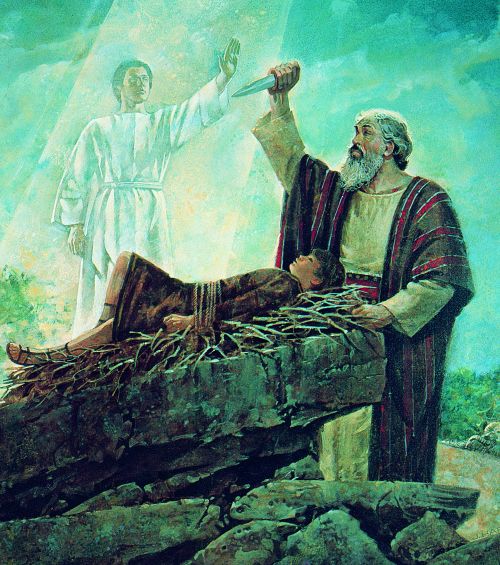
9 And they came to the place which Elohim had told him of. And Avraham built the altar there and laid the wood in order, and bound Yitz’chak his son, and laid him on the altar upon the wood.
10 And Avraham stretched forth his hand, and took the knife to slay his son.
11 And the angel of YHWH called unto him out of heaven, and said: Avraham,
Avraham! And he said, Here am I!
12 And he said: Lay not your hand upon the lad, neither do you any thing unto him. For now I know that you are an Elohim-fearing man, seeing you have not withheld your son– your only son, from Me.
13 And Avraham lifted up his eyes and looked. And behold, behind him a ram caught in the thicket by his horns. And Avraham went and took the ram, and offered him up for a burnt-offering in the stead of his son.
14 And Avraham called the name of that place YHWH34-Yireh: as it is said to this day: in the mount where YHWH is seen
(Gen. 22:1-14 HRV)
Each year at Rosh HaShanna we greet one another with the blessing “may your name be written in the Book of Life” and we blow the shofar [ram’s horn]. But why do we blow the ram’s horn and not some other kind of trumpet? And what does the shofar have to do with the Book of Life? We read in the Talmud:
R. Abbahu said: Why do we blow on a ram’s horn? The Holy One, blessed be He, said: Sound before Me a ram’s horn so that I may remember on your behalf the binding of Isaac the son of Abraham, and account it to you as if you had bound yourselves before Me.
(b.Rosh HaShanna 16a)
The account of the binding of Isaac (Gen. 22:1-13) is known as the Akedah. We blow the shofar to petition YHWH to recall on our behalf, the Akedah. But why?
The Zohar tells us that the event recorded at the opening of the Book of Job where Satan tested Job, was on a Rosh HaShanna:
R. Eleazar then discoursed on the verse: And there was a day when the sons of God came to stand before the Lord, and Satan came also among them (Job I, 6). ‘This “day” ‘, said he, ‘was New Year’s Day, on which the Holy One sits in judgement on the world.
(Zohar 2:32b)
Observe that on New Year’s Day the world is brought to trial before the holy Judgement Seat; and there stands on one side the evil spirit who regards intently and makes a record of all those that are doomed to death. But at the moment that Israel awakens mercy by means of the sound of the trumpet (shofar) he becomes altogether confused and distracted, and turns his gaze away from the doomed ones.
(Zohar 2:237b-238a)
The Book of Jasher contains a prelude to the Akeda which parallels the event at the opening of Job:
46 And the day arrived when the sons of God came and placed themselves before the Lord, and Satan also came with the sons of God before the Lord.
47 And the Lord said unto Satan, Whence comest thou? and Satan answered the Lord and said, From going to and fro in the earth, and from walking up and down in it.
48 And the Lord said to Satan, What is thy word to me concerning all the children of the earth? and Satan answered the Lord and said, I have seen all the children of the earth who serve thee and remember thee when they require anything from thee.
49 And when thou givest them the thing which they require from thee, they sit at their ease, and forsake thee and they remember thee no more.
50 Hast thou seen Abraham the son of Terah, who at first had no children, and he served thee and erected altars to thee wherever he came, and he brought up offerings upon them, and he proclaimed thy name continually to all the children of the earth.
51 And now that his son Isaac is born to him, he has forsaken thee, he has made a great feast for all the inhabitants of the land, and the Lord he has forgotten.
52 For amidst all that he has done he brought thee no offering; neither burnt offering nor peace offering, neither ox, lamb nor goat of all that he killed on the day that his son was weaned.
53 Even from the time of his son’s birth till now, being thirty-seven years, he built no altar before thee, nor brought any offering to thee, for he saw that thou didst give what he requested before thee, and he therefore forsook thee.
54 And the Lord said to Satan, Hast thou thus considered my servant Abraham? for there is none like him upon earth, a perfect and an upright man before me, one that feareth God and avoideth evil; as I live, were I to say unto him, Bring up Isaac thy son before me, he would not withhold him from me, much more if I told him to bring up a burnt offering before me from his flock or herds.
55 And Satan answered the Lord and said, Speak then now unto Abraham as thou hast said, and thou wilt see whether he will not this day transgress and cast aside thy words.
(Jasher 22:46-55)
There is an interesting parallel to this prelude in the Dead Sea Scrolls:
And a son of love was born to Abraham and he named him Isaac. Now the Prince of Malevolence (Mastemah) came to God and brought his animosity to bear against Abraham because of Isaac….
(4Q225)
This is why Gen. 22:1 says that Abraham was being “tested” or “tried” just as Job had been tested. This also tells us that this event took place on a Rosh HaShanna, and thus why we would remind YHWH of the Akeda in connection with Rosh HaShanna.
So let us study the Akeda and see what it can teach us:
[1] And it came to pass after these things, that God did tempt Abraham, and said unto him, Abraham: and he said, Behold, here I am.
[2] And he said, Take now thy son, thine only son Isaac, whom thou lovest, and get thee into the land of Moriah; and offer him there for a burnt offering upon one of the mountains which I will tell thee of.
[3] And Abraham rose up early in the morning, and saddled his ass, and took two of his young men with him, and Isaac his son, and clave the wood for the burnt offering, and rose up, and went unto the place of which God had told him.
[4] Then on the third day Abraham lifted up his eyes, and saw the place afar off.
[5] And Abraham said unto his young men, Abide ye here with the ass; and I and the lad will go yonder and worship, and come again to you,
[6] And Abraham took the wood of the burnt offering, and laid it upon Isaac his son; and he took the fire in his hand, and a knife; and they went both of them together.
[7] And Isaac spake unto Abraham his father, and said, My father: and he said, Here am I, my son. And he said, Behold the fire and the wood: but where is the lamb for a burnt offering?
[8] And Abraham said, My son, God will provide himself a lamb for a burnt offering: so they went both of them together.
[9] And they came to the place which God had told him of; and Abraham built an altar there, and laid the wood in order, and bound Isaac his son, and laid him on the altar upon the wood.
[10] And Abraham stretched forth his hand, and took the knife to slay his son.
[11] And the angel of the LORD called unto him out of heaven, and said, Abraham, Abraham: and he said, Here am I.
[12] And he said, Lay not thine hand upon the lad, neither do thou any thing unto him: for now I know that thou fearest God, seeing thou hast not withheld thy son, thine only son from me.
[13] And Abraham lifted up his eyes, and looked, and behold behind him a ram caught in a thicket by his horns: and Abraham went and took the ram, and offered him up for a burnt offering in the stead of his son.
[14] And Abraham called the name of that place Jehovah-jireh: as it is said to this day, In the mount of the LORD it shall be seen.
(Gen. 22:1-14 KJV)
Notice that in verse 8 Abraham says that YHWH would provide a “lamb” but in verse 13 the substitute is a “ram”. The remez (Implication) is that the ram is only representative of the lamb that YHWH will provide. The text may also be read that YHWH will provide Himself as the substitute “lamb”.
Philo: The Lamb is the Word
The first century Jewish writer Philo of Alexandria understood the Akeda on a drash level as an allegory by which Avraham was prepared to offer up to YHWH his “self-taught wisdom” (represented by Isaac) but YHWH instead substituted the LOGOS “The Word” or “divine reason” represented by the ram:
(4) For the appropriate progeny of God are the perfect virtues, but that offspring which is akin to the wicked, is unregulated wickedness. But learn thou, if thou wilt, O my mind, not to bear children to thyself, after the example of that perfect man Abraham, who offered up to God “The beloved and only legitimate offspring of his soul,” the most conspicuous image of self-taught wisdom, by name Isaac; and who gave him up with all cheerfulness to be a necessary and fitting offering to God. “Having bound,” as the scripture says, this new kind of victim, either because he, having once tasted of the divine inspiration, did not condescend any longer to tread on any mortal truth, or because he saw that the creature was unstable and moveable, while he recognised the unhesitating firmness existing in the living God, on whom he is said to have believed.
(On the Unchangeableness of God 4)
(133) Let us therefore consider what it is that he who is seeking doubts about, and what he who answers reveals, and in the third place what the thing is which was found. Now what the inquirer asks is something of this kind:–Behold the efficient cause, the fire; behold also the passive part, the material, the wood. Where is the third party, the thing to be effected? (134) As if he said, –Behold the mind, the fervid and kindled spirit; behold also the objects of intelligence, as it were so much material or fuel; where is the third thing, the act of perceiving? Or, again, –Behold the sight, behold the colour, where is the act of seeing? And, in short, generally, behold the external sense, behold the thing to be judge of; but where are the objects of the external sense, the material, the exertion of the feeling? (135) To him who puts these questions, answer is very properly made, “God will provide for himself.” For the third thing is the peculiar work of God; for it is owing to his providential arrangement that the mind comprehends, and the sight sees, and that every external sense is exerted. “And a ram is found caught by his horns;” that is to say, reason (LOGOS “The Word”) is found silent and withholding its assent; (136) for silence is the most excellent of offerings, and so is a withholding of assent to those matters of which there are not clear proofs; therefore this is all that ought to be said, “God will provide for himself,”–he to whom all things are known, who illuminates the universe by the most brilliant of all lights, himself. But the other things are not to be said by creatures over whom great darkness is poured; but quiet is a means of safety in darkness.
(On Flight and Finding 133-136)
In another passage Philo reveals that he also understands the “Word” (LOGOS) to be synonymous with the Messiah:
“The head of all things is the eternal Word (Logos) of the eternal God, under which, as if it were his feet or other limbs, is placed the whole world, over which He passes and firmly stands. Now it is not because Messiah is Lord that He passes and sits over the whole world, for His seat with His Father and God but because for its perfect fullness the world is in need of the care and superintendence of the best ordered dispensation, and for its own complete piety, of the Divine Word (Logos), just as living creatures (need) a head, without which it is impossible to live.”
(Q&A on Exodus, II, 117)
The Lamb Slain from the Foundation of the World
The Book of Jasher tells us that this ram had been preserved since creation for this moment:
70 And Abraham lifted up his eyes and saw, and behold, a ram was caught in a thicket by his horns; that was the ram which the Lord God had created in the earth in the day that he made earth and heaven.
71 For the Lord had prepared this ram from that day, to be a burnt offering instead of Isaac.
(Jasher 23:70-71)
Likewise Rashi says in his commentary to verse 13 “and lo! there was a ram: It was prepared for this since the six days of Creation.”
And we read of this verse in the Zohar:
ABRAHAM LIFTED UP HIS EYES AND LOOKED AND BEHELD BEHIND HIM A RAM, ETC. We have been taught that that ram was created at twilight (on the sixth day of Creation), and he was of the first year, as it is written, “one he-lamb of the first year” (Num. VII, 63), thus being according to requirement. But if so, how could he have been created at twilight? The truth is that from that time it was pre-ordained that that ram should be at hand at the moment when Abraham should require it. The same applies to all those things said to have come into being “at twilight”, which in reality means that they were then predestined to appear at the requisite moment.
(Zohar 1:120b)
This reminds us of a Baraita that appears in the Talmud concerning the Yayin MaMeshumar (wine that has been kept):
What is the meaning of “Eye has not seen” (Is. 64:3)
Rabbi Joshua ben Levi said:
This is the wine that has been kept
in its grapes from the six days in the beginning.
(b.Berakot 34b; b.Sanhedrin 99a)
The Midrash Rabbah identified this wine with the blood of the Suffering Servant of Isaiah 53 who is, like the ram, a burnt offering (Is. 53:10)
Because he bared his soul unto death (Is. 53:12)
and bruised themselveswith the Torah which is sweeter than honey,
the Holy One, blessed be He, will hereafter give them to drink
of the wine kept in its grapes since the six days in the beginning….
(Midrash Rabbah to Numbers 13:2 (500))
This lamb that YHWH provides is certainly the Lamb spoken of in Revelations where we read in connection with the Book of Life:
And all that dwell upon the earth shall worship him, whose names are not written in the book of life of the Lamb slain from the foundation of the world.
(Rev. 13:8)
The Temptation
Just at HaSatan attempted to tempt Messiah to abandon his mission, so also did he tempt both Abraham and Isaac to abandon their mission of the Akeda:
25 And whilst Abraham was proceeding with his son Isaac along the road, Satan came and appeared to Abraham in the figure of a very aged man, humble and of contrite spirit, and he approached Abraham and said to him, Art thou silly or brutish, that thou goest to do this thing this day to thine only son?
26 For God gave thee a son in thy latter days, in thy old age, and wilt thou go and slaughter him this day because he committed no violence, and wilt thou cause the soul of thine only son to perish from the earth?
27 Dost thou not know and understand that this thing cannot be from the Lord? for the Lord cannot do unto man such evil upon earth to say to him, Go slaughter thy child.
28 And Abraham heard this and knew that it was the word of Satan who endeavored to draw him aside from the way of the Lord, but Abraham would not hearken to the voice of Satan, and Abraham rebuked him so that he went away.
29 And Satan returned and came to Isaac; and he appeared unto Isaac in the figure of a young man comely and well favored.
30 And he approached Isaac and said unto him, Dost thou not know and understand that thy old silly father bringeth thee to the slaughter this day for naught?
31 Now therefore, my son, do not listen nor attend to him, for he is a silly old man, and let not thy precious soul and beautiful figure be lost from the earth.
32 And Isaac heard this, and said unto Abraham, Hast thou heard, my father, that which this man has spoken? even thus has he spoken.
33 And Abraham answered his son Isaac and said to him, Take heed of him and do not listen to his words, nor attend to him, for he is Satan, endeavoring to draw us aside this day from the commands of God.
34 And Abraham still rebuked Satan, and Satan went from them, and seeing he could not prevail over them he hid himself from them, and he went and passed before them in the road; and he transformed himself to a large brook of water in the road, and Abraham and Isaac and his two young men reached that place, and they saw a brook large and powerful as the mighty waters.
(Jasher 23:25-34)
One cannot help but see the parallel between this temptation, and HaSatan’s attempt to tempt Messiah as recorded in the Gospels (Matthew 4:1-11 and parallels).
In a Tree
Just as the Ketuvim Netzarim refers to the instrument of Yeshua’s crucifixion as a “tree” on five occasions (Acts 5:30, 10:39, 13:29, Galatians 3:13 and 1 Peter 2:24) the Targum Onkelos refers to the “thicket” in which the ram was caught as a “tree”. This is because the Hebrew word for “tree” (ETZ) can also mean “wood” or “lumber” and can be used to refer to the wooden gallows on which a person was executed (As in Ester 9:25).
I and My Father are One
In the Akeda we are twice told that Abraham and Isaac were “together” (verses 6 and 8). The literal Hebrew in these verses means “united” (Yachad) and is closely related to the Hebrew word ECHAD. Certainly it was the Akeda that Yeshua brought to his audience’s minds when he said:
[18] No man taketh it from me, but I lay it down of myself. I have power to lay it down, and I have power to take it again. This commandment have I received of my Father.
[19] There was a division therefore again among the Jews for these sayings.
[20] And many of them said, He hath a devil, and is mad; why hear ye him?
[21] Others said, These are not the words of him that hath a devil. Can a devil open the eyes of the blind?
[22] And it was at Jerusalem the feast of the dedication, and it was winter.
[23] And Yeshua walked in the temple in Solomon’s porch.
[24] Then came the Jews round about him, and said unto him, How long dost thou make us to doubt? If thou be the Messiah, tell us plainly.
[25] Yeshua answered them, I told you, and ye believed not: the works that I do in my Father’s name, they bear witness of me.
[26] But ye believe not, because ye are not of my sheep, as I said unto you.
[27] My sheep hear my voice, and I know them, and they follow me:
[28] And I give unto them eternal life; and they shall never perish, neither shall any man pluck them out of my hand.
[29] My Father, which gave them me, is greater than all; and no man is able to pluck them out of my Father’s hand.
[30] I and my Father are one.
(John 10:18-30)
The Zohar gives a lengthy interpretation of Gen. 22:1f (Zohar 1:119b-120b) which likewise sees in the Akeda as symbolism of the unity of the three pillars of the godhead represented by Abraham (Severity); Isaac (Mercy) and Jacob (harmony) with the idea that Abraham saw Jacob “afar” (Gen. 22:4).
He Carried the ETZ Himself
Another significant parallel between the crucifixion of Yeshua and the Akeda is that just as Yeshua would carry his own wooden gallows, Isaac carried his own wood (Hebrew ETZ translated “gallows” in Ester 9:25). In Hebrew both men carried their won ETZ.
Elohim was Able to Raise Him Up
In Hebrews Paul writes of the Akeda saying:
[17] By faith Abraham, when he was tried, offered up Isaac: and he that had received the promises offered up his only begotten son,
[18] Of whom it was said, That in Isaac shall thy seed be called:
[19] Accounting that God was able to raise him up, even from the dead; from whence also he received him in a figure.
(Heb. 11:17-18 KJV)
There is a tradition concerning the Akeda associating I with the daily liturgy of the Amidah, claiming that Isaac actually died and was resurrected:
Rabbi Judah said: When the sword reached his neck, Isaac’s soul fled and left his body. But, when the Lord caused His voice to be heard from between the two cherubs saying, “Do not stretch out your hand against the child and do not do anything at all to him,” his soul returned to his body and Isaac stood up on his feet. Isaac knew that this is how the dead will be resurrected, and so he opened [his mouth] and said, “Blessed are You, ‘Adonay, Who resurrects the dead.”
(Pirkei de Rabbi Eliezer, chapter 30 [in some translations, chapter 31])
Philo on the Akeda
Philo of Alexandria’s fascinating understanding of the Akeda:
1 And it came to pass after these things, that God did tempt Abraham, and said unto him, Abraham: and he said, Behold, here I am.
2 And he said, Take now thy son, thine only son Isaac, whom thou lovest, and get thee into the land of Moriah; and offer him there for a burnt offering upon one of the mountains which I will tell thee of.
(Gen. 22:1-2 KJV)
…thy son, thine only son Isaac, whom thou lovest…
Philo writes:
For the appropriate progeny of God are the perfect virtues, but that offspring which is akin to the wicked, is unregulated wickedness. But learn thou, if thou wilt, O my mind, not to bear children to thyself, after the example of that perfect man Abraham, who offered up to God “The beloved and only legitimate offspring of his soul,” the most conspicuous image of self-taught wisdom, by name Isaac; and who gave him up with all cheerfulness to be a necessary and fitting offering to God. “Having bound,” as the scripture says, this new kind of victim, either because he, having once tasted of the divine inspiration, did not condescend any longer to tread on any mortal truth, or because he saw that the creature was unstable and moveable, while he recognised the unhesitating firmness existing in the living God, on whom he is said to have believed.
(Unchangeableness of God 4 )
In Philo’s drash, Isaac represents “self-taught wisdom”
3 And Abraham rose up early in the morning, and saddled his ass, and took two of his young men with him, and Isaac his son, and clave the wood for the burnt offering, and rose up, and went unto the place of which God had told him.
4 Then on the third day Abraham lifted up his eyes, and saw the place afar off.
(Gen. 22:3-4)
…the place of which God had told him… the place afar off…
(1.63) According to the third signification, God himself is called a place, from the fact of his surrounding the universe, and being surrounded himself by nothing whatever, and from the fact of his being the refuge of all persons, and since he himself is his own district, containing himself and resembling himself alone. (1.64) I, indeed, am not a place, but I am in a place, and every existing being is so in a similar manner. So that which is surrounded differs from that which surrounds it; but the Deity, being surrounded by nothing, is necessarily itself its own place. And there is an evidence in support of my view of the matter in the following sacred oracle delivered with respect to Abraham: “He came unto the place of which the Lord God had told him: and having looked up with his eyes, he saw the place afar Off.” (1.65) Tell me, now, did he who had come to the place see it afar off? Or perhaps it is but an identical expression for two different things, one of which is the divine world, and the other, God, who existed before the world. (1.66) But he who was conducted by wisdom comes to the former place, having found that the main part and end of propitiation is the divine word (LOGOS), in which he who is fixed does not as yet attain to such a height as to penetrate to the essence of God, but sees him afar off; or, rather, I should say, he is not able even to behold him afar off, but he only discerns this fact, that God is at a distance from every creature, and that any comprehension of him is removed to a great distance from all human intellect. (1.67) Perhaps, however, the historian, by this allegorical form of expression, does not here mean by his expression, “place,” the Cause of all things; but the idea which he intends to convey may be something of this sort; –he came to the place, and looking up with his eyes he saw the very place to which he had come, which was a very long way from the God who may not be named nor spoken of, and who is in every way incomprehensible.
(On Dreams 63-67)
Philo offers two possible interpretations for “place” in verse 3. He explains that “place” can refer to “the divine world” or it could be taken to refer to “the cause of all things”.
Philo offers two possible interpretations for the “place afar off” in verse 4. He explains that the “place afar off” could refer to “God who existed before the world” or to “the God who may not be named nor spoken of, and who is in every way incomprehensible”.
Philo is telling us that wisdom can conduct us the LOGOS (Word) but this leaves us still afar to Ayn Sof.
The Word (LOGOS) is YHWH insofar as man can comprehend him. The Word is synonymous with divine reason, logic itself and the Torah. While Ayn Sof represents YHWH in his infinite nature, beyond human comprehension.
5 And Abraham said unto his young men, Abide ye here with the ass; and I and the lad will go yonder and worship, and come again to you,
6 And Abraham took the wood of the burnt offering, and laid it upon Isaac his son; and he took the fire in his hand, and a knife; and they went both of them together.
(Gen. 22:5-6 KJV)
…the fire in his hand, and a knife…
(27) I have also, on one occasion, heard a more ingenious train of reasoning from my own soul, which was accustomed frequently to be seized with a certain divine inspiration, even concerning matters which it could not explain even to itself; which now, if I am able to remember it accurately, I will relate. It told me that in the one living and true God there were two supreme and primary powers–goodness and authority; and that by his goodness he had created everything, and by his authority he governed all that he had created; (28) and that the third thing which was between the two, and had the effect of bringing them together was reason (the LOGOS), for that it was owing to reason that God was both a ruler and good. Now, of this ruling authority and of this goodness, being two distinct powers, the cherubim were the symbols, but of reason the flaming sword was the symbol. For reason (the LOGOS) is a thing capable of rapid motion and impetuous, and especially the reason of the Creator of all things is so, inasmuch as it was before everything and passed by everything, and was conceived before everything, and appears in everything. (29) And do thou, O my mind, receive the impression of each of these cherubims unadulterated, that thus becoming thoroughly instructed about the ruling authority of the Creator of all things and about his goodness, thou mayest receive a happy inheritance; for immediately thou shalt understand the conjunction and combination of these imperishable powers, and learn in what respects God is good, his majesty arising from his sovereign power being all the time conspicuous; and in what he is powerful, his goodness, being equally the object of attention, that is this way thou mayest attain to the virtues which are engendered by these conceptions, namely, a love and a reverential awe of God, neither being uplifted to arrogance by any prosperity which may befall thee, having regard always to the greatness of the sovereignty of thy King; nor abjectly giving up hope of better things in the hour of unexpected misfortune, having regard, then, to the mercifulness of thy great and bounteous God. (30) And let the flaming sword teach thee that these things might be followed by a prompt and fiery reason combined with action, which never ceases being in motion with rapidity and energy to the selection of good objects, and the avoidance of all such as are evil. (31) Do you not see that even the wise Abraham, when he began to measure everything with a reference to God, and to leave nothing to the creature, took an imitation of the flaming sword, namely, “fire and a Sword,”{11} being eager to slay and to burn that mortal creature which was born of him, that so being raised on high it might soar up to God, the intellect being thus disentangled from the body.
(On the Cherubim 27-31)
In Philo’s Bible, the Greek Septuagint, the word for “knife” was μαχαιραν which can also mean “sword”.
Rashi says concerning the knife:
the knife: Heb. הַמַאֲכֶלֶת, so called because it consumes (אוֹכֶלֶת) the flesh, as it is stated (Deut. 32:42):“and My sword will consume (תֹּאכַלוּ) flesh,” and because it renders meat fit for consumption (אַכִילָה). Another explanation: This [knife] was מַאִכֶלֶת because the people of Israel still eat (אוֹכְלִים) the reward given for it. — [from Gen. Rabbah 56:3]
Philo sees the reference to fire and sword here as suggesting the “flaming sword” of the cherubim (Gen. 3:24) Philo sees the two Cherubim on the Ark of the Covenant as representing “goodness” and “authority” with the sword “between the two… bringing them together” representing the LOGOS “Word”.
It is impossible here not to recall Paul’s words:
For the word of God is quick, and powerful, and sharper than any twoedged sword, piercing even to the dividing asunder of soul and spirit, and of the joints and marrow, and is a discerner of the thoughts and intents of the heart,
(Hebrews 4:12 KJV)
This triad represents the Three Pillars of the Godhead, as presented in the Zohar, with the LOGOS, the Middle Pillar of the Godhead reconciling the Pillar of Severity (authority) and the Pillar of Mercy (goodness).
7 And Isaac spake unto Abraham his father, and said, My father: and he said, Here am I, my son. And he said, Behold the fire and the wood: but where is the lamb for a burnt offering?
8 And Abraham said, My son, God will provide himself a lamb for a burnt offering: so they went both of them together.
(Gen. 22:7-8 KJV)
…Behold the fire and the wood: but where is the lamb for a burnt offering? … God will provide himself a lamb for a burnt offering…
(132) I very greatly wonder at those persons also, I mean at him who is fond of asking questions about what is in the middle between two extremes, and who says, “Behold the fire and the wood, but where is the lamb for the burnt Offering?”{35} And also at him who answers, “My son, God will provide himself a lamb for a burnt offering,” and who afterwards finds what is given as a ransom; “For behold a single ram was caught by his horns in a shrub of Sabec.” (133) Let us therefore consider what it is that he who is seeking doubts about, and what he who answers reveals, and in the third place what the thing is which was found. Now what the inquirer asks is something of this kind:–Behold the efficient cause, the fire; behold also the passive part, the material, the wood. Where is the third party, the thing to be effected? (134) As if he said, –Behold the mind, the fervid and kindled spirit; behold also the objects of intelligence, as it were so much material or fuel; where is the third thing, the act of perceiving? Or, again, –Behold the sight, behold the colour, where is the act of seeing? And, in short, generally, behold the external sense, behold the thing to be judge of; but where are the objects of the external sense, the material, the exertion of the feeling? (135) To him who puts these questions, answer is very properly made, “God will provide for himself.” For the third thing is the peculiar work of God; for it is owing to his providential arrangement that the mind comprehends, and the sight sees, and that every external sense is exerted. “And a ram is found caught by his horns;” that is to say, reason (LOGOS, The Word) is found silent and withholding its assent; (136) for silence is the most excellent of offerings, and so is a withholding of assent to those matters of which there are not clear proofs; therefore this is all that ought to be said, “God will provide for himself,”–he to whom all things are known, who illuminates the universe by the most brilliant of all lights, himself. But the other things are not to be said by creatures over whom great darkness is poured; but quiet is a means of safety in darkness.
(On Flight and Finding 132-136)
Philo understands the “fire” to represent “the efficient cause” and thus “the mind, the fervid and kindled spirit”.
Philo understands the “wood” to represent “the material” and thus “the objects of intelligence”.
Philo regularly speaks in terms of an active cause and a passive subject. For example he speaks of the Creation saying:
…in all existing things there must be an active cause, and a passive subject; and that the active cause is the intellect of the universe, thoroughly unadulterated and thoroughly unmixed, superior to virtue and superior to science, superior even to abstract good or abstract beauty; (9) while the passive subject is something inanimate and incapable of motion by any intrinsic power of its own, but having been set in motion, and fashioned, and endowed with life by the intellect, became transformed into that most perfect work, this world.
(On Creation 8-9)
So now we come to the ram, which Philo understands as “the act of perceiving” “the peculiar work of God” i.e. “reason” (LOGOS, The Word”).
Elsewhere Philo identifies the LOGOS with the Messiah:
“The head of all things is the eternal Word (Logos) of the eternal God, under which, as if it were his feet or other limbs, is placed the whole world, over which He passes and firmly stands. Now it is not because Messiah is Lord that He passes and sits over the whole world, for His seat with His Father and God but because for its perfect fullness the world is in need of the care and superintendence of the best ordered dispensation, and for its own complete piety, of the Divine Word (Logos), just as living creatures (need) a head, without which it is impossible to live.”
(Q&A on Exodus, II, 117)
(For more on Philo’s understanding of the Word or LOGOS click here)
Here we again see the Three Pillars of the Godhead. The active “male” principle of the Father represents Chokmah (Wisdom) which impregnates the passive “female” principle of the Mother, which represents BInah (Understanding) and the Middle Pillar of the Godhead, the Son of Yah, who reconciles these is represented by Da’at (Knowledge) the process of learning, the LOGOS, The Word.
Philo’s teaching here is not only in line with the Kabbalah but closely parallels the wisdom of the Tanya. When we study Torah, the Wisdom of Torah gestates in our Understanding and gives birth to Knowledge of Torah. This is what is meant by having the Torah in our inward parts.
Philo came the place of the LOGOS, a place as close as he could, as a limited human being, get to comprehending YHWH and where he could see Ayn Sof afar. He came to offer his self-taught, human wisdom of this world as an offering to YHWH, yet when Abraham was about to apply the “sword” of the LOGOS, YHWH intervened at this place and substituted the LOGOS, the heavenly wisdom for Abraham’s earthly self-taught wisdom.
[9] And they came to the place which God had told him of; and Abraham built an altar there, and laid the wood in order, and bound Isaac his son, and laid him on the altar upon the wood.
[10] And Abraham stretched forth his hand, and took the knife to slay his son.
[11] And the angel of the LORD called unto him out of heaven, and said, Abraham, Abraham: and he said, Here am I.
[12] And he said, Lay not thine hand upon the lad, neither do thou any thing unto him: for now I know that thou fearest God, seeing thou hast not withheld thy son, thine only son from me.
[13] And Abraham lifted up his eyes, and looked, and behold behind him a ram caught in a thicket by his horns: and Abraham went and took the ram, and offered him up for a burnt offering in the stead of his son.
So Philo supplies us with a nice conclusion when he writes:
And so Isaac is saved, God supplying a gift instead of him, and honouring him who was willing to make the offering in return for the piety which he had exhibited. But the action of the father, even though it was not ultimately given effect to, is nevertheless recorded and engraved as a complete and perfect sacrifice,not only in the sacred scriptures, but also in the middle of those who read them.
(On Abraham 177)
Philo saw the Word, the Messiah, as “a complete and perfect sacrifice” not only giving salvation to Abraham and Isaac, but to you and me who read and understand the account as well!