
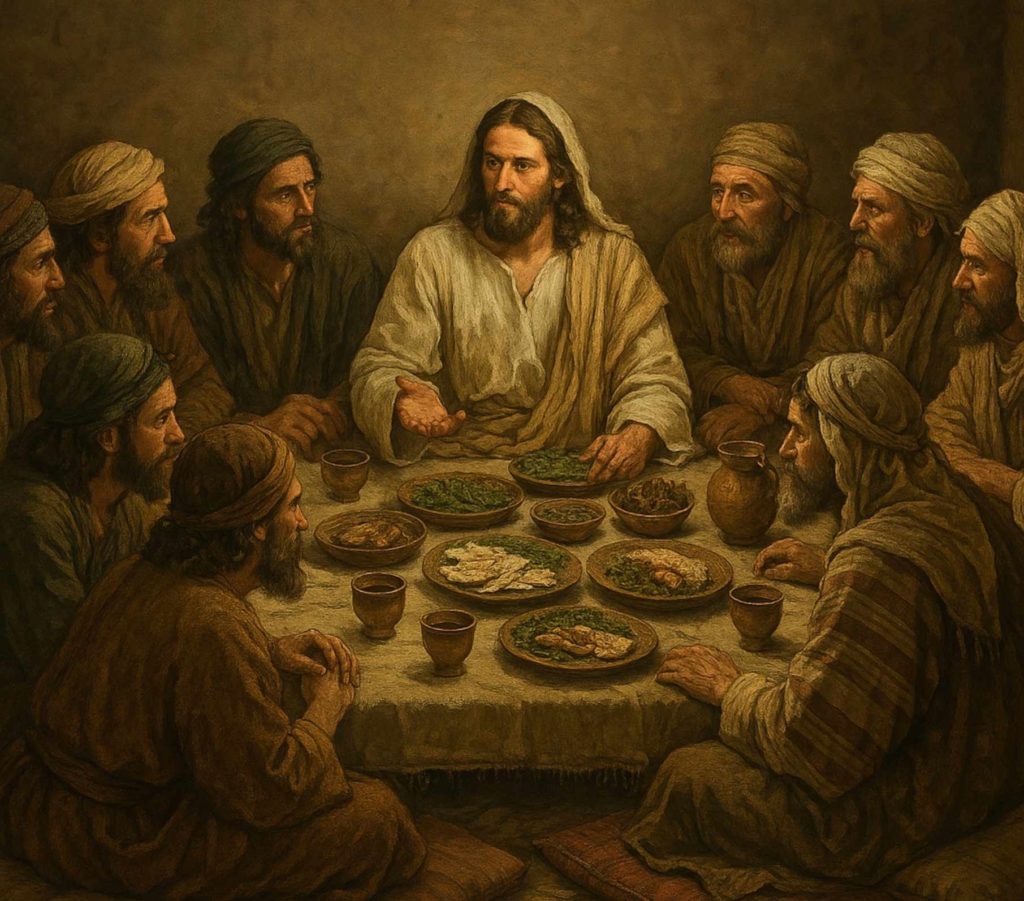
The Chronology of Yeshua’s Last Passover:
A Nazarene Perspective
By
James Scott Trimm
Over the past twenty years, I’ve seen many voices on the internet confidently declare that they have finally solved the “Passion Week puzzle” — claiming airtight timelines for Yeshua’s Last Supper, crucifixion, burial, and resurrection. After studying this issue in depth for over 35 years, I’ve come to a different conclusion: most of these solutions overlook critical variables. In many cases, those who proclaim absolute certainty aren’t even aware that some of the variables exist.
In this blog, I will walk through some of those overlooked issues — and show how a careful reading of the Hebrew and Aramaic texts, along with historical context and halachic understanding, gives us a clearer (if more complex) picture of the Passion chronology.
Variable #1: When Is the “First Day” of Unleavened Bread?
Exodus 12:16 says the “first day” and “seventh day” of Unleavened Bread are annual Sabbaths. But the Hebrew phrase yom rishon can mean more than just “first” — it can also mean “before” or “foremost,” as seen in Numbers 6:12, Joshua 8:33, and 1 Kings 13:6. So there’s a valid halachic debate: is the annual Sabbath on the 15th of Nisan, or the 14th?
Variable #2: Is Passover a Day, a Meal, or Both?
Some ancient interpretations saw the 14th of Nisan as the day of offering the Passover lamb, while the 15th was the festival. Others considered the 14th to be the start of the feast, making the entire observance an eight-day event. By the first century, the whole period was often called “Passover,” blurring distinctions.
Variable #3: What Does “Erev” Mean?
The Hebrew word erev (evening) is a zero-dimensional moment marking the boundary between two days. That means the 14th of Nisan technically has two erevs — one marking its start and one marking its end. This leads to differing interpretations of when the Passover meal was supposed to occur.
Variable #4: “Between the Evenings” and Halachic Differences
The Torah commands that the lamb be slaughtered “between the evenings” (Ex. 12:6). This phrase has multiple interpretations in rabbinic tradition, leading to different practices. Moreover, were Yeshua and his disciples following the halacha of the Temple priesthood, or a different tradition (such as the Essenes or other Pharisaic groups)?
Variable #5: Was the Calendar the Same?
Yeshua and his disciples may not have followed the same calendar as the Temple authorities. Some sects (like the Qumran community) used a solar calendar. Others differed on the definition of the new moon — whether it began with the dark moon or the first crescent. A one-day shift would make a huge difference in determining which night was the true seder night.
Was the “Last Supper” a Passover Seder?
Some argue that the Last Supper couldn’t have been a Passover meal because the Greek word artos (artuo) appears in Matthew 26:26 and elsewhere, implying leavened bread. But this is a misunderstanding.
Artuo can refer to any bread — leavened or unleavened — or even to food in general (Luke 15:17, 2 Thess. 3:8). In fact, artos is used in the LXX to translate lechem, the Hebrew word used in the Passover blessing: Hamotzi lechem min haaretz — over unleavened bread.
Synoptics vs. John: Same Supper or Different Meals?
The Synoptics say the Last Supper was on “the first day of Unleavened Bread” (Matt. 26:17; Mark 14:12; Luke 22:7), while John 13:1 says it happened “before” the feast of Passover. Some say this means John records a different meal.
But the DuTillet Hebrew Matthew uses וביום הרשון, which Hugh Schonfield translated “on the day before.” The Aramaic Gospels use קדמיא, which also has this dual meaning of “first” or “foremost.” In context, all four gospels are describing the same event — a Passover Seder, each phrased differently based on the ambiguity of the original language.
When Was Yeshua Crucified?
Tradition says Friday. Some claim Wednesday. But the Scriptures point to Thursday.
Luke 24:21 tells us “Today is the third day since these things happened,” on a Sunday. Counting backwards:
Sunday = third day
Saturday = second day
Friday = first day
Thursday = the day of crucifixion
This fits best with both a plain reading and inclusive counting traditions.
When Was Yeshua Risen?
Luke 23:54 in the Old Syriac Aramaic says, “And it was the day of preparation and the Sabbath was dawning [nogah].” But nogah can also mean “as it was getting dark” — in other words, Friday night.
Torrey and Jastrow both confirm that nogah can refer to the night or evening. This reinforces that the burial was late on Thursday or early Friday, before the annual Sabbath began that evening.
When Was He Buried and the Tomb Visited?
The Gospel texts vary slightly, especially in Greek. But Hebrew and Aramaic versions clarify:
The DuTillet Hebrew Matthew says “in the evening of Shabbat.”
The Old Syriac Mark 16:1 says “when the Sabbath had passed,” using avra (עברא), which could be misread in Hebrew as erev (ערב) “evening” as it appears in the DuTillet Hebrew Matthew.
This suggests a scribal error in transmission from Semitic to Greek.
It also supports the conclusion that Yeshua was buried late Thursday, and the tomb was found empty early Sunday.
Conclusion: A Complex but Coherent Picture
The timing of Yeshua’s Last Passover cannot be understood with a rigid, one-size-fits-all timeline. Any sound chronology must weigh:
Variations in calendar systems
Halachic ambiguities in defining days and observances
Linguistic flexibility in Hebrew and Aramaic terms
Internal harmony among the Gospels — including Synoptic and Johannine
The evidence, when all these variables are taken into account, points toward a Thursday crucifixion following a legitimate Passover Seder — all within the rich halachic and linguistic context of Second Temple Judaism.
And perhaps that’s the real takeaway: that Yeshua’s Passion did not occur in a vacuum, but within the living, breathing halachic and spiritual traditions of Israel — traditions that Nazarene Judaism continues to honor and study to this day.
Help Us Keep the Vision Alive
If this message stirred something in your heart—if you believe, like we do, that the voices of the ancient Nazarenes deserve to be heard again—we invite you to partner with us.
Your support helps us research, write, and share these forgotten treasures with a new generation. Whether it’s uncovering lost texts, translating forgotten sources, or creating educational resources rooted in the original faith of Yeshua, every gift makes a difference.
Please consider making a donation today. Together, we can restore the ancient paths and light the way for those seeking the truth.


