For nearly two millennia, Christians have assumed—without question—that the New Testament was originally written in Greek. This assumption has shaped theology, translation, and doctrine. But what if it isn’t true? What if the Greek New Testament is only a witness to something older, and far more Jewish?
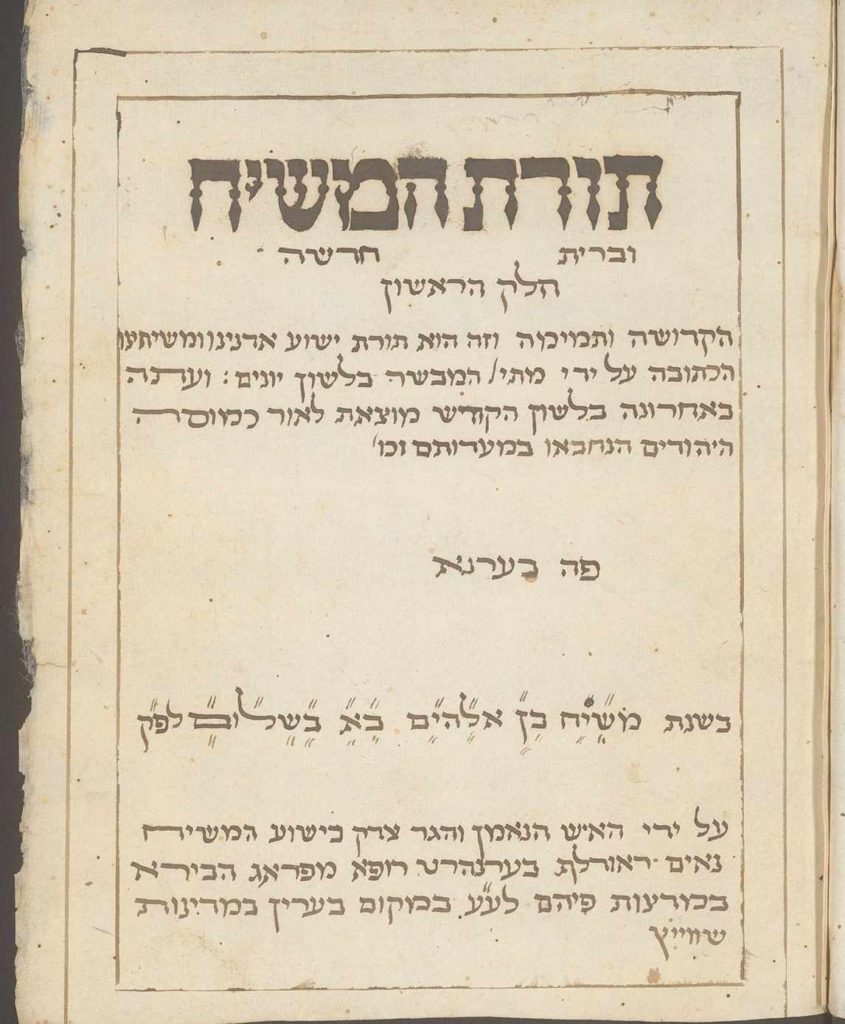
The truth is that the first followers of Yeshua—the Nazarenes—wrote their accounts in the languages they actually spoke: Hebrew and Aramaic. The fingerprints of those Semitic originals remain embedded in the text, hidden beneath the Greek. And history shows us exactly how those originals were pushed aside.
From Jerusalem to Rome
After the last Jewish revolt was crushed in 132 CE, the Roman Empire exiled Jews from Jerusalem. In their place, Rome appointed a Gentile bishop named Markus over the Jerusalem community (Eusebius, Ecclesiastical History 4:5–6). It was the first time the leadership of Yeshua’s movement was torn from its Jewish foundation.
This marked the beginning of a systematic effort to separate Christianity from its roots. Anti-Jewish sentiment became a badge of loyalty to the Empire. The Nazarenes, the original Jewish disciples of Yeshua, were increasingly marginalized and branded as heretics. Epiphanius later catalogued them in his Panarion as if they were apostates (Epiphanius, Panarion 29:9:4).
The Turning Point: Constantine and Nicaea
The real break came in 325 CE. Emperor Constantine, still a pagan sun-worshipper, convened the Council of Nicaea and imposed a new “orthodoxy.” He outlawed Jewish practices (Council of Nicaea, Canon 1; Eusebius, Life of Constantine), replaced biblical feasts with Roman holidays, and formally excluded the Nazarenes from the council.
From that point forward, Jewish followers of Yeshua were erased from the official story. Their writings, in Hebrew and Aramaic, were suppressed. In their place, the Greek versions—already paraphrased and smoothed for a Gentile audience—became the new “originals.”
Erasing the Evidence
To fully Hellenize the faith, it was not enough to reinterpret the Scriptures. The Semitic origins of the New Testament itself had to be buried. The Greek text was treated as though it had always been the original, while the Hebrew and Aramaic manuscripts were ignored, destroyed, or dismissed as “heretical.”
Yet the fingerprints of the Semitic originals could not be completely erased. They survive in the awkward Greek of Revelation, in mistranslations of Hebrew idioms, and in the testimony of early Church Fathers:
- Papias (c. 150 CE): “Matthew composed the words in the Hebrew dialect, and each translated as he was able” (Eusebius, Ecclesiastical History 3:39).
- Irenaeus (c. 170 CE): “Matthew also issued a written Gospel among the Hebrews in their own dialect” (Against Heresies 3:1).
- Jerome (c. 382 CE): “Matthew… first of all evangelists composed a Gospel of Messiah in Judea in the Hebrew language and letters… the Hebrew itself is preserved to this day in the library at Caesarea” (Of Illustrious Men 3).
Why It Matters Today
This isn’t just an academic curiosity. If the New Testament was originally written in Hebrew and Aramaic, then much of Christian tradition is built on a translation of a translation. Meaning has been lost, idioms misunderstood, and theology reshaped through the lens of Greek philosophy rather than Hebraic thought.
Recovering the Semitic original is about more than language. It is about restoring the faith of Yeshua to its authentic Jewish roots—the faith once delivered to the saints, before Rome redefined it.
Conclusion
Constantine buried the Hebrew New Testament under layers of Greek and Roman tradition. But it was never completely lost. The task before us now is to uncover it again—to strip away the veneer of Hellenization and rediscover the words of Messiah and his emissaries in the language they actually spoke.
For those who long to walk in the footsteps of the first disciples, this restoration is not optional. It is essential.
Urgent Appeal – September 16, 2025
Friends,
As you know, NazareneSpace exists to restore the original Hebrew and Aramaic foundations of the New Testament and to proclaim the truth of Nazarene Judaism in a world that has forgotten it. This work takes time, study, and resources—and right now, we are facing a serious need.
We must raise at least $500 by the end of today (Septehttps://nazarenespace.com/blog/donate/mber 16, 2025) to cover bills pending in our account. If this need is not met, it will trigger a chain reaction of returned items and fees that will make our situation even more difficult.
If this ministry has blessed you—if you believe in the importance of recovering the original words of Messiah and his emissaries—please prayerfully consider helping us at this critical moment.
Every gift, large or small, will make a difference today.
Donations can be sent by Paypal to donations@wnae.org or
Thank you for standing with us. Together, we are rebuilding the ancient foundations.