
The Lunar Sabbath Error

The Lunar Sabbath Doctrine is a teaching that has taken root among many in the Hebraic-Roots movement in the last fourteen years.  This false doctrine seeks to replace the repeating weekly seventh day Sabbath with a floating Lunar based Sabbath, which could occur any day of the week.  This Lunar Sabbath theory teaches that one begins counting the day after each new moon such that the 8th, 15th, 22nd and 29th days are Sabbaths.


The Anti-Semitic Origin of the Lunar Sabbath Theory

The so-called “Lunar Sabbath” theory was an invention that came out of Anti-Semitic Groups with ties to the Ku Klux Klan.

Jonathan David Brown is credited with being the first so-called “sabbath keeper” in this century (actually ever) to begin the practice of counting the Sabbath from the New Moon day rather than using the modern seven day week.  Brown published the book Keeping Yahweh’s Appointments in 1998, which explained the practice, which has since spread like a virus.

Brown is a noted ant-Semite who has been convicted for his connection to a 1990 Synagogue shooting.  In 1992, Brown was sentenced to a 27-month federal prison term and fined $10,000 for accessory after the fact to a conspiracy to violate civil rights under 18 U.S.C. 3 and 241 (so-called Hate-Crimes), and for perjury under 18 U.S.C. 1623a. It was established in Court that Brown helped Damion Patton, described by Nashville police as a juvenile “skinhead”, and Leonard William Armstrong, the Grand Dragon of the Tennessee White Knights of the Ku Klux Klan hide from authorities and disguise their car after Patton and Armstrong carried out a pre-dawn drive-by shooting of a synagogue in Nashville, Tennessee on June 10, 1990.
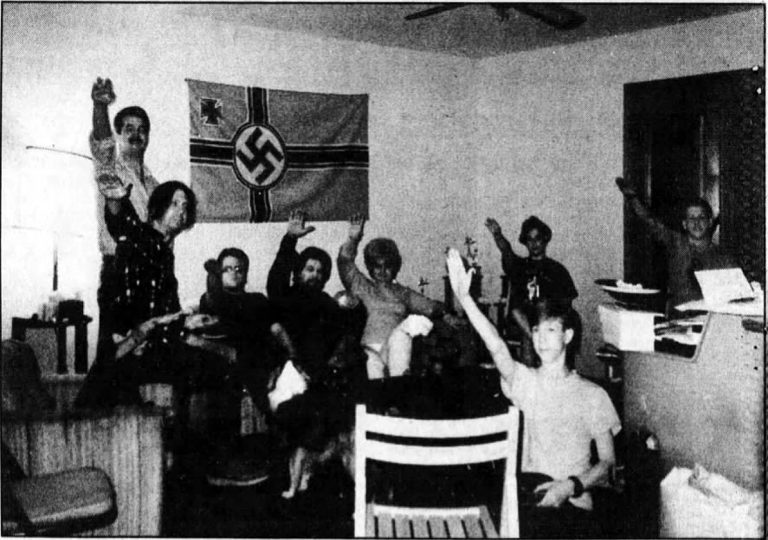
Lunar Sabbath founder Jonathan David Brown at Nazi event, giving Nazi salute (seated on far left)

In court it was revealed that in the evening of June 9, 1990, Brown attended a meeting of an anti-Semitic white supremacists which Patton and Armstrong were also attending.  At 1:00 a.m. on June 10, Patton drove past the West End Synagogue in Nashville and Armstrong fired several shots through its windows with a TEC-9 assault pistol.  Fortunately the building was unoccupied so no one was injured.  Brown’s apartment was searched under warrant on June 15th as police looked for Patton.  As a result of this search, authorities seized items belonging to Mr. Brown, which indicated his membership in the Ku Klux Klan and other white supremacist groups. In the days following the shooting incident, Brown helped Patton evade authorities by lying to police regarding Patton’s whereabouts, by hiding him at his farm in Pleasantville, and by helping Patton change the color of his car from white to black with spray paint.  Brown gave Patton a license plate from one of his trucks and supplied Patton with enough money to drive to Las Vegas and stay there.  Some five months later, Brown allowed Patton to live again on his farm for a month. In September 1991, the FBI arrested Patton who plead guilty to his part in the synagogue shooting.

In 1994 Brown sought to overturn his convictions the United States Court of Appeals for the Sixth Circuit.  Brown argued that the synagogue was owned by a corporation and not by citizens, and thus could not be covered by 42 U.S.C. Sec. 1982 (1988) which he argued applied solely to the property rights of citizens.  Brown also challenged as unwarranted the seizure of his personal property. The three-judge court upheld Brown’s convictions on March 21, 1995.

Three years after these events Brown published his Lunar Sabbath theory which he claimed to have received by direct revelation, and it has spread like a virus.

The so-called floating “Lunar Sabbath” is a recent invention. There is no evidence that anyone ever followed it until recent times. To the contrary the historical evidence proves that the ancient Hebrews (Including Yeshua himself) kept the Seventh day of the week (“Saturday”) and not a so-called floating “Lunar Sabbath”.


An Unbelievable Conspiracy Theory

The Lunar Sabbath theory presupposes that at some point in time, the Sabbath was changed from a floating so-called Lunar Sabbath, to the weekly Sabbath.  So when did this alleged change take place?

 Yeshua and the Pharisees clearly agreed as to what day the Sabbath was.  While at times they disagreed, at times, over what activities were permitted on the Sabbath, but they never disagreed over what day the Sabbath was.

As a result most Lunar Sabbath Proponents maintain that their floating Lunar Sabbath was kept at least until the first century, and that the alleged “change” to the weekly Sabbath came after that time.

This creates certain problems, because it means that Lunar Sabbatarians must place this change well within recorded history, and this created several problems.

To begin with this alleged change would have to have been made without any historical record of the change itself taking place.  This “change” also would have to have been somehow agreed to by both Jews, Christians, and even Samaritans, all over the world.  These groups who were at odds with one another, would have to have agreed to make this change together, without making any historical record of the change, and without leaving behind any dissident sects in any of these movements that rejected the change.  This would include Jews and Christians all over the world, as far south as Ethipoia, as far east as Japan, as far north as Armenia,  to institute this change worldwide without the benefit of modern methods of rapid communication.  Any gradual change would even more certainly have left historical footprints and dissident groups behind.  This is simply unbelievable.

Another problem this creates for the Lunar Sabbath Theory is that by placing this supposed change well within the reach of history, it is a simple matter to reach beyond this period, to show that a Lunar Sabbath was not used in or before the first century.


Authors of Confusion

Many Lunar Sabbath proponents use loaded terminology and misleading claims intended to confuse the real issue.

For example many will refer to the weekly Sabbath with the term “Gregorian” so as to wrongly imply that the seven day week is somehow unique to the rather late Gregorian calendar, or to wrongly imply that the long count of days of the week was disrupted in the change from the Julian to the Gregorian Calendar.  In fact there was no disruption in the count of the days of the week in this calendar change.  Others will refer to the Weekly Sabbath and the long count of the days of the week as “Roman” as if to wrongly imply that these were unique to the Roman calendar.  Others will seek to create confusion based on other Roman methods of long counting weeks, none of which impact the actual long count of weeks going from the present, back into antiquity.    Yet others will seek to create confusion with references to the changes of the Hillel II calendar.  The Hillel II calendar included no revisions in relation to the weekly Sabbath, and only impacted Rabbinic Judaism.  The changes of the Hillel II calendar are only brought up by Lunar Sabbatarians to confuse the real issue.


Six Days of Work

There are always more than seven days between the twenty-nineth day of a lunar month and the eighth day of the next lunar month.  As a result the lunar sabbath teaching violates the mitzvah often repeated in Scripture, and indeed even referenced in the Ketuvim Netzarim:

Six days you shall labor and do all your work,
but the seventh day is a sabbath of YHWH your Elohim.


The Essenes and the Dead Sea Scrolls

There are a multitude of calendar texts which have been found among the Dead Sea Scrolls and which demonstrate clearly that the Essenes did not keep a so-called floating Lunar Sabbath.  The material is far to extensive to present here, and totally unnecessary, since I do not know of any Lunar Sabbath proponents who take issue with this fact.

I will add that Josephus writes of the Essenes:

Moreover, they are stricter than any other of the Jews in resting from their labors on the seventh day; for they not only get their food ready the day before, that they may not be obliged to kindle a fire on that day, but they will not move any vessel out of its place, nor go to stool thereon.
(Wars 2:8:9)  

If the Essenes kept a different Sabbath from the other Jews, it would seem very odd for Josephus not to mention that here.  This would certainly lead us to the conclusion that the Jews of the Second Temple Era did not keep the so-called Lunar Sabbath.


Back to Back Sabbaths

Under the Lunar Sabbath Theory, back-to-back Sabbath’s are impossible.  This is because all of the annual Sabbaths under this theory, would occur on days that would already be Sabbaths. However in the Second Temple Era, back-to-back Sabbaths were very much a possibility and there was much debate on just how to deal with these occasions.

Mishna Besah 2:1-2 deals with halachah surrounding what to do when back-to-back sabbaths occur due to a festival Sabbath falling the day before or the day after a weekly Sabbath (which can never happen in the Lunar Sabbath system):

2:1 “On a festival which coinsides with the eve of the Sabbath [Friday]- a person should not do cooking to begin with the festival day [Friday] for the purpose of the Sabbath.
But he prepares food for the festival day, and he leaves something over, he has lefts it over for use on the Sabbath.
And he prepares a cooked dish on the eve of the festival day [Thursday] and relies on it [to prepare food on Friday] for the Sabbath as well.
The House of Shammai says, “Two dishes.”
And the House of Hillel says, “A single dish.”
But they concur in the case of fish and the egg [cooked] on it, that they constitute two dishes.
[If] one ate [the dish intended for the Sabbath] or it was lost, one should not cook another in its stead in the first instance.
But if he left over any amount at all of it, he relies on it for the Sabbath.
2:2  [If the festival day] coincided with the day after the Sabbath [Sunday],
The House of Shammai says, “The immerse everything before the Sabbath.”
The House of Hillel says, “Utensils [are to be immersed] before the Sabbath.
But man [may immerse] on the Sabbath [itself].”
(m.Besa 2:1-2)

Hillel and Shammai taught when Yeshua was a child, and the Mishna was codified around 250 CE.

Another example of back-to-back Sabbaths is found in the Mishna discussion about how to deal with a Sabbath that falls on the sixteenth of Nisan (the fifteenth being an annual Sabbath):

The bones, and the sinews, and the nothar of the paschal lamb are to be burnt on the sixteenth. If the sixteenth falls on the Sabbath, they are to be burnt on the seventeenth, because they do not override either the Sabbath or the festival.
(m. Pesachim 7:10)

Of course the sixteenth of Nisan could never be a Sabbath under the Lunar Sabbath theory.


A Sabbath that Falls on the First Day of Tabernacles

The Mishna also discusses how mal offerings were handled when the First Day of Tabernacles (the 15th of Tishri) falls on a Sabbath:

A man may offer a meal-offering consisting of sixty tenths and bring them in one vessel if a man said, I take upon myself to offer sixty tenths, he may bring them in one vessel. But if he said, I take upon myself to offer sixty-one tenths, he must bring sixty in one vessel and the one in another vessel; for since the congregation bring on the first day of the feast of tabernacles when it falls on a Sabbath sixty-one tenths as a meal-offering, it is enough for an individual that his meal-offering be less by one tenth than that of the congregation.
(m.Menachot 12:4)

Of course this passage must be speaking of events that took place prior to 70 CE (when the Temple still stood).  Of course under the Lunar Sabbath theory the Sabbath always falls on the 15th of the month, making this discussion meaningless.


The Ninth of Av

The Ninth of Av is a fast which commemorates the destruction of both the First Temple and Second Temple in Jerusalem, which occurred about 655 years apart, but on the same Hebrew calendar date.  According to the Lunar Sabbath theory, the ninth of Av could never fall on a Sabbath, yet the Talmud discusses the issue of what to do when a Sabbath falls on the Ninth of Av as follows:

It was in fact taught: If the Ninth of Av fell on a Sabbath and, similarly, if the eve of the Ninth of Av fell on a Sabbath a man may eat and drink as much as he requires and lay on his table a meal as big as that of Solomon in his time. If the Ninth of Av fell on the Sabbath eve [food] of the size of an egg must be brought and eaten [before the conclusion of the day] so that one does not approach the Sabbath in a state of affliction’.
(b.Eruvin 41a)


New Moon on a Sabbath

The Talmud also discusses the issue of what to do when a New Moon falls on a Sabbath, and records a debate which took place between the House of Hillel and the House of Shammai on the issue:

R. Zera replied: The New Moon is different from a festival – Since its mention is included in the benediction on the sanctity of the day in the morning and evening prayers it is also included in that of the additional prayer. But do Beth Shammai uphold the view that the mention of the New Moon is to be included? Was it not in fact taught: If a New Moon falls on a Sabbath, Beth Shammai ruled: One recites in his additional prayer eight benedictions and Beth Hillel ruled: Seven? This is indeed a difficulty.
(b.Eruvin 40b)

However with the Lunar Sabbath theory, such a debate would not have occurred at all.
Yeshua’s Last Days

One of the biggest gaping holes in the Lunar Sabbath system is Yeshua’s final week on earth… his crucifixion was on the eve of a Sabbath and his resurrection was on the first day “when the sabbath had passed” (Mk. 16:1) and he was in the grave three days…

Now there is much debate over how these days are laid out.  Some argue that Yeshua was crucified on a Wednesday and resurrected at the very end of the Sabbath (Saturday night).  Others (myself included) argue that Yeshua was crucified on a Thursday, and resurrected the morning after the Sabbath (Sunday morning).

But no matter how you slice it you have here either back to back Sabbaths (Friday being the first day of Unleavened Bread and thus an annual Sabbath)  or two Sabbaths with a non-sabbath in between (Thursday being the first day of Unleavened Bread and thus an annual Sabbath).  Neither of these possibilities is possible with a Lunar Sabbath System. With a Lunar Sabbath system, if Yeshua was crucified on the eve of the the sabbath [i.e. the first day of Unleavened Bread- an annual Sabbath] and resurrected on the morning after the Sabbath [since following the Lunar Sabbath System those are the same day] he would have only been in the grave for one day, not three.
Which Sabbath was the Firstfruits Offering?

The well known debate between Pharisees and Sadducees over which day was the first fruits  offering (As recorded in b.Men. 65a-66a) also disproves the Lunar Sabbath System .  It is impossible to debate whether firstfruits is the day after the weekly Sabbath of the day after the annual sabbath if those are the same day.  The Pharisees and Sadducees disagreed on that point, and since there were no Sadducees after the first century, during the first century the Jews of Yeshua’s day definitely recognized these as different days, and therefore could not have been keeping the Lunar Sabbath system.


The Reward Offer

Lunar Sabbath proponent Arnold Bowen has for many years offered “a $10,000 reward to anyone who can pinpoint a weekly Sabbath on any other day than by the moon.”  Specifically “on the 8th, 15th, 22nd, and 29th.”

On August 16th, 2012 I laid claim to this reward when I was able to pinpoint the 14th of Nisan (Abib) in 30 BCE (Saturday, March 28th, 30 BC) as a Sabbath. Bowen never paid the reward.

Hillel the Great became Nasi if the Sanhedrin one hundred years before the destruction of the Temple (b.Shabbat 15a).  The Temple was destroyed in 70 CE, so this means Hillel became Nasi in 30 BCE.

Hillel’s ascension to the office of Nasi took place in a year which the 14th of Nisan (Passover) occurred on a Sabbath.  This situation did in fact occur in 30 BCE.  At the time there was a controversy as to whether the Passover lamb should be slaughtered on the Sabbath or not. Thereupon Hillel proved by argument and tradition that it was permissible, upon which the Bene Bathyra (Sons of Bathyra), the then heads of the Jews of Judea, voluntarily resigned their leadership in his favor.  The account appears in the Talmud in tractate Pessachim on page 66a.  The discussion begins with a section of Mishnah (Pessachim 6:1-2) which states that many Passover duties override the Sabbath.  The Gemara then recounts the story of the problem that Hillel resolved which led to his being made Nasi (president of the Sanhedrin):

THESE THINGS IN [CONNECTION WITH] THE PASSOVER OFFERING OVERRIDE THE SABBATH: ITS SHECHITAH AND THE SPRINKLING OF ITS BLOOD AND THE CLEANSING OF ITS BOWELS AND THE BURNING OF ITS FAT. BUT ITS ROASTING AND THE WASHING OF ITS BOWELS DO NOT OVERRIDE THE SABBATH. ITS CARRYING AND BRINGING IT FROM WITHOUT THE TEHUM AND THE CUTTING OFF OF ITS WART DO NOT OVERRIDE THE SABBATH. R. ELIEZER SAID: THEY DO OVERRIDE [THE SABBATH]. SAID R. ELIEZER, DOES IT NOT FOLLOW A FORTIORI: IF SHECHITAH, WHICH IS [USUALLY FORBIDDEN] AS A LABOUR, OVERRIDES THE SABBATH, SHALL NOT THESE, WHICH ARE [ONLY FORBIDDEN] AS A SHEBUTH, OVERRIDE THE SABBATH? R. JOSHUA ANSWERED HIM, LET FESTIVAL[S] REBUT IT, WHEREIN THEY PERMITTED LABOUR AND FORBADE A SHEBUTH. SAID R. ELIEZER TO HIM, WHAT IS THIS, JOSHUA, WHAT PROOF IS A VOLUNTARY ACT IN RESPECT OF A PRECEPT! R. AKIBA ANSWERED AND SAID, LET HAZA’AH PROVE IT, WHICH IS [PERFORMED] BECAUSE IT IS A PRECEPT AND IS [NORMALLY FORBIDDEN ONLY] AS A SHEBUTH, YET IT DOES NOT OVERRIDE THE SABBATH; SO YOU TOO, DO NOT WONDER AT THESE, THAT THOUGH THEY ARE [REQUIRED] ON ACCOUNT OF THE PRECEPT AND ARE [ONLY FORBIDDEN] AS A SHEBUTH, YET THEY DO NOT OVERRIDE THE SABBATH. SAID R. ELIEZER TO HIM, BUT IN RESPECT OF THAT [ITSELF] I ARGUE: IF SHECHITAH, WHICH IS A LABOUR, OVERRIDES THE SABBATH, IS IT NOT LOGICAL THAT HAZA’AH, WHICH IS [ONLY] A SHEBUTH, OVERRIDES THE SABBATH! (m.Pessachim 6:1-2)

GEMARA. Our Rabbis taught: This halachah was hidden from [i.e., forgotten by] the Bene Bathyra. On one occasion the fourteenth [of Nisan] fell on the Sabbath, [and] they forgot and Passover, R. Akiba holds that the haza’ah must not be performed, though the man is thereby prevented from joining in the Passover sacrifice. did not know whether the Passover overrides the Sabbath or not. Said they, ‘Is there any man who knows whether the Passover overrides the Sabbath or not?’ They were told, ‘There is a certain man who has come up from  Babylonia, Hillel the Babylonian by name, who served the two greatest men of the time, and he knows whether the Passover overrides the Sabbath or not [Thereupon] they summoned him and said to him, ‘Do you know whether the Passover overrides the Sabbath or not?’ ‘Have we then [only] one Passover during the year which overrides the Sabbath?’ replied he to them, ‘Surely we have many more than two hundred Passovers during the year which override the Sabbath! Said they to him, ‘How do you know it?’ He answered them, ‘In its appointed time’ is stated in connection with the Passover, and ‘In its appointed time’ is stated in connection with the tamid; just as ‘Its appointed time’ which is said in connection with the tamid overrides the Sabbath, so ‘Its appointed time’ which is said in connection with the Passover overrides the Sabbath. Moreover, it follows a minori, if the tamid, [the omission of] which is not punished by kareth, overrides the Sabbath, then the Passover,[neglect of] which is punished by kareth, is it not logical that it overrides the Sabbath! They immediately set him at their head and appointed him Nasi [Patriarch] over them, and he was sitting and lecturing the whole day on the laws of Passover. He began rebuking them with words. Said he to them, ‘What caused it for you that I should come up from Babylonia to be a Nasi over you? It was your indolence, because you did not serve the two greatest men of the time, Shemaiah and Abtalyon.’ Said they to him, ‘Master, what if a man forgot and did not bring a knife on the eve of the Sabbath?’ ‘I have heard this law,’ he answered, ‘but have forgotten it. But leave it to Israel: if they are not prophets, yet they are the children of prophets!’ On the morrow, he whose Passover was a lamb stuck it [the knife] in its wool; he whose Passover was a goat stuck it between its horns. He saw the incident and recollected the halachah and said, ‘Thus have I received the tradition from the mouth[s] of Shemaiah and Abtalyon.’
(b.Pesachim 66a)


Now this section of Mishnah and Talmud makes it clear that the 14th of Nisan (Passover) could occur on a Sabbath, and in fact did occur on the Sabbath as early as the days of Hillel the Great, who was elderly in the days of Yeshua’s youth.

Now as I have said before, Yeshua and the Pharisees clearly agreed as to what day the Sabbath was.  They disagreed, at times, over what activities were permitted on the Sabbath, but they never disagreed over what day the Sabbath was.  So if we can demonstrate that the first century Phraisees kept the weekly “Saturday” Sabbath, we would also be demonstrating that Yeshua kept the weekly “Saturday” Sabbath. And if we could show that the first century Pharisees did not keep a so-called floating lunar Sabbath, we would be showing also that Yeshua did not keep such a lunar Sabbath, and thus that such a lunar Sabbath was not valid.

Now this section of Mishnah and Talmud reveal that on occasion the 14th of Nisan could and did happen to fall on the Sabbath as reckoned by the first century Pharisees, and therefore by Yeshua as well.  This is impossible with the so-called Lunar Sabbath System, in which the 8th, 15th, 22nd, and 29th of a Lunar Month were Sabbaths and the 14th could NEVER be a Sabbath.

Philo of Alexandria

The Lunar Sabbatarians have looked far and wide for ancient support for their theory. The problem is that there is none. However in their zealousness they have misappropriated certain quotations from Philo which they wrongly claim support a Lunar Sabbath. The fact is that not only does Philo not teach a Lunar Sabbath, but Philo makes statements that plainly conflict with the Lunar Sabbath Theory, and makes one of the oldest, clearest description of the  Sabbath as the seventh day of a continuous repeating seven day week.

The first quotation Lunar Sabbatarians appropriate from Philo is as follows:

“For it is said in the Scripture: On the tenth day of this month let each of them take a sheep according to his house; in order that from the tenth, there may be consecrated to the tenth, that is to God, the sacrifices which have been preserved in the soul, which is illuminated in two portions out of the three, until it is entirely changed in every part, and becomes a heavenly brilliancy like a full moon, at the height of its increase at the end of the second “week”…
(ON MATING WITH THE PRELIMINARY STUDIES, X1X (102))

The fact is that this passage simply refers to a fourteen day period as “two weeks” just as we do today. A fourteen day period may be called “two weeks” regardless of which day it begins and ends, even if it actually is made up of one complete week and parts of two other weeks.

The next quote often used is as follows:

“9. (Ex. xii. 6a) Why does He command (them) to keep the sacrifice until the fourteenth (day of the month)? (Consisting of) two Sabbaths, it has in its nature a (special) honour because in this time the moon is adorned. For when it has become full on the fourteenth (day), it becomes full of light in the perception of the people. And again through (another) fourteen (days) it recedes from its fullness of light to its conjunction, and it wanes as much in comparison with the preceding Sabbath as the second (waxes) in comparison with the first. For this reason the fourteenth (day) is pre-festive, as though (it were) a road leading to festive rejoicings, during which it is incumbent upon us to meditate”.
(On page 17 of Ralph Marcus’ translation of Philo’s work entitled “Questions and Answers, Exodus, Book 1”)

This parallels Younge’s translation in The Decalogue:

“The fourth commandment has reference to the sacred seventh day, that it may be passed in a sacred and holy manner. Now some states keep the holy festival only once in the month, counting from the new moon, as a day sacred to God; but the nation of the Jews keep every seventh day regularly, after each interval of six days; and there is an account of events recorded in the history of the creation of the world, comprising a sufficient relation of the cause of this ordinance; for the sacred historian says, that the world was created in six days, and that on the seventh day God desisted from his works, and began to contemplate what he had so beautifully created; therefore, he commanded the beings also who were destined to live in this state, to imitate God in this particular also, as well as in all others, applying themselves to their works for six days, but desisting from them and philosophising on the seventh day,”
(The Decalogue ch. 26)

The wording here is obscure. Philo may be referring to the fact that any fourteen day period will contain two Sabbaths, or he may be referring to the fact that the first and last days of Unleavened Bread are annual Sabbaths.

The final two passages Lunar Sabbatarians cite from Philo is as follows:

(161) But to the seventh day of the week he has assigned the greatest festivals, those of the longest duration, at the periods of the equinox both vernal and autumnal in each year; appointing two festivals for these two epochs, each lasting seven days; the one which takes place in the spring being for the perfection of what is being sown, and the one which falls in autumn being a feast of thanksgiving for the bringing home of all the fruits which the trees have produced. And seven days have very appropriately been appointed to the seventh month of each equinox, so that each month might receive an especial honour of one sacred day of festival, for the purpose of refreshing and cheering the mind with its holiday.
(Philo; Decalogue 30, 161)

And the next refers back to this one:

“Again the beginning of this feast is appointed for the fifteenth day of the month on account of the reason which has already been mentioned respecting the Spring season might receive special honor of one sacred day of festival.”
(THE TENTH FESTIVAL XXXIII. (210))

Now while some have tried to use this to support the Lunar Sabbath, to the contrary this statement conflicts with the Lunar Sabbath Theory. Philo here says that the two longest Torah feasts (Unleavened Bread and Tabernacles) differ from all other festivals because, being seven days long, they always include a weekly sabbath (any seven day period will include a weekly Sabbath). However if one follows the Lunar Sabbath theory, virtually all annual Feasts coincide with Sabbaths, which would render Philo’s statement meaningless. Philo makes the nature of the Sabbath clear when he writes:

(56) But after this continued and uninterrupted festival which thus lasts through all time, there is another celebrated, namely, that of the sacred seventh day after each recurring interval of six days, which some have denominated the virgin, looking at its exceeding sanctity and purity…
(Special Laws 2, 56)

Philo clearly did not teach the so-called Lunar Sabbath Theory, but instead taught the repeating weekly Sabbath based on a continuous count of seven day “weeks” going back to the first Sabbath at creation.

Conclusion

Well when I began writing this blog, it was my intent to write an exhaustive treatment of the Lunar Sabbath doctrine and its errors.  However the evidence against the Lunar Sabbath is so overwhelming, it has become clear to me that if I ever write an exhaustive treatment, it will fill a book, not just a blog.  None-the-less I believe enough information has been documented in this short treatment to completely disprove the Lunar Sabbath theory.

As you know we have been digging ourselves out of a budget shortfall.  As I have said to you many times, I look on this work as a co-operative one with me, and all of you combining our resources together in order to get the job done of helping to teach this great truth to all in the world who will listen. Thank you so much from the bottom of my heart for your continued support, you are the ones who make it all possible by your contributions and your prayers for our work. I truly appreciate your help in every way.

If you can make a one time donation of $500 or $1,000 dollars to support this work.


Donations can be sent by Paypal to donations@wnae.org
And don’t forget to join the conversations at the NazareneSpace Social Network

The Woman Caught in Adultery and the Torah

The Woman Caught in Adultery and the Torah
By
James Scott Trimm


The Scriptures relate a well known event involving a woman alleged to have been caught in adultery:

53 Then each of them went to his house
1 And Yeshua went to the Mount of Olives.
2 And in the morning he came again to the Temple and all the people
came to him. And while he was sitting, he was teaching them.
3 And the scribes and P’rushim brought a woman who was caught in
adultery. And placing her in the midst,
4 They said to him, Teacher, this woman was caught in the open in
the act of adultery.
5 Now in the Torah of Moshe, he commanded that we stone those who
are like these. Now, what do you say?
6 They said this testing him so that they would have a reason to
accuse him. But Yeshua, after he had stooped down, wrote on the ground.
7 And when they continued asking him, he straightened himself and
said to them, Whichever one of you is without sin may cast the first
stone at her .
8 And again after he had stooped down, he was writing on the ground.
9 And when they heard [it], they went out one by one having begun
with the elders. And the woman was left by herself being in the midst.
10 And after Yeshua straightened himself he said to the woman, Where
are they? Does no man condemn you?
11 And she said, No man, Adon. And Yeshua said, Neither do I condemn
you. Go, and from now on do not sin again.
(John 7:53-8:11)

The story of the alleged adulteress (John 7:53-8:11) does not actually appear in many of the most ancient manuscripts. It does not appear in the Aramaic Peshita or the Aramaic Old Syraic texts. Those Greek manuscripts which do contain it place it in various places some after Luke 21:38 and some after John 7:36 or after 7:52 or even after 21:24.

According to the “church father” Papias the story also appeared in the Gospel According to the Hebrews (Papias quoted in Eccl. Hist. iii, 39, 17) An apocryphal gospel which was used by the ancient Nazarenes.

But let us look at what this narrative acvtually teaches, John 8:7 says:

Whichever one of you is without sin may cast the first stone at her –

Yeshua was not contradicting the Torah. The Torah required that the witnesses cast the first stone:

At the mouth of two witnesses, or three witnesses,
shall he that is to die be put to death.
The hand of the witnesses shall be first upon him to death,
and afterward the hand of all the people.
So you shall put away the evil from the midst of you.
(Deut. 17:6-7).

According to a Halachah found in the Dead Sea Scrolls:

No one who has knowingly violated a single word of the
commandment will be considered a reliable witness against
his fellow until he is considered fit to return to full fellowship.
(Damascus Document 4Q270 frag. 9 col. 10 lines 2-3)

And in the Mishna we read:

And these are those who are invalid [to serve as witnesses or judges]:
(1) He who plays dice; (2) he who loans money on interest; (3) those who race pigeons; (4) and those who do business in the produce of the Seventh Year. Said Rabbi Simeon, “In the beginning they called them “Those who gather Seventh Year produce.” When the oppressors became many [who collected taxes in the Seventh Year], they reverted to calling them, “Those who do business in the produce of the Seventh Year.” Said Rabbi Judah. “Under what circumstances?” When [the aforenamed] have only that as their profession, but if they have a profession other than that, they are valid.
(m.Sanhedrin 3:3)

And in the Gemara to this passage (24b-27b) we read that Rabba says:

“the Torah said: Do not accept the wicked as witness”
(b.San 25a)

Yeshua seems to have been agreeing with this Halachic precept regarding witnesses. Without witnesses a case of adultery could only be tried by the trial of bitter waters:

[12] Speak unto the children of Israel, and say unto them, If any man’s wife go aside, and commit a trespass against him,
[13] And a man lie with her carnally, and it be hid from the eyes of her husband, and be kept close, and she be defiled, and there be no witness against her, neither she be taken with the manner;
[14] And the spirit of jealousy come upon him, and he be jealous of his wife, and she be defiled: or if the spirit of jealousy come upon him, and he be jealous of his wife, and she be not defiled:
[15] Then shall the man bring his wife unto the priest, and he shall bring her offering for her, the tenth part of an ephah of barley meal; he shall pour no oil upon it, nor put frankincense thereon; for it is an offering of jealousy, an offering of memorial, bringing iniquity to remembrance.
[16] And the priest shall bring her near, and set her before the LORD:
[17] And the priest shall take holy water in an earthen vessel; and of the dust that is in the floor of the tabernacle the priest shall take, and put it into the water:
[18] And the priest shall set the woman before the LORD, and uncover the woman’s head, and put the offering of memorial in her hands, which is the jealousy offering: and the priest shall have in his hand the bitter water that causeth the curse:
[19] And the priest shall charge her by an oath, and say unto the woman, If no man have lain with thee, and if thou hast not gone aside to uncleanness with another instead of thy husband, be thou free from this bitter water that causeth the curse:
[20] But if thou hast gone aside to another instead of thy husband, and if thou be defiled, and some man have lain with thee beside thine husband:
[21] Then the priest shall charge the woman with an oath of cursing, and the priest shall say unto the woman, The LORD make thee a curse and an oath among thy people, when the LORD doth make thy thigh to rot, and thy belly to swell;
[22] And this water that causeth the curse shall go into thy bowels, to make thy belly to swell, and thy thigh to rot: And the woman shall say, Amen, amen.
[23] And the priest shall write these curses in a book, and he shall blot them out with the bitter water:
[24] And he shall cause the woman to drink the bitter water that causeth the curse: and the water that causeth the curse shall enter into her, and become bitter.
[25] Then the priest shall take the jealousy offering out of the woman’s hand, and shall wave the offering before the LORD, and offer it upon the altar:
[26] And the priest shall take an handful of the offering, even the memorial thereof, and burn it upon the altar, and afterward shall cause the woman to drink the water.
[27] And when he hath made her to drink the water, then it shall come to pass, that, if she be defiled, and have done trespass against her husband, that the water that causeth the curse shall enter into her, and become bitter, and her belly shall swell, and her thigh shall rot: and the woman shall be a curse among her people.
[28] And if the woman be not defiled, but be clean; then she shall be free, and shall conceive seed.
[29] This is the law of jealousies, when a wife goeth aside to another instead of her husband, and is defiled;
[30] Or when the spirit of jealousy cometh upon him, and he be jealous over his wife, and shall set the woman before the LORD, and the priest shall execute upon her all this law.
[31] Then shall the man be guiltless from iniquity, and this woman shall bear her iniquity.
(Num. 5:12-31 KJV)


This could only be done if the matter was pushed forward by the husband. (This was the only type of case that could be brought without witnesses ) This is the meaning of “does no man condemn you” (verse 10) as the word “man” in Hebrew can also mean “husband”.

In Jn. 8:8 it says that Yeshua was “writing on the ground”.  Yeshua was is writing in the dust of the Temple floor of which was used to judge an alleged unfaithful bride (Numbers 5:12-31). He probably fulfilled the prophecy when he “wrote their names in the dust” (Jer. 17:13) by writing the names of the unrighteous witnesses in this very same dust:


O YHWH, the hope of Israel, all that forsake thee shall be ashamed, and they that depart from me shall be written in the earth, because they have forsaken YHWH, the fountain of living waters.
(Jer. 17:13)

Our rent is due in just nine days and we don’t yet have it!

As you know we have been digging ourselves out of a budget shortfall.  As I have said to you many times, I look on this work as a co-operative one with me, and all of you combining our resources together in order to get the job done of helping to teach this great truth to all in the world who will listen. Thank you so much from the bottom of my heart for your continued support, you are the ones who make it all possible by your contributions and your prayers for our work. I truly appreciate your help in every way.

If you can make a one time donation of $500 or $1,000 dollars to support this work.


Donations can be sent by Paypal to donations@wnae.org or by Zelle or Go Fund Me!

Click HERE to donate

And don’t forget to join the conversations at the NazareneSpace Social Network

As you know we have been digging ourselves out of a budget shortfall.  As I have said to you many times, I look on this work as a co-operative one with me, and all of you combining our resources together in order to get the job done of helping to teach this great truth to all in the world who will listen. Thank you so much from the bottom of my heart for your continued support, you are the ones who make it all possible by your contributions and your prayers for our work. I truly appreciate your help in every way.

If you can make a one time donation of $500 or $1,000 dollars to support this work.


Donations can be sent by paypal to donations@wnae.org.

Or click HERE to donate

And don’t forget to join the conversations at the NazareneSpace Social Network

How the Church Fathers Invented Christianity

How the Church Fathers Invented Christianity
By
James Scott Trimm

What many Christians do not know, is that the Church Fathers admitted that the original followers of Yeshua as Messiah, including Paul, were Jews of the sect of the Nazarenes, and that Gentile Christianity was their own invention.

Of course the New Testament tells us Paul was a “ringleader of the sect of the Nazarenes” (Acts 24:5).  The so-called church fathers tell us quite a bit about these “Nazarenes”.

The fourth century “church father” Epiphanius gives a detailed description:

But these sectarians… did not call themselves Christians–but “Nazarenes,” … However they are simply complete Jews. They use not only the New Testament but the Old Testament as well, as the Jews do… They have no different ideas, but confess everything exactly as the Law proclaims it and in the Jewish fashion– except for their belief in Messiah, if you please! For they acknowledge both the resurrection of the dead and the divine creation of all things, and declare that God is one, and that his son is Yeshua the Messiah. They are trained to a nicety in Hebrew. For among them the entire Law, the Prophets, and the… Writings… are read in Hebrew, as they surely are by the Jews. They are different from the Jews, and different from Christians, only in the following. They disagree with Jews because they have come to faith in Messiah; but since they are still fettered by the Law–circumcision, the Sabbath, and the rest– they are not in accord with Christians…. they are nothing but Jews…. They have the Goodnews according to Matthew in its entirety in Hebrew. For it is clear that they still preserve this, in the Hebrew alphabet, as it was originally written. (Epiphanius; Panarion 29)

The “church father” Jerome (4th Cent.) described these Nazarenes as those “…who accept Messiah in such a way that they do not cease to observe the old Law.” (Jerome; On. Is. 8:14).

But in a letter to Augustine, Jerome makes an amazing admission concerning the Nazarenes:

“The matter in debate, therefore, or I should rather say your opinion regarding it, is summed up in this: that since the preaching of the gospel of Christ, the believing Jews do well in observing the precepts of the law, i.e. in offering sacrifices as Paul did, in circumcising their children, as Paul did in the case of Timothy, and keeping the Jewish Sabbath, as all the Jews have been accustomed to do. If this be true, we fall into the heresy… [of those who] though believing in Christ, were anathematized by the fathers for this one error, that they mixed up the ceremonies of the law with the gospel of Christ, and professed their faith in that which was new, without letting go what was old. …In our own day there exists a sect among the Jews throughout all the synagogues of the East, which is called the sect of the Minæans, and is even now condemned by the Pharisees. The adherents to this sect are known commonly as Nazarenes; they believe in Christ the Son of God, born of the Virgin Mary; and they say that He who suffered under Pontius Pilate and rose again, is the same as the one in whom we believe. But while they desire to be both Jews and Christians, they are neither the one nor the other. I therefore beseech you, who think that you are called upon to heal my slight wound, which is no more, so to speak, than a prick or scratch from a needle, to devote your skill in the healing art to this grievous wound, which has been opened by a spear driven home with the impetus of a javelin. For there is surely no proportion between the culpability of him who exhibits the various opinions held by the fathers in a commentary on Scripture, and the guilt of him who reintroduces within the Church a most pestilential heresy. If, however, there is for us no alternative but to receive the Jews into the Church, along with the usages prescribed by their law; if, in short, it shall be declared lawful for them to continue in the Churches of Christ what they have been accustomed to practice in the synagogues of Satan, I will tell you my opinion of the matter: they will not become Christians, but they will make us Jews.
(Jerome; Letter 75)

(1) “Minæans” apparently Latinized from Hebrew MINIM (singular is MIN) a word which in modern Hebrew means “apostates” but was originally an acronym for a Hebrew phrase meaning “Believers in Yeshua the Nazarene”.

Jerome repeats Augustine, saying of the Nazarenes: “since the preaching of the gospel of Christ, the believing Jews do well in observing the precepts of the law, i.e. in offering sacrifices as Paul did, in circumcising their children, as Paul did in the case of Timothy, and keeping the Jewish Sabbath, as all the Jews have been accustomed to do.” (Jerome; Letter 75 Jerome to Augustine)

Jerome responds saying of the Nazarenes “though believing in Christ, they were anathematized by the [church] fathers for this one error, that they mixed up the ceremonies of the law with the gospel of Christ, and professed their faith in that which was new, without letting go what was old.”  (ibid)

In other words Augustine and Jerome tell us that the Nazarene doctrine that the Torah should still be observed began with “the preaching of Christ” and was the doctrine kept by Paul, but that the church “fathers” of Christianity declared this to be an error and a heresy.

Ignatius Invents Anti-Nomian Christianity

Up until the time of Ignatius (in the late first century), matters of dispute that arose at Antioch were ultimately referred to the Jerusalem Council (as in Acts 14:26-15:2). Ignatius usurped the authority of the Jerusalem council, declaring himself as the local bishop as the ultimate authority over the assembly of which he was bishop, and likewise declaring the same as true of all other bishops and their local assemblies. Ignatius writes:

…being subject to your bishop…
…run together according to the will of God.
Jesus… is sent by the will of the Father;
As the bishops… are by the will of Jesus Christ.
(Eph. 1:9, 11)

…your bishop…I think you happy who are so joined to him,
as the church is to Jesus Christ and Jesus Christ is to the Father…
Let us take heed therefore, that we not set ourselves
against the bishop, that we may be subject to God….
We ought to look upon the bishop, even as we would
upon the Lord himself.
(Eph. 2:1-4)

…obey your bishop…
(Mag. 1:7)

Your bishop presiding in the place of God…
…be you united to your bishop…
(Mag. 2:5, 7)

…he… that does anything without the bishop…
is not pure in his conscience…
(Tral. 2:5)

…Do nothing without the bishop.
(Phil. 2:14)

See that you all follow your bishop,
As Jesus Christ, the Father…
(Smy. 3:1)

By exalting the power of the office of bishop (overseer) and demanding the absolute authority of the bishop over the assembly, Ignatius was actually making a power grab by thus taking absolute authority over the assembly at Antioch and encouraging other Gentile overseers to follow suite.

Moreover Ignatius drew men away from Torah and declared the Torah to have been abolished, not only at Antioch but at other Gentile assemblies to which he wrote:

Be not deceived with strange doctrines;
nor with old fables which are unprofitable.
For if we still continue to live according to the Jewish Law,
we do confess ourselves not to have received grace…
(Mag. 3:1)

But if any one shall preach the Jewish law unto you,
hearken not unto him…
(Phil. 2:6)

It is also Ignatius who first replaces the Seventh Day Sabbath with Sunday worship, writing:

“…no longer observing sabbaths, but keeping the Lord’s day
in which also our life is sprung up by him, and through
his death…”
(Magnesians 3:3)

Having seceded from the authority of Jerusalem, declared the Torah abolished and replacing the Sabbath with Sunday, Ignatius had created a new religion. Ignatius coins a new term, never before used, for this new religion which he calls “Christianity” and which he makes clear is new and district religion from Judaism. He writes:

…let us learn to live according to the rules of Christianity,
for whosoever is called by any other name
besides this, he is not of God….

It is absurd to name Jesus Christ, and to Judaize.
For the Christian religion did not embrace the Jewish.
But the Jewish the Christian…
(Mag. 3:8, 11)

Conclusion

By the end of the first century Ignatius of Antioch had declared  that the Nazarene doctrine that the Torah should still be observed which Augustine admitted began with “the preaching of Christ” and was the doctrine kept by Paul to be an error and a heresy.

He seceded from Judaism and founded a new religion which he called “Christianity”. A religion which rejected the Torah, and replaced the Seventh Day Sabbath with Sunday Worship.

Yeshua did not come to create a new religion, he came to be the Messiah of Judaism.  The original followers of Yeshua as the Messiah were a sect of Judaism called the sect of the Nazarenes (Acts 24:5).

As you know we have been digging ourselves out of a budget shortfall.  As I have said to you many times, I look on this work as a co-operative one with me, and all of you combining our resources together in order to get the job done of helping to teach this great truth to all in the world who will listen. Thank you so much from the bottom of my heart for your continued support, you are the ones who make it all possible by your contributions and your prayers for our work. I truly appreciate your help in every way.

If you can make a one time donation of $500 or $1,000 dollars to support this work.


Donations can be sent by paypal to donations@wnae.org.

And don’t forget to join the conversations at the NazareneSpace Social Network

What are the “Traditions of Men”?

What are the “Traditions of Men”?
By
James Scott Trimm

Many who attack Jewish tradition and the Oral Law cite Yeshua’s words in Matthew 15:1-9 (and paralleled in Mark 7:1-13) concerning the “traditions of men.”  These commentators argue that the “traditions of men” which Yeshua speaks of in this passage are either the traditions of the Talmud, Oral Law, or Jewish traditions in general.

But lets examine these verses to see if they can accurately be applied to the Jewish traditions of the Talmud.

1 Then came near to Him scribes and P’rushim from Yerushalayim, saying,
2 Why do your talmidim transgress the decrees of the elders? For they clean not their hands when they eat bread.
3 But He answered them and said: And why do you transgress the commandments of Elohim–by means of your decrees?
4 Is it not written in your Torah from the mouth of Elohim, Honor your father and your mother?(Ex. 20:12; Deut. 5:16) And moreover written, And he that curses his father and his mother will surely die? (Ex. 21:17; Lev. 20:9)
5 But you say, Whoever says to father and mother, It is all an offering–[KORBAN] whatever of mine might profit you,
6 And he honors not his father and his mother. Thus have you made void the commandments of Elohim, on account of your judgments.
7 You hypocrites! Yesha’yahu did well indeed to prophesy concerning you, saying,
8 This people honors Me with their mouth and with their lips, but have removed their heart far from Me.
9 And their fear of Me, is a commandment learned of men.(Isa. 29:13)
(Matt. 15:1-9 HRV)

Now there are some important things we can immediately clean from these verses:

1. Yeshua is addressing a specific group of Pharisees whom he has encountered here, and not Phariseeism in general.
2. Yeshua is not criticizing “tradition” in general, but only “traditions of men” and specifically only “traditions of men” which conflict with the written Torah.

Now Yeshua gives us a very specific example of one of these “traditions of men,” a tradition that says that a man who makes a vow that his father or mother might not benefit from anything of his, even though this dishonors their mother or father.

Now interestingly exactly this question is dealt with in one of the many debates recorded in the Talmud.  We read in the Mishna Nedarim 9:1:

R. Elieazar says: they open a vow for a man by reference to the honor of his father or mother.
and the sages prohibit.
said R. Tzadok: before they open a vow for him by reference to his father or mother let them open his vow by reference to the honor of HaMakom.  
If so there will be no vow.
But the sages concede to R. Elieazar, that in a matter that is between him and his mother or father they loose his vow by reference to his father or mother.”
(m.Nedarim 9:1)

Here the exact same question is here debated.  (It is interesting to note that both Matthew 15 and the Talmud (m.Nedarim 9:1 and b.Nedarim 64a-64b) debate this same issue, but it is only the Talmud which gets criticized.)

The question is which commandment is weightier: the commandment to keep all of your vows (Num. 30:3(2)) or the commandment to honor your mother and father (Ex. 20:12; Deut. 5:16).  What happens when there is a conflict between these two commandments and one must break one to keep the other?

Now for a complete understanding of this section of Talmud (m.Nedarim 9:1 and the Gemara at b.Nedarim 64a-64b) see my video “Talmud For Beginners Lesson One”.

It is sufficient here to show that the sages of the Talmud agreed that the type of vow that Yeshua discusses (one which involves “a matter that is between him and his mother or father”) is loosed (and therefore should not be kept) if it dishonors ones mother on one’s father.

So Yeshua and the Talmud agree with each other against the “traditions of men”.  For anyone to try to identify the “traditions of men” of Matthew 15 (and Mark 7) with the traditions of the Talmud, the Oral Law, or Jewish tradition in general, is either dishonest or very shoddy scholarship.

Yeshua’s point here is that a tradition that conflicts with the written Torah should not be kept, a point with which any Orthodox Rabbi would agree.

The “Traditions of Men” spoken of in Matthew 15 (and Mark 7) are not the Oral Law, the Talmud or Jewish traditions in general.  The Sages of the Talmud stand with Yeshua in opposing “Traditions of Men” that conflict with the written Torah, even in the specific example Yeshua gives in these verses.

The rent is due in just one week and we do not have it. We need your help today!

As you know we have been digging ourselves out of a budget shortfall.  As I have said to you many times, I look on this work as a co-operative one with me, and all of you combining our resources together in order to get the job done of helping to teach this great truth to all in the world who will listen. Thank you so much from the bottom of my heart for your continued support, you are the ones who make it all possible by your contributions and your prayers for our work. I truly appreciate your help in every way.

If you can make a one time donation of $500 or $1,000 dollars to support this work.


Donations can be sent by Paypal to donations@wnae.org or by Zelle or Go Fund Me

Click HERE to donate

More Understanding on Baptism for the Dead

I find this passage about actions Judas Maccabee took on behalf of his men who had been killed in battle:

43 And when he had made a gathering throughout the company to the sum of two thousand drachms of silver, he sent it to Jerusalem to offer a sin offering, doing therein very well and honestly, in that he was mindful of the resurrection:
44 For if he had not hoped that they that were slain should have risen again, it had been superfluous and vain to pray for the dead.
45 And also in that he perceived that there was great favour laid up for those that died godly, it was an holy and good thought. Whereupon he made a reconciliation for the dead, that they might be delivered from sin.
(2Maccabees 12:43-45 KJV)

This brings us to a controversial statement by Pual:

And if not, what will those who are immersed do for the dead,
if the dead do not rise? Why are they immersed for the dead?
(1Cor. 15:29 HRV)

In his Jewish New Testament Commentary, David Stern says of this verse only:

A controversial verse with uncertain significance.; this is the only reference in the New Testament to such a practice.

In the past I have taught that Paul is here referring to the Jewish practice called TAHARAH, the ceremonial washing of a dead body before burial. In this “baptism for the dead” the deceased is placed on a special board called a “taharah-board” washed and then “baptized” either by immersion in a mikveh or by pouring a continuous stream of nine kavim (usually three buckets).

However, as I have studied it deeper. in the Aramaic, this passage cannot be referring to the TAHARAH ritual. The key word here in the Aramaic is “for” in the phrase “for the dead”. This word in the Aramaic is KH’LAF (חלף) which literally means “on behalf of” or “instead of”. It cannot refer to the TAHARAH because in this ritual, the dead body itself is immersed, and in the ritual described by Paul in the Aramaic, someone else is being immersed on behalf of, or instead of, the dead person.

This brings us to a statement the fourth Century “Church Father” Epiphanius makes about the Cerenthians. The Cerentians were a very early Jewish-Gnostic offshoot from the Nazarenes and Ebionites. In his section on the Cerenthians, Epiphanius writes:

From Asia and Gaul has reached us the account [tradition] of a certain practice, namely that when any die without baptism among them, they baptize others in their place and in their name, so that, rising in the resurrection, they will not have to pay the penalty of having failed to receive baptism, but rather will become subject to the authority of the Creator of the World. For this reason this tradition which has reached us is said to be the very thing to which the Apostle himself refers when he says, “If the dead rise not at all, what shall they do who are baptized for the dead?”
(Panarion 1.28.6).

This is especially interesting because In the very next section of Panarion, Epiphanius begins to discuss the Nazarenes (the original Jewish followers of Yeshua) with this opening statement:

“After these come Nazoraeans, who originated at the same time or even before, or in conjunction with them or after them. In any case they were their contemporaries. I cannot say more precisely who succeeded whom. For, as I said, these were contemporary with each other, and had similar notions.”
(Panarion 1:29:1)

So the evidence is now very hard to deny:

  1. In 2 Maccabees 12:43-45 we read of prayers and sacrificial offerings made on behalf of the dead.
  2. The Aramaic phrase Paul uses in 1Corinthians 15:29 can only refer to immersion on behalf of the dead.
  3. Epiphanius
    records that the ancient Nazarenes “had similar notions” to the ancient
    Cerenthians, that the Cerenthians practiced a ritual whereby “when any
    die without baptism among them, they baptize others in their place and
    in their name” and that this very ritual “is said to be the very thing
    to which the Apostle himself refers” to in 1Corinthians 15:29.

It seems undeniable that the dead must be able to receive some benefit from prayers, sacrificial offerings and even ritual immersions made on their behalf!

One of the purposes of immersion (“baptism) from a Jewish perspective is that of becoming a proselyte Jew (this is not the same thing as “salvation”. We know from Exodus 12:43-49 that all members of the Assembly of Israel are required to eat the Passover lamb, but that no uncircumcised males may eat it. And we know from Acts 15 that some uncircumcised males are saved. Therefore, as a function of logic, being saved cannot be the same thing as becoming part of the Assembly of Israel.

A person wanting to become part of the Assembly of Israel must first learn the Torah, thus they are in the synagogues studying Moses each Sabbath, and keeping certain minimum standards while they learn (this is what Acts 15 is about). The process for conversion to Orthodox Judaism today is as follows:

“The convert undergoes a period of instruction…. Orthodoxy demands circumcision for males… The postulant is then given time to recover. Both males and females have to undergo submersion in a Mikvah… ” (The Complete Book of Jewish Observance; Leo Trepp; p. 252)

There is a discussion in the Talmud about at what point in time a proselyte is considered a Jew. The conclusion was that it was at the time of the ritual immersion, not at the time of the circumcision. because if it was at circumcision, we would have no rule for women. As we read in the Talmud:

Our Rabbis taught: ‘If a proselyte was circumcised but had not performed the prescribed ritual ablution, R. Eliezer said, ‘Behold he is a proper proselyte; for so we find that our forefathers were circumcised and had not performed ritual ablution’. If he performed the prescribed ablution but had not been circumcised, R. Joshua said, ‘Behold he is a proper proselyte; for so we find that the mothers had performed ritual ablution but had not been circumcised’. The Sages, however, said, ‘Whether he had performed ritual ablution but had not been circumcised or whether he had been circumcised but had not performed the prescribed ritual ablution, he is not a proper proselyte, unless he has been circumcised and has also performed the prescribed ritual ablution.
(b.Yeb. 46a)

So a male would get circumcised and then wait for their circumcision to heal before undergoing ritual immersion. It was not until after that point, that they were regarded as part of the Assembly of Israel.

It stands to reason that a person could die before their circumcision was healed (perhaps even from a wound infection). It appears that the ancient Nazarene halacha allowed another person to undergo the ritual immersion on their behalf so that person would be resurrected as part of the Assembly of Israel, not simply as a saved gentile.

As you know we have been digging ourselves out of a budget shortfall.  As I have said to you many times, I look on this work as a co-operative one with me, and all of you combining our resources together in order to get the job done of helping to teach this great truth to all in the world who will listen. Thank you so much from the bottom of my heart for your continued support, you are the ones who make it all possible by your contributions and your prayers for our work. I truly appreciate your help in every way.

If you can make a one time donation of $500 or $1,000 dollars to support this work.


Donations can be sent by paypal to donations@wnae.org.

And don’t forget to join the conversations at the NazareneSpace Social Network

Nazarenes and the Oral Law

Nazarenes and the Oral Law

By
James Trimm

There has been a great deal of discussion in the movement today over how we as Nazarenes should view Jewish tradition, Oral Law and the Talmud.

Now it is important to understand the first century world from which
Nazarene Judaism emerged. There were three major sects of Judaism at the time: Pharisees, Sadducees and Essenes.

The first century writer Josephus writes of the Pharisees:

“…the Pharisees have delivered to the people a great many  observances by succession from their fathers, which arenot written in the law of Moses;…”
(Josephus; Ant. 13:11:6)

The Pharisees became what is known as Rabbinic Judaism and eventually wrote these traditions (known as “Oral Law”) down in the Mishna and later the Talmud. The Mishna and Talmud are not the Oral Law, but they do contain the Oral Law as recorded by the Pharisees.

The core of the Talmud is the Mishna. The Mishna was complied around 250 CE by Rabbi Y’hudah Ha Nasi from ealier oral and/or written traditions.  It cites the opinions or Rabbis and teachers who lived in the generation immediately following Ezra and Nehemiah, up until the time of its composition.  The Talmud was compiled around 500 CE and consists of the Mishna written in Hebrew and the commentary to the Mishna, known as the Gemara, surrounding it in Aramaic characters.

The Sadducees rejected these traditions, as Josephus continues:

“…for that reason it is that the Sadducees reject them, and say that we
are to esteem those observances to be obligatory which are in the written word, but are not to observe what are delivered from the tradition of our forefathers…”
(ibid)

The Sadducees HAD to reject the Oral Law. They did not believe in a resurrection or an afterlife. They had rejected the things that Judaism has always held to. It was hard enough to make their views compatible with the Written Torah, it was easier for them to simply reject the Oral Torah out of hand. In fact they HAD to reject the Oral Law if they wanted to reject any understanding of the written Torah that included a resurrection and an afterlife!

Then there were the Essenes, these are they who are believed to have
written the Dead Sea Scrolls. The Essenes did not reject the concept of Oral Law, as the Sadducees did, but they did have an ALTERNATE set of such traditions, many of which are recorded in the Dead Sea Scrolls. Among the Scrolls is a document called MMT (“Some of the Works of teh Torah). In this document the Essenes point out some of their differences with the Oral Law as recorded in the Mishna. For example in the Mishna (Hullin 4:1-5) there is an Oral tradition forbidding the eating of the fetus of a slaughtered animal, while item 12 in MMT allows the eating of such a fetus. Many of the points addressed in MMT are addressed directly at points of Oral Torah found in the Mishna. Essenes did not reject the Oral Torah, they had their own understanding of it.

Now our Nazarene forefathers had roots in Pharisaic Judaism and in Essene Judaism but not in Sadduceean Judaism.

Yeshua’s teachings often echoed those of the famous Pharisaic teacher Hillel. When Yeshu was still a child Hillel taught “Do not do to others what you would not have them do to you” while Yeshua grew up to teach “do onto others as you would have them do to you.”

The Nazarenes also clearly had roots in Essene Judaism. There is evidence that Yochanan the immerser (“John the Baptist”) came out of the Qumran community.  Several of Yeshua’s Talmidim (including Kefa) had first been talmidim of Yochanan. Both the Essenes and the Nazarenes called themselves “The Way” and “Sons of Light”.

The Esseneic and Pharisaic origins of Nazarene Judaism are easily
documented and could fill volumes. I have reduced them here to a short paragraph each.

The written Torah is not complete in itself. Instead it presupposes that the reader also has access to additional information. For example the observance of Torah involves the use of the Hebrew calendar. Nowhere does the written Torah tell us the inner workings of this calendar, it presupposes that this information was also passed down to us orally by our forefathers.

There are actually two types of “Oral Law” and they are very different from one another.

The first is Oral Torah from Sinai. Moshe was on Mt. Sinai for forty days. During this time her received much of the material that we know as the Written Torah as recorded in the five books of Moses. However if one to get the five books of Moses as a “books on tape” edition, it would not take anywhere near forty days to listen to them. It would not even take one day to listen to them. So is this ALL the information Moses received on Mount Sinai? Why does Leviticus 26:46 say that Moses received “Laws” (plural) on Mount Sinai? Could he have received Torah She-Bi-Khatav (The Written Torah) and Torah She-Al-Peh (The Oral Torah)?

As we stated earlier, there is not sufficient information in the written Torah to allow it to be observed without some additional information.

For example the written Torah says not to go out of ones “place” on the Sabbath (Ex. 16:29) but just what does this mean? If the Sabbath starts and I am in the latrine, must I stay there until it is over? If I am in my home and the Sabbath starts, must I wait until the Sabbath end to go out to the latrine? Does it mean I cannot leave my house? my yard? my city? Surely the ancient Hebrews (our forefathers) asked Moses what this commandment meant. Did Moses shrug his shoulders and say “heck if I know”, or was this part of the information he also received on Mount Sinai? If so then our forefathers had this information. Is this what the Psalmist means when he says:

1: Give ear, O my people, to my Torah: incline your ears to the words of my mouth.
2: I will open my mouth in a parable: I will utter dark sayings of old:
3: Which we have heard and known, and our fathers have told us.
4: We will not hide them from their children, showing to the generation to come the praises of YHWH, and his strength, and his wonderful works that he hath done.
(Ps. 78:1-4)

Another example can be found in Deut. 12:21 which tells us that if we live to far from the Temple and need to slaughter an animal to eat, YHWH says we may do so as long as we do it “as I [YHWH] have commanded you”. But there are no instructions for the ritual slaughter of an animal in the written Torah. This commandment of the written Torah must be alluding to an oral companion to the written Torah.

One can give many more examples. What does it mean not to “work” on the Shabbat? what constitutes “work”? How does one “celebrate” the Shabbat (Ex. 31:16)? What constitutes a “Bill of Divorcement” (Deut. 24:1f) what is it supposed to say?

When Ezra read the Torah to the people in Nehemiah 8:1-8, he and the Levites also “gave the sense, and caused them to understand the reading” (8:7-8). They gave them an oral companion to the written text:

1: And all the people gathered themselves together as one man into the street that was before the water gate; and they spoke unto Ezra the scribe to bring the Book of the Torah of Moses, which YHWH had commanded to Israel.
2: And Ezra the priest brought the Torah before the congregation both of men and women, and all that could hear with understanding, upon the first day of the seventh month.
3: And he read therein before the street that was before the water gate from the morning until midday, before the men and the women, and those that could understand; and the ears of all the people were attentive unto the Book of the Torah.
4: And Ezra the scribe stood upon a pulpit of wood, which they had made for the purpose; and beside him stood Mattithiah, and Shema, and Anaiah, and Urijah, and Hilkiah, and Maaseiah, on his right hand; and on his left hand, Pedaiah, and Mishael, and Malchiah, and Hashum, and Hashbadana, Zechariah, and Meshullam.
5: And Ezra opened the book in the sight of all the people; (for he was above all the people;) and when he opened it, all the people stood up:
6: And Ezra blessed YHWH, the great Elohim. And all the people answered, Amen, Amen, with lifting up their hands: and they bowed their heads, and worshipped YHWH with their faces to the ground.
7: Also Jeshua, and Bani, and Sherebiah, Jamin, Akkub, Shabbethai, Hodijah, Maaseiah, Kelita, Azariah, Jozabad, Hanan, Pelaiah, and the Levites, caused the people to understand the Torah: and the people stood in their place.
8: So they read in the Book in the Torah of Elohim distinctly, and gave the sense, and caused them to understand the reading.
(Nehemiah 8:1-8)

When the old Worldwide Church of God began observing the biblical festivals, one of the problems they ran into was how to celebrate them. Only sketchy information is given in the written Torah on many of these festivals (we will revisit this issue again later in this article in relation to Yeshua’s observances of Sukkot and Passover).

When it comes to answering these questions, we can turn to the understandings our forefathers had of these things, which they passed down to us orally, or we can make something up. Short of a mutually accepted pipeline to Elohim, those are our only choices.

Another form of Oral Law are the decrees from the Elders. The Elders are said to have ha the “halachic authority”. Halachic authority is the authority to make halachic determinations interpreting the Torah forbidding and permitting activities based on these interpretations (for example if a matter came up which was not settled by the written Torah), and resolving matters between fellow believers. The word “halacha” means “the way to walk.” Torah observance requires halachic authority for three reasons. First there are matters about which the written Torah is ambiguous and must be clarified. Secondly is the matter of conflicting Torah commands. For example the Torah requires the priests to circumcise on the eight day after a birth, but also requires rest from work on the Sabbath. Which commandment holds priority? Finally the Torah requires us to establish courts (Deut. 16:18).

In the Torah the Halachic authority was originally held by Moses himself (Ex. 18:13) but later a council of Elders were appointed (Ex. 18:13-26; Dt. 1:9-18) These Elders showed men “the way wherein they must walk” (i.e. Halacha) (Ex. 18:20) Their judgments were regarded as the judgment of Elohim himself (Dt. 1:17) and were even called “Torah” (Dt. 17:11) At first these men had authority only in small matters (Ex. 18:22, 26; Dt. 1:17) but later their authority was expanded (Dt. 17:8). This council was later defined as seventy Elders whom Elohim placed his Spirit upon (Num. 11:16-17; 24-25).

The decrees of these elders added to the body of what was known as the “Oral Law” in much the same was as “legal precedence” does in secular law today.

One classic example of a matter settled by a Decree of the Elders was the issue of circumcision on the Sabbath. Circumcision is commanded to be done on the eighth day (Gen. 17:11) yet on every seventh day no work is allowed (Ex. 20:10). The Elders decreed that the commandment to circumcise on the eighth day held priority over the commandment to rest on the Sabbath (as recorded in the Mishna m.Shabbat 18:3-19:2 and in the Talmud b.Shabbat 128a). Yeshua alluded to and agreed with this Decree of the Elders when he said:

If a man is circumcised on the day of the Sabbath
that the Torah of Moshe be not loosed,
do you murmur against me because
I have healed a whole man on the Sabbath day?
(Jn. 7:23)

Similarly we read in the Talmud:

Rabbi Eleazar answered and said: If circumcision
which attaches to one only of the two hundred and
forty eight members of the human body, suspends
the Sabbath, how much more shall [the saving of]
the whole body suspend the Sabbath!
b.Yoma 85b

Yeshua clearly advocated and recognized the authority of these Elders when he said such things as “…whoever shall say to his brother, RAKA, shall be liable to the Sanhedrin…” (Mt. 5:22) and “The scribes and Pharisees sit in Moses’ seat…” (Mt. 23:1).

At the same time Yeshua also took issue with the Decrees of the Elders when they conflicted with Scripture (Mt. 15; Mt. 23)

The Torah also allowed for the Halachic authority to be held by a King (Dt. 17:8-12; 14-20). Eventually the Elders decided to establish such a monarchy (1Sam. 8:1-7). The throne of these Kings was sees as being “the throne of Elohim” (1Chron. 29:23) Their Halachic authority became termed “the key of the House of David” (Is. 22:21-22).

The Pharisees once held the Keys of the House of David. Mt. 23:13 is key to understanding Yeshua’s attitude to the Halachic authority of the Pharisees. Here Yeshua says:

But woe to you scribes and Pharisees, hypocrites!
For you shut up the Kingdom of Heaven against men;
for you neither go in,
nor do you allow those who are entering to go in.

A parallel passage appears in Lk. 11:52:

Woe to you scribes!
For you have taken away the key of knowledge.
you did not enter in yourselves,
and those who were entering in you hindered.

Now when we look at these two passages together it becomes clear that the “key” in Luke 11:52 had the potential to open up or shut up the Kingdom of Heaven. This “key” is clearly then “the key of the house of David” in Is. 22:22:

The key of the House of David I will lay on his shoulder;
so he shall open, and no one shall shut;
and he shall shut and no one shall open.

The Pharisees took away the key (authority) thus shutting up the
Kingdom. They lost the authority, it was taken from them and given to Yeshua’s Talmidim:

In Mt. 16:18-19 Yeshua says he would give “the keys of the Kingdom” to Kefa and his other talmidim:

And I also say to you that you are Kefa,
And upon this rock I will build my assembly,
and the gates of Sheol shall not prevail against it.
And I will give you the keys of the Kingdom of Heaven,
and whatever you bind on earth will be bound in Heaven
and whatever you loose on earth will be loosed in heaven.

The Pharisees lost this authority because of hypocrisy. Yeshua describes their hypocrisy in Mt. 23 as follows:

On Moshe’s seat sit the scribes and P’rushim.
And all that he (Moshe) says to you observe and do.
But not according to their works,
for they say, but do not.
(Mt. 23:2-3)

Yeshua repeatedly charges the Pharisees with Hypocrisy (Mt. 6; 15:7
and Matt. 23 for examples). Yeshua often charged Pharisees with
“hypocrisy” even the Talmud itself makes the same association:

King Jannai said to his wife’, `Fear not the Pharisees and the
non-Pharisees but the hypocrites who are the Pharisees; because their deeds are the deeds of Zimri but they expect a reward like Phineas’
(b.Sotah 22b)

Job 13:16 says “a hypocrite shall not come before him.”

Based on this verse the Talmud itself correctly lists Hypocrites as one of four classes who will not receive the presence of the Shekhinah:

R. Hisda also said in the name of R. Jeremiah b. Abba: Four classes
will not receive presence of the Shechinah, — the class of scoffers,
the class of liars, the class of hypocrites, and the class of
slanderers. `The class of scoffers’ — as it is written, He withdrew
His hand from the scoffers.(Hosea 7:5) `The class of liars’ — as it is
written, He that telleth lies, shall not tarry in my sight.(Ps. 101:7)
`The class of hypocrites’ — as it is written, For a hypocrite shall
not come before him.(Job 13:16) `The class of slanderers — as it is
written, For thou art not a God that hath pleasure in wickedness:
neither shall evil dwell with thee,'(Ps. 5:5) [which means] Thou art
righteous, and hence there will not be evil in thy abode.
(b.San. 103a)

We know from Numbers 11:16-17 that the Elders must have the Spirit of Elohim upon them, but since hypocrites cannot receive the presence of the Shekhinah, they cannot serve as valid Elders.

Job says: “the congregation of the hypocrites shall be desolate” (Job. 15:34)

Thus Yeshua took the Keys from the Pharisees and gave these keys to Kefa and his Talmidim:

This key is the halachic authority. Yeshua recognized that the Pharisees held that halachic authority but he also tells us that they had squandered it by rejecting the Kingdom offer (see article “The Kingdom Offer”) and refusing to use the key to help Messiah open up the Messianic Kingdom.

The Messiah himself also had the Key of David (Rev. 3:7). In Mt. 16:18-19 Yeshua says he would give “the keys of the Kingdom” to Kefa and his students:

And I also say to you that you are Kefa,
And upon this rock I will build my assembly,
and the gates of Sheol shall not prevail against it.
And I will give you the keys of the Kingdom of Heaven,
and whatever you bind on earth will be bound in Heaven
and whatever you loose on earth will be loosed in heaven.

This passage is best understood when compared to Mt. 18:15-20 This passage deals with the law of witnesses (Mt. 18:16 = Dt. 19:15) and refers to an “assembly” (Mt. 18:17) which has the power to “bind” and “loose” (Mt. 18:18) just as does Mt. 16:18-19. Since Mt. 18:16 quotes Dt. 19:15 it is clear that the “assembly” in Mt. 18:17 (and also Mt. 16:18) is the “priests and judges who serve in those days” in Dt. 19:17. This is also clear because this “assembly” has the power to “bind” and “loose.” These are two Semitic idioms used in Rabbinic literature as technical terms referring to Halachic authority. To “bind” means to “forbid” an activity and to “loose” means to permit an activity (as in j.Ber. 5b; 6c; j.San. 28a; b.Ab. Zar. 37a; b.Ned. 62a; b.Yeb. 106a; b.Bets. 2b; 22a; b.Ber. 35a; b.Hag. 3b). Thus in Mt. 16:18-19 & 18:18 Yeshua gave his students the Halachic authority which we see them using in Acts 15.

Today we as restored Nazarenes must also have our own unique halachic authority apart from that of Rabbinic Judaism. As “sons of light” we cannot be halachicly yoked with unbelievers. While we cannot be halachicly yoked with unbelievers (Rabbinic Judaism) we must “come out from among them and be separate” (2Cor. 6:14-18 & Is. 52:11) for we must ourselves establish courts (Dt. 16:18).

We cannot turn to the “wisdom” of the “Pharisaic Rabbinical” Rabbis and sages of the last two thousand years and simply “accept all the Rabbinical Halakhah, except where Mashiach and His Talmidim clearly and definitely offer another position of Halakhah” for the Tenach warns us:

How can you say, “We are wise, and the Torah of YHWH is with us”?
Look, the false pen of the scribe certainly works falsehood.
The wise men are ashamed, they are dismayed and taken.
Behold they have rejected the Word of YHWH;
So what wisdom do they have?
(Jer. 8:8-9)

The unbelieving sages and Rabbis of “Pharisaic Rabbinical” Judaism claim they “are wise” and that “the Torah of the LORD is with us.” But they have “rejected the Word of YHWH” (i.e. Yeshua the Messiah; see Jn. 1:1, 14; Rev. 19:13) “So what wisdom do they have?”

There are preserved for us five fragments from an ancient Nazarene Commentary on Isaiah in which the fourth century Nazarene writer makes it clear that Nazarenes of the fourth century were not “following Pharisaic Rabbinical Halakhah.” The following is taken from the Nazarene commentary on Isaiah 8:14:

“And he shall be for a sanctuary; but for a stone of stumbling and for a rock of offence to both the houses of Israel¦”
The Nazarenes explain the two houses as the two houses of Shammai and Hillel, from whom originated the Scribes and Pharisees… [they Pharisees] scattered and defiled the precepts of the Torah by traditions and mishna. And these two houses
did not accept the Savior

The Nazarene commentary on Isaiah 8:20-21 has:

The Scribes and the Pharisees tell you to listen to them
answer them like this:
“It is not strange if you follow your traditions since every tribe
consults its own idols. We must not, therefore, consult your
dead [sages] about the living one.”

So it is clear that the original Nazarenes were not “following Pharisaic Rabbinical Halakhah.”

Let us return to the subject of the Oral Law in general. Now in Acts 23:6 Paul states “I am a Pharisee”. The Pharisees maintained a belief in the traditions handed down by their forefathers. As Josephus writes:

…the Pharisees have delivered to the people a great
many observances by succession from their fathers,
which are not written in the law of Moses; …
(Josephus; Ant. 13:10:6)s

Concerning his Pharisee background Paul says:

And I advanced in Judaism beyond many of my
contemporaries in my own nation, being more
exceedingly zealous for the tradition of my fathers.
(Gal. 1:14)

Notice that in Acts 28:17 Paul insists:

I have done nothing against our people
or the customs of our fathers.
(Acts 28:17)

Paul writes to the Thessalonians concerning these “traditions”:

“Therefore, brothers stand fast and hold the traditions which you have been taught…
withdraw yourselves from every brother that walks disorderly and not after the traditions which he received from us.”
(2Thes. 2:15; 3:6)

Paul even made use of these oral “traditions” in his writings. Paul says “…they drank of that spiritual rock that followed them: and that rock was Messiah.” (1Cor. 10:4). The Torah records more than one occasion when Moshe (Moses) brought forth water from a rock (Ex. 16:4-35; 17:1-9; Num. 20:1-13; 16-20). According to Rabbinic tradition the rock did in fact follow them. The Talmud says that it was “a moveable well” (b.Shabbat 35a) and calls it “the Well of Miriam” (b.Ta’anit 9a). Rashi comments on b.Ta’anit 9a saying that the rock “rolled and went along with Israel, and it was the rock Moshe struck.” The tradition of the moving rock known as the “Well of Miriam” is also found in B’midbar Parshat Chukkat. Paul’s statement that the rock “followed them” testifies to the fact that he accepted this oral tradition as being factual.

The second century Nazarene writer Gish’fa (Heggissipus) made use in his writings of these oral traditions. Eusebius writes of him:

And he quotes some passages from The Gospel according to
the Hebrews and from ‘The Syriac’, and some particulars from
the Hebrew tongue, showing that he was … from the Hebrews,
and he mentions other matters as taken from the oral tradition
of the Jews.”
(Eccl. Hist. 4:22)

Yeshua himself seems to have also accepted the “traditions of our fathers” which had been passed down orally.

In John 7:37-38 we read:

“And on the great day, which is the last of the feast, Yeshua stood and cried out and said, If anyone thirsts, let him come to me and drink. Whoever believes in me, as the Scriptures have said, rivers of water of life will flow from his belly.”

The occasion is the last great day of Sukkot (Jn. 7:2) and the setting appears to be the water libation ceremony at the Temple as prescribed by the Oral Law. A priest had a flask of gold filled with water and another has a flask of gold filled with wine. There were two silver bowls perforated with holes like a narrow snout. One was wide for the water the other is narrow for the wine. The priests poured the wine and water into each of their bowls. The wine and water mixed together. The wine flowing slowly through the narrow snout and the water flowing quickly through the wider snout. (m.Sukkot 4:9) Yeshua said that this ritual from the Oral Law was actually prophetic and symbolic of himself!

In all four Gospels Yeshua participates in the Passover Sader. The elements of the sader, such as the “cup of redemption”; dipping in bitter herbs; and the afikomen (the last piece of unleavened bread passed around and eaten at the end) all come from the Oral Law as recorded in the Mishna (m.Pes. 10). Yeshua not only accepted and kept these Oral Law rituals, but also spoke of them being prophetic of himself.

There is an interesting story in the Talmud which makes a profound point about the Oral Law:

Our Rabbis taught: A certain heathen once came before Shammai and asked him, ‘How many Torahs have you?’ ‘Two,’ he replied: ‘the Written Torah and the Oral Torah.’ ‘I believe you with respect to the Written, but not with respect to the Oral Torah; make me a proselyte on condition that you teach me the Written Torah [only]. [But] he scolded and repulsed him in anger. When he went before Hillel, he accepted him as a proselyte. On the first day, he taught him, Alef, beth, gimmel, daleth; the following day he reversed [them ] to him. ‘But yesterday you did not teach them to me thus,’ he protested. ‘Must you then not rely upon me? Then rely upon me with respect to the Oral [Torah] too.’
(b.Shabbat 31a)

The point of the story is that the same forefathers that passed the written Torah down to us, also passed the Oral Torah down to us with it. What logic is there in accepting the written Torah that they delivered to us as truth, while rejecting the Oral Law passed down by the very same forefathers?

Now we as Nazarenes do not believe that the Rabbis of Pharisaic/Rabbinic Judaism held the power to bind and loose after the first century, perhaps not even before the first century. Thus we should not simply accept these rulings, on the other hand we should not simply reject them out of hand. In may cases the Talmud or the related halachic Midrashim present the line of logic which led to the decisions being made. We should look at these lines of logic to determine if the decisions were valid and sound.

For example I heard one Messianic Rabbi bashing the Talmud and claiming that the Rabbis had added thirty-nine rules to the simple commandment not to work on the Sabbath. In fact the thirty-nine categories (given in m.Shabbat 7:2) are drawn from the text of the Torah. In the Torah the instructions concerning the building of the Tabernacle are interrupted by a restatement of the commandment not to work on the Sabbath (Ex. 31:12-17).  The connection this section of Exodus has with the surrounding material seems to be the word “work” (Ex. 31:14) and “workmanship” (Ex. 31:3) (same word in the Hebrew). Thus the commandment not to “work” on the Sabbath (Ex. 31:14) is restated as a reminder to abstain from the  “workmanship” of the Tabernacle mentioned in Ex. 31:3. Thus the term “work” in the commandment not to work on the Sabbath may be elaborated and defined by the thirty-nine categories of  “workmanship” involved in building the Tabernacle.

We as Nazarenes should not reject the material in the Talmud out of hand, we should seek to understand it. Then we should “eat the date and spit out the seeds”. The same approach should be taken to the Dead Sea Scrolls.

Nazarenes should not be modern day Sadducees.

As you know we have been digging ourselves out of a budget shortfall.  As I have said to you many times, I look on this work as a co-operative one with me, and all of you combining our resources together in order to get the job done of helping to teach this great truth to all in the world who will listen. Thank you so much from the bottom of my heart for your continued support, you are the ones who make it all possible by your contributions and your prayers for our work. I truly appreciate your help in every way.

If you can make a one time donation of $500 or $1,000 dollars to support this work.


Donations can be sent by Paypal to donations@wnae.org
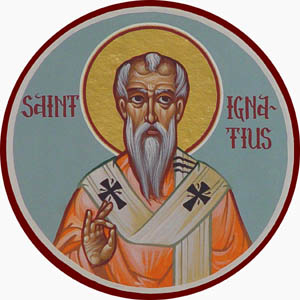

Or click HERE to donate

And don’t forget to join the conversations at the NazareneSpace Social Network

They Shall Look Toward Me Whom They Have Pierced

They Shall Look Toward Me Whom They Have Pierced
By
James Scott Trimm

We read in the prophet Zechariah:

And I will pour upon the house of David,
and upon the inhabitants of Yerushalayim,
the spirit of grace and of supplication.
And they shall look unto Me, whom they pierced through,
and they shall mourn for him, as one mourns for his only son:
and shall be in bitterness for him, as one that is in bitterness
for his firstborn.
(Zech. 12:10 HRV)

In the Talmud Rabbi Dosa (who lived around 250 CE) teaches regarding Zech. 12:10:

What is the cause of the mourning [of Zech. 12:12]–…
It is well according to him who explains that
the cause is the slaying of Messiah the son of Joseph,
since that well agrees with the Scriptural verse:
And they shall look upon me whom they have pierced,
And they shall mourn for him as one mourns for his
only son. (Zech. 12:10)
(b.Sukkot 52a)

In fact the Jerusalem Targum to Zechariah also identifies this one being pierced in Zechariah 12:10 as the “Messiah ben Ephraim”.

Lets look at a key phrase from this verse in the Hebrew:

והביטו אלי את אשר דקרו

“And they shall look toward me whom they pierced.”

have pierced
they
whom<—–toward
me
And
shall look
they
דקרואשראתאליוהביטו

Although many attempts have been made to translate this passage in other ways, the Hebrew is obvious. The article את points to the next term אשר דקרו “whom they have pierced” as receiving the action of the verb והביטו “and they shall look” while the preposition אלי must be understood “toward me” as the final י indicates the first person “me”.
Now lets look at how this was translated in the Aramaic Peshitta Tanak:

whom
have pierced
they
at
him
toward me shall look they
דדקרובמןלותידנחורון

Note that the Aramaic translation adds the phrase “at him” to the passage.  This is because the Aramaic translator was attempting to translate the Hebrew word for word into Aramaic.  In his quest for such a word for word translation, he attempted to translate the untranslatable Hebrew word את with “at him” במן so as to convey the idea of a pointer to “whom they pierced” as the direct object.  The Hebrew word את is a preposition which is unique to Hebrew and which points to the next word or phrase as the direct object receiving the action of the verb.  In this case the word indicates that the ”whom they pierced” is receiving the action of  ”and they shall look toward me”.  The Aramaic translator has added ”at him” so at to connect ”whom they pierced” with ”they shall look toward me”. 

whom have pierced they at him shall look they
דדקרובמןדנחורון

Note that the Aramaic as it appears in Jn. 19:37 differs from the Peshitta Aramaic of Zech. 12:10 only by one word.  This Aramaic reading omits the phrase ”toward me” and retains only ”at him”.  Either Yochanan or the scribe of the Aramaic text of Zech 12:10 which served as his source text, seems to have found the phrase “toward me at him” to be redundant and thus omitted the phrase ”toward me”.  This shift from “toward me” to “at him” could only have occurred in the Aramaic text of Yochanan 19:37 and been translated into the Greek text of John 19:37.  Thus pointing to the Aramaic origin of the book of Yochanan and explaining the shift in the reading of this verse.


Now if we look at Zech. 12:10 in context we will see that the speaker here is YHWH:


 The saying of YHWH concerning Israel…
I [YHWH] will seek to destroy all of the nations
that come against Jerusalem.
And I will pour upon the house of David
And upon the inhabitants of Jerusalem,
The Spirit of grace and of supplication;
And they shall look toward me whom they pierced
And they shall mourn for him, as one mourns for his only son…
(Zech. 12:1, 9-10)

So we see that:

1.      “Me” the speaker is YHWH.
2.      YHWH (“Me”) is being looked upon.
3.      The one receiving the action of being pierced is the “Me” being looked upon.
4.      Therefore the one being pierced here is YHWH.

Many translations have bent over backwards to try to avoid this reading.  For example the JPS (1917) text has:

“And they shall look unto Me because they have thrust him through.”

And the Hebrew Publishing Company 1916 text has:

“and they shall look unto me for every one whom they have pierced”

As we have said above the Hebrew word ET את is an untranslatable Hebrew preposition which points to the next word or phrase as the direct object which receives the action.  While often Hebrew is very ambiguous, here is could not be more specific in saying that the one being pierced is the one being looked upon.  These Rabbinic versions are aimed at making the one looked upon be YHWH and the one being pierced as being someone else.  Another translation that mistranslates Zech. 12:10 is the Jehovah’s Witnesses “New World Translation” which reads:

and they will certainly look to the One
whom they pierced through

These translators do not have the luxury of making the one “looked upon” and the one “pierced” be different because Yochanan 19:37 makes it clear that they are the same.


Their only “way out” has been to wrongly translate אלי ”toward me” as “to the One”.  This translation is intended to avoid the problem presented to Jehovah’s Witnesses (who reject the idea that Messiah was YHWH incarnate) by a text that plainly says that the “Me” (YHWH) is being both looked upon and pierced.  Since Yochanan identifies the one pierced as well as the one looked upon as Yeshua, the JW’s must find some way to prevent this from being YHWH.   They do so by mistranslating אלי as “to the One”.  In reality the אל means “toward” and the י suffix is the first person indicator.  This י cannot mean simply “the One” but must mean “Me”.  This is clear to any first year Hebrew student.


What is especially interesting is that those who wish to avoid the clear meaning of Zech. 12:10 cannot agree together on what it is supposed to say instead. This is because they are all trying to make it say something other than what the Hebrew text actually does say.

The rent is due in just one week and we do not have it. We need your help today!

As you know we have been digging ourselves out of a budget shortfall.  As I have said to you many times, I look on this work as a co-operative one with me, and all of you combining our resources together in order to get the job done of helping to teach this great truth to all in the world who will listen. Thank you so much from the bottom of my heart for your continued support, you are the ones who make it all possible by your contributions and your prayers for our work. I truly appreciate your help in every way.

If you can make a one time donation of $500 or $1,000 dollars to support this work.


Donations can be sent by Paypal to donations@wnae.org
or by Zelle or Go Fund Me

Click HERE to donate

And don’t forget to join the conversations at the NazareneSpace Social Network

The Channukah Martyrs as Types of the Messiah

The Channukah Martyrs as Types of Messiah
by
James Scott Trimm

We read in 4th Maccabees concerning the martyrs under Antiochus Epiphanies:


[7] I could prove to you from many and various examples that reason is dominant over the emotions,
[8] but I can demonstrate it best from the noble bravery of those who died for the sake of virtue, Eleazar and the seven brothers and their mother.
[9] All of these, by despising sufferings that bring death, demonstrated that reason controls the emotions.
[10] On this anniversary it is fitting for me to praise for their virtues those who, with their mother, died for the sake of nobility and goodness, but I would also call them blessed for the honor in which they are held.
[11] For all people, even their torturers, marveled at their courage and endurance, and they became the cause of the downfall of tyranny over their nation. By their endurance they conquered the tyrant, and thus their native land was purified through them.
(4Macc. 1:7-11)


[24] When they saw that he was so courageous in the face of the afflictions, and that he had not been changed by their compassion, the guards brought him to the fire.
[25] There they burned him with maliciously contrived instruments, threw him down, and poured stinking liquids into his nostrils.
[26] When he was now burned to his very bones and about to expire, he lifted up his eyes to God and said,
[27] “You know, O God, that though I might have saved myself, I am dying in burning torments for the sake of the law.
[28] Be merciful to your people, and let our punishment suffice for them.
[29] Make my blood their purification, and take my life in exchange for theirs.”
[30] And after he said this, the holy man died nobly in his tortures, and by reason he resisted even to the very tortures of death for the sake of the law.
[31] Admittedly, then, devout reason is sovereign over the emotions.
(4Macc. 6:28-29)

[17] The tyrant himself and all his council marveled at their endurance,
[18] because of which they now stand before the divine throne and live through blessed eternity.
[19] For Moses says, “All who are consecrated are under your hands.”
[20] These, then, who have been consecrated for the sake of God, are honored, not only with this honor, but also by the fact that because of them our enemies did not rule over our nation,
[21] the tyrant was punished, and the homeland purified — they having become, as it were, a ransom for the sin of our nation.
[22] And through the blood of those devout ones and their death as an expiation, divine Providence preserved Israel that previously had been afflicted.
[23] For the tyrant Antiochus, when he saw the courage of their virtue and their endurance under the tortures, proclaimed them to his soldiers as an example for their own endurance,
(4Macc. 17:21)


These martyrs were a type [allegorical symbol] of the Messiah.  They brought redemption to Am-Yisrael (the People of Israel) by overcoming the Yetzer Ra (Evil Inclination).


To begin with, it is important to understand the two inclinations.  We read in Genesis 2:7:


And YHWH Elohim formed (YETZER) man of the dust of the ground,and breathed into his nostrils the breath (NISH’MAT) of life; and man became a living soul (nefesh).
(Gen. 2:7)


In the original Hebrew of this verse, the word YETZER (which can also mean “freewill” or “inclination”) is spelled with two YUDs (Y’s) when it should be spelled with one.  The Talmud observes:


R. Nahman b. R. Hisda expounded:
What is meant by the text, Then the Lord God
formed [va-yetzer] man? [The word va-yetzer] (Gen. 2:7)
is written with two yods, to show that God created
two inclinations, one good (tov) and the other evil (ra).
(b.Ber. 61a)


It has been taught: R. Jose the Galilean says,
The righteous are swayed by their good inclination, as it says,
My heart is slain within me. (Ps. 109:22)
The wicked are swayed by their evil inclination, as it says,
Transgression speaks to the wicked,
methinks, there is no fear of God before his eyes. (Ps. 36:1)
Average people are swayed by both
inclinations, as it says, Because He stands at
the right hand of the needy, to save him from them
that judge his soul. (Ps. 109:31)
Raba said: People such as we are of the average.
(b.Ber. 61b)


We read in the Wisdom of Ben Sira:

It was He who created man in the beginning.
And He left him in the power of his own inclination (Heb: yetzer).


If you will, you can keep the commandments,
and to act faithfully is a matter of your own choice.
He has placed before you fire and water:
Stretch out your hand for whichever you wish.
(Sira 15:14-16)


We read in 4Maccabees:


21 Now when Elohim fashioned man, he planted in him emotions and inclinations,
22 but at the same time he enthroned the mind among the senses as a sacred governor over them all.
23 To the mind he gave the Torah; and one who lives subject to this will rule a kingdom that is temperate, just, good, and courageous.
(4Macc. 2:21-23)


As Philo of Alexandria wrote:


“For these passions are the causes of all good and of all evil; of good when they submit to the authority of dominant reason, and of evil when they break out of bounds and scorn all government and restraint.”
(Life of Moses 1; VI, 26)


These martyrs mentioned in 4Maccabees were types of Messiah, because they physically redeemed their people by overcoming the Yetzer Ra in their martyrdom.  They, thru the Torah in their minds, used reason to overcome their emotions.


7:1 For like a swift ship captain, thus was the mind of the aged Eleazar. By way of the steering of the fear of Eloah, his thought was leading, over the great sea of torture and emotions.
7:2 And while threats and tortures of the Tyrant were coming upon him, and tumultuous waves of tribulation.
7:3 And in no way did he turn the rudder from fear of Eloah until he voyaged and arrived to the haven of victory that does not die.
7:4 No city besieged ever held out against mighty vassals coming against its walls and its various parts like this. He was dressed in all the armor. For while his soul was suffering, consumed by torture, and by tribulation, and by burning, he conquered the tribulation because of his mind was fighting with the shield of truth.
(4th Maccabees 7:1-4)


How Messiah Defeated the Yetzer Ra

This correlates with the redemption of Messiah through his defeat of the Yetzer Ra. In tractate Sukkah the Talmud records that there was a debate between Rabbi Dosa and other Rabbis concerning the meaning of Zechariah 12:12.  The Talmud says:

What is the cause of the mourning [mentioned in Zech 12:12]?
R. Dosa and the Rabbis differ on the point. One [Rabbi Dosa] explained, The cause is the slaying of Messiah the son of Joseph, and the other [the Rabbis] explained, The cause is the slaying of the Evil Inclination.

It is well according to him who explains that the cause is the slaying of Messiah the son of Joseph, since that well agrees with the Scriptural verse, And they shall look upon me whom they have pierced, and they shall mourn for him as one mourns for his only son (Zech. 12:10).

But according to him who explains the cause to be the slaying of the Yetzer Ra (Evil Inclination), is this [it may be objected] an occasion for mourning? Is it not rather an occasion for rejoicing? Why then should they weep? — [The explanation is] as R. Judah expounded: In the time to come the Holy One, blessed be He, will bring the Evil Inclination and slay it in the presence of the righteous and the wicked. To the righteous it will have the appearance of a towering hill, and to the wicked it will have the appearance of a hair thread. Both the former and the latter will weep; the righteous will weep saying, ‘How were we able to overcome such a towering hill!’ The wicked also will weep saying, ‘How is it that we were unable to conquer this hair thread!’ And the Holy One, blessed be He, will also marvel together with them, as it is said, Thus says the Lord of Hosts, If it be marvelous in the eyes of the remnant of this people in those days, it shall also be marvelous in My eyes.
(Sukkah 52a)

However, when we understand the how the destruction of the Yetzer Ra is achieved, we will see that there is in reality no conflict between the view of Rabbi Dosa (not only Rabbi Dosa, but the Jerusalem Targum to Zech. 12:10 which agrees with Dosa’s view) and the view of the Rabbis.

Another exposition of the text, ‘ My beloved is like a gazelle ‘:
Israel, explained R. Isaac, said to the Holy One, blessed be
He: ‘ Sovereign of the Universe! Thou hast told us that Thou
wilt come to us first.’ ‘ My beloved is like a gazelle ‘; as the
gazelle appears and then disappears, so the first redeemer
appeared and then disappeared. R. Berekiah in the name of R.
Levi said: Like the first redeemer so will the final redeemer be.
The first redeemer was Moses, who appeared to them and then
disappeared. For how long did he disappear from their sight?
R. Tanhuma said: Three months; accordingly it is written, And
they met Moses and Aaron, etc. (ib. V, 20).2 The final
redeemer will also appear to them and then disappear.
(Midrash Rabbah Bamidbar 11:2)

We read in Exodus:

13 And Moshe said unto the people, Fear you not. Stand still, and see the salvation of YHWH, which He will work for you today! For whereas you have seen the Egyptians today, you shall see them again, no more, forever.
14 YHWH will fight for you, and you shall hold your peace.
(Ex. 14:13-14 HRV)

Therefore we have a picture of the “salvation of YHWH” in Exodus 14:19-29

19 And the angel of Elohim, who went before the camp of Yisra’el, removed, and went behind them. And the pillar of cloud removed from before them, and stood behind them.
20 And it came between the camp of Egypt and the camp of Yisra’el. And there was the cloud and the darkness here, yet gave it light by night there: and the one came not near the other all the night.
21 And Moshe stretched out his hand over the sea. And YHWH caused the sea to go back by a strong east wind all the night, and made the sea dry land, and the waters were divided.
22 And the children of Yisra’el went into the midst of the sea upon the dry earth, and the waters were a wall unto them on their right hand, and on their left.
23 And the Egyptians pursued, and went in after them into the midst of the sea; all
Pharaoh’s horses, his chariots, and his horsemen.
24 And it came to pass in the morning watch, that YHWH looked forth upon the host of the Egyptians, through the pillar of fire and of cloud, and discomfited the host of the Egyptians.
25 And He took off their chariot wheels, and made them to drive heavily, so that the Egyptians said, Let us flee from the face of Yisra’el, for YHWH fights for them against the Egyptians.
26 And YHWH said unto Moshe: Stretch out your hand over the sea, that the waters may come back upon the Egyptians; upon their chariots, and upon their horsemen.
27 And Moshe stretched forth his hand over the sea, and the sea returned to its strength when the morning appeared. And the Egyptians fled against it, and YHWH overthrew the Egyptians in the midst of the sea.
28 And the waters returned and covered the chariots, and the horsemen, even all the host of Pharaoh that went in after them into the sea: there remained not so much as one of them.
29 But the children of Yisra’el walked upon dry land, in the midst of the sea, and the waters were a wall unto them on their right hand, and on their left.
(Ex. 14:19-29 HRV)

Philo writes of this:

(2.265) Again, when you see, amid the wars and disasters of life, the merciful hand of God and his favorable power held over you and standing in defense of you, be silent yourself; for that champion stands in no need of any assistance. And there are proofs of this fact recorded in the sacred writings; such, for instance, as the verse, “The Lord will fight for us, and ye shall be Silent.” (Ex 14:14.)
(2.266) And if you see the genuine offspring and the firstborn of Egypt destroyed, namely desire, and pleasures, and pain, and fear, and iniquity, and mirth, and intemperance, and all the other qualities which are similar and akin to these, then marvel and be silent, dreading the terrible power of God;
(Philo; Dreams Book 2; 40; 265-266)

So Philo sees an allegory here where the “Egyptians” represent “desire, and pleasures, and pain, and fear, and iniquity, and mirth, and intemperance, and all the other qualities which are similar and akin to these.” In other words Philo sees the Egyptians as representing the sin-nature which the Rabbis call the Yetzer Ra, the Evil inclination.

 So Philo sees an allegory here where the “Egyptians” represent “desire, and pleasures, and pain, and fear, and iniquity, and mirth, and intemperance, and all the other qualities which are similar and akin to these.” In other words Philo sees the Egyptians as representing the sin-nature which the Rabbis call the Yetzer Ra, the Evil inclination.  The first redeemer (Moses) delivered us from the Egyptians, but the second redeemer (the Messiah) would deliver us from the Evil Inclination.

Ramban (Rabbi Moshe ben Nachman) (1194-1270 C.E.) wrote one of the most authoritative Torah commentaries in Rabbinic Judaism. He says on this topic:

And YHWH your Elohim will circumcise your heart (Deut.
30:6) It is this which the Rabbis have said, “If someone comes
to purify himself, they assist him” [from on High]. The verse
assures you that you will return to Him with all your heart and
He will help you.

This following subject is very apparent from Scripture: Since
the time of Creation, man has had the power to do as he
pleased, to be righteous or wicked. This [grant of free will]
applies likewise to the entire Torah period, so that people can
gain merit upon choosing the good and punishment for
preferring evil. But in the days of the Messiah, the choice of
their [genuine] good will be natural; the heart will not desire
the improper and it will have no craving whatever for it. This
is the “circumcision” mentioned here, for lust and desire are
the “foreskin” of the heart, and circumcision of the heart
means that it will not covet or desire evil.

Man will return at that time to what he was before the sin of
Adam, when by his nature he did what should properly be
done, and there were no conflicting desires in his will, as I
have explained in Seder Bereshit.

It is this which Scripture states in [the Book of] Jeremiah
31:30], Behold, the days come, says YHWH, that I will make a
new covenant with the house of Israel, and with the house of
Judah; not according to the covenant that I made with their
fathers ..etc. But this is the covenant that I will make with the
house of Israel after those days, says the Eternal, I will put my
Law in their inward parts, and in their heart will I write it.
This is a reference to the annulment of the evil instinct and to
the natural performance by the heart of its proper function.
Therefore Jeremiah said further, and I will be their Elohim,
and they shall be My People; and they shall teach no more
every man his neighbor, and every man his brother, saying:
‘Know YHWH; ‘for they shall all know Me, from the least of
them to the greatest of them.

Now, it is known that the imagination of man’s heart is evil
from his youth and it is necessary to instruct them,
but at that time it will not be necessary to instruct them
[to avoid evil] for their evil instinct will then be completely
abolished. And so it is declared by Ezekiel, A new heart
will I also give you, and a new spirit will I put within you;
and I will cause you to walk in My statutes . (Ezekiel 36:26)

The new heart alludes to man’s nature, and the [new] spirit to
the desire and will. It is this which our Rabbis have said : “And
the years draw nigh, when you shall say: I have no pleasure in
them; these are the days of the Messiah, as they will offer
opportunity neither for merit nor for guilt,” for in the days of
the Messiah there will be no [evil] desire in man but he will
naturally perform the proper deeds and therefore there will be
neither merit nor guilt in them, for merit and guilt are
dependent upon desire.
(Ramban on Deut. 29:6)

Thus we learn that the death and defeat of the Yetzer Ra is the direct result of the work of Messiah. The mourning in Zechariah 12:12 is for the the death of the Messiah, but the death of Messiah also results in the death and defeat of the Yetzer Ra, thus Rabbi Dosa and the other Rabbis can actually be understood to agree.
And now we see how the Martyrs of 4th Maccabees are a type of the Messiah. because they also overcame the Yetzer Ra in their martyrdom.

We need your help today! We must raise at least $350 by the end of the day today (12/11/24) or our account will plunge into the negative, starting a chain reaction of returned items and fees !

As I have said to you many times, I look on this work as a co-operative one with me, and all of you combining our resources together in order to get the job done of helping to teach this great truth to all in the world who will listen. Thank you so much from the bottom of my heart for your continued support, you are the ones who make it all possible by your contributions and your prayers for our work. I truly appreciate your help in every way.

If you can make a one time donation of $500 or $1,000 dollars to support this work.

Now is time to step up to the plate!

Donations can be sent by Paypal to donations@wnae.org

Donations can be sent by Paypal, Zelle, or Go Fund Me


Or click HERE to donate

Keep in Touch by Email


By submitting this form, you are consenting to receive marketing emails from: . You can revoke your consent to receive emails at any time by using the SafeUnsubscribe® link, found at the bottom of every email. Emails are serviced by Constant Contact


And don’t forget to join the conversations at the NazareneSpace Social Network

Channukah and the Message of 4th Maccabees

Channukah and the Message of 4th Maccabees
By
James Scott Trimm

As Channukah is coming to a close this year, I wanted to take a moment to explore the meaning of 4th Maccabees.

So often at Channukah we recall the “Channukah Story” and read the accounts of 1st Maccabees and 2nd and 2nd Maccabees, but we often run out of time before getting to the very deep material in 4th Maccabees. 

4th Maccabees elaborates on the Channukah martyrs spoken of in Second Maccabees.  Specifically Eleazar, who refused to eat meat that had even been represented as having been offered to idols, but was not, lets his actions mislead others into idolatry (See 2Maccabees 6:18-31 & 4Maccabees chapters 5-7).  And the account of Hannah and her seven sons, who refused to pay homage to Antiochus Epiphanies (See 2Maccabees 7;  4th Maccabees chapters 8-19 and b.Gittin 57b in the Talmud).   

4th Maccabees reveals how these martyrs were able to remain true to Torah, despite being tortured and ultimately killed for their testimony. 

The core teaching of 4th Maccabees draws upon a deep understanding of Genesis 2:7 in the Torah, which says:

And the YHWH Elohim formed man of the dust of the ground, and breathed into his nostrils the breath of life; and man became a living soul. (Gen. 2:7)

The Hebrew word for “formed” is yetzer which can also mean “inclination” or even “freewill.”  However in Genesis 2:7 in the Hebrew, the word yetzer is spelled with to “yuds” yyetzer.  The Talmud has an interesting comment about this nuance in the Hebrew of this verse:

R. Nahman b. R. Hisda expounded:
What is meant by the text, Then the Lord God
formed [va-yetzer] man? [The word va-yetzer] (Gen. 2:7)
is written with two yods, to show that God created
two inclinations, one good (tov) and the other evil (ra).
(b.Ber. 61a)

It has been taught: R. Jose the Galilean says,
The righteous are swayed by their good inclination,
as it says, My heart is slain within me. (Ps. 109:22)
The wicked are swayed by their evil inclination,
as it says, Transgression speaks to the wicked,
methinks, there is no fear of God before his eyes.
(Ps. 36:1) Average people are swayed by both
inclinations, as it says, Because He stands at
the right hand of the needy, to save him from them
that judge his soul. (Ps. 109:31) Raba said: People
such as we are of the average.
(b.Ber. 61b)

Likewise we read in the Wisdom of Ben Sira:        

It was He who created man in the beginning.
And He left him in the power of his own inclination (Heb: yetzer).
If you will, you can keep the commandments,
and to act faithfully is a matter of your own choice.
He has placed before you fire and water:
Stretch out your hand for whichever you wish.
 (Sira 15:14-16)

4th Maccabees gives us an important insight on this as well, saying:

21 Now when Elohim fashioned man, he planted in him emotions and inclinations,
22 but at the same time he enthroned the mind among the senses as a sacred governor over them all.
23 To the mind he gave the Torah; and one who lives subject to this will rule a kingdom that is temperate, just, good, and courageous.
(4Macc. 2:21-23)

As the first century Jewish writer Philo of Alexandria said:

“For these passions are the causes of all good and of all evil; of good when they submit to the authority of dominant reason, and of evil when they break out of bounds and scorn all government and restraint.”
(Life of Moses 1; VI, 26)

According to 4th Maccabees, the Channukah Martyrs were able to endure to the end and hold to their testimony in the face of torture and death, because their rational mind was in the drivers seat, and their emotions were in the passenger’s seat. 

This does not mean emotions are a bad thing, to the contrary, emotions subject to the rational mind (the Neshoma) that is the good inclination and the cause of all good in this world.  But when our emotions are in the drivers seat and our rational mind is in the passenger’s seat, that is the evil inclination.

So let us learn this lesson from 4th Maccabees and the Channukah martyrs this Channukah.

We need your help today! Our rent is due tomorrow!

As you know we have been digging ourselves out of a budget shortfall.  As I have said to you many times, I look on this work as a co-operative one with me, and all of you combining our resources together in order to get the job done of helping to teach this great truth to all in the world who will listen. Thank you so much from the bottom of my heart for your continued support, you are the ones who make it all possible by your contributions and your prayers for our work. I truly appreciate your help in every way.

If you can make a one time donation of $500 or $1,000 dollars to support this work.


Donations can be sent by Paypal to donations@wnae.org or by Zelle or Go Fund Me
Click here to donate

And don’t forget to join the conversations at the NazareneSpace Social Network

Check out the Latke recipe for Channukah at the new Messianic Home Space at NazareneSpace!

Channukah, Paul and Meat Offered up to Idols

Channukah, Paul and Meat Offered up to Idols
By
James Scott Trimm

Well it is Channukah time and so it is a very good time to discuss the subject of meat offered up to idols

In Acts 15 we are told that Gentiles do not need to be circumcised in order to be saved, but that they must still keep certain minimum levels of Torah observance even as they continue to go to synagogue on the Sabbath and learn the rest of the Torah. 

Among these four minimum commandments was to “abstain from things offered up to idols” (Acts 15:20, 29 & 21:25)

Furthermore in the Book of Revelation, the Assembly at Thyatira is condemned for eating things offered up to idols.

Paul discusses the issue of eating meat that has been offered up to idols in 1Cor. 8 & 10:

The fact is that Paul clearly agrees that one may not knowingly eat meat offered up to idols (1Cor. 8:1-13; 10:7, 14-28).

The halachic issue Paul questions, is whether or not one must ask, when purchasing meat, whether or not it has been offered to idols. Paul argues (based on Ps. 24:1=1Cor. 10:26, 28) that meat is not actually altered by the idol but that eating such meat appears to others to endorse the idol to which it was offered.

If meat is advertised as having been offered to idols, then believers may not eat it, since this would appear to endorse the idol. However, since the idol has no real power over the meat, believers are not required to ask, since this would imply that the believer believed that the idol had power over the meat, thus ascribing power to the idol and endorsing idolatry by acknowledging the idol’s alleged power.

Paul summarizes his argument as follows:

But if a man should say to you, that this is that which is sacrificed,
you should not eat: for the sake of the one who told you
and, because of conscience.
(1Cor. 10:28 HRV)

A basis for Paul’s argument here can be found in the story of the martyr Eleazar in 2Maccabbes.

Eleazer was a prominent Jew under the Helene rule. A day came when all of the Jews were to show their loyalty by eating meat offered to idols at a public feast. Eleazar was not willing to do so, but because of his prominence, the authorities offered to allow him to sneak kosher meat into the feast and eat it instead, thus only appearing to eat meat offered up to idols. Eleazer refused, knowing that this would appear to endorse idolatry, despite the fact that the meat would be kosher. As a result Eleazar was executed.  (2Maccabees 6:1-29).

This account demonstrates that eating meat offered to idols is wrong, not because of the meat itself, but because of the implied endorsement of the idolatry.

Therefore, Paul’s interpretation does not conflict with Acts 15 but actually implies a very strict interpretation, by which eating kosher meat would also be forbidden, if the meat were falsely advertised as having been offered to an idol.

The question has been posed: why would these people be buying meat from anything other than a Kosher butcher? Why would they be buying meat at the gentile market-place anyway?

OK now for an Aramaic word study. Paul writes:

Whatever is sold in the shambles (מקלון), that eat,
asking no questions for conscience sake:
(1Cor. 10:25)

The answer lies in the Aramaic word which appears in 1Cor. 10:25 where the KJV has “shambles”.

I often find that it sheds light on a passage when I research a key Aramaic word which appears in the Aramaic “New Testament” to see how that Aramaic word is used in the Targums, Talmuds and Zohar.

This Aramaic word (MAKLON) appears in the Talmud as follows:

Rab said: Meat which had disappeared from sight is forbidden.  An objection was raised. Rabbi says: Where the meat stalls (מקולין) [kept by gentiles are supplied with meat by] Israelite butchers, any meat found in the possession of the gentile is permitted! — It is different where it is found in the possession of the gentile.
(b.Hullin 95a)

The Talmud uses this word here to describe meat-stands run by Gentiles but where Jewish butchers are used. This section of Talmud proposes several hypothetical situations involving such markets and lays out debates by various Rabbis as to whether the meat from such a market should be presumed kosher or not.

There is not conflict between Paul’s statements here, Acts 15 and Jewish law as expressed in the Talmud.  One may not knowing eat meat that has been offered up to idols.  However, when buying meat that has not been advertised as having been offered up to idols, one should not ask. 

We Need Your Help Today! Bills are due!

As you know we have been digging ourselves out of a budget shortfall.  As I have said to you many times, I look on this work as a co-operative one with me, and all of you combining our resources together in order to get the job done of helping to teach this great truth to all in the world who will listen. Thank you so much from the bottom of my heart for your continued support, you are the ones who make it all possible by your contributions and your prayers for our work. I truly appreciate your help in every way.

If you can make a one time donation of $500 or $1,000 dollars to support this work.


Donations can be sent by Paypal to donations@wnae.org or by Zelle or Go Fund Me

Click HERE to donate

Stay in Touch by Email


By submitting this form, you are consenting to receive marketing emails from: . You can revoke your consent to receive emails at any time by using the SafeUnsubscribe® link, found at the bottom of every email. Emails are serviced by Constant Contact

And don’t forget to join the conversations at the NazareneSpace Social Network