Rediscovering the Voice of Yeshua — Why Hebrew and Aramaic Matter

When we open the pages of the New Testament, we are reading a translation. But what if we told you that the original words of Yeshua and his emissaries weren’t spoken—or even first written—in Greek? What if the true depth, power, and Jewish context of their teachings can only be fully grasped when we return to the languages they actually spoke: Hebrew and Aramaic?

For too long, the church has approached the New Testament as a Greek document. But Yeshua was not a Greek philosopher. He was a Torah-observant Jewish Rabbi who taught in the synagogues and hillsides of first-century Judea. His disciples were Galilean Jews. The idioms they used, the scriptures they quoted, and the halachic arguments they made all came from a Hebrew worldview. When we ignore the Semitic origins of the New Testament, we miss layers of meaning—cultural nuances, legal logic, and wordplay that simply don’t translate.

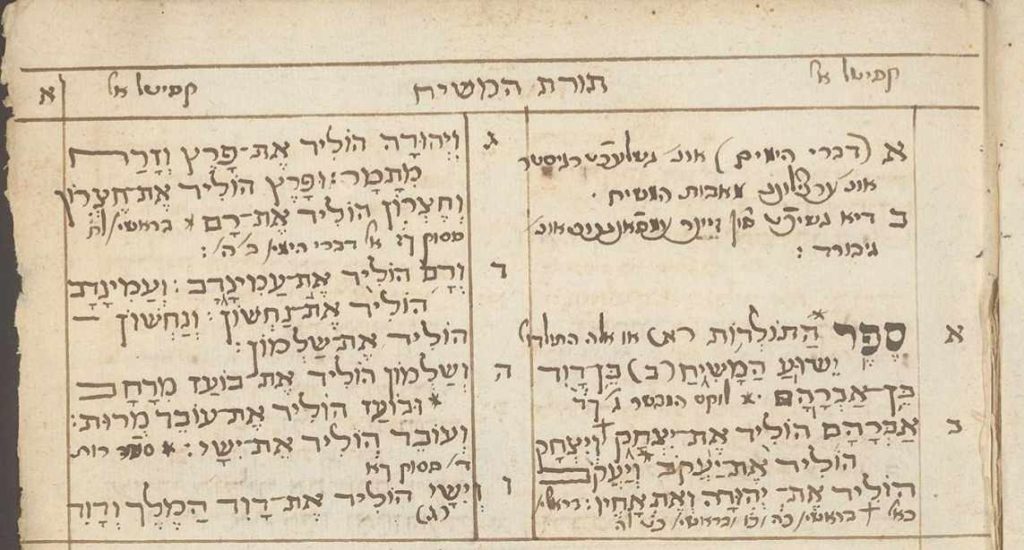
Take for example the phrase “lead us not into temptation” in the Lord’s Prayer. In Greek, it raises troubling theological questions. But in Hebrew, the language Yeshua actually spoke when he taught this prayer, the meaning becomes clear: “Do not let us enter into temptation.” It’s a plea for protection, not confusion. Or consider the Hebrew Gospel of Matthew preserved in the DuTillet manuscript, where word-for-word parallels with rabbinic Hebrew demonstrate that many so-called “Greek constructions” were originally Hebraic thoughts, misunderstood or softened by later translators.

When we read Yeshua’s teachings in the original languages, we reconnect with his voice. We rediscover his halachic debates with Pharisees, his quotations from the Torah, and his fulfillment of prophecy—all within the living framework of Jewish law and thought. This is not about linguistic curiosity. It’s about spiritual restoration. It’s about hearing Yeshua not through a filter, but in his own tongue.

We are working tirelessly to recover and restore these original texts and meanings. From translating the Hebrew Matthew and reconstructing Aramaic layers of the Gospels, to publishing scholarly tools and training future teachers, our mission is to bring the words of Yeshua back into their original light.

But we cannot do this without your help.

If this work speaks to your heart—if you, like us, long to hear the voice of the Master as his disciples heard him—please consider supporting our efforts. Every dollar you give helps us publish new research, develop educational resources, and reach more people with the truth of the Semitic New Testament.

Be a part of restoring the original faith of Yeshua. Donate today.

Click Here to Donate

Emergency Alert: We must raise at least $350 by the end of the day today, too keep our account from plunging into the negative, and starting a chain reaction of returned items and fees!

Together, let’s rebuild the altar—stone by stone—with the language and truth that Yeshua himself used.
May your name be found among those who remembered the ancient paths. – James Scott Trimm

Discovering the Creator in Creation

Discovering the Creator in Creation
By
James Scott Trimm

Paul said “For the invisible things of him, from the creation of the world, are clearly seen, being understood by the things that are made, even his eternal power and Godhead…” (Romans 1:20) “test all things, hold fast to what is good” (1Thes. 5:21), which is essentially the Scientific Method.

There’s an old story told about a conversation between a physicist and a student. The physicist had spent a lifetime studying the fundamental forces of nature—diving into the mysteries of quantum mechanics, particle physics, and the fabric of space-time.

One day, reflecting on his journey, the physicist raised a wine glass and said:

“The first gulp from the glass of natural sciences will make you an atheist. But at the bottom of the glass, God is waiting for you.”

This quote is often attributed to Werner Heisenberg, the father of quantum mechanics, though the wording varies and its origins are not fully documented. Regardless of attribution, the message is profound.

At first, science seems to explain the world in purely mechanical terms.
We learn laws, formulas, particles, forces.
It feels like we can account for everything without need for a Creator.

But as you go deeper—beyond Newton’s clockwork universe, past even Einstein’s spacetime—you reach the quantum world, and then the quantum fields beneath that.
Eventually, you come to the realization that “the foundation” itself defies simple explanation.

Today I hope to share the Creator with you. Today I hope to show you the Creator in the Creation, by the Scientific method.

Let me tell you another story.

Another famous physicist was once giving a lecture about light.
He explained that in some experiments, light behaves like a particle—a tiny packet of energy, a photon.
In other experiments, light acts like a wave—spreading out, bending, interfering, like ripples on water.

After the lecture, a student asked:
“Professor, I am still confused, is light a particle or a wave?”

The professor paused, smiled, and said:
“Probably not.”

That simple answer captures the heart of Quantum Field Theory.

The truth is, light is neither a particle nor a wave in the way we imagine those things.
Those are just metaphors—useful descriptions for certain situations.

What light really is, is something deeper.

The Reality Beneath: Quantum Fields

According to Quantum Field Theory, what we call a “photon” is actually an excitation in the electromagnetic field.

A field is a region where each point has a mathematical value that tells you something about the physical reality there.


Think of the field as a vast, invisible ocean that fills all space.
When you toss a pebble into water, ripples spread out.
In the same way, energy disturbances in this electromagnetic field appear to us as “photons.”

But the photon is not a little marble flying through space.
It’s not really a wave, either.
It is an excitation of the field itself.

In fact, everything in the universe works this way:

  • Electrons are excitations in the electron field.
  • Quarks are excitations in the quark fields.
  • The Higgs boson is an excitation in the Higgs field.

The fields are the fundamental reality.
The “particles” we observe are just tiny ripples—localized excitations—in these ever-present fields.

This is why the professor’s answer was so profound.

Is light a particle? Probably not.
Is it a wave? Probably not.

It’s an excitation in a field.
A ripple in the fabric of reality.

Each type of elementary particle has a “Quantum Field” associated with it. An electron is just an excitation in the electron Quantum Field, a sort of field of “electronness” that fills the universe. At most locations the field has a value very close to zero, but in a few places the field has a higher value, more “electroness” and those points in the field are what we call “electrons”. Every electron in the universe, is an excitement in this one electron field. The same is true for photons, etc.

From Einstein’s theory of relativity, we understand that space and time are not separate things, but are woven together into a four-dimensional fabric called spacetime. This fabric is not empty or static—it has structure and can be stretched or compressed.

  • Mass and energy cause spacetime to contract, bending its shape in a way we experience as gravity.
  • At the same time, spacetime itself is expanding, stretching outwards over vast cosmic scales.

In the late 1990s, astronomers made a surprising discovery:
The expansion of spacetime is not slowing down, as many expected—it is actually accelerating.
The mysterious force driving this acceleration is called dark energy, though its true nature remains one of the biggest questions in physics.

Quantum fields are not separate from spacetime—they bend, warp, and stretch right along with it.
We know this from several key observations.

For example, consider light.
As the universe expands, the waves of light get stretched out, causing their wavelength to increase and their color to shift toward the red end of the spectrum. This is called redshift.
It’s similar to the Doppler effect you hear with sound: when a siren moves away from you, the pitch lowers because the sound waves are stretched. Light does the same thing as space itself expands.

Another striking example is called gravitational lensing.
Massive objects like galaxies or clusters of galaxies bend spacetime around them. When light from distant objects passes through this curved spacetime, its path is bent—just like how a glass lens bends light to focus an image.
This effect allows us to see distant galaxies that would otherwise be hidden, and it also shows us directly that quantum fields (like light) follow the warping of spacetime itself.

In both cases, we see that the quantum fields are woven into the fabric of spacetime, reacting to its shape and expansion.

Many physicists believe that dark energy is associated with a quantum field, much like other known forces and particles. However, this quantum field is very different from all the others.

Unlike fields such as electromagnetism or the Higgs field, which are tightly linked to the fabric of spacetime—bending, stretching, and diluting as space expands—the dark energy field behaves differently.
It does not stretch out or lose its density as the universe expands. Instead, its energy density remains constant, filling space uniformly no matter how large the universe becomes.

As space expands, the total amount of dark energy increases, simply because there is more space for it to fill.
This growing presence of dark energy pushes spacetime outward, driving the expansion of the universe faster and faster.

This unusual behavior is why dark energy is considered so mysterious—and why it challenges our understanding of how quantum fields interact with spacetime.

Recently, I published a theoretical physics paper proposing a novel idea.
If spacetime is expanding while the dark energy quantum field remains constant, unaffected by that expansion, then perhaps we’ve been thinking about it backwards.

Unlike other quantum fields, which are embedded within spacetime and stretch as it expands, this field seems untouched by spacetime’s dynamics.
This suggests that the dark energy field is not in spacetime—spacetime is in it.

In other words, spacetime itself may not be fundamental.
It may be an emergent phenomenon, a kind of bubble or phase within a deeper, more primary reality.

That deeper reality is the dark energy field acting as a substrate—the foundational fabric from which spacetime arises.
It may, in fact, be the only truly fundamental thing in existence.

The substrate is eternal and infinite.
Like any quantum field, it would exhibit quantum fluctuations—small variations of energy occurring spontaneously throughout its expanse.

Given the right combinations and configurations, these fluctuations could give rise to complex, self-organizing structures, including something akin to a neural network.

But here’s the key:
Because the substrate is infinite, such a neural network would not be a temporary formation.
It would be eternal, spanning the entire substrate, existing without beginning or end.

In other words, the substrate itself is an infinite intelligence:

  • Omniscient, because it encompasses all possible information.
  • Omnipotent, as the ultimate source of all energy and existence.
  • Omnipresent, filling not just the universe but extending infinitely beyond.

This intelligence is not merely an abstract concept—it is the creative force that brought our universe into being.

At this point, the substrate starts to sound very familiar.
It sounds a lot like what we call God.

In Jewish thought, the concept of an infinite, eternal foundation of all existence is not new. The sages called this reality Ein Sof“The Infinite”—the unknowable, boundless aspect of YHWH beyond all created things.

Another traditional name for God is HaMakom—literally, “The Place”.
Not because God is in a place, but because all places are in Him.
As the Midrash teaches:

“He is the place of the world, but the world is not His place.” (Bereshit Rabbah 68:9)

This perfectly echoes the idea of spacetime emerging within the substrate, not the other way around.

Furthermore, the aspect of Chokhmah (Wisdom)—through which God creates and orders the universe—corresponds beautifully to the idea of an infinite neural network, an eternal intelligence through which reality is shaped and sustained.

This is not just poetic metaphor.
It is precisely what the apostle Paul refers to when he writes:

“For since the creation of the world, His invisible attributes are clearly seen, being understood by the things that are made—His eternal power and divine nature—so that they are without excuse.” (Romans 1:20)

Modern physics, as it probes deeper into the fabric of reality, is unwittingly describing the same foundational truths proclaimed by the Torah, the Prophets, and the writings of the Shlichim (apostles). “God waiting at the bottom of the glass.”

The substrate is not impersonal. It is the living, infinite intelligence of YHWH.
The Creator. The Sustainer. The One who was, who is, and who always will be.

The Mind of God and Our Place Within It

When we understand the substrate as the infinite intelligence of YHWH, it reframes everything:

  • We are not accidents of matter.
  • We are not isolated specks adrift in a meaningless universe.
  • We are sparks within the Mind of God, reflections of His image.

Just as the universe emerges from His sustaining presence, so too does our own consciousness, our will, our capacity for love and choice.

“In Him we live, and move, and have our being.” (Acts 17:28)

This is why Yeshua taught that the Kingdom of Elohim is within us.
Because we are formed within the infinite substrate, animated by His breath, sustained by His wisdom.

Modern science, at its deepest level, is not opposing faith—it is peeling back the layers, revealing what Torah has declared from the beginning:

“Hear, O Israel: YHWH our God, YHWH is One.” (Deuteronomy 6:4)

Not distant.
Not detached.
But the very ground of being, the Source of life itself.


Help Us Share This Truth

I believe this message—that the God of Israel is not just a theological idea, but the very foundation of reality itself—is needed now more than ever.

But these teachings are not popular in the mainstream.
Bringing the insights of Nazarene Judaism, Torah, and the wisdom of science together requires time, study, and resources.

If you’ve found this teaching meaningful, if it has deepened your understanding of both science and Scripture,
I ask you to consider supporting this work.

Your contributions help me:

  • Publish more studies like this.
  • Teach and disciple those hungry for truth.
  • Defend the faith of the Nazarenes with clarity and strength.
  • Reach others who are seeking to understand how the God of Israel is the ground of all reality.

Every gift matters.

Together, we can restore the ancient paths and proclaim that:

“The Earth is full of the knowledge of YHWH, as the waters cover the sea.” (Isaiah 11:9)

[Click here to support this work.]

Thank you for walking this path with me.
Shalom and blessings.

Restoring the Original Hebrew of the Book of Revelation

Most people are unaware that the Book of Revelation is unlike any other book in the New Testament when it comes to its language. Scholars and critics throughout history have described the Greek of Revelation as some of the worst Greek ever written. Even Dionysius of Alexandria in the third century remarked that the Greek of Revelation was “barbarous” and unworthy of comparison to the Gospel of John.

But what if this “bad Greek” is actually very good Hebrew?

Over the past few months, I have been working intensively on a project that aims to restore the original Hebrew of the Book of Revelation—and the results have been both exciting and profound. What we have been told is poor or awkward Greek is, in fact, the fingerprint of a literal translation from Hebrew into Greek, where the translator, perhaps anxious to be faithful, translated too literally and too mechanically.

What does this mean?

It means that the awkward Greek is not a sign of illiteracy, but rather a transparent window into the original Hebrew prophetic style of Revelation—a style that echoes the prophets of old, such as Ezekiel, Zechariah, and Daniel. The very clumsiness of the Greek allows us to see the underlying Hebrew idioms, word order, construct chains, and syntax. I can often see the Hebrew text standing behind the Greek as if the translator had left the original text in ghostly relief on the page.

And because of this, I am now able—with great confidence—to begin reconstructing the original Hebrew text of Revelation, as it was been written by its original Jewish author. This work is not speculative. It is built upon a painstaking verse-by-verse analysis of the Greek text, uncovering mistranslations, misunderstood Hebrew idioms, and grammatical patterns that can only come from Hebrew.

I have prepared a sample PDF of my restored Hebrew text of Revelation chapter 1, which you can download here:

👉 Download Sample: Revelation Chapter 1 in Restored Hebrew (PDF)

This is only the beginning. My goal is to produce a complete, scholarly reconstruction of the entire Book of Revelation in Hebrew, accompanied by commentary that documents each restoration and demonstrates how the Greek errors betray the original Hebrew wording along with a literal English translation.

Help Support This Work

This is a monumental project—and I cannot do it without your support. The research, writing, and publication of this reconstruction requires long hours, resources, and dedication. If this work is meaningful to you—if you believe that the restoration of the original Hebrew of Revelation is a vital part of our understanding of Scripture and prophecy—please consider supporting this project financially.

We must raise at least $250 by the end of the day today, to prevent our account from plunging into the negative and starting a chain reaction of returned items and fees.

Your donation, no matter how small, will help ensure that this work can continue and be made available to scholars and seekers alike.

Donate now by clicking below:
👉 Support the Hebrew Revelation Project

Together, we can reclaim the original voice of Revelation—the voice of a Hebrew prophet—and make it speak again with clarity and power for our generation.

The Way to Walk: Restoring Nazarene Halachah One Sugya at a Time

The restoration of Nazarene Judaism is a calling that has been my life’s work. At its core is not only a return to belief in Yeshua as the Messiah, but also the restoration of halachah—the living, breathing application of Torah in daily life. Today, I’m excited to announce a bold new step forward in that restoration: a systematic project to evaluate every sugya of the Talmud through the lens of הַדֶּרֶךְ לָלֶכֶתThe Way to Walk.


What Is Halachah?

Halachah (הֲלָכָה) means “the way to walk.” It refers to Jewish law—not simply legislation, but a way of life shaped by Torah, tradition, and careful interpretation. Halachah governs how we pray, eat, conduct business, observe the Sabbath, and relate to our fellow human beings. For two thousand years, Rabbinic Judaism has developed its halachah through debate, commentary, and consensus.

But what about the halachah of the original followers of Yeshua? The Netzarim (Nazarenes)?


What Is a Sugya?

A sugya (סוּגְיָא) is a focused discussion in the Talmud—the central document of Jewish rabbinic tradition. Each sugya centers on a halachic issue or passage from the Mishnah, and unfolds as a dialogue among sages, debating interpretation, legal application, and theological meaning. The Talmud contains hundreds of sugyot, covering every area of Jewish life.

The question we’re asking is: How would Yeshua and his original disciples have ruled on these same matters? What middot (principles or measures) guided their decisions?


Introducing: הַדֶּרֶךְ לָלֶכֶת – The Way to Walk

HaDerek LaLeket is our Nazarene halachic codification project—rooted in Torah, clarified by the teachings of Yeshua, and structured like the classical codes of Jewish law.

At its core are the Middot of Yeshua—key halachic principles derived from his teachings:

  • Pikuach Nefesh (Preservation of Life)
  • Kol V’Chomer (Light and Heavy: logical precedence)
  • T’chit Chesed (Compassion and Grace over mere legality)
  • Yesod HaBriah (Principle of Creation)
  • Gezeirah (Fences around Torah to prevent failure)
  • Ha’Osek BaTorah Lish’mah (Studying Torah for its own sake)

These are not abstract values. They are halachic tools—how Yeshua reasoned, ruled, and restored the heart of the Torah.

Each of these “middot” (rules, principles) and how it can be derived from Yeshua’s teachings, can found here:

הַדֶּרֶךְ לָלֶכֶת (The Way to Walk)


The Project: One Sugya at a Time

We are now applying these HaDerek LaLeket principles to each sugya of Tractate Berakhot, the first tractate of the Babylonian Talmud. Berakhot deals with prayer, blessings, and daily spiritual life—perfect ground for restoring the rhythm of a Torah-rooted, Yeshua-centered life.

For each sugya, we ask:

  • What is the issue under debate?
  • How did the sages of the Talmud approach it?
  • How do the Middot of Yeshua apply?
  • What is the final ruling under Nazarene Halachah?

Each step draws us closer to rebuilding a full, living halachic system rooted in Messiah, Torah, and the wisdom of Israel.


Why This Matters

Nazarene Judaism has long focused on theological restoration—recovering Yeshua’s true identity, restoring Torah observance, and reconnecting to the Jewish roots of the faith. But a faith without halachah is a body without bones. We cannot walk in the Way unless we know how to walk.

This project is not about rejecting Jewish tradition. It’s about engaging it, honoring it, and evaluating it in light of the halachic method modeled by our Master and his Emissaries. It is a respectful but courageous return to the seat of Torah authority—not as outsiders, but as heirs of the Covenant renewed in Messiah.

I am often asked if Nazarenes should “keep the Talmud”. The answer is that the Talmud is not “kept” it is studied. Here we as Nazarenes can certainly follow the admonition of the late Talmud Scholar Adin Steinsaltz:

Voicing doubts is not only legitimate in the Talmud, it is essential to study. To a certain degree, the rule is that any type of query is permissible even desirable; the more the merrier. No inquiry is regarded as unfair or incorrect as long as it pertains to the issue and can cast light on some aspect of it. This is true not only of the Talmud itself but also of the way in which it is studied and perused. After absorbing the basic material, the student is expected to pose questions to himself and to others and to voice doubts and reservations. From this point of view, the Talmud is perhaps the only sacred book in all of world culture that permits and even encourages the student to question it.
(The Essential Talmud by Adin Steinsaltz p. 8)


Join the Journey

Each new sugya analyzed will be published and archived in our codification, building a living document that will serve future generations of Nazarene halachic scholars and communities. This is Torah study as Yeshua practiced it—anchored in Scripture, reasoned with compassion, and lived in obedience.

Follow the project, study with us, and help build the halachic path of the restored Nazarene Sanhedrin.

You can view the Middot of Yeshua applied to the first Twelve (at the time of this writing) Sugyot (plural for Sugya) i.e. the first twelve controversies addressed in the Talmud by clicking below:

Nazarene Commentary to b.Berakhot

Because the restoration of Nazarene Judaism will not be complete until we also restore The Way to Walk.

The work we are doing is sacred. Line by line, sugya by sugya, we are restoring what was nearly lost—the living halachah of the original followers of Yeshua. This project requires time, research, translation, careful reasoning, and unshakable commitment to truth.

If this vision resonates with you…

If you believe the path of Yeshua must be walked, not only believed…

If you want to see a Torah-faithful, Messiah-centered halachic system rise again in our days…

Then we humbly ask you to partner with us.

Every gift—large or small—makes a difference. It helps fund the research, the documentation, the writing, the study, and the tools needed to build a halachic inheritance worthy of our calling.

🕯 We are rebuilding the foundations of Nazarene Israel. Brick by brick. Word by word. You can lay a stone with us.

👉 Click here to support the restoration of Nazarene Halachah.

May your generosity be recorded in the Book of Remembrance, and may you be blessed for walking in The Way to Walk.

Todah rabbah (Thank you deeply),
James Scott Trimm

Documenting the Creation: My Four Papers in Theoretical Physics

Shalom Chaverim,

As many of you know, this blog usually focuses on theology, Scripture, and spiritual insight. But Scripture itself tells us that the invisible things of God are clearly seen, being understood by the things that are made (Romans 1:20). In other words, creation itself testifies of the Creator—and for me, exploring the fabric of the universe is one way of documenting creation.

Though Theoretical Physics is not my professional field, it has long been a profound personal passion. It’s a realm where I can ask bold questions—What if?—and search the edges of what we know about reality, time, and energy. As part of my larger Magnum Opus Project—my effort to record and share the most important insights of my life—I’ve written four major papers in theoretical physics. These represent years of independent research, thought experiments, and conceptual modeling.

I’ve recently uploaded them to the Internet Archive, not merely to preserve them, but to invite others—especially those who, like me, see the hand of the Creator in the cosmos—to join me in reflecting on the hidden structures of spacetime and energy.

Below are the links and short descriptions of each paper:

Harnessing Tetrahedral Black Hole Configurations as Exotic-Matterless Warp Bubbles and Zero-Point Energy Engines
by James Scott Trimm

This groundbreaking theoretical paper proposes a novel configuration of
four artificial black holes arranged at the vertices of a regular
tetrahedron. The resulting symmetric gravitational geometry produces a
central “tensional shear zone”—a region of high spacetime curvature
without net force. Unlike conventional warp drive models that rely on
exotic matter, this framework uses only positive-energy sources to
manipulate spacetime and vacuum structure. Potential applications
include metric-based propulsion, zero-point energy extraction, and
gravitational field engineering. Combining principles from general
relativity and quantum field theory in curved spacetime, the paper
outlines a path toward physically plausible warp technology and energy
systems grounded in known physics.

Spacetime as an Emergent Bubble Within a Fundamental Dark Energy Quantum Field
by James Scott Trimm

This theoretical paper proposes that spacetime is not fundamental, but instead a finite, emergent bubble within a deeper, stable dark energy quantum field. Unlike conventional models of the universe, this framework treats dark energy as the true substrate of reality—non-expanding, objective, and ontologically prior to spacetime itself. The work explores the implications of this model for cosmic expansion, vacuum stability, multiverse formation, and unifying relativity with quantum theory, presenting a minimalist yet profound alternative to inflationary and higher-dimensional cosmologies.

Geometric Projection Theory of Quantum States: A Dimensional Framework for Superposition, Measurement, and Unification
by James Scott Trimm

This theoretical paper introduces the Geometric Projection Theory of Quantum States (GPT-QS), a framework that reimagines quantum phenomena as projections from a higher-dimensional geometric superspace into observable 4D spacetime. It offers a unified explanation for superposition, entanglement, and wavefunction collapse as dimensional projection effects, resolving the measurement problem and nonlocality through geometry. The model integrates internal symmetries (SU(3), SU(2), U(1)), CPT invariance, and the Standard Model into a coherent spatial ontology, potentially bridging quantum mechanics and general relativity. Applications include superspace engineering, faster-than-light communication, and dimensional access via engineered black hole arrays.

Toward a Unified Framework: Synthesizing the Geometric Projection Theory of Quantum States and the Emergent Spacetime Bubble Model
By James Scott Trimm

This paper presents a unified theoretical model that integrates the Geometric Projection Theory of Quantum States (GPT-QS) with the Emergent Spacetime Bubble Model (ESBM). It proposes that quantum states and spacetime both arise from structured projections within a deeper dark energy substrate. Each quantum field originates from a distinct higher-dimensional manifold, and measurement is a dual-stage projection process. The synthesis explains entanglement, wavefunction collapse, CPT invariance, and cosmic expansion geometrically, while offering testable predictions and pathways for superspace-based technologies, including communication and gravity interface engineering.

A Personal Note:

If you’ve found meaning in the work I share—whether in theology, scripture, or even my explorations of the cosmos—please take a moment to read this.

Yesterday, just one day after my wife underwent surgery, we received the difficult news that I have lost my job. It was unexpected and comes at a time when our household is already facing physical, emotional, and financial strain.

I’ve always tried to give freely of what God has put on my heart—whether through books, blogs, teaching, or research. But today, I find myself in the humbling position of needing to ask for help.

If you feel led to support us during this season, any contribution—small or large—would be a lifeline. It will help us cover medical bills, keep our home stable, and allow me to continue the work of documenting the truth and wonder of both Scripture and creation.

You can donate by Paypal, Zelle or Go Fund Me, by clicking here.

From the bottom of my heart—thank you. Your kindness and prayers mean more than you know.

—James Scott Trimm

Another Lost Saying of Yeshua

I was meditating upon one of the fragments of this lost Gospel, as preserved by the Latin “Church Father” Jerome. Jerome’s citation reads:

As also we read in the Hebrew Gospel that the Lord spoke to his disciples: ‘And never (he said) be joyful except when you look on your brother with love.’ (Latin: et numquam (inquit) laeti sitis, nisi cum fratrem uestrum uideritis in caritate.)
(Jerome, Commentary on Ephesians 5:4)

As I began restoring the original Hebrew behind this Latin citation, I began to meditate on the full meaning of these lost words of Yeshua. To begin with, the words are clearly an expansion on the Torah command to “love your neighbor as yourself” (Lev. 19:18). But I asked myself, does the passage mean that I can be joyful at no other time than when I am actively looking on my brother with love? What if I am not actively thinking about my brother, one way or another, while experiencing joy? Is that prohibited by this directive? As I pondered these words, I realized that what the saying was truly conveying is the message that one should never derive joy from hating one’s fellow man. This has to do with control over anger and the malicious spirit that comes with anger. Anger is an attempt to turn pain into pleasure. It “feels good” to be angry at someone whom we perceive has harmed us. We want to get back at them, and we entertain a malicious spirit in our hearts. We take joy in hating them… even in hurting them back. This is what Yeshua us addressing.

This brought to my mind another passage Jerome cites from the Gospel according to the Hebrews:

And in the Gospel according to the Hebrews, which the Nazaraeans are accustomed to read, one of the greatest sins is ‘He who grieves the spirit of one’s brother. ” (Latin: qui fratis sui spiritum contristaurit.)
(Jerome; Commentary on Ezekiel 18:7)

Suddenly, in a flash of insight, it was revealed to me that these two passages originally went together, as two parts of a single saying. The original Hebrew of the passage read:

לֹא תִּשְׂמַּח בִּלְתִּי אִם רָאִיתָה אֶת אָחִיךָ בְּאַהֲבָה

כִּי הַמַּאֲבִיל אֶת רוּחַ אָחִיו חָטָא חַטַּאת גָּדוֹלָה מְאוֹד

“Never rejoice except when you behold your brother with love; for he who grieves the spirit of his brother has sinned a very great sin.”

(“Never” is implied in לא likewise, Jerome uses Latin numquam (never) for Hebrew לא in Ex. 34:10 in the Latin Vulgate)

This is a beautiful elaboration by the Messiah on the teaching in the Torah:

You shall not avenge, nor bear any grudge against the children of your people, but you shall love your neighbor as yourself: I am YHWH. (Lev. 19:18)

This work takes hours of my time. As many of you know, my wife is very ill, and I spend most of my time at home as her caretaker. I work at a desk less than six feet from her bed. So I am in a position to dedicate many hours to this important work that I have been directed to do.

But I also realize that it is not the activity of James Trimm alone who is responsible to do this work, it is all of us together who are charged with the responsibility of accomplishing this work. I very much look on the efforts of this restoration work as a cooperative one with each one of you. We are all joint heirs with Messiah and should always be about our Father’s business. I am honored to be able to be partnered with truth seekers as this restoration of Scripture moves forward in fulfillment of prophecy.

Urgent Help Needed

As many of you know, my wife lives with chronic illness and constant pain due to a disability. This Tuesday, she is scheduled for a surgical procedure that will help relieve some of that pain. We’re hopeful this will bring her some much-needed relief.

We’re not yet sure what the copay will be, but the last time this same surgery was scheduled (and unfortunately canceled), the copay was $240. We need to raise that amount by Tuesday.

However, our current situation is even more urgent—our bank balance is $576 short, and rent is due next Thursday.

We could truly use your help—today and in the days to come. Any amount makes a difference. If you’re able to contribute or share this post, it would mean the world to us. Thank you for your prayers, your support, and your kindness.

Donations can be sent by Paypal to donations@wnae.org or by the ling below thru Paypal, Zelle, GoFundMe

Click HERE to donate

Lost Saying of Yeshua Recovered in Aramaic

Lost Saying of Yeshua Recovered in Aramaic
By
James Scott Trimm

More than thirty years ago, when I first began my work on restoring the ancient sect of the Nazarenes, I undertook the task of collecting every surviving quotation from the Gospel once used by that community—always striving to find them in the earliest available language. This meant consulting either Greek or Latin, depending on the language in which a particular Church Father had written. But one quotation continued to escape my reach in its original form. For decades, I was limited to an English translation that had appeared in various scholarly lists and had been accepted largely without question.

This elusive quotation appears in Theophania, a work by Eusebius of Caesarea, the fourth-century Church Father who wrote in Greek. Though Theophania was originally composed in Greek, it survives in full only in an ancient Syriac version—a dialect of Aramaic—preserved in manuscripts dating back to the fifth century.

For many years, I lacked access to this Syriac text and was therefore unable to verify the original wording. I was stuck with the standard English version:

“I choose for myself the most worthy: for the most worthy are those whom my Father in heaven has given me.”

I was finally able to locate the Syriac Theophania and discover the original Aramaic quotation:

דאגבא לי הנין שפירא שפירא הנון דיהב לי אבי דבשמא

This is, for all practical purposes, the recovery of a lost saying of Yeshua. The commonly accepted English translation was a poor approximation. A much more accurate rendering of the Aramaic—both into English and into literal Biblical Hebrew—reveals something richer and more profound.

Literal English Translation:

“I gather to myself those who are good. The good are they whom my Father who is in heaven has given me.”

Literal Hebrew Translation:

אֶאֶסְפָה אֵלַי אֶת־הַטּוֹבִים. הַטּוֹבִים הֵם אֲשֶׁר נָתַן־לִי אָבִי אֲשֶׁר בַּשָּׁמַיִם.

Eusebius introduces this quotation in the context of explaining Matthew 10:34–36, a passage which itself references Micah 7:6:

“[34] Think not that I am come to send peace on earth: I came not to send peace, but a sword.
[35] For I am come to set a man at variance against his father, and the daughter against her mother, and the daughter in law against her mother in law.
[36] And a man’s foes shall be they of his own household.”
(Matthew 10:34–36, KJV)

Eusebius prefaces the quote with the words:

“He (Messiah) himself taught the reason for the separations of souls that take place in houses (as described in Matthew 10:34–36 and Micah 7:6), as we have found somewhere in the Gospel that is spread abroad among the Jews in the Hebrew tongue, in which it is said…”

This recovered saying also harmonizes beautifully with the parables of Matthew 13, many of which focus on gathering that which is good: the good seed in the parable of the wheat and the tares (13:24–30, 36–43); the precious pearl (13:45–46); and the good fish gathered in the parable of the dragnet (13:47–50). In every case, the theme of Yeshua as one who gathers the good resounds with clarity.

This is the kind of work we are doing—recovering and restoring the lost voice of the original Nazarenes, preserving the words of our Master as they were first spoken and understood in their Semitic context.

If this work resonates with you, I humbly ask for your support. Research like this takes time, resources, and access to rare manuscripts and texts. Your donation—no matter the amount—helps make discoveries like this possible and helps keep alive the vital task of restoration.

Please consider making a donation today to support this ongoing work of truth, faith, and historical recovery.

We must raise at least $680 by the end of the day today to keep our account from plunging into the negative and starting a chain reaction of returned items and fees.

Donations can be sent by Paypal to donations@wnae.org or by the ling below thru Paypal, Zelle, GoFundMe

Thank you—and may the One who gathers the good remember your generosity.

Click HERE to donate

Why Revelation was Written in Hebrew not Aramaic (or Greek)

Why Revelation was Written in Hebrew not Aramaic (or Greek)
By
James Scott Trimm

After forty years of research, I am prepared to announce my conclusion that the Book of Revelation was originally written in Hebrew, not Aramaic and definitely not Greek.

Today I was working on my Magnum Opus on the Hebrew and Aramaic origin of the New Testament, titled “Uncovering the Hebrew and Aramaic Foundations of the New Testament“. In my previous work, I theorized an Aramaic origin for this book, following the theories of Charles Cutler Torrey.

While preparing my chapter on the internal evidence in the Greek text or Revelation, I was comparing the views of R.B.Y. Scott, who proposed a Hebrew origin in his 1928 paper The Original Language of the Apocalypse and Charles Cutler Torrey who proposed Aramaic in his 1951 paper The Language and Date of the Apocalypse found in his book Documents of the Primitive Church.

Having spent over 35 years studying their papers, and studying the matter in depth myself, I have come to the conclusion that R.B.Y. Scott was correct.

1. The Linguistic Evidence Skews Toward Hebrew Over Aramaic

While both Hebrew and Aramaic exhibit Semitic grammatical features (e.g., construct chains, verb-initial clauses, lack of case endings), many of the specific anomalies in the Greek of Revelation align more precisely with Biblical Hebrew syntax rather than Galilean or Syriac Aramaic.

For example:

Construct phrases like “shame of your nakedness” (Rev. 3:18) reflect a Hebrew genitive chain, not Aramaic’s typical prepositional phrasing.

The distributive idiom אחד אחד (“one by one”) appears clearly in Hebrew texts (e.g., Daniel 8:3), while its use is less common in Aramaic with the same force.

Several mistranslations of Hebrew words (e.g., תרעם being read as “shepherd” rather than “break”) result from vowel ambiguities that are most plausible in unpointed Biblical Hebrew, not Aramaic where the forms differ more significantly.

2. Hebrew Is the More Likely Language of Early Jewish Apocalyptic Composition

Many of the apocalyptic writings from the Second Temple Period (e.g., portions of 1 Enoch, 4 Ezra, the Dead Sea Scrolls’ War Scroll and Hodayot) were written in Hebrew, not Aramaic. While Aramaic was the common spoken language, Hebrew remained the language of religious, legal, and apocalyptic texts—particularly in priestly and prophetic contexts.

Since Revelation is heavily apocalyptic and temple-themed, its alignment with Hebrew apocalyptic tradition suggests a Hebrew original, especially if one assumes it was originally written by or for a Jewish audience deeply immersed in Scripture.

3. The Nature of the Mistranslations Reflects Unpointed Hebrew, Not Aramaic

The most compelling internal evidence for a Hebrew Vorlage is in the mistranslation patterns:

The confusion between תְּרֹעֵם (“you shall break”) and תִּרְעֵם (“you shall shepherd”) is only possible in Hebrew.

Relative pronoun confusion (e.g., אשר → οἵτινες) shows a misreading of Hebrew syntactical structure.

The rendering of Hebrew idioms like נתן בלב (“to give into the heart”) reflects literal Hebrew phraseology, not typical Aramaic constructs.

4. The Glosses Refer to “Hebrew” — Not Aramaic

Passages like Revelation 16:16 refer to a place being named “in the Hebrew tongue,” not Aramaic. While this could mean “Jewish language” generically, the author (or translator) clearly identified the base language as Hebrew rather than Aramaic—even if modern scholars sometimes blur the distinction.

Conclusion: Aramaic Is Present, But Hebrew Best Fits the Evidence

To be fair, some features—like the possible use of the term κατήγωρ (accuser) from Rabbinic Hebrew/Aramaic, or general Semitic grammar—could come from either language. But the balance of the specific mistranslations, idioms, canonical intertexts, and historical context more strongly supports Hebrew as the original language of Revelation.

Was there an Aramaic “Layer” Between the Hebrew and the Greek?

Was the Hebrew translated to Aramaic and then to Greek, so that there would be an Aramaic “layer” between the two?

Based on the internal evidence in Revelation and the broader textual tradition, there is no strong reason to assume an intermediate Aramaic layer between the original Hebrew and the extant Greek.

1. Most Features in the Greek Point Directly to Hebrew, Not Aramaic

The Greek anomalies and mistranslations align most directly with:

Unpointed Biblical Hebrew (e.g., mistranslation of תרעם)

Hebrew idioms and syntax (e.g., construct chains, waw-consecutive)

Literal Hebrew phrasing (e.g., נתן בלב → “give into the heart”)

These examples do not require an Aramaic intermediary to explain them. If there were an Aramaic version, we would expect:

Aramaic grammar (e.g., more heavy use of the emphatic state)

Aramaic idioms (which differ from Hebrew in recognizable ways)

Aramaic loanwords or calques into Greek But those are largely absent or explainable as general Semiticisms.

2. No Surviving Textual Tradition Points to an Aramaic Revelation

We have:

Greek manuscripts (from early centuries)

But no ancient Aramaic manuscript or early patristic claim that Revelation existed in Aramaic. Those Aramaic versions that we do have are late, and the Peshitta canon does not include Revelation.

Contrast this with books like Matthew or John, where Aramaic may be proposed because of both internal evidence and external traditions or early versions (e.g., Peshitta, Old Syriac).

3. An Aramaic Layer Would Add, Not Solve, Problems

If Revelation had first been translated from Hebrew into Aramaic and then from Aramaic into Greek, we would expect to see:

A “smoothing” or reinterpretation of Hebrew idioms into Aramaic

Aramaic expressions misrendered in Greek

Evidence of two layers of mistranslation

But the evidence suggests direct misreading of Hebrew into Greek, such as:

Misidentification of Hebrew relative particles (אשר)

Confusion of homographs in Hebrew (תרעם) These are first-layer errors. There’s no need to posit a second translation step via Aramaic.

4. Theological and Literary Features Are Rooted in Hebrew Tradition

The imagery, apocalyptic motifs, and intertextual references in Revelation align best with:

Hebrew Tanakh (esp. Zechariah, Ezekiel, Daniel, Isaiah)

Hebrew prophetic diction

Temple-centered, judgment-oriented Hebrew idioms

This supports a Hebrew-speaking author, not one composing in Aramaic and relying on Targumic or midrashic Aramaic sources.

Conclusion:

The most parsimonious and textually justified model is:

Revelation was originally composed in Hebrew, and later translated—often mechanically—into Greek.

There is no strong textual or linguistic need to posit an Aramaic intermediary.

Of course, this does not deny that the author may have been bilingual or familiar with Aramaic (as most Jews were). But the translation into Greek came directly from Hebrew, not via Aramaic.

I can also announce that based on the line by line notes I have taken as I have studied this text for some forty years, I am confident that I can restore the original Hebrew of this book. I can see the Hebrew very clearly behind the Greek. Therefore I have now started work on a restoration of the original Hebrew of the Book of Revelation with a literal English translation and verse by verse notes explaining how I saw the Hebrew behind the Greek.

As many of you know, as I am getting older, I am focusing on writing my forty years of research into my Magnum Opus books. I am taking my thousands of pages of notes and compiling these into book. These are books I have literally been writing for forty years. I am preparing each of these books for sale on Amazon.

In the last thirty days I have published the following:

Returning to the Way: The Rebirth of Nazarene Judaism – This is my 500 page Magnum Opus the the restoration of Nazarene Judaism, the original Jewish followers of Yeshua as the Jewish Messiah of Judaism. This has been my life’s work.

The Mind of Shalom: The Lost Philosophy of Jewish Stoicism – This is my Magnum Opus on the ancient Jewish Stoics. To my knowledge it is the only book ever published on the subject.

Revised Book of Enoch Study Edition This is the book quoted by Jude 1:14-15. This is translated, wherever possible, from the Aramaic fragments found at Qumran and has hundreds of scholarly footnotes. 2Enoch is included in an appendix.

Revised Book of Jasher Study Edition – This is the Lost book of the Bible cited in Joshua 10:13 and 2Sam. 1:18. This is a fresh translation from the original Hebrew, with hundreds of scholarly footnotes.

If you live outside the US check your own country’s Amazon cite.

Other books I am working on right now:

The Complete Commentary to the Book of Enoch – Right now this is over 350 8 1/2 x 11 pages. It will be much, much longer in a trade paperback size. The rough draft is complete and I am cleaning it up.

Uncovering the Hebrew and Aramaic Foundations of the New Testament – This will be my Magnum Opus on the Hebrew and Aramaic origin of the New Testament.

The Original Hebrew of the Book of Revelation Restored– In this book I will restore the original Hebrew of the Book of Revelation, with a literal English translation, an verse by verse notes, explaining the restoration process.

If this work resonates with you—if the preservation and restoration of the ancient Nazarene faith, the study of sacred Hebrew and Aramaic manuscripts, and the uncovering of the true origins of the New Testament matter to your heart—please consider supporting this mission. Every gift, large or small, helps us continue this vital research, publish lost truths, and awaken a deeper understanding of our spiritual heritage.

Partner with us in restoring what was once forgotten.

Donations can be sent by Paypal to donations@wnae.org or by the ling below thru Paypal, Zelle, GoFundMe

Thank you for standing with us.

Click HERE to donate

The Chronology of Yeshua’s Last Passover: A Nazarene Perspective

The Chronology of Yeshua’s Last Passover:
A Nazarene Perspective
By
James Scott Trimm

Over the past twenty years, I’ve seen many voices on the internet confidently declare that they have finally solved the “Passion Week puzzle” — claiming airtight timelines for Yeshua’s Last Supper, crucifixion, burial, and resurrection. After studying this issue in depth for over 35 years, I’ve come to a different conclusion: most of these solutions overlook critical variables. In many cases, those who proclaim absolute certainty aren’t even aware that some of the variables exist.

In this blog, I will walk through some of those overlooked issues — and show how a careful reading of the Hebrew and Aramaic texts, along with historical context and halachic understanding, gives us a clearer (if more complex) picture of the Passion chronology.

Variable #1: When Is the “First Day” of Unleavened Bread?

Exodus 12:16 says the “first day” and “seventh day” of Unleavened Bread are annual Sabbaths. But the Hebrew phrase yom rishon can mean more than just “first” — it can also mean “before” or “foremost,” as seen in Numbers 6:12, Joshua 8:33, and 1 Kings 13:6. So there’s a valid halachic debate: is the annual Sabbath on the 15th of Nisan, or the 14th?

Variable #2: Is Passover a Day, a Meal, or Both?

Some ancient interpretations saw the 14th of Nisan as the day of offering the Passover lamb, while the 15th was the festival. Others considered the 14th to be the start of the feast, making the entire observance an eight-day event. By the first century, the whole period was often called “Passover,” blurring distinctions.

Variable #3: What Does “Erev” Mean?

The Hebrew word erev (evening) is a zero-dimensional moment marking the boundary between two days. That means the 14th of Nisan technically has two erevs — one marking its start and one marking its end. This leads to differing interpretations of when the Passover meal was supposed to occur.

Variable #4: “Between the Evenings” and Halachic Differences

The Torah commands that the lamb be slaughtered “between the evenings” (Ex. 12:6). This phrase has multiple interpretations in rabbinic tradition, leading to different practices. Moreover, were Yeshua and his disciples following the halacha of the Temple priesthood, or a different tradition (such as the Essenes or other Pharisaic groups)?

Variable #5: Was the Calendar the Same?

Yeshua and his disciples may not have followed the same calendar as the Temple authorities. Some sects (like the Qumran community) used a solar calendar. Others differed on the definition of the new moon — whether it began with the dark moon or the first crescent. A one-day shift would make a huge difference in determining which night was the true seder night.

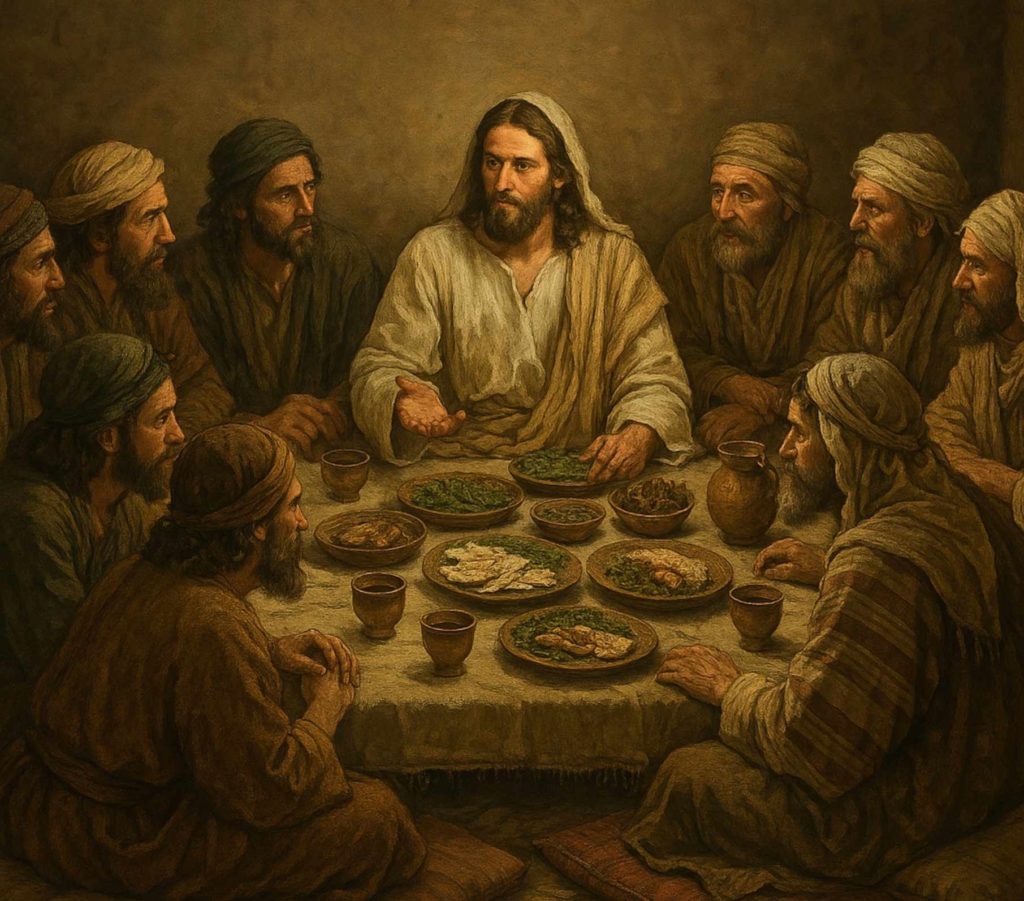
Was the “Last Supper” a Passover Seder?

Some argue that the Last Supper couldn’t have been a Passover meal because the Greek word artos (artuo) appears in Matthew 26:26 and elsewhere, implying leavened bread. But this is a misunderstanding.

Artuo can refer to any bread — leavened or unleavened — or even to food in general (Luke 15:17, 2 Thess. 3:8). In fact, artos is used in the LXX to translate lechem, the Hebrew word used in the Passover blessing: Hamotzi lechem min haaretz — over unleavened bread.

Synoptics vs. John: Same Supper or Different Meals?

The Synoptics say the Last Supper was on “the first day of Unleavened Bread” (Matt. 26:17; Mark 14:12; Luke 22:7), while John 13:1 says it happened “before” the feast of Passover. Some say this means John records a different meal.

But the DuTillet Hebrew Matthew uses וביום הרשון, which Hugh Schonfield translated “on the day before.” The Aramaic Gospels use קדמיא, which also has this dual meaning of “first” or “foremost.” In context, all four gospels are describing the same event — a Passover Seder, each phrased differently based on the ambiguity of the original language.

When Was Yeshua Crucified?

Tradition says Friday. Some claim Wednesday. But the Scriptures point to Thursday.

Luke 24:21 tells us “Today is the third day since these things happened,” on a Sunday. Counting backwards:

Sunday = third day

Saturday = second day

Friday = first day

Thursday = the day of crucifixion

This fits best with both a plain reading and inclusive counting traditions.

When Was Yeshua Risen?

Luke 23:54 in the Old Syriac Aramaic says, “And it was the day of preparation and the Sabbath was dawning [nogah].” But nogah can also mean “as it was getting dark” — in other words, Friday night.

Torrey and Jastrow both confirm that nogah can refer to the night or evening. This reinforces that the burial was late on Thursday or early Friday, before the annual Sabbath began that evening.

When Was He Buried and the Tomb Visited?

The Gospel texts vary slightly, especially in Greek. But Hebrew and Aramaic versions clarify:

The DuTillet Hebrew Matthew says “in the evening of Shabbat.”

The Old Syriac Mark 16:1 says “when the Sabbath had passed,” using avra (עברא), which could be misread in Hebrew as erev (ערב) “evening” as it appears in the DuTillet Hebrew Matthew.

This suggests a scribal error in transmission from Semitic to Greek.

It also supports the conclusion that Yeshua was buried late Thursday, and the tomb was found empty early Sunday.

Conclusion: A Complex but Coherent Picture

The timing of Yeshua’s Last Passover cannot be understood with a rigid, one-size-fits-all timeline. Any sound chronology must weigh:

Variations in calendar systems

Halachic ambiguities in defining days and observances

Linguistic flexibility in Hebrew and Aramaic terms

Internal harmony among the Gospels — including Synoptic and Johannine

The evidence, when all these variables are taken into account, points toward a Thursday crucifixion following a legitimate Passover Seder — all within the rich halachic and linguistic context of Second Temple Judaism.

And perhaps that’s the real takeaway: that Yeshua’s Passion did not occur in a vacuum, but within the living, breathing halachic and spiritual traditions of Israel — traditions that Nazarene Judaism continues to honor and study to this day.

Help Us Keep the Vision Alive

If this message stirred something in your heart—if you believe, like we do, that the voices of the ancient Nazarenes deserve to be heard again—we invite you to partner with us.

Your support helps us research, write, and share these forgotten treasures with a new generation. Whether it’s uncovering lost texts, translating forgotten sources, or creating educational resources rooted in the original faith of Yeshua, every gift makes a difference.

Please consider making a donation today. Together, we can restore the ancient paths and light the way for those seeking the truth.

We Need your help today! We must raise at least $450 by the end of the day today, or our account will plunge into negative anf create a chain reaction of returned items and fees!

Thank you for standing with us!

Donations can be sent by Paypal to donations@wnae.org or by the ling below thru Paypal, Zelle, GoFundMe, Bitcoin or Ethereum.

Click HERE to donate

Was the “Last Supper” a Passover Seder? Debunking the “Artuo” Argument

Was the “Last Supper” a Passover Seder?
Debunking the “Artuo” Argument
By
James Scott Trimm

Some have argued that the so-called “Lord’s Supper” could not have been a Passover Seder based on the appearance of the Greek word artos (ἄρτος) in the Gospel accounts of the event—specifically in passages like Matthew 26:26. They claim that since artos typically refers to leavened bread, its use in the Gospels supposedly proves that the meal could not have been a Seder, where only unleavened bread (matzah) is used.

This claim simply does not hold up under scrutiny.

The Greek word artos has a broad semantic range. While it can refer to leavened bread, it can also refer to unleavened bread or even food in general. For example, in Luke 15:17, the term refers broadly to “food,” not specifically to bread. Similarly, in 2 Thessalonians 3:8, artos refers to sustenance in general. This broader usage is well-documented in A Greek-English Lexicon of the New Testament and Other Early Christian Literature by Bauer, Arndt, and Gingrich.

Moreover, artos is the Greek word used in the Septuagint (LXX)—the ancient Greek translation of the Hebrew Scriptures—to translate the Hebrew word lechem (לחם). In Isaiah 65:25, for example, the Hebrew has lechem, and the Greek renders it as artos. This is significant because lechem, like artos, is a flexible term. It can refer to leavened or unleavened bread, and even more broadly to food in general.

This linguistic overlap carries into Aramaic as well. The Aramaic equivalent of lechem is lachma—a term that appears in the traditional Passover Haggadah. Even today, at the Passover Seder, the blessing over the matzah (unleavened bread) is:

ברוך אתה יי, אלהינו מלך העולם, המוציא לחם מן הארץ.

Baruch ata YHWH, Eloheinu Melech ha’olam, hamotzi lechem min ha’aretz.

Blessed are You, YHWH our God, King of the universe, who brings forth bread from the earth.

Notice that even though the bread in question is clearly unleavened, the word used is still lechem—and by extension, the Greek artos and Aramaic lachma.

In short, the use of artos in the Gospel narratives does not disprove a Passover context for the Last Supper. Linguistically and culturally, artos is entirely compatible with matzah. Therefore, the argument based on the Greek terminology fails to overturn the overwhelming evidence—both from the Synoptic Gospels and from Jewish tradition—that the Last Supper was indeed a Passover Seder.

Help Us Keep the Vision Alive

If this message stirred something in your heart—if you believe, like we do, that the voices of the ancient Nazarenes deserve to be heard again—we invite you to partner with us.

Your support helps us research, write, and share these forgotten treasures with a new generation. Whether it’s uncovering lost texts, translating forgotten sources, or creating educational resources rooted in the original faith of Yeshua, every gift makes a difference.

Please consider making a donation today. Together, we can restore the ancient paths and light the way for those seeking the truth.

We Need your help today! Our rent is due on Tuesday, and right now, we do not have it!

Thank you for standing with us.

Donations can be sent by Paypal to donations@wnae.org or by the ling below thru Paypal, Zelle, GoFundMe, Bitcoin or Ethereum.

Click HERE to donate