The Brazen Serpent Lifted up in the Wilderness

The Brazen Serpent Lifted up in the Wilderness
by
James Scott Trimm

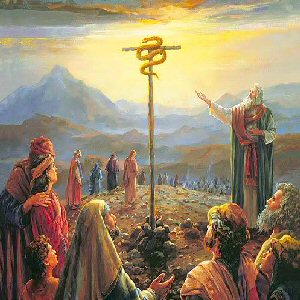
One of the most beautiful pictures of Messiah in the Torah is that of the brazen serpent lifted up in the wilderness to heal the people. We read in the Torah:


[6] And YHWH sent fiery serpents among the people, and they bit the people; and much people of Israel died.
[7] Therefore the people came to Moses, and said, We have sinned, for we have spoken against YHWH, and against thee; pray unto YHWH, that he take away the serpents from us. And Moses prayed for the people.
[8] And YHWH said unto Moses, Make you a fiery serpent, and set it upon a pole: and it shall come to pass, that every one that is bitten, when he looks upon it, shall live.
[9] And Moses made a serpent of brass, and put it upon a pole, and it came to pass, that if a serpent had bitten any man, when he beheld the serpent of brass, he lived.
(Numbers 21:6-9).


In the Wisdom of Solomon we are told that this “fiery serpent” represented a “sign of salvation (Yeshua)” the “Savior of all”: (“Yeshua is Hebrew for “salvation”)


[5] For when the horrible fierceness of beasts came upon these, and they perished with the stings of crooked serpents, your wrath endured not for ever:
[6] But they were troubled for a small season, that they might be admonished, having a sign of salvation, to put them in remembrance of the commandment of your Torah.
[7] For he that turned himself toward it was not saved by the thing that he saw, but by you, that are the Savior of all.
(Wisdom of Solomon 16:5-7)


In the Good News according to Yochanan , Messiah boldly identified himself as this “Savior” saying:


13 And no man has ascended into heaven, but He who descended from heaven– the Son of Man, who is in heaven.
14 And as Moshe raised up the serpent in the wilderness, thus the Son of Man will be raised,
15 So that everyone who believes in Him will not perish, but have eternal life.
(John 3:13-15 NHRV)


28 Yeshua said to them again: When you have lifted up the Son of Man, then you will know that I am He. And I did not do a thing of My own, but as My Father taught Me, so I speak.
(John 8:28 NHRV)


32 And when I am lifted up from the earth, I will draw all men to Me.
(John 12:32 NHRV)


Why was this serpent a type of Messiah? Because the gematria (numerical value) of the Hebrew word for “serpent” (נחש) is 358 which is also the gematria of the word “Messiah” (משיח) 358 is also the gematria for the phrase “Shiloh comes” (יבא שילה) (Gen. 49:10). This is why the Talmud says that “Shiloh” is one of the names of Messiah (b.San. 98b) and why the Targums paraphrase the word “Shiloh” as “Messiah” in in Gen. 49:10.

Donations have been low, and we need your help today or our account will go into the negative Monday night (7/8/24) and start a chain reaction of returned items and fees!

As you know we have been digging ourselves out of a budget shortfall.  As I have said to you many times, I look on this work as a co-operative one with me, and all of you combining our resources together in order to get the job done of helping to teach this great truth to all in the world who will listen. Thank you so much from the bottom of my heart for your continued support, you are the ones who make it all possible by your contributions and your prayers for our work. I truly appreciate your help in every way.

If you can make a one time donation of $500 or $1,000 dollars to support this work.


Donations can be sent by Paypal to donations@wnae.org or by Zelle or Go Fund Me

Click HERE to donate

And don’t forget to join the conversations at the NazareneSpace Social Network


Those Pagan Virgin Birth Stories Evaporate

Those Pagan Virgin Birth Stories Evaporate
By
James Scott Trimm


Anti-Missionaries, Atheists and other critics have spread far and wide a false claim that the virgin birth doctrine was borrowed from paganism.  The fact is that this claim is an outright lie.  A close examination of the alleged origins/births of the pagan gods these persons claim were “virgin births” shows that not one of these pagan gods was supposed to be the result of a virgin birth.


Horus

Horus was the son of Osiris and Isis.  Isis was impregnated by Osiris after she gathered the parts of the dismembered body of her husband Osiris and resurrected him.  In the oldest accounts of the story, she retrieved the whole body, but in later versions she could not locate his male member and so she fashioned a new member for him out of gold.  There was no indication that Isis was a virgin, and the gold member was by implication fully functional.  Horus did not have a virgin birth.


Attis

The myth of the origin of Attis begins with the daemon Agdistis.  Agdistis initially had both male and female genitalia. But the Olympian gods, fearing Agdistis, castrated the male member and cast it away. An almond-tree grew up from the male member, and when its fruit was ripe, Nana (a daughter of the river-god Sangarius), picked an almond from the tree and laid it in her bosom. It then disappeared, and she became pregnant with Attis.  There is no indication in the myth that Nana was a virgin, and her impregnation resulted from a seed which came forth from a male member, so there is no virgin birth here either.


Dionysus

Dionysus was born to the mortal woman Semele and the Greek god Zeus… but since Zeus’ wife Hera discovered that Zeus was having an affair with Semele, this is certainly not a virgin birth, but a very physical, sexual relationship between Zeus and Semele which resulted in her pregnancy.


Krishna

Krishna was also not the result of a virgin birth.  In fact Krishna was the eighth child of the union of his mother and father.  That’s right, Krishna’s mother was not only not a virgin, but she had seven sons before Krishna!


Mithra

The original story of Mithra’s origin had Mithra crawling out of a rock.  Now unless the rock was a virgin, then there is no virgin birth here either.  There was a later Roman Mithra cult, and this later version of Mitha (known as Mithras) was born thru a form of artificial insemination, when his mother bathed in water in which his father’s semen had been preserved.  Even if we take this as a virgin birth, this Mithra cult did not exist yet at the time of Yeshua’s birth.  So if this was a virgin birth, then it might have been copied from the birth of Yeshua, but it could not have been the other way around.


None of these pagan gods were alleged to be the result of a virgin birth, and thus the virgin birth of Yeshua was not simply copied from paganism.

Donations have been extremely low, we need your support more than ever. We must raise at least $600 by the end of the day today (7/8/24) or our account will go into the negative and start a chain reaction of returned items and fees. The time is short, and there is much work to be done. This is no time to pull back from the great work in front of us!

As you know we have been digging ourselves out of a budget shortfall.  As I have said to you many times, I look on this work as a co-operative one with me, and all of you combining our resources together in order to get the job done of helping to teach this great truth to all in the world who will listen. Thank you so much from the bottom of my heart for your continued support, you are the ones who make it all possible by your contributions and your prayers for our work. I truly appreciate your help in every way.

If you can make a one time donation of $500 or $1,000 dollars to support this work.


Donations can be sent by Paypal to donations@wnae.org or by Zelle or Go Fund Me.

Click HERE to donate

And don’t forget to join the conversations at the NazareneSpace Social Network

Judah in Prophecy: You Aint Seen Nothin Yet!

Judah in Prophecy: You Aint Seen Nothin Yet!
By
James Scott Trimm


The concept of the Two House message was an important message for the world and it generated a good deal of excitement, but it was not the last stage of restoration. The Two House message had to do with the grafting in of “wild branches” (Ephraimites) into the cultivated olive tree (Judah).

Now Romans 11 does discuss this stage of the restoration, but it also tells us that an even more powerful stage will involve Judah being grafted back into its own olive tree:

And if their stumbling became riches for the world, and their loss, riches to the
Goyim:how much more therefore,their fullness?
(Rom. 11:12 HRV)

For if their reprobation was reconciliation to the world, how much more therefore, their return, but life that is from among the dead?
(Rom. 11:15 HRV)

23 And those, if they do not remain in their lack of trust, also will be grafted in: for Eloah is able to graft them in again.
24 For if you, who are from the olive [tree] that was wild by your nature, were cut off and were grafted–contrary to your nature–into the good olive [tree], how much more then, those, if they be grafted in their natural olive [tree]?
(Rom. 11:23-24 HRV)

Paul says here: You think the restoration of Ephraim is great, wait until you see the restoration of Judah!

That is what the WNAE is about, not just the grafting in of Ephraim (although that is part of it) but the restoration of Judah, the restoration of the ancient sect of Nazarene Judaism!

We need your help today! We must raise at least $300 by the end of the day today (7/9/24) or our account will go into the negative and start a chain reaction of returned items and fees!

As you know we have been digging ourselves out of a budget shortfall.  As I have said to you many times, I look on this work as a co-operative one with me, and all of you combining our resources together in order to get the job done of helping to teach this great truth to all in the world who will listen. Thank you so much from the bottom of my heart for your continued support, you are the ones who make it all possible by your contributions and your prayers for our work. I truly appreciate your help in every way.

If you can make a one time donation of $500 or $1,000 dollars to support this work.


Donations can be sent by Paypal to donations@wnae.org or by Zelle or Go Fund Me!

Click HERE to donate

And don’t forget to join the conversations at the NazareneSpace Social Network

In Search of Lost Tribes: Native American Languages and Hebrew

In Search of Lost Tribes:
Native American Languages and Hebrew
By
James Scott Trimm


From the 17th thru the early 19th Centuries, it was a commonly held belief that the Native Americans were descended from the Lost Ten Tribes of Israel.  This view was held not only by many Christians (including Thomas Jefferson), but by many Jewish writers (such as Mordecai Noah) as well, but fell out of favor by the late 19th Century.

One of the many reasons that many scholars came to this conclusion was that it was quickly recognized that there was an apparent influence of Hebrew on Native American languages.  It was noted that Native American languages often followed the Hebrew pattern of making prepositions into prefixes, and that Native American languages were similarly used prefixes and suffixes in much the same was as Hebrew.

More importantly it was noted that Native American languages had many cognates to Hebrew words.  Some of these (as given by Ethan Smith in his 1825 book “View of the Hebrews”) are as follows:
(I have made some occasional improvements on the below table, especially in transliteration of some Hebrew words):

EnglishIndianHebrew or Chaldaic
JehovahYohewahYahuweh
GodAleEl
JahYahYah
ShilohShiluShiloh
HeavensChemimShamayim
FatherAbbaAv, Abba
ManIsh, IshteIsh
WomanIshtoIsha
Wife/EveAwahChavah
YouKeahKa
His WifeLianiLihene
This man (he)UwohHu
NoseNiehiriNeheri
Roof of a houseTraubana-oraDebonaour
WinterKoraKorah
CanaanCannaiCanaan
To prayPhalePhalac
NowNaNa
Hind partKeshKish
DoJennaisYannon
To blowPhaubacPhaubac
Rushing windRowahRuach
Ararat or high mountainAraratArarat

There are many other possible Hebrew linguistic influences on Indian languages.  For example the Mayan word for “real” or “true” is halach.  Could this have been derived from the Hebrew term halacha meaning “the way to go” and commonly used to refer to Jewish customs and laws.

The ancient Hebrews called false gods Baalim (“lords”) while the Mayans worshiped the jaguar as a god and their word for “jaguar” was “Balam”.

There are also connections between Hebrew and the Uto-Aztecan dialects which were spoken across the western portion on North America and down into Mexico.  My old friend and mentor the late Dr. Cyrus Gordon pointed out  that in the Native American Teletzinco Nahuatl language (a Uto-Atzecan dialect), wa means ‘and’ just as in Semitic languages (such as Hebrew and Aramaic)  (Before Columbus; Cyrus Gordon; Crown Publishers; N.Y. 1971 p. 136)

In Uto-Aztecan the plural suffix is –ima while in Hebrew the masculine plural suffix is –im.  In UA the reciprocal passive reflexive prefix is na- while in Hebrew it is ni-. 

In 1998 linguist Brian Stubbs published a revolutionary paper which demonstrated a distinct Hebrew influence on the Uto-Aztecan languages .

Stubbs points out that cognate words in Hebrew and Uto-Aztecan which share the same ambiguity are especially compelling. Among the more compelling examples cited by Stubbs is the Uto-Aztecan word yesipa meaning “sit” or “dwell” which appears related to the Hebrew root yashav (Strong’s 3427) meaning “sit” or “dwell”.  Stubbs gives many more examples to numerous to list here.  (ESOP (Epigraphic Society Occasional Papers) 23; “A Curious Element in Uto-Aztecan”; Brian Darrel Stubbs; pp. 109-140; 1998)

The following are just some of the examples given by Stubbs in his detailed analysis of the relationship:

EnglishUto-AtecanHebrew
plural suffix-ima-im
psv/rfl/rcp prefixna-ni-
Sit, DwellYasipaYashav
LightningBerokBarak
KidneyKaliKilya
Water, oceanMemet (ocean)Mayim, Mem (water)
ShoulderKotpaKatep
ShoulderSika/SikuSekem
Man, PersonOtamAdam
Prudent, WiseIskaliaHiskal
Shave, Scrape, SmoothSipaSippa
SquirrelSikkuSikkov
TwinConoCinw
BirdCipu(ri)Cippur
interrogative prefixHa-Ha-
keep locked, lock
lizard
cakwa
cakwa
cabba
cabb
ArrowHukHek

Why would Native American languages have such commonalities with Hebrew?  There is evidence that there was some transoceanic contact between ancient Hebrews and the New World (as I have shown in a previous blog).  But these linguistic connections seem to show much more than just transoceanic contact, and occur throughout North America (Smith’s examples of 1825 were largely from the Indian languages of the North East United States, while Stubb’s Uto-Aztecan examples are from the West and Southwest.) 

The question of the origins of Native Americans was one that received considerable attention in the first few centuries after Europeans re-discovered the New World.  One answer can be found in the Bible itself.  In Genesis we are told that at the scattering of mankind following the fall of the Tower of Babel that “from there, did YHWH scatter them abroad upon the face of all the earth” (Gen. 11:9) and the first century Jewish Roman historian Josephus writes of this event “There were some also who passed over the sea in ships…” (Ant. 1:5:1).  Certainly we know today that ancestors of the Native Americans crossed over the land bridge from Asia into Alaska.  But is it possible there is more to the story?

Certainly portions of the Lost Tribes migrated into Europe and even Asia, but is it possible that some portion of the Lost Ten Tribes of Israel also migrated to the New World and become a part of the ancestry of at least some Native American groups?  Could this be part if a bigger puzzle?  In a future article I will present more of the evidence that suggests that such a thing may well have occurred, and that some of the Lost Tribes did indeed migrate to the American Continents and did indeed become part of the ancestry of at least some Native American groups.

We must raise at least $500 ASAP to cover our electric bill!

As you know we have been digging ourselves out of a budget shortfall.  As I have said to you many times, I look on this work as a co-operative one with me, and all of you combining our resources together in order to get the job done of helping to teach this great truth to all in the world who will listen. Thank you so much from the bottom of my heart for your continued support, you are the ones who make it all possible by your contributions and your prayers for our work. I truly appreciate your help in every way.

If you can make a one time donation of $500 or $1,000 dollars to support this work.


Donations can be sent by paypal to donations@wnae.org.

And don’t forget to join the conversations at the NazareneSpace Social Network

Free Online Class: Thru the Book of Hebrews

Home study group in Australia going thru the Thru the Book of Galatians class, soon to being Thru the Book of Hebrews

Pictured above is a home study group in Australia which has Gone thru our Thru the Book of Romans class and our Thru the Book of Galatians class, and will soon be going line by line thru Hebrews with the Thru the Book of Hebrews class with James Trimm, complete with PDF class handouts! Check out this Free Multi part class on Hebrews! and be sure to share it with your friends! Its all part of the NEW NazareneSpace!

Click Here: For all Three Classes

We must raise at least $500 ASAP to cover our electric bill!

As you know we have been digging ourselves out of a budget shortfall.  As I have said to you many times, I look on this work as a co-operative one with me, and all of you combining our resources together in order to get the job done of helping to teach this great truth to all in the world who will listen. Thank you so much from the bottom of my heart for your continued support, you are the ones who make it all possible by your contributions and your prayers for our work. I truly appreciate your help in every way.

If you can make a one time donation of $500 or $1,000 dollars to support this work.


Donations can be sent by paypal to donations@wnae.org.

And don’t forget to join the conversations at the NazareneSpace Social Network

Do You Have to Keep Torah to be Saved? – Judaism v. Christendom

Do You Have to Keep Torah to be Saved?
Judaism v. Christendom
By
James Scott Trimm


I have often been asked, does one have to keep the Torah to be saved? Surprisingly, the answer can be fond in the Rabbinic literature. When we look at the basic emphasis of Judaism* and of Christendom, we find that there is a core difference at their very root.  This core difference is closely tied to the two inclinations within man, the Yetzer Ra (the evil inclination) and the Yetzer Tov (the good inclination).

R. Nahman b. R. Hisda expounded:
What is meant by the text, Then the Lord God
formed [va-yetzer] man? [The word va-yetzer] (Gen. 2:7)
is written with two yods, to show that God created
two inclinations, one good (tov) and the other evil (ra).
(b.Ber. 61a)

It has been taught: R. Jose the Galilean says,
The righteous are swayed by their good inclination,
as it says, My heart is slain within me. (Ps. 109:22)
The wicked are swayed by their evil inclination,
as it says, Transgression speaks to the wicked,
methinks, there is no fear of God before his eyes.
(Ps. 36:1) Average people are swayed by both
inclinations, as it says, Because He stands at
the right hand of the needy, to save him from them
that judge his soul. (Ps. 109:31) Raba said: People
such as we are of the average.
(b.Ber. 61b)

Likewise we read in the Wisdom of Ben Sira:

It was He who created man in the beginning.
And He left him in the power of his own inclination (Heb: yetzer).
If you will, you can keep the commandments,
and to act faithfully is a matter of your own choice.
He has placed before you fire and water:
Stretch out your hand for whichever you wish.
 (Sira 15:14-16)

Paul writes of the two inclinations as well saying:

14 For we know that the Torah is of the spirit,
but I am of the flesh and I am sold to sin.
22 For I rejoice in the Torah of Eloah in the inward son of man.
(Romans 7:14, 22 HRV)

Because of this, we are not weary, for even if our
outer man is corrupted, yet that which [is] inside
is renewed day by day.
(2Cor. 4:16 HRV)

for the flesh desires a thing which is opposed to
the Spirit and the Spirit desires a thing that is
opposed to the flesh and the two of these are
opposed to each other, that you do not do the thing
which you desire.
(Gal. 5:17 HRV)

And as we read in Tanya:

Just as two kings wage war over a town,
which each wishes to capture and rule,
that is to say, to dominate its inhabitants according to his will,
so that they obey him in all that he decrees for them,
so do the two souls— the Divine and the vitalizing animal soul…
wage war against each other over the body and all its limbs.
(Tanya Chapter 9)


Now through our intellect, we receive the Wisdom of the Torah, and having heard the Wisdom of Torah we subject it to Understanding.  When Wisdom (chochmah) is subjected to Understanding (binah) the result is Knowledge (da’at)… it is Knowledge that brings Wisdom and Understanding together.  When we receive as Wisdom a precept of Torah, and that precept like a seed enters into Understanding then that precept becomes part of us as our Knowledge.  As we read in the Tanya:

Specifically: the faculties of ChaBaD in his soul are clothed in the comprehension of the Torah, which he comprehends in Pardes, to the extent of his mental capacity and the supernal root of his soul.
(Tanya Chapter 4)

Now, when an intellect conceives and comprehends a concept with its intellectual faculties, this intellect grasps the concept and encompasses it. This concept is [in turn] grasped, enveloped and enclothed within that intellect which conceived and comprehended it.

The mind, for its part, is also clothed in the concept at the time it comprehends and grasps it with the intellect. For example, when a person understands and comprehends, fully and clearly, any halachah (law) in the Mishnah or Gemara, his intellect grasps and encompasses it and, at the same time, is clothed in it.
(Tanya Chapter 5)

And after a bit more we read:

Since, in the case of knowledge of the Torah, the Torah is clothed in the soul and intellect of a person, and is absorbed in them, it is called “bread” and “food” of the soul. For just as physical bread nourishes the body as it is absorbed internally, in his very inner self, where it is transformed into blood and flesh of his flesh, whereby he lives and exists— so, too, it is with the knowledge of the Torah and its comprehension by the soul of the person who studies it well, with a concentration of his intellect, until the Torah is absorbed by his intellect and is united with it and they become one. This becomes nourishment for the soul, and its inner life from the Giver of life, the blessed En Sof, Who is clothed in His wisdom and in His Torah that are absorbed in it [the soul].

This is the meaning of the verse, “Yea, Thy Torah is within my inward parts.”

It is also stated in Etz Chayim, Portal 44, ch. 3, that the “garments” of the soul in the Can Eden (Paradise) are the commandments while the Torah is the “food” for the souls which, during life on earth, had occupied themselves in the study of the Torah for its own sake. It is [similarly] written in the Zohar. As for the meaning of “For its own sake,” it is [study with the intent] to attach one’s soul to G-d through the comprehension of the Torah, each one according to his intellect, as explained in Peri Etz Chayim.
(Tanya Likutei Amarim 5)


And as we read in the Zohar:


Rabbi El’azar said, “Whoever engages in Torah for her own sake,
does not die by means of the Yetzer Ra (Evil Inclination),
since he grasps the Tree of Life, never letting go.”
(Zohar 1:168a)

This is the key.  The basis of true Judaism is studying and observing Torah “for its own sake” as we read in the Mishna:

Antigones of Soko received [Torah] from Simeon the Righteous. He used to say, “Be not like servants who serve their master for the sake of wages, but be like servants who serve their master with no thought of a wage – and let the fear of Heaven be upon you.”
(m.Avot 1:3)

The main basis of true Judaism is to study and observe Torah “for its own sake” out of the love and awe for Elohim that naturally results and unites us with Elohim.  This does not mean that there is no reward, or that there is no afterlife, but it means that we are not motivated by that reward.  So if we do not observe Torah as one wishing to earn something, what is our motive? The Torah answers this question:

…you shall diligently keep all of these commandments
which I command you, to do them, to love YHWH your Elohim,
to walk in all his ways, and to cleave unto him.
(Deut. 11:22)

You shall walk after YHWH your Elohim,
and fear him, and keep his commandments,
and obey his voice, and you shall serve him,
and cleave unto him.
(Deut. 13:5 (13:4))

We must observe Torah as one cleaving to YHWH. The Hebrew word for “cleaving” is DEVEKUT (DEVEKUS in Ashkenazi). When we observe Torah it should not be an empty act, but an act of DEVEKUT, of cleaving or communion to YHWH.

The motive of Devekus is a pure motive, “for its own sake” and this is true Judaism. nThis was the core teaching of Pharisee-ism, especially that of the House of Hillel as opposed to the House of Shammai.  One of the first disputes recorded in the Talmud, is a dispute between the House of Hillel and the House of Shammai, over the recitation of the Shema:

The House of Shammai says: In the evening one should recline in order to recite the shema, and in the morning they should stand. As it is written “when you lie down and when you rise up.” (Deuteronomy 6:7)
But the House of Hillel says: Everyone may recite the Shema in his own way, as it is written: “And you shall go by the way” (Deuteronomy 7:7)
(m.Berachot 1:3)


The House of Shammai required that the Shema be recited in the evening while reclining.  However the House of Hillel was not concerned with whether one was laying down, or standing up, but with the intent of their heart.  Likewise the Talmud teaches that in making offerings, it is not the size of the offering that is important, but that one directs one’s intention to Elohim:


“…all are the same, the one who offers much and the one who offers little, on condition that a man will direct his intention to Heaven.”
(m.Menachot 13:11)


Christendom has a very different guiding motive.  When I speak to Christians about Torah observance, their first question is “Do I have to do those things to be saved?”  And if they are told that they do not have to do those things to be saved, then they are totally disinterested in them.  In short, Christendom tends to be primarily interested in what they do or not have to do to obtain a reward.  This is the complete opposite of Judaism.

This agrees well with what we read in the Talmud:

Rabban Johanan b. Zakkai said to his disciples: My sons, what is the meaning of the verse, Righteousness exalteth a nation, but the kindness of the peoples is sin? (Prov. 14:34) R. Eliezer answered and said: ‘Righteousness exalteth a nation:’ this refers to Israel of whom it is written, Who is like thy people Israel one nation in the earth? (2Sam 7:23) But ‘the kindness of the peoples is sin’: all the charity and kindness done by the heathen is counted to them as sin, because they only do it to magnify themselves”
(b.Babba Batra 10b)

The Talmud (based on Proverbs) is telling us that even when the goyim do good things, it is always with a selfish motive, and thus it originates from the Yetzer Ra, not the Yetzer Tov.  Can “good” originate from the Yerzer Ra?  The Midrash Rabbah has an interesting insight on this:


Nachman said, In the name of Rabbi Shmu’el: “and behold it was very good” (Gen. 1:31) refers to the YETZER RA’. But can the YETZER RA’ be “very good”? Amazingly enough, yes– were it not for the YETZER RA’ no man would build a house, take a wife and father children, or engage in buisness; as Solomon said, “I considered all labor and excellence in work and concluded that it comes from a man’s rivalry with his neighbor” (Eccl. 4:4).
(Gen. Rabbah 9:7)


And the Zohar says that had had it not been for the Yerzer Ra and Adam’s fall, Adam and Havah would never have populated the world:


For indeed, if Adam had brought offspring with him out of the Garden of Eden, these would never have been destroyed, … and all would have lived for ever; and not even the angels would have equalled them in illumination and wisdom, as we read, “In the image of God he created him” (Gen. 1:27). But since, through his sin, he left the Garden by himself and bore offspring outside it, these did not endure in the world, and this ideal was, therefore, not realised.’ Said R. Hizkiah: ‘How could they have begotten children there, seeing that, had the evil inclination [YETZER RA] not enticed him to sin, Adam would have dwelt for ever in the world by himself and would not have begotten children?
(Zohar 1:60a-61a)


So is it with Christendom, the goyim may at times do good deeds, their primary focus is on “being saved” which in their vocabulary is synonymous with having a reward in the afterlife.  The primary focus on Christendom is a selfish motive, rooted in the Yetzer Ra, while the primary focus of true [Nazarene] Judaism is to cleave to YHWH through studying and observing Torah “for its own sake” and is rooted in the Yetzer Tov.


( * Though out this article I refer to “Judaism” and “true Judaism”- be aware that I see Nazarene Judaism as “true Judaism” – The Nazarenes being the original Jewish followers of Yeshua ), 

Donations have been extremely low this month, our rent is due tomorrow and we do not have it. In these uncertain times, we need your support more than ever. The time is short, and there is much work to be done. This is no time to pull back from the great work in front of us!

As you know we have been digging ourselves out of a budget shortfall.  As I have said to you many times, I look on this work as a co-operative one with me, and all of you combining our resources together in order to get the job done of helping to teach this great truth to all in the world who will listen. Thank you so much from the bottom of my heart for your continued support, you are the ones who make it all possible by your contributions and your prayers for our work. I truly appreciate your help in every way.

If you can make a one time donation of $500 or $1,000 dollars to support this work.


Donations can be sent by Paypal to donations@wnae.org

Or click HERE to donate

And don’t forget to join the conversations at the NazareneSpace

Yeshua on the Murders of Abel and Zechariah

Yeshua on the Murders of Abel and Zechariah
By
James Scott Trimm


Yeshua said:

34 Therefore I tell you, Behold, I send to you, prophets and the wise men, and the scribes. And some of them you will kill and crucify, and some of them will you scourge with whips in your synagogues, and persecute from city to city.
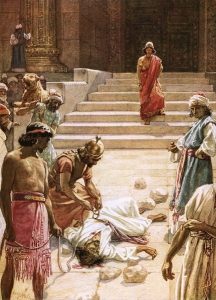
35 That upon you may come, all the righteous blood, which has been shed upon the earth: from Hevel the righteous, to Z’kharyah Ben Berekhyah, whom you slew between the Temple and the altar!
(Matthew 23:34-35 HRV)

Yeshua here is speaking of the first murder to be recorded near the beginning of the Tanak (Gen. 4:8-15) and a murder recorded near the end of the Tanak (2Chron. 24:20-21).  This, of course, justifies the original manuscript order of the books, as they are still ordered in Jewish editions.

I should mention that extant text of Matt. 23:35 reads “Z’kharyah Ben Berekhyah” (Zechariah ben Berechiah).  This, however, seems to be a scribal error.  A scribe seems to have confused “Zechariah ben Jehoidai”(2Chron. 24:20-21) with “Zechariah ben Berechiah” (Zech. 1:1).  The “Church Father” Jerome records that the Gospel used by the original Jewish followers of Yeshua (known as “Nazarenes”) (i.e. the Gospel according to the Hebrews. I have shown elsewhere that our Gospel of Matthew is an abridgement of that longer Gospel).  According to Jerome the original Hebrew text used by the ancient Nazarenes read correctly with “Zechariah ben Jehoidai”.  (The parallel in Luke 11:51 has only “Zechariah”) Jerome writes:

In the Gospel which the Nazarenes use, instead of “son of Barachias” we have found written “son of Joiada.”
(Jerome; Commentary on Matthew 23:35)

There is something else very important which connects these two murders, at least in Jewish tradition.

The first is a tradition recorded in the Mishnah concerning the murder of Havel (Able) that understands the plural word “bloods” crying out from the ground in Gen. 4:10 to signify that whoever kills one person is guilty of killing everyone:

…it is said , “The bloods of your brother cry” (Gen. 4:10) It does not say, “The blood of your brother,” but. “The bloods of your brother”—his blood and the blood of all those who were destined to be born from him.  Another matter—the bloods of your brother— for his blood was splattered on trees and stones…. whoever destroys a single Israelite soul is deemed by Scripture as if he had destroyed the whole world and whoever saves a single Israelite soul by Scripture as if he had saved the whole world…
(m.San. 4:5)

Both Talmuds records a similar tradition surrounding the murder of “Zechariah ben Jehoidai”(2Chron. 24:20-21).  This tradition parallels the tradition concerning Abel above.  In this tradition Zechariah’s blood also cries out for vengeance but ceases its cry lest all Israel be destroyed.  The Babylonian Talmud records the story this way:

Nebuzaradan, [After that] he saw the blood of Zechariah seething. ‘What is this?’ cried he. ‘It is the blood of sacrifices, which has been spilled,’ they answered. ‘Then,’ said he, ‘bring [some animal blood] and I will compare them, to see  whether they are alike.’ So he slaughtered animals and  compared them, but they were dissimilar. ‘Disclose [the secret] to me, or if not, I will tear your flesh with iron combs,’ he  threatened.  They replied: ‘This is [the blood of] a priest and a  prophet, who foretold the destruction of Jerusalem to the  Israelites, and they killed him.’ ‘I,’ said he, ‘will appease him.’  So he brought the scholars and slew them over him,  yet it did not cease [to boil]. He brought schoolchildren  and slew them over him, still it did not rest; he brought the  young priests and slew them over him, and still it did not rest, until he had slain ninety four thousand, and still it did not rest.  Whereupon he approached him and cried out, ‘Zechariah, Zechariah, I have destroyed the flower of them: dost thou desire me to massacre them all?’ Straightway it rested.  Thoughts of repentance came into his mind: if they, who killed  one person only, have been so [severely punished], what will be my fate?  So he fled, sent his testament to his house, and became a proselyte.
(b.San 96b)

The Jerusalem Talmud give a more detailed account:

Rabbi Jochanan said, Eighty thousand priests were slain for the blood of Zachariah.   Rabbi Judas asked Rabbi Achan, Where did they kill Zachariah?  Was it in the woman’s court, or in the court of Israel?  He answered:  Neither in the court of Israel, nor in the  court of women, but in the court of the priests; and they did not treat his blood in the same manner as they were wont to treat the blood of a ram or a young goat.  For of these it is written, He shall pour out his blood, and cover it with dust.  But it is written here, The blood is in the midst of her:  she set it upon the top of the rock; she poured it not upon the ground.  (Ezek. xxiv. 7.)  But why was this? That it might cause fury to come up to take vengeance: I have set his blood upon the top of a rock, that it should not be covered.  They committed seven evils that day: they murdered a priest, a prophet, and a king; they shed the blood of the innocent: they polluted the court: that day was the Sabbath : and the day of expiation. When therefore Nebuzaradan came there (viz.  Jerusalem), he saw his blood bubbling, and said to them, What meaneth this?  They answered, It is the blood of calves, lambs, and rams, which we have offered upon the altar.  He commanded them, that they should bring calves, and lambs, and rams, and said I will try whether this be their blood: accordingly they brought and slew them, but the blood of (Zachariah) still bubbled, but the blood of these did not bubble.  Then he said, Declare to me the truth of the matter, or else I will comb your flesh with iron combs.  Then said they to him, He was a priest, prophet, and judge, who prophesied to Israel all these calamities which we have suffered from you; but we arose against him, and slew him. Then, said he, I will appease him: then he took the rabbis and slew them upon his (viz. Zachariah’s) blood, and he was not yet appeased.  Next he took the young boys from the schools, and slew them upon his blood, and yet it bubbled.  Then he brought the young priests and slew them in the same place, and yet it still bubbled. So he slew at length ninety-four thousand persons upon his blood, and it did not as yet cease bubbling.  Then he drew near to it and said, O Zachariah, Zachariah, thou hast occasioned the death of the chief of thy countrymen; shall I slay them all? Then the blood ceased, and did bubble no more.
(j.Ta’anit 69)

Yeshua tied these two murders together for two reasons.  First, in the original manuscript order of the books, these two murders are like bookends on each end of the Tanak, implying the totality of Scripture and the true and correct ordering of the books of the Tanak.

It is no coincidence that these two murders are also connected by traditions that connect each to blood crying out for vengeance, and the potential murder of all Israelites.  Yeshua clearly had these traditions in mine when he formulated his statement.  In fact Yeshua specifies the location of Zechariah’s murder more specifically that the written Tanak does.  The Tanak says only that the murder occurred “in the court of the House of YHWH”.  However the tradition recorded in the Talmud is more specific:

Rabbi Judas asked Rabbi Achan, Where did they kill Zachariah?  Was it in the woman’s court, or in the court of Israel?  He answered:  Neither in the court of Israel, nor in the court of women, but in the court of the priests
(j.Ta’anit 69)

While the Tanak places the murder simply “in the court of the House of YHWH”, Yeshua places it more specifically in the Court of Priests located “between the Temple and the alter” just as the Talmud proclaims it.  Yeshua’s source here was certainly the tradition also recorded in the Talmud.

We have another example of how a knowledge of Second Temple Era Judaism and especially the Talmud, can shed light on our understanding of the “New Testament” and the words of Yeshua.
By better understanding Torah and by better understanding the customs and practices of second Temple Era Judaism, we can better understand the Scriptures.

The Rent is due in just five days and we do not have it!

As you know we have been digging ourselves out of a budget shortfall.  As I have said to you many times, I look on this work as a co-operative one with me, and all of you combining our resources together in order to get the job done of helping to teach this great truth to all in the world who will listen. Thank you so much from the bottom of my heart for your continued support, you are the ones who make it all possible by your contributions and your prayers for our work. I truly appreciate your help in every way.

If you can make a one time donation of $500 or $1,000 dollars to support this work.


Donations can be sent by Paypal to donations@wnae.org or by Zelle or Go Fund Me

Or click HERE to donate

Should a Man Wear a Kippah?

Should a Man Wear a Kippah?
By
James Scott Trimm

How are we to understand Paul’s statement: “For a man ought not to veil his head” (1Cor. 11:7) does this refer to the wearing of the kippah?

Absolutely not! The Aramaic word here is K’SA and refers to that which hides or veils. We are to understand that a man is not to wear a woman’s veil, as it is written:

A woman shall not wear that which pertains unto a man, neither shall a man put on a woman’s garment: for whosoever does these things is an abomination unto YHWH your Elohim.
(Deut. 22:5 HRV)

This cannot refer to the wearing of a kippah, which does not veil the head since the High Priest and Priest were commanded in the Torah to wear head coverings:

And these are the garments which they shall make: a breastplate, and an ephod, and a robe, and a tunic of checker work, a mitre, and a girdle. And they shall make Set-Apart garments for Aharon your brother, and his sons, that he may minister unto Me in the cohen’s office.
(Ex. 28:4)

And for Aharon’s sons, you shall make tunics, and you shall make for them
girdles,and headtires shall you make for them, for splendour and for beauty.
(Ex. 28:40)

Torah does to prohibit the wearing of a kippah, and Paul had no authority to add to the Torah.

Concerning the apostasy the Ancient Nazarene writer Hegesippus (c. 180 CE) writes that the apostate group had bare heads:

Up to that period (98 CE) the Assembly had remained like a virgin pure and
uncorrupted: for, if there were any persons who were disposed to tamper with the wholesome rule of the preaching of salvation, they still lurked in some dark place of concealment or other. But, when the sacred band of Emissaries had in various ways closed their lives, and that generation of men to whom it had been vouchsafed to listen to the Godlike Wisdom with their own ears had passed away, then did the confederacy of godless error take its rise through the treachery of false teachers, who, seeing that none of the emissaries any longer survived, at length attempted with bare and uplifted head to oppose the preaching of the truth by preaching “knowledge falsely so called.”
(Hegesippus the Nazarene; c. 185 CE Eusebius; Eccl. Hist.3:32)

Moreover in the Shem Tob Hebrew Text of Matthew we read that HaSatan tempted the Messiah to bare his head saying:

And HaSatan took him to an exceedingly high mountain and showed him all the kingdoms of the earth and their glory and said to Him, `All these things I will give to you if you bare your head to me.
(Matt. 4:8-9 Shem Tob text)

It certainly seems that the Nazarene custom for a man to wear a kippah (head covering).

The Talmud records that the wearing of a kippah was a custom of humility:

Rabbi Isaac said: He who transgresses in secret is as though he pressed the feet of the Shechinah for it is written: Thus says the Lord, The heaven is my throne, and the earth is my footstool. R. Joshua b. Levi said: One may not walk four cubits with haughty mien, for it is said, the whole earth is full of His glory. Rabbi Huna son of R. Joshua would not walk four cubits bareheaded, saying: The Shechinah is above my head.
(b.Kiddushin 31a)

Rabbi Nahman ben Isaac’s mother was told by astrologers, Your son will be a thief. [So] she did not let him [be] bareheaded, saying to him, `Cover your
head so that the fear of heaven may be upon you, and pray [for mercy]’. Now, he did not know why she spoke that to him. One day he was sitting and studying under a palm tree; temptation overcame him, he climbed up and bit off a cluster of dates with his teeth.
(b.Shabbat 156b)

While the Torah certainly does not require a man to wear a kippah, it also does not prohibit wearing a kippah, and there is some evidence that it was the custom of the original followers of Yeshua (and perhaps Yeshua himself) to wear a kippah as a sign of humility.

As you know we have been digging ourselves out of a budget shortfall.  As I have said to you many times, I look on this work as a co-operative one with me, and all of you combining our resources together in order to get the job done of helping to teach this great truth to all in the world who will listen. Thank you so much from the bottom of my heart for your continued support, you are the ones who make it all possible by your contributions and your prayers for our work. I truly appreciate your help in every way.

If you can make a one time donation of $500 or $1,000 dollars to support this work.


Donations can be sent by paypal to donations@wnae.org.

And don’t forget to join the conversations at the NazareneSpace

Did the Law and the Prophets Only Prophecy Until John?

Did the Law and the Prophets Only Prophecy Until John?
By
James Scott Trimm

We have often said that the Hebrew and Aramaic Origin of the “New Testament” is very important because there are many passages that do not make sense until we look at them in the original Hebrew and Aramaic.  A very good example of this is to be found in Matthew 11:13 where we read in the King James Version:

For all the prophets and the law prophesied until John.
(Matt. 11:13 KJV)

Many have found this passage difficult to understand. Some Antinomians have quoted it to claim that the “law was until John”.  However this does not even fit their theology, since John died before Yeshua’s death.  Others have taken it to mean that all prophecy was fulfilled before John.  This argument is made by Cambelites.  However many prophecies of the last days have not yet been fulfilled.  Finally many have taken it to mean that prophecy ended with Yochanan.  However this argument also fails because there were prophets long after his death (see for example Acts 13:1).

The solution to this difficult verse may be found by looking at the Hebrew of Matthew and comparing the Shem Tob Hebrew version with the DuTillet/Munster Hebrew version.  In this particular text, it appears the Shem Tob text may preserve the original reading.  The Shem Tob Hebrew version of Mathew tells us that the Torah and the Prophets prophecied על “concerning” Yochanan which seems to have become misread as עד “until” Yochanan as we see it in the DuTillet and Munster Text.  “Concerning” (על) Yochanan (as it reads in the Shem Tob Hebrew text) is easily misread as עד (until) (as it appears in the DuTillet and Munster Hebrew texts) (This is one of the few passages in which Shem Tob appears to preserve a more original reading than DuTillet).  The reading “concerning John” seems to fit the text better because in verse 11:10 Matthew has just quoted Malachi 3:1 and applied the text to Yochanan.  And earlier in Mt. 3:3 Matthew had quoted Is. 40:3 as pertaining to Yochanan.

Emergency Alert!

Donations have been extremely low this month. Our rent is due in just three days and we do not have it. In these uncertain times, we need your support more than ever. The time is short, and there is much work to be done. This is no time to pull back from the great work in front of us!

As you know we have been digging ourselves out of a budget shortfall.  As I have said to you many times, I look on this work as a co-operative one with me, and all of you combining our resources together in order to get the job done of helping to teach this great truth to all in the world who will listen. Thank you so much from the bottom of my heart for your continued support, you are the ones who make it all possible by your contributions and your prayers for our work. I truly appreciate your help in every way.

If you can make a one time donation of $500 or $1,000 dollars to support this work.


Donations can be sent by Paypal to donations@wnae.org

Or click HERE to donate

And don’t forget to join the conversations at the NazareneSpace Social Network
In Defense of Talmudic Law – “Traditional Messianic Judaism”

While digging through my old papers I ran across this article written way back in 1981 by a Messianic Jew named Andrew P. Pilant. At the time Pilant was advocating something he called “Traditional Messianic Judaism” which was getting little attention from the mainline of the movement. Although I never met Pilant, when I came into the Messianic movement from Rabbinic Judaism around 1984 I found myself influenced by this paper. I do not agree with everything said in it, but I think it is worthy of posting here some 40 years later:

In Defense of Talmudic Law
By Andrew P. Pilant
1981

“If we we’re going to be Jewish, we have to be honest about it. . .
Jewishness is something that was more than laying teffilin,
more than just singing Jewish songs. It is thinking Jewish,
it is smelling Jewish, it was taking Judaism
and putting it out to the ends of your fingertips —
so that everything that you come in contact with
would have a Jewish touch to it.”
– Andrew P. Pilant


This paper is concerned with the facet of Rabbinic study that is involved with the defense of Talmudic Law, as being a natural and integral part of Rabbinics, it must be pointed out, rests on five very important principles, as elucidated by scholars such as Z. H. Chajes:

A. That the Written, and especially parts of the Oral Law, were not the result of a historical process, but of a single divine revelation;

B. The principle that two ‘Laws’ are organically related;

C. The principle that the progressive and historical development of Jewish Law is limited exclusively to the laws of non-Pentateuchal statutes (i.e. the decrees of the Sanhedrin);

D. The principle that the Talmudic Rabbis claimed for their own teaching the finality which later authorities ascribe to them;

E. The Principle that the Torah gave to the Rabbis of the Talmudic era (500 B.C.E.-200 C.E.) Divine sanction for their legislation, and that such legislation could not be abrogated at will.

In defense of these principles, one should, because of the very nature of the subject, be able to use the rules of logic and scientific reasoning. One should assume these aspects to be true, logically testing their fundamental components and inferred derivations.

The Torah is divided into two parts, the written and unwritten (Oral) Law. The former is the written text of Scripture, the Torah, which was divinely revealed to Moses at Sinai. The later consists of expositions and interpretations. In order to understand the relationship between the Oral and Written Law, it is necessary to understand their goal. The goal of the Oral Tradition and its teachings is to get one to integrate the written Law into one’s own being. The most important tools to allow one to arrive at this goal are the many and varied Mitzvot. Mitzvot are deeds reflecting the correct interpretation of Scripture, i.e. the Oral Tradition.

The whole emphasis of Mitzvot (for example laying tefillin, not driving a car on Sabbath, not eating pork) is not in the actions that an individual must go through to perform the deed. Rather, the importance of Mitzvot lies in the inward quality the actions stimulate. A Mitzvah is not a Mitzvah because of the physical actions an individual performs, but because it stimulates in the individual an understanding of Scripture. Thus, the thoughts and intents of the heart are the more important aspect of Mitzvot. In the final analysis, the Lord is concerned with intent rather than action. This is not to say that the actions do not play a role, but should be a natural by-product of the intent. For example, two individuals can go through exactly the same actions, and it will be a Mitzvah for one and not for the other. The difference would be one of “intent.” If one understood Elohim’s Law the way He designed it to be understood, one would not be performing it as a list of instructions but would perform it as a natural result of his understanding of the world. In fact, it would never occur to him to do anything else.

Adam, being created perfect, understood the world correctly, and so he performed Mitzvot simply because he had no reason to think otherwise. By the time of Noah, however, this understanding of the world had suffered aberration to the extent that Noah was given commandments to not drink blood, not fornicate, etc. Noah’s understanding coupled with the commandments brought him up to Adam’s former level. Without the commandments, Noah may have deviated from the natural course of things and drank blood. Thus, the Lord gave him this commandment. This is also true of Enoch, and Abraham, where the Lord gave them insight to correct any misunderstandings they may have had about how the world has supposed to work.

The Lord sought to call a people to Himself. Through Moses, the Children of Israel were called to Sinai and were given the Torah along with the correct understanding of how it was to be applied in every circumstance… not the details of every situation but the mechanisms to derive the correct interpretation. For this generation, the Law and their understanding of it brought them to the level that Adam had been in Eden. This provided the Israelites with a level of understanding higher than any other nation of that generation. This is obvious, for when Moses was given the Ten Commandments he was not given two tablets of stone and left to figure them out. He understood each Commandment and its ramifications to the utmost extent.

In the course of Israel’s history, fine points of this Law and its understanding were forgotten. The Lord sent Judges who were experts in dealing with “fine points” for this generation. The Judges expertise, combined with the people’s remembrance of the revelation at Sinai and with the written Torah, was sufficient. The bulk of Scriptures written a this time dealt with these judges. Later generations not only forgot points of the Law, but began to misinterpret and misapply them. Thus, the Lord sent the Prophets to inject correct understanding where the people had erred in their interpretation of Scripture.

Even before the birth of Messiah, the generations had deviated to such an extent from their Father’s teaching that the rabbis sought to record the “understanding” before it was forgotten all together. This attempt is seen in the Talmud. Rules and methods were discovered at this time that enabled them to write down what had previously been only mental thoughts. They sought to crystallize the Oral Tradition by giving many examples. Through the understanding of these examples and the techniques of the rabbis one should be able to reconstruct the understanding the Children of Israel had at Sinai. To one who is not aware of the methods and direction of the rabbis, the Talmud appears as a mass of confused examples and legalistic rituals. However, to those who desire to integrate the teachings of the rabbis in the fashion in which they were intended, it will stimulate within them an attitude both proper and coherent with the universe that the Lord created. The Messiah understood this perfectly. He understood the balance between the understanding that was to be integrated and the importance of the tools to accomplish this goal. Some rabbis of His day did not “understand” this balance. They emphasized the physical aspect of the Mitzvot sometimes to the exclusion of the Mitzvot’s purpose. Thus the Messiah saw that they were so wrapped up in the tool that they lost sight of the purpose of the tool. This was the only point of contention between the Messiah and the rabbinical leaders of His day. Thus, in Matthew 23:23 He declares to the Jewish leaders, “For you tithe mint and dill and cumin, and have neglected the weightier provisions of the law; justice and mercy and faithfulness; but these are the things you should have done without neglecting the others.”

In the Middle Ages, a large quantity of time was spent studying and transmitting the teachings of the sages of the Second Temple Era. For these generations, the rabbi’s teaching combined with all that had gone before them was sufficient to give them a proper understanding of how the world should be. After years had passed, people began once again to lose sight of the purpose and direction of Mitzvot. Groups such as the Hasidim sought to correct this imbalance. For this generation, their teaching gave the people a correct understanding of Scripture, when combined with what they knew already.

With this background, some questions can be asked. Is the Talmud inspired? This is an awkward question to ask. The Torah is inspired in its entirety. The Oral Tradition is the Torah’s integration into one’s person, and thus is in a sense inspired because it is a reflection of the Torah. The Talmud is a logical exploration of the Oral Tradition and should be logically correct. It is important and authoritative but it functions as a tool. The Talmud is only a tool when it is used correctly, otherwise it could be a dangerous thing. Fortunately, because of its size, people do not study it unless they have a good reason.

Another question that could be addressed is whether or not the Talmud is a product of progressive revelation. This is absolutely not true! The Talmud is simply a crystallization, a reflection of the Oral Tradition. Our ability to understand the Oral Tradition in this present day has decreased to the extent that we need a portion of the Oral Tradition written down in order to understand it. The Lord has continually spoken to his people throughout the ages, but only to raise them back up to a certain level.

A third question is whether or not the Talmud is fixed and unbending. Yes and no. The Talmud reflects the perfect attitude that a person should attain, but unfortunately human beings are not perfect. Therefore the emphasis should be shifted from the Talmud to the Oral Tradition itself, which is constant for all people. It is possible that it may manifest itself with different emphases through various people’s understanding of it. A traditional Jew will make the assumption that the Talmud scholars knew enough about people that their descriptions of how Oral Tradition should manifest itself are consistent for people of all times and places. If too much emphasis is placed on the physical aspect of Mitzvot, one could totally miss the purpose for which the Mitzvot were given. For example, when a Jew dies it is a Mitzvah that he be buried in a plain pine box so that all Jews will have equal expenses in their burials. In Los Angeles, it is actually more expensive and a symbol of wealth if one can import a pine box from New York to Los Angeles. This totally negates what the rabbis were trying to say, and because the rabbis’ advice was misapplied, the Mitzvah did not achieve its purpose. It did not increase their understanding of Scripture.

Talmudic Law is a natural and integral part of the divinely revealed written Law. Each generation has lost a portion of its understanding of how the Lord wants the word to work. Each generating has been given teaching to bring them back to this level. The Mitzvot are one tool used to achieve this goal, but only if understood correctly. For any Jew and anyone who has an understanding of the Oral Tradition, the Mitzvot can increase this understanding in a very beautiful way.

Andrew P. Pilant, 1981

We need your help today, our rent is due in two days and donations this month have been very low!

As you know we have been digging ourselves out of a budget shortfall.  As I have said to you many times, I look on this work as a co-operative one with me, and all of you combining our resources together in order to get the job done of helping to teach this great truth to all in the world who will listen. Thank you so much from the bottom of my heart for your continued support, you are the ones who make it all possible by your contributions and your prayers for our work. I truly appreciate your help in every way.

If you can make a one time donation of $500 or $1,000 dollars to support this work.


Donations can be sent by Paypal to donations@wnae.org

Or click HERE to donate

And don’t forget to join the conversations at the NazareneSpace Social Network