The Queen of Meroë and the Gospel According to the Hebrews

Revealing the Lost Roots of the Original Hebrew Gospel

Shalom chaverim,

I want to share with you a remarkable insight that has emerged from our ongoing project to reconstruct the lost Gospel according to the Hebrews — the original Gospel cherished by the earliest followers of Yeshua, the Netzerim (Nazarenes). This Gospel was in Hebrew and read by the emissaries themselves, including Matthew and James, and it is the true source behind our synoptic Gospels, later abridged into what we now call the Gospel of Matthew.

One particular verse — Matthew 12:42 — offers a perfect example of how restoring the Hebrew text sheds new light on the meaning and context of Yeshua’s words.


📜 The Mystery of the Queen of the South

In the familiar verse, Yeshua says:

“The queen of the South shall rise up in the judgment with this generation and shall condemn it, for she came from the ends of the earth to hear the wisdom of Solomon.”
— Matthew 12:42 (cf. Luke 11:31)

In Greek and English, this “queen of the South” is commonly identified with the Queen of Sheba, who visited King Solomon in 1 Kings 10. But early sources reveal something deeper — something that may have been preserved in the original Hebrew Gospel.


🏺 A Lost Name Recovered

According to several medieval commentaries, the Gospel according to the Hebrews included the name of the queen — and it wasn’t “Sheba.” It was Meroe.

This puzzled scholars for centuries. But in the course of our research, we’ve discovered that this is not a mistake — it’s a relic of the original Hebrew Gospel.

In our reconstruction of GH 12:43 (the verse numbering in the restored Hebrew Gospel), we read:

מ״ג מַלְכַּת מְרֹאָה תָּקוּם בַּמִּשְׁפָּט עִם זֶה הַדּוֹר וְתַרְשִׁיעֶנּוּ כִּי־בָאָה מִקְצֵה הָאָרֶץ לִשְׁמוֹעַ אֶת חָכְמַת שְׁלֹמֹה וְהִנֵּה יוֹתֵר מִשְּׁלֹמֹה פֹה

“The Queen of Meroë shall rise in the judgment with this generation and shall condemn it, for she came from the ends of the earth to hear the wisdom of Solomon — and behold, one greater than Solomon is here.”


📖 Who Was the Queen of Meroë?

Ancient sources help us understand who this queen really was:

  • Josephus says the Queen of Sheba was the queen of Egypt and Ethiopia, and that the capital of Ethiopia was formerly called Seba but was renamed Meroë by Cambyses of Persia.
  • The Book of Acts mentions Candace, a dynastic title for queens of Meroë, showing the region’s ongoing royal lineage.
  • The Kebra Nagast, Ethiopia’s national epic, calls her Makeda, queen of Cush, and says she bore Solomon a son — Menelik I, father of the Ethiopian dynasty.
  • The Talmud, Targum Sheni, and Midrash ha-Hefez all preserve fascinating riddles and mystical interactions between Solomon and the queen, affirming her spiritual insight and royal authority.

All these traditions point to a single region: Meroë — the capital of the Kingdom of Kush, in modern-day Sudan, between the Blue and White Nile.


🔍 Why the Confusion?

In Hebrew, the phrase מַלְכַּת מְרֹאָה (Malkat Meroe) can mean either:

  • The Queen of Meroë,”
    or
  • Queen Meroe” (interpreting the place as her name).

Because Hebrew doesn’t use capital letters and the original manuscripts lacked punctuation, it’s easy to see how later readers misunderstood the text — assuming Meroë was her personal name, when in fact it was the name of her kingdom.

This discovery is more than linguistic nuance — it’s a living example of how restoring the original Hebrew text brings clarity and truth to the teachings of Yeshua.


🔨 Help Us Restore the Original Gospel

We are now nearing completion of a full reconstruction of the lost Gospel according to the Hebrews, restored in its original Hebrew and accompanied by a literal English translation and critical notes. This is the Gospel that predates the Greek manuscripts and forms the earliest record of Yeshua’s words — written not for Rome, but for the faithful remnant of Israel.

Our work is part of a broader mission: the Restoration of Nazarene Judaism, the ancient faith of the original disciples — Torah-observant Jews who believed in Yeshua as the promised Messiah.

This vital work takes time, prayer, scholarship, and resources. If you believe in what we’re doing — if you want to be part of restoring the authentic Jewish Gospel and preserving the original faith of the apostles — we need your support.


💙 Partner with Us

Your donations help us:

  • Translate and restore ancient Hebrew and Aramaic texts.
  • Publish scholarly and accessible editions of Scripture.
  • Preserve and teach the theology and halakhah of the original Netzerim.
  • Defend the historical truth of the Hebrew New Testament.

🎯 You can give today via PayPal:
donations@wnae.org
Or visit: https://nazarenespace.com/blog/donate/

Even a small gift helps preserve great treasures.


Together, we can recover what was lost.
Together, we can restore the Gospel in its original light.
Together, we can bring truth to a generation that needs it.

Shalom and blessings in Yeshua HaMashiach,

James Scott Trimm
Restoration Scholar & Founder, World Nazarene Assembly of Elohim
NazareneSpace.com

Reconstructing the Lost Gospel of the Hebrews — A 40-Year Dream Nearing Completion

For nearly four decades, I have been driven by a passion to recover the original Gospel once used by the earliest Jewish followers of Yeshua—the ancient Nazarenes. That Gospel, known historically as the Gospel according to the Hebrews, was referred to by early Church Fathers as:

“The especial delight of those of the Hebrews who have accepted Messiah.” — Eusebius, Eccl. Hist. 3:25:5

“The Gospel which the Nazarenes and Ebionites use.” — Jerome, On Matthew 12:13

This gospel predates our canonical Gospels. According to Jerome and others, it was likely the original unabridged Hebrew version of Matthew, and the common source behind both Matthew and Luke. Fragments of this gospel have survived across centuries—quoted in the writings of early Church Fathers, scattered throughout Hebrew, Syriac, Greek, and Latin sources.

After years of collecting and analyzing these fragments, I am now nearing completion of a massive and historic project:
A full reconstruction of the Gospel according to the Hebrews, presented in its original Hebrew alongside a literal English translation.

This has never been done before—not at this scale and not with this level of scholarship and care.

This gospel gives us an unfiltered window into the faith and practice of the earliest disciples—those who still spoke Hebrew and lived as Torah-observant Jews, even as they followed Yeshua as Messiah. It sheds light on passages found only in Luke or only in Matthew, and confirms that the canonical gospels were each shaped with a specific audience in mind, drawing from this more ancient source.

As I write this, the manuscript is nearing completion. I hope to publish it within the next week or so—and I truly believe it may be the most important work I’ve ever produced in the field of Scripture Restoration and Nazarene Judaism.

But I need your help.

This past week, we suffered a major financial setback. A ghostwriting book deal that would have paid our rent for the next six months fell through unexpectedly—due to a death in the client’s family and related expenses. That project was our financial lifeline, and now we are in serious need.

To make matters worse, I’ve spent the last two days fighting with my wife’s insurance company trying to get her reinstated with backdated Medicare coverage. The process has been grueling and time-consuming. While we succeeded in getting her in to see a much-needed specialist, we had to pay out of pocket—and we are now days away from August 1st with no way to pay our rent.

I am continuing to move forward with this historic Gospel project, but the reality is—we urgently need your support.

If this work has ever blessed you… if you believe in the mission of restoring the ancient paths of Nazarene Judaism… if you want to be a part of this groundbreaking moment in Scripture restoration—
please consider making a donation today.

Donate now:

👉 PayPal: donations@wnae.org
👉 Online: https://nazarenespace.com/blog/donate/

Your support will help us meet urgent needs and carry this Gospel project across the finish line.

Thank you for standing with us—for believing in this vision and this work.

Stay tuned… great things are coming.

With gratitude and shalom,
James Scott Trimm
Founder, WNAE

The Restoration of Nazarene Judaism, Both Houses of Israel and Prophetic Scripture Restoration

Recently I told you that YHWH is preparing to do great things with both the House of Judah and the House of Israel. The ground has been softened, broken, and made ready for planting. A spiritual season is shifting. The time has come for us to deepen our commitment to the restoration of the original faith of the emissaries and first followers of Yeshua—the faith once delivered to the set-apart ones.

When I speak of the “House of Judah,” I am not referring merely to ethnic Jews or Rabbinic Judaism. I mean Nazarene Judaism—the ancient and original Jewish sect of the first century that followed Yeshua as the Jewish Messiah within Judaism, not apart from it. The restoration of this sect is the restoration of the remnant of Judah in the last days. It is not Christianity, and it is not Rabbinic Judaism, but it is a return to the faith of the original Netzarim—the Nazarenes.

To understand this prophetic moment, we must revisit a long-overlooked but vitally important theme in Scripture: the restoration of the two houses of Israel, Judah and Ephraim.

Hosea and the Scattering of Ephraim

Let us begin with the prophet Hosea:

“And the earth shall respond to the grain, and the wine, and the oil—and they shall respond to Yizre’el. And I will sow her unto Me in the land, and I will have compassion upon her that had not obtained compassion. And I will say to them that were not My people: You are My people, and they shall say, You are my Elohim.”
—Hosea 2:24–25 (HRV)

This beautiful promise is grounded in the name Yizre’el (Jezreel in the KJV). The name is a wordplay on Yisra’el, but carries the meaning “El sows” or “El scatters.” This pun is not poetic ornamentation—it is prophetic. In Hosea 1:4, YHWH names Hosea’s first son Yizre’el to signify what He will do to the House of Israel—the northern tribes, often referred to collectively as Ephraim.

“Call his name Yizre’el, for yet a little while and I will visit the blood of Yizre’el upon the house of Yahu, and will cause to cease the kingdom of the House of Yisra’el.”
—Hosea 1:4 (HRV)

The scattering of Ephraim was a divine sowing—a planting for a future harvest.

Hosea’s second and third children are named Lo-Ruchamah (“not pitied”) and Lo-Ammi (“not My people”), symbolizing the spiritual divorce and identity loss of the House of Israel. But even in judgment, YHWH promises mercy and restoration:

“Yet, the number of the children of Yisra’el shall be as the sand of the sea, which cannot be measured nor numbered. And it shall come to pass, that instead of that which was said unto them, You are not My people: it shall be said unto them, You are the children of the living El.”
—Hosea 2:1 (1:10 HRV)

This is not referring to Gentiles in general—it is referring to Ephraim, the lost northern tribes who were scattered and came to forget their identity. Their restoration is not a conversion from Gentile to believer—it is a return from exile. A remembering of who they are.

Remembering Themselves in the Land of Captivity

This return to identity is echoed in the Book of Baruch, where we are told that in the lands of their captivity:

“…they shall remember themselves. And shall know that I am YHWH their Elohim: for I will give them a heart, and ears to hear… and they shall remember the way of their fathers, which sinned before YHWH… and I will bring them again into the land which I promised with an oath unto their fathers, Avraham, Yitzchak, and Ya’akov…”
—Baruch 2:30–35

This is not a generic spiritual awakening. It is the awakening of a people—the lost sons of Jacob—returning to covenant consciousness.

Paul’s Use of Hosea: Gentiles or Ephraim?

This context is crucial when we read Romans 9, where Paul quotes Hosea:

“I will call those who were not My people, My people: and to whom I have not shown mercy, I will show mercy… there they will be called, sons of the Living Eloah.”
—Romans 9:25–26 (HRV)

Paul is not misquoting Hosea; he is interpreting it within its original context. In Hosea, the “not My people” are the children of Israel, as opposed to the children of Judah (see Hosea 2:1–2). Therefore, in Romans 9, when Paul contrasts “Jews” and “Gentiles,” he is actually contrasting Judah and Ephraim—the two houses of Israel.

This same pattern continues into Romans 11, where Paul presents the now-famous allegory of the two olive trees.

The Olive Tree: Two Houses, One Root

Romans 11 speaks of two kinds of branches: natural and wild. The natural branches represent Judah, and the wild branches represent Ephraim, scattered and assimilated among the nations.

“If some branches were broken off, and you who are a wild olive tree, were grafted into their place… do not boast against the [natural] branches… you are not bearing the root, but the root bears you.”
—Romans 11:17–18 (HRV)

The wild branches are those scattered of Ephraim—grafted not into a new religion, but back into the cultivated tree of Judah, nourished by the covenant root.

This imagery directly parallels Ezekiel 37, where the prophet sees two sticks—one for Judah, one for Ephraim—joined into one in the hand of YHWH. The Hebrew word etz (עֵץ) means both “stick” and “tree,” further linking the visions of Paul and Ezekiel.

Paul warns Ephraim not to boast against Judah. They are being grafted into Judah’s tree, not vice versa.

The Coming Restoration of Judah

Yet Paul also speaks of something even greater:

“If their stumbling became riches for the world… how much more therefore, their fullness?”
—Romans 11:12 (HRV)

“For if you… were grafted into the good olive tree, how much more then, those, if they be grafted in their natural olive tree?”
—Romans 11:24 (HRV)

In other words: if the restoration of Ephraim is powerful, the restoration of Judah will be explosive. Paul calls it “life from the dead” (Romans 11:15).

This prophetic moment is upon us. A Nazarene remnant from Judah is awakening. YHWH is pouring out His Spirit and restoring what was lost, hidden, and corrupted. But to fully understand this restoration, we must revisit Isaiah 29:

“For YHWH has poured out upon you the spirit of deep sleep, and has closed your eyes… the seers has He covered.”
—Isaiah 29:10 (HRV)

This blindness, Paul says, is temporary:

“…blindness of the heart, in part, has happened to Yisra’el until the fullness of the Goyim should come.”
—Romans 11:25 (HRV)

Yet the same chapter in Isaiah also prophesies restoration:

“And in that day shall the deaf hear the words of a book, and the eyes of the blind shall see…”
—Isaiah 29:18 (HRV)

The “book” is being opened again. And we must not neglect it.

A Restoration of Scripture

We live in a time when YHWH is restoring the Scriptures themselves—both textually and interpretively.

We now have access to restored Hebrew and Aramaic manuscripts of the so-called “New Testament.” Books long cast aside—the Apocrypha, the Book of Enoch, and others—have resurfaced for the remnant.

As the Book of Enoch foretold:

“Then, I know another mystery, that books will be given to the righteous and the wise… and they shall believe in them and rejoice over them…”
—1 Enoch 104:11–13

We have not only believed in these books—we have labored to restore and publish them for the faithful:

And most recently:

These works lay the foundation for our future projects, which include:

  • A reconstruction of the original Hebrew of the lost Gospel according to the Hebrews
  • A restoration of the Hebrew source text behind the Book of Revelation
  • And a full recovery of the Jewish Western Aramaic behind the Old Syriac Gospels—and from there, the original Hebrew

This is not mere scholarship. It is the restoration of the Word to the people it was given to—Judah and Israel.

We Need Your Help Today

All of this restoration takes immense time, effort, and funding. Today, we are facing a critical need. We must raise at least $500 by the end of the day to prevent our account from plunging into the negative and triggering a chain reaction of returned items and fees.

If this work has blessed you… if you believe in the restoration of Nazarene Judaism… if you believe that the two houses are being restored… please support this work today.

👉 Donate here: http://nazarenespace.com/blog/donate

We are sowing Yizre’el once again. May YHWH bless you for helping us bring in the harvest.

—James Trimm
NazareneSpace

The Armor of Elohim and the War in Heaven: Your Role in the Cosmic Battle

We are living in a time of great spiritual conflict. But this battle is not just within ourselves, our communities, or the world around us—it is cosmic in scale. Scripture reveals that there is a war in heaven, a very real conflict between the forces of light and the powers of darkness. This war, described in Revelation 12, is not fought with physical weapons or armies—it is a spiritual war, and we are not mere observers. We are participants.

But how can ordinary believers take part in a heavenly war? And what are the weapons of such a conflict?

Torah and the Light of the Armor

To understand this, we must begin by rejecting the Hellenized worldview that dominates most Christian interpretations of Scripture. The early followers of Yeshua were not Romans or Greeks—they were Jews, deeply rooted in the Hebrew Scriptures. They understood spiritual warfare not through the lens of Roman military might, but through the framework of Torah, covenant, and heavenly order.

In Ephesians 6, Paul exhorts believers to “put on the whole armor of Elohim.” Many commentators assume he is describing Roman armor. But Paul wasn’t inspired by the Roman garrison—he was drawing from Hebrew sources: the Book of Isaiah, the Wisdom of Solomon, 4th Maccabees, and his own deep knowledge of the Torah.

“Let us lay aside the works of darkness and put on the armor of light.”
— Romans 13:12

Paul is describing an armor of light, not leather and iron. That light, according to Proverbs 6:23 and Psalm 119:105, is none other than the Torah. To “walk in light” is to walk in obedience to the commandments of YHWH. When we don this armor, we are literally clothing ourselves in divine truth and righteousness.

The Fourfold Armor and the Four Strategies of HaSatan

Paul wasn’t creating a metaphor out of thin air. He was revealing a spiritual technology designed to counter the enemy’s specific strategies—ancient tactics that have not changed since the garden of Eden.

There are four fixed items of armor in Ephesians 6, and each one corresponds to a known strategy of the adversary:


🛡 The Helmet of Salvation

Counters: Accusation

The Hebrew word for “salvation” (yeshua) also means deliverance. This helmet protects the mind—our thoughts, our identity—from the accusations of the adversary.

In Zechariah 3, HaSatan accuses the High Priest Yahushua before the heavenly throne. But YHWH rebukes him, replaces the priest’s filthy garments with clean ones, and restores him.

When the adversary accuses you—reminding you of your failures, your unworthiness—you stand under the covering of covenant. Just as David exchanged robes with Yahunatan (1Sam. 18:3-4), we exchange our filthy garments for robes of righteousness in Messiah. That is our helmet.


🪖 The Breastplate of Righteousness

Counters: Temptation

Righteousness is not vague moral virtue—it is defined by obedience to the Torah (Deut. 6:25; Ezek. 18:9). The Hebrew word for breastplate, shiryon, refers to chain mail—tiny links of brass that, if left untended, corrode and break.

We must keep our righteousness polished and intact. When temptation comes, as it did for David in 1Chronicles 21:1, it is the integrity of our walk—our guarded obedience—that deflects the enemy’s arrows.


🔗 The Belt of Truth

Counters: Deception

The Hebrew warrior’s belt girded up his garments so he wouldn’t stumble in battle. Likewise, the belt of truth—Torah truth—keeps us from tripping over error.

“Your righteousness is an everlasting righteousness, and Your Torah is truth.”
— Psalm 119:142

This piece of armor protects us from HaSatan’s oldest tactic: deception. It was the serpent’s weapon in Eden, and it still works because many are without Torah—the plumb line of truth. Only by binding the Torah around our waist can we stay balanced and free from doctrinal error.


👣 The Shoes of the Good News of Shalom

Counters: Oppression

Isaiah 52:7 tells us how beautiful are the feet of the one who brings good news—besorah. But to bring that good news, we must first walk in it.

The Good News is not a message of lawlessness, but of shalom through obedience. In 4th Maccabees, the martyrs overcame not by denying their suffering, but by enduring with Torah-rooted peace. These are the shoes that keep us grounded when the ground beneath us shakes.


Mobile Weapons: The Shield and Sword

The armor includes two mobile items—the shield of faith and the sword of the Spirit—both drawn directly from the Hebrew Scriptures and apocryphal texts.

The shield of faith, described in Wisdom of Solomon as the “shield of holiness,” deflects fiery darts from any direction. And the sword? That’s no metaphor.

“For the Word of Elohim is living and powerful, sharper than any two-edged sword…”
— Hebrews 4:12

That sword is the Torah. Messiah Himself wields it (Rev. 19:15). When Yeshua faced HaSatan in the wilderness, he did not shout or debate—he quoted Deuteronomy.


This War Is Real—and We Are Not Neutral

Revelation 12 says that HaSatan will be cast out of heaven by Mikha’el, but the victory is tied to the believers—those who keep the commandments of Elohim and have the testimony of Yeshua.

We are not spectators. Through intercessory prayer, Torah obedience, and spiritual discipline, we empower Mikha’el and his host. Daniel fasted for three weeks and turned the tide of a celestial battle (Daniel 10). If he could, so can we.

But there is a warning: Once cast down, the dragon does not give up. He turns to wage war against “the remnant of her seed”—those who are Torah observant and bear witness to Yeshua (Rev. 12:17). That means us.

This Is Our Moment

This is not a drill. This is not metaphor. The war in heaven is real. It is active. And you, dear reader, are already enlisted.

Put on the armor. Speak the truth. Live the Torah. Do not retreat. We are the generation that stands in the gap.


🚨 We Need Your Help — Today 🚨

We are in a financial crisis, and we urgently need your help. We are currently $500 in the negative, and we must raise this amount by the end of today to prevent a cascade of returned payments and fees. If you’ve ever been blessed by our teachings, please stand with us now.

📢 Click here to donate:
http://nazarenespace.com/blog/donate/

Your support equips not only us—but also the faithful remnant in this battle.

Together, we fight. Together, we overcome.

— James Scott Trimm
www.NazareneSpace.com

Will the Real Israel Please Stand? A Nazarene Jewish Response to Rising Anti-Zionism

Antisemitism is once again on the rise—globally, in the United States, and even here in Texas. Tragically, some of this resurgence is emerging within conservative political circles, including the Texas Republican Party. While our state party has long stood as a champion of the State of Israel, recent developments are alarming. Efforts were made during the platform deliberations to remove pro-Israel planks. And although those efforts largely failed, an amendment excluding the term “antisemitism” from the platform did succeed. This is a warning sign.

Now, some voices in our movement are asking, “Will the Real Israel Please Stand?”—challenging not only the legitimacy of the modern State of Israel but the very idea of Zionism itself. This challenge often masquerades as theological discourse—specifically, eschatological interpretation—but in reality, it frequently serves as a smokescreen for antisemitism.

Let’s be clear: Zionism is simply the belief that the Jewish people have a right to self-determination in their ancestral homeland. If you deny the Japanese their only homeland, you are anti-Japanese. If you deny the Jewish people their only homeland, you are an antisemite. Anti-Zionism is antisemitism.

The Mask of Eschatology

Anti-Zionist rhetoric in some religious circles disguises itself as a mere interpretation of prophecy. It presents the modern State of Israel as illegitimate—a “false Israel” or even, in some radical interpretations, as the “synagogue of Satan” mentioned in Revelation. These claims are not only unscriptural; they are dangerous.

To understand where this thinking comes from, we must consider the theological frameworks shaping views of Israel:

  • Premillennialism holds that Yeshua will return before a literal 1,000-year Kingdom. Dispensational premillennialists, the majority among American Evangelicals, believe that Israel and the Church are distinct and that God’s covenant with Israel is ongoing.
  • Postmillennialism teaches that the Church builds the Kingdom and Yeshua returns after its establishment. This view undergirds Kingdom Now and Dominion Theology, the ideological seedbeds of modern Christian Nationalism.
  • Amillennialism believes the Kingdom is spiritual and present now in the Church.

Those with replacement theology—mostly postmillennialists and amillennialists—often see the Church as having replaced Israel. In its extreme forms, this theology strips the Jewish people of their role in redemption history. Though some embrace a more moderate “dual covenant” view, others deny the legitimacy of modern Israel entirely.

Christian Nationalist writer Andrew Isker recently decried dispensationalism and its pro-Israel theology as “dubious theological shackles.” That tells you everything you need to know.

Catholicism and the Jews

A special note must be made about the Roman Catholic Church. Since Vatican II, the Church has officially renounced antisemitism and affirmed the enduring covenant between God and the Jewish people. In 1994, the Vatican established diplomatic relations with the State of Israel. However, some fundamentalist Catholic groups reject these developments and persist in older supersessionist thinking.

What Do the Scriptures Say?

Allow me to share my own view, of biblical prophecy concerning the birth of modern Israel.   

1 Also, thou son of man, prophesy unto the mountains of Israel, and say, Ye mountains of Israel, hear the word of the LORD:
2 Thus saith the Lord GOD; Because the enemy hath said against you, Aha, even the ancient high places are ours in possession:
3 Therefore prophesy and say, Thus saith the Lord GOD; Because they have made you desolate, and swallowed you up on every side, that ye might be a possession unto the residue of the heathen, and ye are taken up in the lips of talkers, and are an infamy of the people:
4 Therefore, ye mountains of Israel, hear the word of the Lord GOD; Thus saith the Lord GOD to the mountains, and to the hills, to the rivers, and to the valleys, to the desolate wastes, and to the cities that are forsaken, which became a prey and derision to the residue of the heathen that are round about;
5 Therefore thus saith the Lord GOD; Surely in the fire of my jealousy have I spoken against the residue of the heathen, and against all Idumea, which have appointed my land into their possession with the joy of all their heart, with despiteful minds, to cast it out for a prey.
6 Prophesy therefore concerning the land of Israel, and say unto the mountains, and to the hills, to the rivers, and to the valleys, Thus saith the Lord GOD; Behold, I have spoken in my jealousy and in my fury, because ye have borne the shame of the heathen:
7 Therefore thus saith the Lord GOD; I have lifted up mine hand, Surely the heathen that are about you, they shall bear their shame.
(Ezekiel 36:1-7 KJV)

I have included only the first seven verses here, but you may want to read the whole chapter.  God does not restore the Jewish nation because of merit.  He does not do so because of anything the Jews have done.  Ezekiel 36 tells us that God would restore the Jewish people to their land because of their terrible mistreatment at the hands of other nations.  And this is exactly what happened.  In the wake of the holocaust, there was great sympathy for the Jewish people, and the UN voted to partition land for Israel out of the British Mandate (there was never a Palestinian State there).  

Is God done with the Jewish People?  The prophet Jeremiah writes:  

35 Thus saith the LORD, which giveth the sun for a light by day, and the ordinances of the moon and of the stars for a light by night, which divideth the sea when the waves thereof roar; The LORD of hosts is his name:
36 If those ordinances depart from before me, saith the LORD, then the seed of Israel also shall cease from being a nation before me for ever.
37 Thus saith the LORD; If heaven above can be measured, and the foundations of the earth searched out beneath, I will also cast off all the seed of Israel for all that they have done, saith the LORD.
(Jer. 31:35-37 KJV)

What is the “Synagogue of Satan” mentioned in Revelation 2:9 and 3:9?   Both passages identify this group as “those who say they are Jews but lie”.

An interpretation of the above texts have surfaced which interprets these texts to refer to those Jews who do not accept Yeshua as the Messiah. But an honest look at the Scriptures will show that it is not possible to identify the “Synagogue of Satan” in this way.

To begin with it is important to recognize that the same John wrote both Revelation and the Gospel of John. Not only is this the traditional understanding, but there are a number of common elements that point to the common authorship of these two books. Both books identify the Messiah as the “lamb” (Jn. 1:29; Rev. 5:6, 8, 12; 14:1) and as the incarnate “word” (Jn. 1:1-3, 14; Rev. 19:13) and both refer to the “living waters” (Jn. 4:10; 7:38; Rev. 22:1). 

Now we must look at how John uses the word “Jew” in his own writings. John himself frequently invokes the term “Jews” to refer to Jewish people who did not accept Jesus as the Messiah. For example:

“therefore did the Jews persecute Jesus” (Jn. 5:16)
“the Jews sought more to kill him” (Jn. 5:18)
“the Jews then murmured at him” (Jn. 6:41)
“the Jews sought to kill him” (Jn. 7:1)
etc. etc. etc.

Clearly John has absolutely no objection whatsoever to using the term “Jews” to refer either to Jews who accepted Messiah or those that rejected him. Therefore the statement in Rev. 2:9 and 3:9 cannot be criticizing the usage of the word “Jews” to describe Jews who don’t believe Jesus in the Messiah. Otherwise John would here be criticizing his own inspired writing in the Gospel of John in which he does just that himself frequently!

The Secular Origins of Modern Israel—and God’s Hand in It

It is true that the birth of modern Israel in 1948 came through secular Zionism, not a mass national return to Torah. And yet, Scripture foretells just such a gathering—even of a “shameless nation”:

“Gather yourselves together, yea, gather together, O shameless nation…”
Zephaniah 2:1

Rashi interprets “shameless” here as “those who have no desire to return to the Torah.” That is secular Zionism. Yet Zephaniah says that even so, they are gathered by divine decree. Rav Kook insightfully taught that even secular Zionists are moved by a divine spark—nitzotz—guiding them unwittingly toward fulfilling God’s prophetic plan.

Religious Zionism and the Halachic Duty to Defend

Despite their differences, many religious Jews support the modern State of Israel. The Shulchan Aruch (Orach Chaim 329) rules that even on the Sabbath, arms may be taken up to defend a Jewish community—even for minimal threats. The Lubavitcher Rebbe cited this ruling as justification for defending the modern State of Israel militarily, regardless of its secular origin.

In truth, the prophetic regathering described in Ezekiel and Isaiah is partially fulfilled in modern Israel—but not yet complete. More will come.

“And I will bring you into your own land… and a new spirit will I put within you.”
Ezekiel 36:24–28

A Nazarene Zionism

As Nazarene Jews, we must be clear: we do not conflate the modern State of Israel with the full restoration of the Kingdom promised in the Prophets. That Kingdom awaits the return of Messiah. But we also do not deny the prophetic significance of 1948. And we certainly do not join hands with those who question Israel’s right to exist or the Jewish people’s ongoing covenant.

We are commanded to remember God’s covenant with Abraham, Isaac, and Jacob—and to support our brothers and sisters in the Land.

In a time of rising antisemitism and moral confusion, we must reject the deceptive mask of anti-Zionist “prophecy talk.” We must expose it for what it is: a modern echo of ancient hatred.

Am Yisrael Chai!
The People of Israel Live.

At NazareneSpace, we are committed to restoring Nazarene Judaism, defending the Jewish people, and standing boldly for the truth—especially in times of rising antisemitism and spiritual confusion.

If this article spoke to you, informed you, or inspired you, please consider making a donation to support this important work. Your gift helps us publish vital content, expand our outreach, and continue defending Israel and the Jewish roots of our faith.

We must raise at least $500 by the end of the day today to avoid a chain reaction of returned items and bank fees. As of now, our account is overdrawn by $500, and without immediate support, critical obligations will bounce—creating further financial strain. If you’ve ever been helped, encouraged, or informed by this work, please consider making a donation right now.

👉 Donate securely online here:
http://nazarenespace.com/blog/donate/

Every dollar makes a difference.
Together, we will not be silent.

AM YISRAEL CHAI!

The Torah: For All Generations Forever

In today’s theological climate, where popular Christian voices claim the Torah was “nailed to the cross” or “fulfilled and therefore obsolete,” it is more important than ever to return to the Scriptures themselves and ask: What does the Word of YHWH actually say about His Torah?

Does the Torah have an expiration date? Was it merely a temporary measure until Messiah? Or is it, as the Tanak repeatedly declares, for all generations forever?

Let us be like the noble Bereans (Acts 17:11), and test all things in light of the Scriptures.


📖 Torah According to the Tanak

The Torah itself answers this question many times:

“It shall be a statute forever to their generations…”
Exodus 27:21

“It is a sign between Me and the children of Israel forever.”
Exodus 31:17

And again:

“You shall not add to the word which I command you, neither shall you diminish a thing from it.”
Deuteronomy 4:2

“Every one of Your righteous judgments endures forever.”
Psalm 119:160

In passage after passage, the Torah affirms its own eternal and unchanging nature. The idea that it would be abolished later simply does not exist in the Tanak.


📜 What Did Yeshua Say?

Far from abolishing the Torah, Yeshua affirmed its permanence:

“Do not think that I have come to destroy the Torah or the Prophets. I have not come to destroy but to fulfill… Till heaven and earth pass away, not one yud or one hook will pass from the Torah until all is fulfilled.”
Matthew 5:17–18

He did not come to void the Torah, but to magnify it and reveal its full intent.


✡️ What Did the Early Nazarenes Believe?

The earliest followers of Yeshua — the Nazarenes — understood that the Torah and the Messiah were not in conflict. Church fathers like Epiphanius and Jerome (though hostile toward them) admit that the Nazarenes:

  • Believed in Yeshua as the Messiah
  • Continued to observe the Torah
  • Read the Scriptures in Hebrew
  • Possessed a Hebrew Gospel of Matthew

In other words, the Nazarenes walked exactly as Revelation describes the end-time remnant:

“Here is the perseverance of the holy ones: those who keep the commandments of Elohim and have the faith of Yeshua.”
Revelation 14:12


⚔️ Truth vs. Torah-lessness

There is a battle being waged in the spirit — a battle between truth and deception.

According to Psalm 119:142, “Your Torah is truth.”
According to 1 John 3:4, “Sin is transgression of the Torah.”

So what is the lie of the Adversary? It is Torah-lessness — the belief that YHWH’s righteous standard no longer applies. And that lie is at the very heart of apostasy.

Yeshua warned of this in Matthew 7:23:

“Depart from Me, you who work Torah-lessness (ἀνομία / anomia).”


📚 A New Resource: The Everlasting Torah

This very topic — the eternal nature of the Torah — is the subject of my newly released book:
The Everlasting Torah: For All Generations Forever
Now available on Amazon:
👉 https://www.amazon.com/dp/B0FHDY6QNV

The book contains two parts:

  • Part I lays out a strong scriptural foundation proving that the Torah was never abolished — not by Yeshua, not by Paul, not ever.
  • Part II answers nearly every misunderstood New Testament passage that has been twisted to justify Torah-lessness.

Whether you are defending your faith, exploring the roots of Nazarene Judaism, or simply hungering for a deeper walk with YHWH, this book is for you.


🙏 Support the Restoration

We are currently facing a serious financial crisis.

As of this morning, our bank account is overdrawn by $553, and we must raise that amount by the end of the day today to avoid a chain reaction of returned transactions and mounting overdraft fees.

As some of you may know, Social Security mishandled my wife’s case, which has left her with a gap in medical coverage. We’re actively fighting with Social Security and Medicare to correct their error, but meanwhile the consequences are painful. Just today, I took her to a critical appointment with one of her specialists—but we were turned away because her Medicare D coverage wasn’t showing as active. They asked for $225 in cash to be seen, and we simply do not have it. They rescheduled her for next week, but unless we can raise that $225, she still won’t receive the care she needs.

And tomorrow—July 15th—marks our 35th wedding anniversary. I would love nothing more than to give my wife a bit of relief, a reason to smile, and a day free of financial stress. After everything she’s endured, I just want her to feel supported and cared for.

If you’re able to help today, even in a small way, it would mean so much to us. Your kindness would not only help us meet today’s urgent financial need, but it could also bring some joy to a woman who truly deserves a better day tomorrow.

Donations can be sent via PayPal to: donations@wnae.org
Or through our website: http://nazarenespace.com/blog/donate/

Thank you from the bottom of our hearts for your prayers, your support, and your generosity.

Let us rise as the remnant of Revelation — those who cling to both the Torah of Elohim and the faith of Yeshua.

The Torah is everlasting. Let us walk in it.


James Scott Trimm
Founder, WNAE
Author of The Everlasting Torah: For All Generations Forever
📕 Order here

The Buried Language of the New Testament: Tracing Its Hebrew and Aramaic Roots

For nearly two thousand years, most Christians have accepted without question that the New Testament was originally written in Greek. But what if that’s not how the story began?

What if the Greek text we read today is actually a translation—twice removed—from a more ancient Semitic original? What if the Gospels and epistles were first written in Hebrew or Jewish Aramaic, and what we’ve inherited is a refined Greek version, shaped by theology, empire, and time?

This is the central argument of my new book, Unveiling the Hebrew and Aramaic Origins of the New Testament. It is a theory rooted in linguistic, historical, and manuscript evidence—and one that restores the Semitic voice of Yeshua and his early followers.


A Forgotten Flow of Transmission

The evidence reveals a much more intricate story than “Greek first.” A growing number of scholars and linguists are recognizing that the Greek New Testament reflects translation—not composition. But what exactly did that process look like?

Here’s the flowchart that emerges from the research:


📜 Original Hebrew Gospels and Letters

📖 Translated into Jewish Western Aramaic

📘 Revised into the Old Syriac Aramaic Gospels

📗 Translated into the Western Greek Text Type

📙 Smoothed and Modified into the Alexandrian and Byzantine Greek Text Types


Understanding the Flow

  1. Hebrew Originals
    Early Church Fathers like Papias, Irenaeus, Origen, Jerome, and Epiphanius testified that Matthew—and possibly other books—were first written in Hebrew. The Hebrew style, idioms, and grammatical patterns embedded in the Greek text strongly support this.
  2. Jewish Western Aramaic Translation
    A now-lost Jewish Western Aramaic version, distinct from later ecclesiastical Aramaic, likely emerged as the first Semitic translation. It preserved Hebrew idioms and theology, while making the text more accessible to diaspora Jews familiar with Aramaic.
  3. Old Syriac Aramaic Gospels
    The Old Syriac (Curetonian and Sinaitic) Gospels are literal, early translations from that Jewish Western Aramaic source—not from Greek. Their close linguistic relationship to both Hebrew idioms and the Western Greek text type reveals their intermediary role.
  4. Western Greek Text Type
    The Greek “Western Text” (seen in Codex Bezae and Old Latin) shows many signs of Semitic interference—idioms, word order, mistranslations, and redundancies that mirror Semitic structures. Unlike the more polished Alexandrian text, the Western Greek retains the rough edges of an underlying Semitic origin. In fact, it shares more Semitisms with the Old Syriac than any other Greek text type, implying it was translated directly from the same Semitic source.
  5. Later Greek Revisions (Alexandrian and Byzantine)
    As Christianity became more Hellenized, these rough Greek texts were edited and smoothed. The result? The familiar Alexandrian and Byzantine Greek text types we know today—polished but further removed from the Semitic source.

The Old Hebrew Connection

Here’s where it gets even more interesting: The Old Syriac Gospels and the Western Greek text both show striking affinities to the Old Hebrew manuscripts of the Gospel of Matthew—such as DuTillet, Munster, and Garza-Trimm. These Hebrew texts are often dismissed as medieval back-translations, but their vocabulary, idioms, and textual agreements with the Old Syriac suggest they descend from an earlier Hebrew Gospel tradition—possibly even the original itself.

This suggests a textual triangle:

  • The Old Hebrew Matthew reflects the same Semitic base as
  • The Old Syriac Gospels, which reflect the same base as
  • The Western Greek Text.

All three point back to a Hebrew original, not forward from a Greek one.


Why It Matters

This theory isn’t just about linguistic preference—it changes how we read and understand Scripture. The Hebrew and Aramaic thought-world of Yeshua and his followers is embedded in idioms, wordplay, and covenantal themes that often get lost in Greek. Restoring that original language brings clarity, context, and authenticity to the message of the New Testament.

It also realigns us with the Jewish roots of the faith—roots that were deliberately severed by the Roman church beginning with Constantine and the Council of Nicaea.


Recovering the Original Voice

The restoration of the New Testament’s Hebrew and Aramaic foundation is more than an academic pursuit. It’s a spiritual return—a reconnection with the voice of the Messiah in his own tongue, and with the early Jewish movement that walked in his steps.


📕 Unveiling the Hebrew and Aramaic Origins of the New Testament
Now available on Amazon: https://www.amazon.com/dp/B0FD7ZVHT9

✍️ By James Scott Trimm
Independent Hebraist and translator

🙏 Support the Restoration of the Original New Testament

If this research speaks to your heart—if you believe in restoring the authentic Hebrew and Aramaic foundations of the New Testament—I invite you to support this work.

Your donations make it possible to continue this mission:

  • Publishing scholarly and accessible research
  • Defending the Hebrew origins of our faith
  • Translating and preserving ancient texts
  • Reconnecting believers with the words of Messiah in his own language

💠 Donate today: http://nazarenespace.com/blog/donate/

Every gift helps. Whether you can give once or monthly, you become a vital part of restoring truth, language, and legacy.

Thank you for standing with us.

Should a Man Wear a Kippah?

A Nazarene Jewish Perspective on Head Coverings and Reverence
By James Scott Trimm

One of the more misunderstood topics in the modern Messianic and Nazarene movements is whether a man should wear a head covering—specifically a kippah—during worship, study, or throughout the day. Some appeal to Paul’s statement in 1 Corinthians 11:7 as a prohibition:

“For a man indeed ought not to cover his head, since he is the image and glory of Elohim…”
(1 Corinthians 11:7)

But is Paul actually condemning the wearing of a kippah here?

The answer is no, and a closer study of the cultural, linguistic, and scriptural context makes this abundantly clear. What Paul is referring to in this passage is not the Jewish kippah (or yarmulke), but something entirely different—a woman’s veil.


What Does the Text Really Say?

In the Aramaic, the word used in this verse is K’SA, meaning “to veil” or “to hide.” This is not a reference to a small symbolic head covering like a kippah, but rather to a veil that conceals the head, which was a common practice among women in Greek and Roman culture, and even among some pagan male priests. What Paul was opposing was the practice of effeminate men wearing veils as part of a broader concern about immorality and gender confusion in Corinth. This is made clear when we examine 1 Corinthians 6:9, where Paul warns against effeminacy and sexual perversion.

“Do you not know that the unrighteous shall not inherit the kingdom of Elohim? Be not deceived: neither fornicators, nor idolaters, nor adulterers, nor effeminate, nor homosexuals…”
(1 Corinthians 6:9 HRV)

So Paul’s warning about head coverings must be understood in that cultural and moral context—it was not a general ruling against the Jewish custom of men wearing symbolic head coverings out of reverence for God.


The Torah and Head Coverings

Far from forbidding male head coverings, the Torah actually commands them for the sons of Aharon—the kohanim:

“And these are the garments which they shall make: a breastplate, and an ephod, and a robe, and a tunic of checker work, a mitre, and a girdle…”
(Exodus 28:4)

“And for Aharon’s sons, you shall make tunics, and you shall make for them girdles, and headtires shall you make for them, for splendour and for beauty.”
(Exodus 28:40)

The priestly head covering was part of proper worship attire. Paul, who claimed to be a strict observer of Torah (Acts 22:3; 25:8; 28:17), would not have spoken against something the Torah itself prescribed.


Nazarene Historical Sources

The ancient Nazarene writer Hegesippus (c. 180 CE) gave us an important clue when describing the rise of apostasy in the post-apostolic era. He noted that the apostate teachers rose up with bare heads, in contrast to the earlier faithful tradition:

“But… the confederacy of godless error took its rise through the treachery of false teachers… who, seeing that none of the emissaries any longer survived, at length attempted with bare and uplifted head to oppose the preaching of the truth by preaching ‘knowledge falsely so called.’”
Ecclesiastical History 3:32

This suggests that the normative practice among the early Nazarenes was for men to cover their heads, and it was the apostate faction that abandoned this custom.

In fact, in the Shem Tob Hebrew Gospel of Matthew, Satan tempts Yeshua not to bow, but to bare his head as a sign of submission:

“All these things I will give you, if you bare your head to me.”
—Matthew 4:9, Shem Tob Hebrew Text

This shows that uncovering the head was a symbolic act of spiritual submission—in this case, to HaSatan.


The Kippah as a Sign of Reverence

While the Torah does not require a man to wear a kippah, it also does not forbid it. In fact, Jewish tradition has long held that wearing a kippah is a symbol of humility and reverence before God.

The Talmud records:

“Rabbi Huna son of Rabbi Joshua would not walk four cubits bareheaded, saying: ‘The Shechinah is above my head.’”
—b.Kiddushin 31a

“Rabbi Nahman ben Isaac’s mother said to him, ‘Cover your head so that the fear of heaven may be upon you.’”
—b.Shabbat 156b

The idea was simple but profound: covering one’s head reminds a man that he is always under the presence of the Divine. It is a sign not of legalistic ritualism, but of spiritual mindfulness.


Let Each Man Be Fully Persuaded

In light of all this, it becomes clear that Paul was not condemning the wearing of a kippah. He was speaking against a specific Greco-Roman practice involving veils, immorality, and gender confusion.

Those who wear a kippah today out of reverence and humility are acting well within both Torah and early Nazarene tradition. As Glenn Weaver rightly wrote:

“A head covering which is worn out of reverence for God, not out of bondage to the Law or custom, should be accepted, and those who feel led by Him to wear one should be encouraged, not condemned.”

In the end, let each man be led by his own heart. For those of us who seek to walk in the ancient paths of the Nazarenes and the Torah of our forefathers, the kippah remains a beautiful sign of reverence, not a burden of law.


Support the Restoration of Nazarene Judaism

If this teaching has blessed you, please consider supporting this ministry. Your donations help us continue restoring the original faith once delivered to the set-apart ones, sharing powerful truths like this one, and equipping the remnant of Israel worldwide.

📉 Donations this month have been very low. We rely entirely on your support to keep this work going—producing studies, maintaining our websites, hosting live teachings, and reaching those hungry for truth.

If you’ve ever been strengthened, enlightened, or encouraged by our work, now is the time to stand with us.

👉 You can donate securely here:
https://nazarenespace.com/donate

🕊️ May YHWH bless you and reward you for your generosity.

James Scott Trimm
NazareneSpace.com
Restoring the Original Faith of the First Century Nazarenes

Genesis and My Grand Unified Field Theory of Asymmetry

A verse‑by‑verse commentary integrating Modern Physics, Philo of Alexandria, and Nazarene Judaism


Preface

For centuries, Jewish readers have mined B’reshit (Genesis) chapters 1 and 2 for profound metaphysical truths. One such reader was Philo of Alexandria (c. 20 BCE – 50 CE), a Jewish philosopher who read Genesis allegorically and found in it a blueprint for the universe: a divine mind (Logos) shaping formless matter (hylē). Though he lived two millennia before quantum theory, his interpretations foreshadow ideas we are only now expressing through modern field theory.

This commentary introduces a modern scientific framework I call the Grand Unified Field Theory of Asymmetry (GUFT) which I recently proposed in a Theoretical Physics paper (See: A Grand Unified Field Theory of Asymmetry: Spacetime and Gravity as Emergent Phases of the Dark Energy Quantum Field). GUFT proposes that the universe is built from two foundational quantum fields:

  • The Dark Energy Quantum Field (DEQF)—a pervasive, eternal field that is not random or chaotic, but exhibits patterns of intelligence. In another recent paper, I describe it as an Eternal Neural Network—a conscious, infinite substrate from which logic, order, and structure emerge. It is, in essence, a scientific way of describing the concept of an eternal, omniscient Mind underlying creation. (See The Eternal Neural Network: Time, Will, and Intelligence in the Infinite Substrate)
  • The Graviton Quantum Field (GQF)—a field that emerges from the DEQF and gives rise to spacetime and gravity. Unlike the DEQF, the GQF is not intelligent in itself—it is a responsive medium, the passive hylē (matter) that the Mind shapes.

In this theory, all of reality is the interaction between these two fields: the eternal mind (DEQF) and the responsive medium (GQF). What we call “nature” or “physics” is the visible unfolding of these interactions.

As Galileo said “Mathematics is the language with which God has written the universe.”

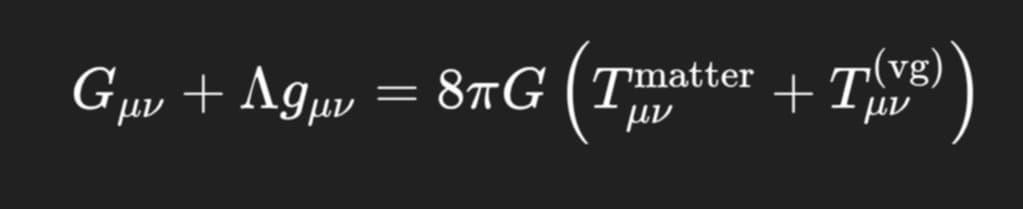
Below is the equation that describes how spacetime emerges from the interaction of the DEQF Substrate with the Graviton Quantum Field:

But my purpose here is not to dazzle the reader with equations or jargon. If you’ve never read a physics paper in your life, that’s fine—this blog is for you. If you believe Genesis is the inspired Word of God—as I do—then I want to show you how this view of the universe not only respects the text of Genesis, but actually flows from it. In fact, a similar understanding was taught 2,000 years ago by Philo of Alexandria. He saw Genesis as describing a divine mind impressing form on passive matter—and GUFT affirms that same duality (as expressed in the two sides of the equation above) using the language of modern science.

This commentary walks through Genesis 1–2 and presents GUFT in plain language, verse by verse. My goal is to help readers of faith understand that modern physics, rightly interpreted, need not challenge belief in the Creator—it may, in fact, offer us a clearer glimpse of how the creation unfolded.


Day 0 | Genesis 1 : 1

בְּרֵאשִׁית בָּרָא אֱלֹהִים אֵת הַשָּׁמַיִם וְאֵת הָאָרֶץ

Reading the Verse

*”In a beginning”—The original Hebrew could be understood as it was by the LXX translator, “In a principle”—“Elohim created the heavens and the earth.”

  • Principle, not timestamp. As Philo notes (On Creation §27), time begins within creation. “In the beginning” thus refers to a logical principle, not a temporal event. GUFT identifies this principle as the DEQF—the eternal neural substrate, or mind, from which all patterns emerge.
  • Heavens and Earth. Philo interprets these as representing mind and matter—active intellect and passive substance. My GUFT maps these onto DEQF (mind, order) and GQF (formless substrate).

Physics Analogy

The DEQF contains all possible configurations as pure potential. Genesis 1:1 is the moment that distinction is drawn: a domain of form (shamayim) and a domain of potential (aretz) are declared.


Day 1 | Genesis 1 : 2–5

“The earth was without form and void… and the Spirit of Elohim hovered…”

  • Tohu and Bohu describe a field without symmetry or structure. The GQF exists but has not yet undergone coherence. Spacetime has no metric.
  • Spirit hovering represents the first ripple of order: the DEQF stimulating the GQF into alignment.

“Let there be light.”

  • Not physical photons—but the first informational coherence, a kind of cosmic initialization or phase alignment. Philo calls it intelligible light; GUFT calls it the first coherent signal of the GQF.

“Day one.”

  • Not “first day” (ordinal) but literally “day one”, one complete phase loop. Time as we know it begins inside this closed system.

Day 2 | Genesis 1 : 6–10

The firmament (raqia) separates waters above from waters below. Philo sees it as the first corporeal boundary. GUFT reads it as the emergence of a metric shell—a three-dimensional spatial manifold enclosing an entangled field domain. The Hebrew root raqa (רָקַע), meaning “to hammer out” or “to spread thin,” aligns strikingly with the concept of an expanding universe that begins in extreme density and rapidly stretches outward. This expansion not only decreases density, but also establishes the initial framework of spacetime itself. In GUFT, this is the birth of the spacetime “bubble”—an emergent domain stabilized by the geometry of the Graviton Quantum Field (GQF), yet seeded and structured by the eternal logic encoded in the Dark Energy Quantum Field (DEQF).

This is the bubble of spacetime: an emergent domain stabilized by the structure of the GQF, but seeded by the DEQF’s encoded logic.


Day 3 | Genesis 1 : 11–13

Plants appear already mature. This reflects recursive structure. Philo emphasizes fruit→seed→fruit cycles. GUFT highlights this as self-replicating algorithmic code—an echo of the Eternal Neural Network which also runs recursive cycles to sustain memory, consciousness, and biological life.


Day 4 | Genesis 1 : 14–19

Philo emphasizes that God did not need the sun to create light—a point echoed by Genesis, which distinguishes between the light of Day 1 and the creation of the sun and stars on Day 4. GUFT agrees: the first light is not physical illumination but coherent informational order emerging from the DEQF. Stars appear later as by-products of that encoded order. What modern physics reveals is astonishing: the universe exhibits precise mathematical fine-tuning that favors life. The fundamental constants of physics and the structure of quantum fields are such that matter slightly outweighs antimatter; gravity is weak enough for stars to form, yet strong enough to ignite fusion; and most remarkably, the nuclear resonance levels in helium and carbon nuclei are exactly right to favor the triple-alpha process—a highly improbable fusion chain that produces carbon inside stars. This process is so delicately tuned that even slight changes in the strong force or electromagnetic coupling would prevent carbon from forming. Yet carbon is the foundation of organic life. This as no accident: these outcomes reflect embedded logic in the Eternal Neural Network (DEQF). Life is not an afterthought, but part of the field’s initial condition set. In Genesis terms, the stars are placed in the heavens after the informational foundation for life has already been laid.

Philo notes the prominence of the number 4. GUFT points out this corresponds to the 4D structure of spacetime and the symmetry groups that govern particle physics.


Day 5 | Genesis 1 : 20–23

Fish and birds are tied to sensation and perception. Philo associates them with the five senses. This as emergence of localized feedback loops—a precursor to neural information processing.


Day 6 | Genesis 1 : 24–31

Humans are created “in the image” of God. Philo locates this image in mind, not flesh. My theory of the Substrate as an eternal Neural Network agrees: the Eternal Neural Network instantiates finite nodes—human minds—that reflect its infinite intelligence.

Creation climaxes in intellect capable of moral will. This is no evolutionary accident, but the fulfillment of a universe designed to host observers who can mirror the Creator.


Day 7 | Genesis 2 : 1–3

Philo says God did not cease absolutely, but ceased from one mode of creation and began another: from mortal creation to divine. Six days = entropy‑bound matter; the seventh = eternal coherence.

My GUFT affirms: Sabbath marks synchronization with the DEQF, a reset from temporal process to timeless substrate. Our weekly rest parallels quantum coherence maintenance—a return to foundational order.


Genesis 2:4–5 | The Book within the Book

Philo calls this the “book” of creation—a metaphor for the Logos, in which all patterns are inscribed. My GUFT identifies this with the DEQF’s eternal data layer. Before any thing appears visibly, it exists ideally within the field. Form precedes function.

Even “herbs before they grew” signify archetypal forms. Just as modern physics views particles as excitations of fields, Genesis presents reality as first encoded in mind, then rendered in matter.


Conclusion

My GUFT does not revise Genesis—it decodes it. The two-field ontology of DEQF and GQF matches the ancient duality of divine Logos and formless matter. The narrative of Genesis 1–2 anticipates:

  1. An eternal mind (DEQF) as substrate of all order.
  2. A secondary field (GQF) as passive recipient, shaping spacetime.
  3. Recursive intelligence as the divine image in man.
  4. Sabbath as synchronization with eternal coherence.

Philo glimpsed these truths 2,000 years ago. GUFT articulates them in the language of modern science. For those who trust in the inspired truth of Genesis, the message is clear: faith and physics need not be at odds. They may, in fact, be telling the same story—across the ages.


For more on the GUFT and the Eternal Neural Network substrate, see my related full-length scientific papers:

Spacetime as an Emergent Bubble Within a Fundamental Dark Energy Quantum Field

The Eternal Neural Network: Time, Will, and Intelligence in the Infinite Substrate

Virtual Gravitons as the Quantum–Vacuum Origin of Dark–Matter Phenomena

A Grand Unified Field Theory of Asymmetry: Spacetime and Gravity as Emergent Phases of the Dark Energy Quantum Field

Support This Work

If this commentary has helped you see the creation account in a new light—where science and Scripture walk hand in hand—please consider supporting this ministry. Your donations help make ongoing research, teaching, and writing possible.

We rely entirely on the support of readers like you. If you believe in the vision of restoring the original context of Scripture and integrating it with truth revealed through creation itself, please stand with us.

🔗 Donate here: http://nazarenespace.com/blog/donate

Thank you for being a part of this journey of discovery and faith. Shalom and blessings!

The Universe-Hacking Blueprint: How We Might Jump Straight to a Type IV Civilization

This blog is about a theoretical physics idea rather than Nazarene Judaism. It is an idea I recently presented in a Theoretical Physics paper, but written in plain English rather than jargon and complex math.

The Universe-Hacking Blueprint: How We Might Jump Straight to a Type IV Civilization

By James Scott Trimm – Independent Researcher


1. A Ruler, a Newspaper and an “Aha!” Moment 🤯

Remember the old classroom trick?
Slide half a wooden ruler off the edge of a desk, cover the part still on the desk with a flimsy sheet of newspaper, then whack the overhanging end. SNAP! The ruler breaks because the air pressing on the newspaper is far stronger than it looks.

That hidden force is my favorite metaphor for empty space. The vacuum isn’t empty at all—it’s under enormous “pressure” from something physicists call dark energy. The big idea in this article: if we learn to tap that invisible pressure, we may unlock more power than every star in the galaxy combined.


2. From Dyson Spheres to Something Better

Tech visionaries often talk about a Kardashev scale of civilizations:

  • Type I – Masters the energy of a planet
  • Type II – Harnesses the power of a star (hello, Dyson sphere)
  • Type III – Uses the energy of an entire galaxy

But there’s a Type IV no one talks about much: a civilization that taps the fabric of the universe itself. If that sounds grandiose, consider this:

We observe zero Dyson spheres in the sky. Maybe smarter aliens skip mega-solar panels and go directly for the “dark-energy outlet” that powers everything.


3. The Tetrahedral Black-Hole Array (Yes, Really) 🔺⚫

At the heart of the idea is a strange but symmetrical device: four artificial black holes arranged like the corners of a perfect pyramid (a tetrahedron).

  • Why black holes? Because they’re nature’s ultimate energy funnels.
  • Why a tetrahedron? It pulls spacetime evenly in all directions, creating a “shear zone” in the middle—like a three-dimensional tug-of-war with no winner.

The math suggests that inside that tiny central pocket the everyday rules of spacetime thin out. We might poke through to a deeper quantum sea—the Dark Energy Quantum Field (DEQF)—and siphon off its energy.


4. Three Giant Engineering Hurdles (and How to Clear Them)

HurdleThe Fix (short version)
1. Energy Input – Making black holes in a lab sounds impossible.Blanket Mercury in solar collectors, put panels on the far side of the Moon, and harvest Venus’s heat. Altogether: ~102410^{24}1024 joules per year—enough to ignite an array.
2. Focus to the Planck Scale – We must cram that energy into a region smaller than an atom.Three-fold trick: (a) synchronize photon beams so their waves add up, (b) guide them through carbon-nanotube “rifle barrels” to stop them from fanning out, (c) pump in extra energy to cover any loss.
3. Containment – Micro black holes evaporate or run amok.Give each baby black hole a huge electric charge (by “feeding” it electrons or positrons) and hold it steady with electromagnetic traps plus standing-wave “pressure nodes” that pin it in place.

None of that is easy—but all are extensions of real tech: giant solar farms, particle accelerators, superconducting magnets, and nano-fabrication.


5. What Could We Actually Do With This?

  • Unlimited clean energy. Tap the vacuum the way a hydro-dam taps a river.
  • Switchable gravity. Crank gravity up or down at will—handy for Mars bases or space habitats.
  • Warp-style propulsion. Expand space behind a craft and shrink it in front. You move without moving.
  • Galaxy-wide Wi-Fi. Modulate the DEQF itself; messages arrive instantly anywhere it touches.
  • Entropy escape hatch. If heat death looms trillions of years from now, step into the substrate and skip the funeral.

6. But… Should We? ⚖️

Power this big could end us faster than it could save us. So before flipping the switch, consider a few “Physics Commandments”:

  1. Don’t time-travel to break causality.
  2. Don’t trigger vacuum collapse.
  3. Don’t weaponize spacetime.
  4. Always safeguard life, liberty and property.
  5. Vet every spin-off tech for unintended horrors.

In short: stewardship, not domination.


7. Baby Steps Toward Omnipotence

Today this may read like high-octane sci-fi. But every ingredient—black holes, dark energy, quantum fields, solar megastructures—comes straight from mainstream physics. The real question isn’t whether the math works; it’s whether our collective wisdom will keep up with our tools.

The match is lit. Whether it warms us or burns us down is up to all of us.


If this sparked your curiosity, dive into the full paper (free PDF): https://archive.org/details/toward-a-type-iv-civilization

Feel free to share, discuss, or debate in the comments—civilization-scale ideas need civilization-scale conversations.