Why was Yeshua Immersed?

Why was Yeshua Immersed?
By
James Scott Trimm

The Forth Century “Church Father” Jerome wrote concerning the Gospel according to the Hebrews (the original Jewish Gospel used by the ancinet Nazarenes):

In the Gospel according to the Hebrews, which is written in the Chaldee and Syrian language, but in Hebrew characters, and is used by the Nazarenes to this day (I mean the Gospel according to the Apostles, or, as is generally maintained, the Gospel according to Matthew, a copy of which is in the library at Caesarea), we find:

ecce mater domini et fratres eius dicebant ei: Joannes baptista baptizat in remissionem peccatorum, eamus et baptizemur ab eo. dixit autem eis: quid peccaui, ut uadam et baptizer ab eo? nisi forte hoc ipsum quod dixi ignorantia
est.

Behold, the mother of our Lord and His brothers said to Him, John Baptist baptizes for the remission of sins; let us go and be baptized by him. But He said to them, what sin have I committed that I should go and be baptized by him? Unless, erchance, the very words which I have said is [a sin of] ignorance.
(in Jerome, Against Pelagius III.2)

This passage raises the obvious question: If Yochanan immersed unto the remission of sins (see Mt. 3:11; Mk. 1:4-5; Lk. 3:2-3, 7; Acts 19:3-4) and Yeshua was without sin (Heb. 4:15) then why should he be immersed for the remission of sins?

The concept of the “sin of ignorance” is found in the Torah (Lev. 4:2, 22, 27; 5:15-18; 22:14) and in Hebrews (Heb. 9:7). Messiah gave up certain qualities to become a man (Phil. 2:6-8; Heb. 2:7, 9, 14) and this apparently included omniscience, In Luke we are told that Messiah “grew and filled with wisdom” (Lk. 2:40, 52) and as an adult he did not have all of the knowledge of the Father (Mk. 13:32). This raises the possibility that Yeshua could have sinned in ignorance (Heb. 4:15 makes it clear that he did not, but that he could have), which is the point, made in the Goodnews according to the Hebrews here.

Note that the phrase “a sin of” is in brackets, meaning that it was not in the Latin of Jerome’s quote but was added by the translator as implied. The text might also be seen as Yeshua challenging his brothers by saying “I claim not to have sinned… are you saying I am ignorant and I really have sinned? And if so just when and where did I sin?”

Many people fail to realize what Messiah actually achieved. Messiah made daily choices as a human. He often wrestled with his nefesh (soul, self) pushing himself to make the right choice every time. While it is true that Messiah was able not to sin, do not mistake this to mean that Messiah was not able to sin. As we read in Hebrews:

For we do not have in this Cohen, one who is not able to bear our weakness, but one who was tempted on all sides like we, yet without sin.
(Heb. 4:15 HRV)

Many miss this very important point, and even think it is blasphemous to declare this wonderful truth: Messiah could have failed! Many seem to think there was no real risk involved! It is clear that in the garden of Gethsemane Messiah was weighed down with a battle to submit his human will to Elohim. It was a struggle, but he won.

But Messiah could have failed! It was possible! Otherwise he was not tempted in all things just as we have been. There would have been no risk involved. There would have been no real struggling to overcome temptation, if Messiah had not been able to sin in the first place. Messiah was able to sin, but he was also able not to sin.

Now is the time for the last days restoration on Nazarene Judaism, the faith of the original Jewish followers of Yeshua as the Jewish Messiah of Judaism!

We need your support for this important work! We must raise at least $630 by the end of the day today, or our account will plunge into the negative tonight, and start a chain reaction of returned items and fees!

As I have said to you many times, I look on this work as a co-operative one with me, and all of you combining our resources together in order to get the job done of helping to teach this great truth to all in the world who will listen. Thank you so much from the bottom of my heart for your continued support, you are the ones who make it all possible by your contributions and your prayers for our work. I truly appreciate your help in every way.

If you can make a one time donation of $500 or $1,000 dollars to support this work.

Donations can be sent by Paypal to donations@wnae.orgor by Zelle, Go Fund Me, Bitcoin or Ethereum.

Click HERE to donate

The Zohar Reveals Yeshua is the Stone the Builders Rejected!

The Zohar Reveals Yeshua is the Stone the Builders Rejected
By
James Scott Trimm

We read in Matthew:

38 Behold, your house is forsaken; to you desolate.
39 And I tell you, that you will not see Me here after,
until you say,
Blessed is He that comes in the Name of YHWH!
(Matt. 23:38-39)


Of course this is quoting Ps. 118:26:

“Blessed be he that comes in the Name of YHWH; we bless you out of the House of YHWH.” (Ps. 118:26).

Above this is the phrase “the stone the builders rejected is become the chief corner-stone” (Ps. 118:22)

Now we read in the Zohar concerning the stone that the builders rejected:

David, indeed, was king in this world and will be king in the time to come; hence “the stone the builders rejected is become the chief corner-stone”. For, when the sun turns away his face from the moon, and does not shine upon her, she has no light whatever and so does not shine, but is poverty-stricken and dark on all sides; but when the sun turns towards her and radiates his light upon her, then her face is illumined and she adorns herself for him as a woman for a man. She thus is then invested with the dominion of the world. So David adorned himself after this very manner. Now he would appear poor and dejected, but then again he would be revelling in riches. Hence David’s declaration, “I am small and despised, yet have I not forgotten thy precepts.” It behoves, indeed, every man to follow this example and to humble himself in every respect so as to become a vessel in which the Holy One, blessed be He, may find delight. This lesson has also been expounded in connection with the phrase, “with him also that is of a contrite and humble spirit’ (Isa. LVII, 15).’
(Zohar 2:232b)

The Zohar says that when this stone is rejected “the sun turns away his face from the moon, and does not shine upon her.”

Earlier the Zohar says:

So it says: AND HIS HAND HAD HOLD ON ESAU’S HEEL , i.e he put his hand on Esau’s heel in order thereby to force him down. According to another explanation, the words “and his hand had hold” imply that he could not escape him entirely, but his hand was still clinging to his brother’s heel. Esoterically speaking, the moon was obscured through the heel of Esau; hence it was necessary to deal with him cunningly, so as to thrust him downwards and make him adhere to the region assigned to him.’
(Zohar 1:138a)

The moon is obscured “through the heel of Esau”, and therefore the stone is rejected “through the heel of Esau” because the sun “turns away his face”.

And to whom does the sun refer:

Moses asked: ‘ Shall they remain in pledge for ever?’ God replied: ‘No, only Until the sun appears’ that is, till the coming of the Messiah; for it says, But unto you that fear My name shall the sun of righteousness arise with healing in its wings (Mal.3:20).
(Midrash Rabba Ex. 31:10)

So what does this mean?

It points us to Gen. 25:26 which reads:

And after that, came forth his brother. And his hand had hold on Esav’s heel, and his name was called Ya’akov. And Yitz’chak was threescore years old when she bore them.

ואחרי־כן יצא אחיו וידו אחזת בעקב עשו ויקרא שמו יעקב ויצחק בן־ששים שנה בלדת אתם

If we take the first letter of each word (a process called Notarikon) starting with the name Ya’akov (Jacob) and ending with Esav (Esau) going backwards we spell the name YESHUA (ישוע), and if we continue through the next two words we read “Yeshua comes.” (ישוע בא)

So the moon is obscured in shining the light of Messiah by the heal of Esau.

Now the last letter in YESHUA (ישוע) in the Hebrew is an AYIN (ע) and that is the initial letter of the name ESAU in “Esau’s heel”. So if the heal of “Esau” is taken from YESHUA we have “YESHU” (ישו).

“Yeshu” is a name used in Rabbinic Judaism which refers to the anathema Rabbinic Judaism associates with Yeshua.

For Rabbinic Jews is is a acronym for a curse on the name of Yeshua meaning “may the name be blotted out forever”.

But Yeshua said:

38 Behold, your house is forsaken; to you desolate.
39 And I tell you, that you will not see Me here after,
until you say,
Blessed is He that comes in the Name of YHWH!
(Matt. 23:38-39)


They will say “Blessed is He that comes in the Name of YHWH!” (Ps. 118:26) when they accept the “stone that the builders rejected” (Ps. 118:22). This happens when the AYIN is restored to the name YESHUA, the reversal of the anathema, thus the Messiah, the Sun of Righteousness, will shine his light on the moon, which was obscured by the “heel of Esau”. And when the “heel of Esau” no longer obscures the “Sun of Righteousness” and YESHU is restored to YESHUA, then we can clearly see that “Yeshua comes”!

Rabbi Shimon bar Yochai knew that Yeshua is the Messiah, the stone that the builders rejected and the Servant of Isaiah 53, and he hid this information in the Zohar!

This is one of the reasons I have been working on a Free Online Commentary to the Zohar. If you really want to understand the Gospel of Yochanan (especially Yochanan Chapter 1) you really need to understand the Zohar.

Now is the time for the last days restoration on Nazarene Judaism, the faith of the original Jewish followers of Yeshua as the Jewish Messiah of Judaism!

OWe must raise at least $700 by the end of the day today (5/13/24) or our account will plunge into the negative, starting a chain reaction of returned items and fees! We need your help today!

As I have said to you many times, I look on this work as a co-operative one with me, and all of you combining our resources together in order to get the job done of helping to teach this great truth to all in the world who will listen. Thank you so much from the bottom of my heart for your continued support, you are the ones who make it all possible by your contributions and your prayers for our work. I truly appreciate your help in every way.

If you can make a one time donation of $500 or $1,000 dollars to support this work.

Donations can be sent by Paypal to donations@wnae.org or by Zelle or Go Fund Me.

Click HERE to donate

Commentary to Yochanan 3 Posted

Shalom Chaverim,

I have just posted my Commentary to Yochanan Chapter 3 and invite you all to take a look. Find out, from a Jewish perspective:

Who was Nicodemus?

What does “Born Again” really mean?

What is the Kingdom of Elohim?

What does the Brazen Serpent in the Wilderness have to do with Yeshua?

What does the famous Bible verse John 3:16 really mean?

Take a look and find out: Commentary to Yochanan Chapter 3

This is part of the Free Online Scripture Commentaries I am working on.

This is one of many projects I am working on. as part of this great work of the restoration of Nazarene Judaism!

We need your support for this important work! And in these challenging times, we need your support more than ever! Rent will be due in less than two weeks, and right now we do not have it!

As I have said to you many times, I look on this work as a co-operative one with me, and all of you combining our resources together in order to get the job done of helping to teach this great truth to all in the world who will listen. Thank you so much from the bottom of my heart for your continued support, you are the ones who make it all possible by your contributions and your prayers for our work. I truly appreciate your help in every way.

If you can make a one time donation of $500 or $1,000 dollars to support this work.

Donations can be sent by Paypal to donations@wnae.org

Or click HERE to donate

The Gospel of Barnabas and the Gospel according to the Hebrews

The Gospel of Barnabas and the Gospel according to the Hebrews
By
James Scott Trimm

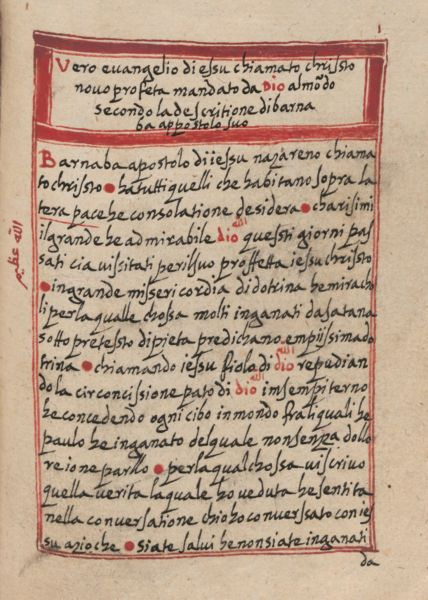
While doing some recent research I discovered that the Gospel of Barnabas (a sort of Islamic apocryphal Gospel from the Middle Ages) seems to have embedded in it some elements from the Gospel according the Hebrews, the original Jewish Gospel used by the ancient Nazarenes.

At this point, I want to make it very clear that the Gospel of Barnabas is a false Gospel. The fact that I am making academic use of it, should in no way be misinterpreted as losing site of that fact. This point cannot be made too clearly.

This relationship is not a complete surprise, some scholars have maintained that there was a relationship between the ancient Ebionites and the roots of early Islam (and Barnabas has its closest affinity with the Ebionite version of GH). Moreover the editor of Barnabas is likely to have used some earlier Gospel(s) as his source material, since GH was certainly in existence, we should not be surprised that it was used as a source text.

My first clue came from Barnabas’ account of the immersion of Yeshua (or at least its reworking of that account). Barnabas reworks the immersion story into a story about how Yeshua (i.e. “Jesus”) received the “Gospel”. In Islamic belief the “Gospel” was a book that “Jesus” received from Gabriel in much the same way that Mohammed is supposed to have received the Quran. In keeping with this idea Barnabas reworks the immersion account into an account of Yeshua receiving his book in much the same way that Muhammed supposedly received the Quran:

Jesus having come to the age of thirty years, as he himself said
unto me, went up to Mount Olives with his mother to gather
olives. Then at midday as he was praying, when he came to these
words: ‘Lord, with mercy . . . ,’ he was surrounded by an exceeding
bright light and by an infinite multitude of angels, who were
saying: ‘Blessed be God.’ The angel Gabriel presented to him as it
were a shining mirror, a book, which descended into the heart of
Jesus, in which he had knowledge of what God hath done and what
hath said and what God willeth insomuch that everything was laid
bare and open to him; as he said unto me: ‘Believe, Barnabas, that I
know every prophet with every prophecy, insomuch that whatever I
say the whole bath come forth from that book.’

Jesus, having received this vision, and knowing that he was a
prophet sent to the house of Israel, revealed all to Mary his mother,
telling her that he needs must suffer great persecution for the honour
of God, and that he could not any longer abide with her to serve her.
Whereupon, having heard this, Mary answered: ‘Son. Ere thou west
born all was announced to me; wherefore blessed be the holy name
of God. Jesus departed therefore that day from his mother to attend
to his prophetic office.
(Barnabas 10)

This account has many subtle parallels to the immersion account in the Gospel according to the Hebrews, which is fully examined in my previous blog Restoring the Original Hebrew Gospel Account of Yeshua’s Immersion.

Now immediately we may take note of the fact that in Barnabas, as in GH, it is mentioned that Yeshua’s mother is present at the event, we may also note that both Barnabas and GH indicate that Yeshua was thirty years old.

The phrase “was surrounded by an exceeding bright light” in Barnabas recalls the phrase “a great light shone around the place” in GH.

The phrase “a book, which descended into the heart of Jesus” in Barnabas recalls: “the Holy Spirit in the form of a dove descending and entering into him” in the Ebionite version of GH.

The phrase “everything was laid bare and open to him” (Barnabas) recalls “the heavens were opened” in GH (and Matthew).

The phrase “Son. ere thou west born” (Barnabas) recalls “…Son… I have begotten” (GH Ebionite) and “My son… my firstborn son” (GH Nazarene).

“That day” (Barnabas) recalls “this day” (GH Ebionite)

These parallels cannot be mere coincidence. The account in Barnabas is clearly a corruption based (at least in part) in the account of Yeshua’s immersion in GH.

Within Barnabas we also find a solution to a long time GH mystery. The Ebionite version of GH had the following quote:

“I am come to do away with the sacrifices,
and if you cease not sacrificing
the wrath of God will not cease from you.”

(This quote only appeared in the Ebionite version and was not in the original
Nazarene version.)

Scholars have long been curious about where this quote belonged in the text since there was no obvious parallel or context in the canonical Gospels. However similar material occurs in Barnabas which could easily be the home of this quote:

‘For ye say unto them: “Bring of your sheep and bulls and lambs to
the temple of your God, and eat not all, but give a share to your
God of that which he hath given you”; and do not tell them of the
origin of sacrifice, that it is for a witness of the life granted
to the son of our father Abraham, so that the faith and obedience of
our father Abraham, with the promises made to him by God and the
blessing given to him, should never be forgotten. But by Ezekiel the
prophet saith God: “Remove from me these your sacrifices, your
victims are abominable to me.” For the time draweth near when that
shall be done of which our God spoke by Hosea the prophet,
saying: “I will call chosen the people not chosen.” And as he saith
in Ezekiel the prophet: “God shall make a new covenant with his
people, not according to the covenant which he gave to your fathers,
which they observed not and he shall take from them a heart of
stone, and give them a new heart”: and all this shall be because ye
walk not now in his law. And ye have the key and open not: rather do
ye block the road for those who would walk in it.’
The priest was departing to report all to the high priest, who
stood nigh unto the sanctuary, but Jesus said: ‘Stay, for I will
answer thy question.’
(Barnabas 67)

Of course this would have been part of the apostate Ebionite version of GH and not the original Nazarene Version.

Barnabas also offers a solution to another great GH mystery. Scholars have long noted that the quotes from GH seem to switch from a third person account, to a first person account from the Emissaries, to a first person account from Yeshua himself, but how this took place was a mystery. For example Epiphanius quotes the Ebionite version of GH as reading:

There appeared a certain man named Jesus of about thirty years
of age, who chose us. And when he came to Capernaum, he
entered into the house of Simon whose surname is Peter, and
opened his mouth and said: “As I passed the Lake of Tiberias, I
chose John and James the sons of Zebedee, and Simon and Andrew
and Thaddeus and Simon the Zealot and Judas the Iscariot, and
you, Matthew, I called as you sat at the receipt of custom, and
you followed me. You, therefore, I will to be twelve apostles for
a testimony unto Israel.”
(Epiphanius, Panarion 30.13.2-3)

Here we see this shift taking place, but in other passages it is not so simple to understand how this shift took place. For example Origin quotes GH as follows:

“Even now did my mother the Holy Spirit take me by one of mine
hairs, and carried me away unto the great mountain Thabor”
(Origen; on Jn. 2:12)

Now this appears to be an account of the Temptation, but all three canonical accounts of the Temptation are in the third person, how could GH have worked in a first person account?

Again Barnabas gives us the solution. In Barnabas the flowing third person narrative is at times interrupted by a first person account by an emissary (Barnabas- in the Gospel of Barnabas, Baranabas is misidentified as an Apostle) recalling and recounting a first person account of the events given them by Yeshua.

In Barnabas, for example, we read:

“…as he said unto me: ‘Believe, Barnabas, that I know every
prophet with every prophecy, insomuch that whatever I say
the whole bath come forth from that book.'”
(Barnabas 10)

Barnabas and GH must both have had such interspersed interruptions suddenly shifting from the third person into a first person account of an emissary (or emissaries) recalling a first person account they received from Yeshua. This makes especially good sense when we realize that the “Church Fathers” sometimes referred to GH as the Gospel of the Twelve.

So despite the fact that the Gospel of Barnabas is a false, apostate, Islamified Gospel, on an academic level, it may still provide us with some subtle clues concerning the Gospel according to the Hebrews.

We need your support now more than ever. Donations have been very low this month, and rent will be due in just two weeks!

As I have said to you many times, I look on this work as a co-operative one with me, and all of you combining our resources together in order to get the job done of helping to teach this great truth to all in the world who will listen. Thank you so much from the bottom of my heart for your continued support, you are the ones who make it all possible by your contributions and your prayers for our work. I truly appreciate your help in every way.

If you can make a one time donation of $500 or $1,000 dollars to support this work.

Donations can be sent by Paypal to donations@wnae.org

Or click HERE to donate

Is DuTillet Hebrew Matthew a Translation from Greek?

Is DuTillet Hebrew Matthew a Translation from Greek?
By
James Scott Trimm

Recently I have seen several persons dismiss the DuTillet Hebrew version of Matthew claiming that it is a “translation from Greek.” Whenever I see someone make this claim, it becomes immediately apparent that they are not familiar enough with the subject matter to be commenting.

In a recent blog I shared how the close relationship between the DuTillet Hebrew Matthew and the Old Syriac Aramaic Matthew is strong evidence that the DuTillet Hebrew version of Matthew is directly related to the original Hebrew of Matthew.

There is further evidence that the original Hebrew from which Du Tillet is an exemplar is directly connected to the original Aramaic of which the Old Syriac is an exemplar apart from the Greek text. 

Both Hebrew and Greek have a definite article (English “the”).  Yet there seems to be no real connection between where DuTillet uses the definite article and where it appears in the Greek:

Three Examples where the Hebrew has no definite articles but the Greek does have them:

Mt. 3:7 “many of the Pharisees and Sadducees”
Mt. 6:32  “the Gentiles”
Mt. 14: 15  “the villages”

Three examples where the Hebrew does have definite articles and the Greek lacks them:

Mt. 3:8 “the fruit worthy”
Mt. 4: 18 “the net”
Mt. 7:9 “the stone”

This would certainly imply that at some point in between the Hebrew and the Greek the text went through a language that either had a weak definite article or none at all. The likely candidate for such a language would be Aramaic (Syriac) which lacks a definite article.

In other words the evidence indicates that the Hebrew text of DuTillet is not a Hebrew translation of the Greek.  Instead it appears that the Aramaic text represented by the Old Syriac is a direct Aramaic translation of the Hebrew text represented by DuTillet, and that our Greek text is a representative of a Greek version which was translated from the Aramaic. 

If anyone who was actually educated about these texts wanted to dismiss the DuTillet Text as a translation, they would never claim it was translated from Greek, they would claim it was translated from Latin, which has no definite article. Of course this argument is also incorrect, as evidenced by the close relationship between the DuTillet text and the Old Syriac. But if anyone tries to dismiss the DuTillet Hebrew as a translation from Greek, they have demonstrated themselves to be ignorant of the nuances of the text about which they are claiming to know so much.

I want to thank all of you who are supporting the work we are doing. I say we, because I am always mindful that this is a joint effort in which you are all an equal part with me. I could not do this work without you.

We are facing an exceptionally difficult month. In addition to co-pays on medical tests and appointments for myself and my wife (her condition has become worse), the transmission on our car must be replaced. That is a repair costing between five and six thousand dollars! Fortunately we have major mechanical breakdown covered on our auto-insurance, so after the deductible, diagnosis, and related expenses, our out of pocket expense is about $500, which is a lot, but not the prohibitive $5,000 plus.

And right now we are literally broke, with $0.00 in our account!

We must raise at least $850 to cover the car repair and other bills!

As I have said to you many times, I look on this work as a co-operative one with me, and all of you combining our resources together in order to get the job done of helping to teach this great truth to all in the world who will listen. Thank you so much from the bottom of my heart for your continued support, you are the ones who make it all possible by your contributions and your prayers for our work. I truly appreciate your help in every way.

If you can make a one time donation of $500 or $1,000 dollars to support this work.

Donations can be sent by Paypal to donations@wnae.org

Or click HERE to donate

The Catalan Gospels: Hebrew Paraphrase of the Latin Vulgate

The Catalan Gospels: Hebrew Paraphrase of the Latin Vulgate
By
James Scott Trimm

Some high claims have been made or the so-called “Catalan Gospels” (Vat. Ebr. 100), however, after a careful examination, I have come the conclusion that these Gospels are merely a Hebrew translation whose ultimate source, is the Latin Vulgate, and that they play absolutely no part in Gospel origins. Either the Hebrew is itself a paraphrase, or there was a paraphrase somewhere between the Latin Vulgate and the Hebrew.

The first, and most obvious sign, that the ultimate source of the Catalan Hebrew is not the original Hebrew of the Gospels, is the fact that wherever our canonical text of the Gospels contains an explanation as to the meaning of a Hebrew word of proper noun, the Catalan text also has such such an explanation, in exactly the same passage. This is significant, because such explanations would not have been in the original Hebrew, since they would have been completely unnecessary. It is impossible to believe that they were independently inserted in the source of the Catalan text, in exactly the same places that they appear in our canonical text, unless they both derive these from the same source that was not the original Hebrew.

For example in Yochanan 1:41 our received John explains “Messiah, which is translated Christos” and in this exact place, the Catalan text explains that Messiah means “Messiahos”

In Yochanan 1:42 where our received text informs us that Kefa means “rock” the Catalan also has this explanation in exactly the same place.

Again in John 4:25 the Catalan text explains that Messiah means “Messiahos” where the received text explains that Messiah means “Christos”.

Another evidence that the Catalan Gospels are not sourced from the original Hebrew, is that they contain the text of John 7:53-8:11, and in exactly the same location as in our standard editions of John. This would not be the case if the ultimate source were the original Hebrew or John. The story of the alleged adulteress (John 7:53-8:11) does not actually appear in many of the most ancient manuscripts. It does not appear in the Aramaic Peshita or the Aramaic Old Syriac texts. Those Greek manuscripts which do contain it place it in various places some after Luke 21:38 and some after John 7:36 or after 7:52 or even after 21:24. The fact that it appears in the Catalan John and in exactly the place where we have it in our modern versions, is very much evidence that the ultimate source of the Catalan Gospels is not the original Hebrew.

That the true ultimate source of the Catalan Gospels is the Latin Vulgate is to be seen from the fact that the Catalan tends to follow many unique Latin Vulgate readings, especially where the Latin Vulgate omits a word or phrase, the Catalan Gospels will also omit that word or phrase.

For example in John 8:14 the Latin Vulgate uniquely omits the phrase “but you cannot tell from where I come, and where I go.” and this exact phrase is also lacking in the Catalan manuscript.

And in John 10:30 Codex W and Δ and some minuscules read “I and my Father are one” the Latin Vulgate omits “my” and the Catalan text also omits “my” from this verse.

Proponents of the Catalan Gospels have ignored the obvious textual evidence that the Catalan Gospels are actually a paraphrase of the Latin Vulgate.

There is an account, found in all four gospels, that there was a prevailing Passover custom in Jerusalem that allowed Pilate, the governor of Judea, to commute one prisoner’s death sentence by popular acclaim. According to all four Gospels (Matt. 27:15-26; Mk. 15:6-15; Lk. 23:13-25 and Jn. 18:38b-40) . According to all four accounts, Pilate put forward to individuals, and let the crowd choose between the two: Yeshua and Barabbas. As the accounts go, the crowd chose Barabbas.

However in the Commentary to Matthew by the Fourth Century Church Father Jerome, he makes an interesting comment, speaking about Barabbas in his commentary to Matthew 27:16 he writes “… is interpreted in the so-called Gospel according to the Hebrews as ‘son of their teacher’ (Latin: filius magistri eorum). (Jerome on Matthew 27:16)

I have written in depth about the Gospel according to the Hebrews elsewhere. It is the original source text behind the synoptic gospels (and to a lesser extent John) and our Gospel of Matthew is essentially an abridgement of it.

It has been proposed by some authors that Jerome is saying that Barabbas (Bar Abba) was not really names “Bar Abba” (son of a father) but “Bar Rabbon” (Son of their master”). The problem is that when Jerome says “their” here, is is almost certainly doing so to distinguish himself from the Jews. It is very unlikely that anyone would be given the name or title “son of their master”. It is much more likely that the word “their” is Jerome’s, and that the term that appeared in the original Hebrew Gospel source was “Son of the Master” or “Son of a Master” not “Son of their Master.” Thus we would expect the original Hebrew to read Bar Rabbah (בר רבה) rather than Bar Abba (בר אבא).

It has been proposed (by Dr. Miles Jones) that the “Catalan” Gospels may express Jerome’s proposed original reading here. Unfortunately the Catalan version has here בראבן or בר אבן in it’s text. Which might be “son of their father” but not “son of their master” and since the word “their” is almost certainly Jerome’s and not part of the original name, the Catalan Gospels do not really testify in this passage to this original reading at all.

However, both the DuTillet Hebrew Matthew and the Munster Hebrew text of Matthew, have in their accounts, not “Barabbas”, or “Bar Abba” but “Bar Rabbah” (בר רבה) just exactly as we would expect to find in the original Hebrew of the Gospels!

Jones has further proposed that the readings of the Catalan Gospels in Matthew 27:51; Mark 15:38 and Luke 23:45, agree with the Gospel according to the Hebrews ((Which he regularly refers to ambiguously as the “Hebrew Gospel” in his books).

We read in the Goodnews according to Matthew that at the death of Yeshua:

And, behold, the veil of the temple was rent in twain from the top to the bottom; and the earth did quake, and the rocks rent;
(Matthew 27:51)

The fourth century “Church Father” Jerome writes concerning The Gospel According to the Hebrews (a Gospel use by the ancient sect of the Nazarenes along side our familiar four):

“But in the Gospel which is written in Hebrew characters we read not that the veil of the Temple was rent, but that the lintel of the Temple of wondrous size was broken and even forced asunder.”
(Jerome; Letter 120 to Hedibia; Jerome on Mat. 27:51)

Also in the Historia passionis Domini we read likewise:

“Also in the Gospel of the Nazarenes we read that at the time of Messiah’s death the lintel of the Temple, of immense size, had split (Josephus says the same and adds that overhead awful voices were heard which said: ‘Let us depart from this abode’.”
(Historia passionis Domini; MS: Theolog. Sammelhandschrift 14th-15th Century, foll. 65r)

The lintel was a crossbeam over the doorway to the Holy of Holies in the Temple. The lintel stood atop pillars eight stories high which formed this doorway. The lintel was some thirty feet across and made of solid stone. It would have weighed about 30 tons! At the death of Yeshua there was an earthquake. This earthquake caused the lintel to split, breaking in the middle. It would have been no small event when the two pieces of this thirty ton lintel came crashing down eight stories! The veil hung from the lintel and the hekel doors were attached to the pillars. When the lintel broke it caused the veil to be rent in two from top to bottom.  (In the Jewish culture it is common for a father to morn the death of his son by renting his garment in just such a fashion.) 

Dr. Miles Jones maintains that the Catlan Gospels reflect this reading, and that this is their “authentication” by which he ascertains that they “come from a first century source”. As evidence Jones cites their readings of Matthew 27:51; Mark 15:38 and Luke 23:45 from the Catlan Gospels (ibid page 262) He presents the following translations:

“And here the Temple was broken on both sides up and down and the earth quaked and the stones split in the middle.” (Matthew 27:51)

“The Temple was broken on both sides up and down.” (Mark 15:38)

“And the sun went dark and covered the Temple and it was split in the middle.” (Luke 23:45)

However the word Jones translates as “Temple” in these verses is not the normal Hebrew word for Temple, but is מקדש which can mean “Sanctuary” but can also simply refer to “a holy thing” or “something consecrated”. There is no special indication here of the lintel. And the verb used is שבר which can mean to “break” but it can also mean to “tear” (as in 1Kn. 13:26)

There is an even greater problem with Jones’ translation of Luke 23:45. The phrase Jones translates “And the sun went dark and covered the Temple” is in the Hebrew והשמש חשך ומכסה המקדש Which is very clearly “And the sun was dark and the covering of the Sanctuary [split]” The word ומכסה can only be a noun, and cannot be a verb.

There is nothing about these verses of the Catalan Gospels, that indicates any connection to the Gospel according to the Hebrews (or “The Hebrew Gospel”). The textual nature of the Catalan Gospels indicates that they are a Hebrew language version of some paraphrase ultimately sourced in the Latin Vulgate. The Catalan Gospels have no part to play in Gospel origins.

Our rent was due today, and we do not have it! We need your help today!

As I have said to you many times, I look on this work as a co-operative one with me, and all of you combining our resources together in order to get the job done of helping to teach this great truth to all in the world who will listen. Thank you so much from the bottom of my heart for your continued support, you are the ones who make it all possible by your contributions and your prayers for our work. I truly appreciate your help in every way.

If you can make a one time donation of $500 or $1,000 dollars to support this work.

Donations can be sent by Paypal to donations@wnae.org

Or click HERE to donate

The Word Became Flesh (Jn 1:14)

Shalom Chaverim,

Work continues on the free online Nazarene Commentary. I just added commentary on Yochanan (John) 1:1-5, 15 (More commentary to Yochanan chapter 1 will be added in coming days.) Please have a look. It is very interesting to see how well these verses connect with the teachings of Philo of Alexandria, as well as the Zohar. From a Jewish perspective, these verses are very profound and deep. These verses reach into the deepest Jewish “Sod” understanding’s of the opening verses of the Torah. The ideas related in these opening verses of Yochanan are Jewish ideas, and in fact the whole book of Yochanan is written on the very deepest lever of Jewish understanding, known as SOD.

Take a look by clicking here.

Donations this month have been very low and we need your financial support now more than ever! Our rent is due in just three days, and we still have unpaid bills this month!

As I have said to you many times, I look on this work as a co-operative one with me, and all of you combining our resources together in order to get the job done of helping to teach this great truth to all in the world who will listen. Thank you so much from the bottom of my heart for your continued support, you are the ones who make it all possible by your contributions and your prayers for our work. I truly appreciate your help in every way.

If you can make a one time donation of $500 or $1,000 dollars to support this work.

Donations can be sent by Paypal to donations@wnae.org

Or click HERE to donate
What do You Mean… Turn the Other Cheek?

What do You Mean… Turn the Other Cheek?
By
James Scott Trimm

We read in the King James Version of Matthew:

But I say unto you,
That ye resist not evil:
but whosoever shall smite thee on thy right cheek,
turn to him the other also.
(Matthew 5:39 KJV)

This verse has been used by many to teach the doctrine of pacifism. But is that really what Yeshua was teaching?

To begin with, the Torah does not teach pacifism.  To the contrary the Torah requires us to defend ourselves.  

We read in the Torah:

“If a thief be found breaking in, and be smitten so that he dies, there shall be no
bloodguiltiness for him.”
(Ex. 22:1(2))

It is from this verse that we have the Baraita which says:

“When a man comes to kill you, rise early and kill him first.”
(b.Berachot 58a, 62b; Numbers Rabbah XXI:4; Zohar 1:138a)

Rashi writes of this verse:

“He has no blood. [This signifies that] this is not [considered] murder. It is as though he [the thief] is [considered] dead from the start. Here the Torah teaches you: If someone comes to kill you, kill him first. And this one [the thief] has come to kill you, because he knows that a person will not hold himself back and remain silent when he sees people taking his money. Therefore, he [the thief] has come with the acknowledgement that if the owner of the property were to stand up against him, he [thief] would kill him [the owner]. – [From Talmud Sanhedrin. 72a]”.

So if the Torah teaches that we should defend ourselves from attack, then is Yeshua countering the Torah, or has he been misunderstood? Yeshua’s point in this whole section of Matthew is to build a fence around the Torah so that we can be more righteous than Pharisees (Matt. 5:17-20).

In Matt. 5:21-26 he builds a fence around “you shall not murder” advising us not to even hate.

In. Matt. 5:he builds a fence around “you will not commit adultery” advising us not to commit adultery in our imaginations either.

In Matt. 5:31-32 he builds a fence around the commandment not to divorce without giving your wife a bill of divorcement and suggests not divorcing at all except for cause of fornication.

In Matt. 5:33-37 he builds a fence around the commandment to keep oaths, and suggests not making oaths at all in the first place.

(Skipping 5:58-42 for the moment)

In Matt. 5:43-48 he builds a fence around “you your neighbor” suggesting we should love everyone just to be sure.

In order to properly understand this verse we must look at the verse in context.  This passage is part of Yeshua’s teaching on the proper meaning of the Torah passage which says “An eye for an eye; a tooth for a tooth.” (Ex. 21:24; Lev. 24:20; Deut. 19:2) Here Yeshua also builds a fence around “en eye for an eye, a tooth for a tooth” (as a law of liability rather than revenge) by paying double damages, more than an eye for an eye.  Thus, two garments, two miles, and two cheeks… not that the cheeks are literally smiten, but the financial value of two smiten cheeks rather than just one.

In this teaching Yeshua said:

38 You have heard what was said, An eye for an eye; a tooth for a tooth.
39 But I tell you, that you not withstand evil: but if one would smite you on the right cheek, turn unto him the other.
40 And whoever wishes to contend you in judgment, and wishes to take from you your coat, leave him the cloak also.
41 And he that impresses you for one mile, go with him even two.
42 And whoever asks of you, give to him: and from him that would borrow of you, turn not you away.
(Matthew 5:38-42 HRV)

Now to understand this teaching one must understand that in the first century there was a great debate between Pharisees and Sadducees regarding the interpretation of the phrase “an eye for an eye, a tooth for a tooth.”  

The Sadducees took this very literally as a law of revenge.  They maintained that the court should be knocking out teeth and putting out eyes.  

The Pharisees, on the other hand, understood the passage, in light of the Oral Law, to be a law of liability and not a law of revenge.  Thus if a man caused another to loose a tooth or an eye he was liable to compensate that man financially as we read in the Talmud:

Why [pay compensation]? Does the Divine Law not say
‘Eye for eye’?   Why not take this literally to mean [putting
out] the eye [of the offender]? — Let not this enter your mind,
since it has been taught: You might think that where he put out
his eye, the offender’s eye should be put out, or where he cut
off his arm, the offender’s arm should be cut off, or again
where he broke his leg, the offender’s leg should be broken.
[Not so; for] it is laid down, ‘He that smiteth any man. . .’
‘And he that smiteth a beast . . .’ just as in the case of
smiting a beast compensation is to be paid, so also in the
case of smiting a man compensation is to be paid.
(b.Baba Kama 83b)

Yeshua seems to have understood this passage in the light of Oral Torah, as did the Pharisees, as a law of liability rather than as a law of revenge.  This is a good example of how the “letter of the law” kills but the “spirit of the law” gives life.  (see also notes to Lk. 10:29-36)

Yeshua begins by saying:

But I tell you, that you not withstand evil:
but if one would smite you on the right cheek, ‘
turn unto him the other.

You may notice that the KJV has “That ye resist not evil”.  However the actual Hebrew reads: meaning literally “You will not stand before evil” (שלא לעמוד נגד הרע) The KJV understands this verse to mean “you will not stand against evil” but it is actually meant to be understood “you will not stand for evil” or “you shall not withstand evil”.  It is telling us not to allow evil in our presence.  

Next Yeshua addresses the idea that “eye for an eye” is a rule of revenge.  He tells us “if one would smite you on the right cheek, turn to him the other.” Not that the cheeks are literally smiten, but the financial value of two smiten cheeks rather than just one, just as the text speaks of two garments or two miles.

Yeshua continues:

And whoever wishes to contend you in judgment,
and wishes to take from you your coat,
leave him the cloak also.
And he that impresses you for one mile, ‘
go with him even two.

Here Yeshua discusses the Torah command concerning collateral on a loan.  As the Torah says:

10 When you do lend your neighbor any manner of loan, you shall not go into his house to fetch his pledge.
11 You shall stand without, and the man to whom you do lend, shall bring forth the pledge without unto you.
12 And if he be a poor man, you shall not sleep with his pledge.
13 You shall surely restore to him the pledge, when the sun goes down, that he may sleep in his garment, and bless you, and it shall be righteousness unto you before YHWH your Elohim.
(Deut. 24:10-13 HRV)

Yeshua is telling us that this general principle of liability means that borrowers must beet the financial liability.  

Finally Yeshua says:

And whoever asks of you, give to him:
and from him that would borrow of you,
turn not you away.

Telling lenders that they may freely lend knowing that they are protected by the same law of civil liability.

Yeshua’s point in these verses is not to nullify the Torah precept of “an eye for an eye and a tooth for a tooth” with a teaching of pacifism, to the contrary just a few verses earlier Yeshua tells us that he did not come to nullify the Torah (Matt. 5:17-18).  Instead Yeshua supports the idea that “an eye for an eye” is a Torah principle of financial liability.  

The fact that Yeshua teaches “an eye for an eye” is not a law of revenge, this does not mean that he taught pacifism.  Yeshua absolutely upheld the Torah principle that we can, and should defend ourselves, even going so far as to say: “And he who does not have a sword: let him sell his garment and buy for himself a sword.” (Luke 22:36).

Donations this month have been very low and we need your financial support now more than ever!

As I have said to you many times, I look on this work as a co-operative one with me, and all of you combining our resources together in order to get the job done of helping to teach this great truth to all in the world who will listen. Thank you so much from the bottom of my heart for your continued support, you are the ones who make it all possible by your contributions and your prayers for our work. I truly appreciate your help in every way.

If you can make a one time donation of $500 or $1,000 dollars to support this work.

Donations can be sent by Paypal to donations@wnae.org or by Paypal or Go Fund Me.

Click HERE to donate

Torah and the Right to Bear Arms

Torah and the Right to Bear Arms
By
James Scott Trimm

Yeshua the Messiah said:  “And he who does not have a sword: let him sell his garment and buy for himself a sword.” (Luke 22:36)

How are we to understand this? Elsewhere we read that Yeshua instructs his Talmidim as follows:

Provide neither gold, nor silver, nor lesser coin in
your belts. Pack not for the journey, either two coats, or sandals, or a staff, for the laborer is worthy of his food. And into whatever city or town you will enter, enquire who in it is honorable, and there abide until you go out from there.”
(Mt. 10:9-11)

Some light on this text may be acquired by examining a statement by Josephus concerning the first century Essene sect of Judaism:

…and if any of their sect come from other places,
what they have lies open for them, just as if it were their own;
and they go into such as they never knew before,
as if they had been ever so long acquainted with them.
For which reason they carry nothing with them
when they travel into remote parts,
though still they take their weapons with them, for fear of thieves. Accordingly there is, in every city where they live,
one appointed particularly to take care of strangers,
and provide garments and other necessaries for them.
(Josephus; Wars 2:8:4)


By this we are to understand that the Creator has given the people the unalienable right to keep and bear arms.

The first decree of King David upon becoming King of Israel was “teach the sons of Y’hudah the bow. Behold, it is written in the Sefer HaYashar.” (2Sam. 1:18).

And what if one should say “the bow” was the name of a song, and archery was not referred to here?  We read in Sefer HaYashar (The Book of Jasher):

8 And Jacob said unto Judah, I know my son that you are a mighty man for your brothers; reign over them, and your sons shall reign over their sons forever.
9 Only teach your sons the bow and all the weapons of war, in order that they may fight the battles of their brother who will rule over his enemies.
(Jasher 56:8-9)

And Rashi says of this verse (2Sam 1:18):

18. And he said to teach the sons of Judah the bow. Behold it is written in thebook of the just [Sefer HaYashar].
And he said to teach the sons of Judah the bow: And David said, Since the heroes of Israel have fallen, the sons of Judah must teach them (to wage) war and to draw the bow.:
Behold, it is written in the book of the just: In the Book of Genesis, which is the book of the just: Abraham, Isaac, and Jacob. Now, where is it implied?” Your hand be on the nape of your enemies.” (Gen. 49:8) What type of warfare is it wherein one directs his hand against his forehead which is opposite his nape? We must say that this is the bow.
(Rashi on 2Sam 1.18)

And how are we to understand “sword”?  By “sword” we are to understand a specific example of the general phrase “the bow and all the weapons of war” (Jasher 56:9)

For what purpose should a believer keep and bear arms?

We read in the Torah:

“If a thief be found breaking in, and be smitten so that he dies, there shall be no
bloodguiltiness for him.” (Ex. 22:1(2))

It is from this verse that we have the Baraita which says:

“When a man comes to kill you, rise early and kill him first.”
(b.Berachot 58a, 62b; Numbers Rabbah XXI:4; Zohar 1:138a)

Rashi writes of this verse:

“He has no blood. [This signifies that] this is not [considered] murder. It is as though he [the thief] is [considered] dead from the start. Here the Torah teaches you: If someone comes to kill you, kill him first. And this one [the thief] has come to kill you, because he knows that a person will not hold himself back and remain silent when he sees people taking his money. Therefore, he [the thief] has come with the acknowledgement that if the owner of the property were to stand up against him, he [thief] would kill him [the owner]. – [From Talmud Sanhedrin. 72a]”.

Thus we have the right to keep and bear arms to defend ourselves as well as our property.

We also have the right to keep and bear arms so that we may defend others.  As we read in the Torah:

“You shall not stand idly by the blood of your neighbor: I am YHWH.”
(Leviticus 19:16)”

Rashi says of this verse:

“You shall not stand by [the shedding of] your fellow’s blood. [I.e., do not stand by,] watching your fellow’s death, when you are able to save him; for example, if he is drowning in the river or if a wild beast or robbers come upon him. — [Torath Kohanim 19:41; Talmud, Sanhedrin 73a]”

Finally we have the right to keep and bear arms in order to protect our rights from oppressive governments.  As we read in the Books of the Maccabees that when the Seleucid Empire became oppressive and violated the rights of the Jewish people to worship YHWH, they took up arms against this oppression (1Macc. 2; 2Macc. 8:1-4).   Resistance to tyrants is obedience to Yahweh.

Therefore the International Nazarene Beit Din says:

“It is incumbent upon a believer to keep and bear arms, this is not limited to a sword, or a bow, but includes “all the weapons of war” including all types of firearms.  A believer should not only “buy” arms (Luke 22:36) but teach their sons the bow and all the weapons of war, in order that they may fight the battles of their brothers.

Donations this month have been very low and we need your financial support now more than ever! Our rent is due in just a few days, and we still have unpaid bills this month!

As I have said to you many times, I look on this work as a co-operative one with me, and all of you combining our resources together in order to get the job done of helping to teach this great truth to all in the world who will listen. Thank you so much from the bottom of my heart for your continued support, you are the ones who make it all possible by your contributions and your prayers for our work. I truly appreciate your help in every way.

If you can make a one time donation of $500 or $1,000 dollars to support this work.

Donations can be sent by Paypal to donations@wnae.org

Or click HERE to donate

New Update from James Trimm

It has been a while since I have written you a personal update, so here goes.

As I told you previously back in 2019 I tried to “get out of politics.” I felt very much like Phio, preferring to spend my time basking in the wisdom of Torah. But in September of this last year, pure evil forced me to divert some of my time towards politics, literally foe the sake of children being slaughtered and castrated. I wrote about all of this in a previous update a few months ago.

That election went to a runoff which was held this last TuesdyI am disappointed to report to you, that evil won that battle (Read my political blog Klicks Dirty Trick’s – Evil Prevailed Last Night for an explanation of what happened in the election Tueasday.

The good news, to the degree that there is any, out of this situation, I now have much more time to dedicate to the great work., the restoration of the ancient sect of Nazarene Judaism, and the original Hebrew and Aramaic of the books of the “New Testament”.

As I said back in March “I expect that I will now have a lot more time to dedicate to the great work of the restoration of Nazarene Judaism! (And even more time after May 24th).”

Some of you may also be curious about my health issues in that I have been suffering partial paralysis and pain in my legs. I have been seeing a neurologist and having a lot of tests done. I had an MRI of my brain done, which came up normal.

But I had a “nerve test” done (I do not recommend this test, as it involves passing electricity through various parts of your body) and it came out very bad. I have severe nerve damage throughout my body, especially in my legs. The neurologist’s words were “It’s bad.” I am still having tests done to try to determine an actual cause.

In closing, the great work continues. Recently I acquired a thumb drive containing containing about 4,000 pages of Hebrew mss. of New Testament books. I am engaged in the work of analyzing these pages, to determine if any of them play any part in “New Testament” origins, and which of them can be determined to be mere Hebrew medieval translations from Greek, Latin and other languages.

I am continuing the work of the Scripture Restoration Project, restoring the original Hebrew and Aramaic of the books of the “New Testament” as well as the Gospel according to the Hebrews. With more time available, I will also continue updating other projects such as the Online Commentary, the Halacha Project, the Systematic Theology project, teaching videos etc.

With all of this said, rent is due in less than a week, and right now we do not have it.

As I have said to you many times, I look on this work as a co-operative one with me, and all of you combining our resources together in order to get the job done of helping to teach this great truth to all in the world who will listen. Thank you so much from the bottom of my heart for your continued support, you are the ones who make it all possible by your contributions and your prayers for our work. I truly appreciate your help in every way.

If you can make a one time donation of $500 or $1,000 dollars to support this work.

Donations can be sent by Paypal to donations@wnae.org

Or click HERE to donate