Yesod HaBriah: Why Monogamy is Yeshua’s Halacha

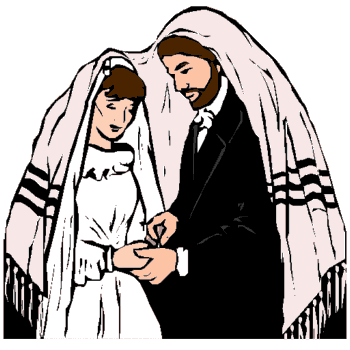
My wife and I at our wedding.

Yesod HaBriah: Why Monogamy is Yeshua’s Halacha
By
James Scott Trimm

One of the halachic principles which distinguished the Essenes from the Pharisees (whom the Essenes termed “Wall Builders”) was a principle the Essenes called “Yesod HaB’riah” (The Principle/Foundation of Creation).

The Pharisees were divided on the issue of divorce. The House of Shammai allowed divorce only in the case of an “unclean matter” (adultery) while the House of Hillel allowed divorce even if the wife only spoiled a dish, and Akiva stretched this to allow a man to divorce his wife because he found a prettier one (m.Gittin 9:10)

The Essenes said the Pharisees had fallen into a trap of Belial saying:

They are caught in…Fornication, by taking two wives
in their lifetime although the Principle of Creation (Yesod HaBriah)
is “male and female He Created them” (Gen. 1:27) and those who
entered the ark “went into the ark two by two” (Gen. 7:9). Concerning
the Leaders it is written “he shall not multiply wives to himself” (Dt. 17:17)
(Damascus Document 4,20-5,2)

The Essenes were accusing the Pharisees of effectively practicing polygamy in allowing divorce so easily, and in doing so, violating the Yesod HaBriah.

No doubt Messiah is citing Yesod HaBriah (The Principle of Creation) when he has the following halachic debate with a group of Pharisees:

19:3 And the P’rushim approached him, and tempted him,
saying, “Is it right for a man to put away his wife for every cause?”
19:4 And he answered and said to them:
“Have you not read that he who made man the beginning,
‘made them male and female’ (Gen. 1:27)
19:5 And said,
‘Wherefore shall a man shall leave his father
and his mother, and cleave to his wife, and the two shall become one flesh’ (Gen. 2:24)
19:6 And now then, they are no more two but one flesh
only. What therefore Elohim has joined together man cannot separate.”
19:7 But they said,
“And why then did Moshe then command
to give a bill of divorcement, and to put her away
if she was not pleasing in his sight?” (Deut. 24:1, 3)
19:8 And he answered them and said,
“Because Moshe on account of the hardness of your hearts,
allowed you to put away your wives,
but from the beginning it was not so.
19:9 And I tell you,
every man that has put away, or shall put away his wife,
except it be for fornication, and takes another,
commits adultery. And whoever takes the divorced also
commits adultery.
(Mt. 19:3-9)

Notice that divorce and polygamy equally fall under the violation of the Yesod HaBriah. Neither actually violates the Torah itself, but both violate a halachic principle which is preferred.

Notice that Yeshua treats divorce as a last resort, which YHWH does not forbid, but does discourage. YHWH recognized that divorces happen in society and thus the Torah regulates divorce. The Torah does not encourage divorce, and certainly does not find it a blessing, because it violates the Yesod HaBriah (Principle of Creation).

Polygamy, like divorce, violates the Yesod HaBriah. The Torah does not forbid polygamy, it recognized that polygamy was practiced and thus regulated it. The Torah did not encourage polygamy, and certainly does not find it to be a blessing, because it violates the Yesod HaBriah (Principle of Creation).

Now imagine a leader in the movement wrote a book encouraging men to divorce their wives because they found prettier women, or because their food was not cooked to suite them. Imagine that the book called this a “shocking freedom” and a blessing even for women. Imagine the leader sends out an email soliciting pretty women to match with these men who are ready to divorce. Imagine he changes the whole focus of his ministry to promoting divorce to find prettier women. What would you expect the Overseers to do?

Just as divorcing a wife for a prettier woman violates the Yesod HaBriah, so does Polygamy. While polygamy does not violate the Torah, it does violate the Yesod HaBriah. A leader within the movement who encourages polygamy should be treated just as one who encourages divorcing wives for prettier women, and solicits pretty women to step into the dissolved marriages.

Yeshua’s Halacha, was for monogamy and against polygamy, and that therefore, is Nazarene halacha.

In these uncertain times, we need your support more than ever. Donations have been very low these last six weeks. The time is short, and there is much work to be done. This is no time to pull back from the great work in front of us!

As you know we have been digging ourselves out of a budget shortfall.  As I have said to you many times, I look on this work as a co-operative one with me, and all of you combining our resources together in order to get the job done of helping to teach this great truth to all in the world who will listen. Thank you so much from the bottom of my heart for your continued support, you are the ones who make it all possible by your contributions and your prayers for our work. I truly appreciate your help in every way.

If you can make a one time donation of $500 or $1,000 dollars to support this work.

If you can make a one time donation of $500 or $1,000 dollars to support this work.

Now is time to step up to the plate!

Donations can be sent by Paypal to donations@wnae.org.


Or click HERE to donate

The Three Garments of the Soul

The Three Garments of the Soul
and
The Manifestations of the Ruach
By
James Scott Trimm

Concerning the manifestations of the Ruach HaKodesh (Holy Spirit) Paul writes:

7 But the manifestation of the Spirit is given to each man, as it is profitable for him.
8 There is a word of wisdom that is given for it by the Spirit: and for another, a word of knowledge by the same Spirit,
9 For another, has trust by the same Spirit; for another, gifts of healing by the same Spirit,
10 And for another, power, and for another, prophecy, and for another, discerning of the Spirit, and for another, kinds of tongues, and for another, the interpretation of tongues.
11 Now all these [things], the same Spirit works and distributes to every man as He wills.
(1Cor. 12:7-11 HRV)

These nine manifestations fit neatly into three groups which correspond perfectly with the Chasidic teaching of the “Three Garments of the Soul”.  The Baal Shem Tov taught that the Soul has three garments, these are three ways in which the nefesh elokit (divine soul) expresses itself in this world:

“And Hashem spoke to Moshe saying: Speak to the B’nai Yisrael and say to them, When  you come over the Yarden into the land of Canaan, then shall appoint for yourselves cities that will be cities of refuge for you; that the slayer who kills an person unintentionally shall flee thereto. And they shall be to you cities for refuge from the avenger…” (Bamidbar 35:9-12.)

Reb Levi Yitzchak of Berditchev taught in the name of the Baal Shem Tov, that the three cities of refuge (there were three cities of refuge on each side of the Jordan) represent the three garments of the soul: thought, speech and action.

And as Rebbe Zalman writes in the Tanya:

In addition, every divine soul (nefesh elokit) possesses three garments, viz., thought, speech and action, [expressing themselves] in the 613 commandments of the Torah. For, when a person actively fulfils all the precepts which require physical action, and with his power of speech he occupies himself in expounding all the 613 commandments and their practical application, and with his power of thought he comprehends all that is comprehensible to him in the Pardes of the Torah— then the totality of the 613 “organs” of his soul are clothed in the 613 Commandments of the Torah.
(Tanya; Likutei Amarim; Chapter 4)

These three garments of the soul are derived from the Torah:
But the word is very near unto you:
in your mouth and in your heart,
that you may do it.
(Deut. 30:14 HRV)

The first century Jew Philo of Alexandria understood this passage similarly saying:

(236) It is worth while, therefore, to examine what is meant by this purification which may be accomplished in three ways. Now it may almost be said that both offences and good actions are perceived to exist in three things; in intention, or in words, or in actions. On which account Moses, teaching in his hortatory admonitions that the attainment of good is not impossible nor even very difficult, says, (237) “It is not necessary to soar up to heaven, nor to go to the borders of the earth and sea, for the attainment of it, but it is near, yea, and very Near.”(Deut. 30:10.) And then in a subsequent passage he shows it all but to the naked eye as one may say, where he says, “Every action is in thy mouth, or in thy heart, or in thy Hands:”(Deut. 30:14.) meaning under this symbolical expression, in thy words, or in they designs, or in thy actions. For he means that human happiness consists in wise design, and good language, and righteous actions, just as the unhappiness arises from the contrary course.
(On the Change of Names 236-237)

(183) Moreover, Moses delivers to us very beautiful exhortations to repentance, by which he teaches us to alter our way of life, changing from an irregular and disorderly course into a better line of conduct; for he says that this task is not one of any excessive difficulty, nor one removed far out of our reach, being neither above us in the air nor on the extreme borders of the sea, so that we are unable to take hold of it; but it is near us, abiding, in fact, in three portions of us, namely, in our mouths, and our hearts, and our hands; (Deut. 30:11.) by symbols, that is to say, in our words, and counsels, and actions; for the mouth is the symbol of speech, and the heart of counsels, and the hands of actions, and in these happiness consists. (184) For when such as the words are, such also is the mind; and when such as the counsels are, such likewise are the actions; then life is praiseworthy and perfect. But when these things are all at variance with one another life is imperfect and blameable, unless some one who is at the same time a lover of God and beloved by God takes it in hand and produces this harmony. For which reason this oracular declaration was given with great propriety, and in perfect accordance with what has been said above, (Lev. 26:12.) “Thou hast this day chosen the Lord to be thy God, and the Lord has this day chosen thee to be his people.”
(On the Virtues 183-184)

And yet, what need is there, either of long journeys over the land, or of long voyages, for the sake of investigating the seeking out virtue, the roots of which the Creator has laid not at any great distance, but so near, as the wise lawgiver of the Jews says, (Deut. 30:14.) “They are in thy mouth, and in thy heart, and in thy hands:” intimating by these figurative expressions the words, and actions, and designs of men; all of which stand in need of careful cultivation.
(Every Good Man is Free 68)

Likewise the three manifestations of the Spirit follow this same pattern of the three garments:

The manifestations of the Word of Wisdom, Discerning of the Spirit and the Word of Knowledge are the Ruach manifesting itself through the garment of thought.

The manifestations of Power, Faith and Gifts of Hearing are the Ruach manifesting itself through the garment of action.

And the manifestations of Tongues, Prophecy and Interpretation of Tongues are the Ruach manifesting itself through the garment of speech.

The Ruach HaKodesh is manifested through the three garments by which our nefesh elokit (divine soul) is expressed in this world.

In these uncertain times, we need your support more than ever. Donations have been very low these last six weeks. The time is short, and there is much work to be done. This is no time to pull back from the great work in front of us!

As you know we have been digging ourselves out of a budget shortfall.  As I have said to you many times, I look on this work as a co-operative one with me, and all of you combining our resources together in order to get the job done of helping to teach this great truth to all in the world who will listen. Thank you so much from the bottom of my heart for your continued support, you are the ones who make it all possible by your contributions and your prayers for our work. I truly appreciate your help in every way.

If you can make a one time donation of $500 or $1,000 dollars to support this work.

If you can make a one time donation of $500 or $1,000 dollars to support this work.

Now is time to step up to the plate!

Donations can be sent by Paypal to donations@wnae.org.


Or click HERE to donate

Monogamy: The Ideal Union of Two Half Souls

Monogamy: The Ideal Union of Two Half Souls
By
James Scott Trimm

Although the Torah does not forbid polygamy, in the soul of the Torah we learn that the Image of Elohim is a “male and female” image, and that the ideal marriage is a reunion of two half souls, which become one.

Mankind was created in the image of Elohim (Gen. 1:26-27; 1Cor. 11:7). This image of Elohim is an invisible image of attributes, which make up the Godhead (Col. 1:15; Rom. 1:27).

Because that which may be known of Elohim is manifest in them;
for Elohim hath shewed it unto them.
(Rom. 1:19)

Then in Rom. 1:26-28 we are told that those who fail to perceive these things may fall into the errors of Homosexuality and Lesbianism . So when in creation were Elohim’s invisible attributes manifested in man and made clearly seen. The answer is in the Torah, in Gen. 1:26, 27 where we read:

Then Elohim said, “Let Us make man in Our image,
according to Our likeness…
So Elohim created man in His own image;
in the image of Elohim He created him;
male and female He created them.

Now following the parallelism of the passage, “Our image”, “Our likeness” and “male and female” appear to be parallel terms.

These feminine and masculine attributes are represented in the Tanak (“Old Testament”) by the Father (Jer. 31:9; Mal. 1:6; Is. 63:16; 64:8), the Mother (Is. 66:13 ) and the Son (Prov. 30:4; Ps. 2:2, 7, 12).

According to Jewish tradition, as stated in the Sefer Yetzirah, the Godhead is made up of ten aspects called “sefirot”:

Ten Sefirot of Nothingness ten and not nine ten and not eleven…
(Sefer Yetzirah 1:4)

If we arrange the attributes (sefirot) under three columns according to their characteristics as Mother (feminine), Father (masculine) and Son (feminine and masculine in perfect balance).

According to Jewish tradition the ten sefirot are arranged on a chart known as the “Tree of Life” under three columns known as the “three pillars of the Godhead”.

As we read in the Bahir:

Why are they called Sephirot?
Because it is written (Psalm 19:2),
“The heavens declare (me-SaPRim) the glory of Elohim.”
And what are they?
They are three. Among them are three troops and three dominions.
(Bahir 125-126)

The Zohar describes the three pillars of the Godhead as follows:

Then Elohim said, “Let thee be light; and there was light.
And Elohim saw that the light was good…
Why, it may be asked, was it necessary to repeat the word “light” in this verse? The answer is that the first “light” refers to the primordial light which is of the Right Hand, and it is destined for the “end of days”; while the second “light” refers to the Left Hand, which issues from the Right.

The next words, “And Elohim saw the light that it was good” (Gen. 1:4), refer to the pillar which, standing midway between them, unites both sides, and therefore when the unity of the three, right, left, and middle, was complete, “it was good”, since there could be no completion until the third had appeared to remove the strife between Right and Left, as it is written, “And Elohim separated between the light and between the darkness.”…

This is the Middle Pillar: Ki Tov (that it was good) threw light above
and below and on all other sides, in virtue of YHWH, the name which
embraces all sides.
(Zohar 1:16b)

The three columns of the Tree of Life chart are known as the “Three
Pillars of the Godhead.” These three pillars or columns correspond to
three “Supernal Lights” also known as the three Tzachtzachot.

The Encyclopedia Judaica explains these three supernal lights this way:

…above all emanated powers, there exist in “the root of all roots” three hidden lights which have no beginning, “for they are the name and essence of the root of all roots… It is stressed that these three lights constitute one essence and one root which is “infinitely hidden” (ne’lam ad le-ein sof) [literally: hidden until Eyn-Sof],
forming a kind of kabbalistic trinity that precedes the emanation of the ten Sefirot…. In the terminology of the Kabbalah these three lights are called tzachtzachot (splendors)… Christians later found an allusion to their own doctrine of the trinity in this theory.
(KABBALAH by Scholem p. 95)

These qualities represent the male and female aspects of Elohim as the Encyclopedia Judaic also states:

Reference to male and female appear not only in the symbolism of father and mother, son and daughter… but also in the striking use of sexual imagery which is a particular characteristic of the Zohar…
(Kabbalah p. 573 – emphasis added)

This concept of YHWH being expressed as a Father (Is. 63:16; 64:8; Jer. 31:9 & Mal. 1:6) and a Mother (Is. 66:13) is found in the Tanak (“Old Testament”) itself, in which we are told that the image of Elohim in which man was created was “male and female” (Gen. 1:26-27).

Now in Romans 1:19-20 we are told:

19: Because that which may be known of Elohim is manifest in them; for Elohim hath shewed it unto them.
20: For the invisible things of him from the creation of the world are
clearly seen, being understood by the things that are made, even his
eternal power and Godhead; so that they are without excuse:
(Rom. 1:19-20)

Further down in Rom. 1:26-28 we are told that those who fail to
perceive these things may fall into the errors of Homosexuality and
Lesbianism.

So when in creation was Elohim’s invisible attributes manifest in man
and made clearly seen. The answer is in Gen. 1:26, 27 where we read:

Then Elohim said, “Let Us make man in Our image,
according to Our likeness…
So Elohim created man in His own image;
in the image of Elohim He created him;
male and female He created them.

Now following the parallelism of the passage, “Our image”, “Our likeness” and “male and female” appear to be parallel terms.

The male aspect of this image of Elohim is called “Father” as we read in the Tanak (“Old Testament”):

…If then I be a Father, Where is My honor?…
Says the YHWH of Hosts. …
(Mal. 1:6)

…You, O YHWH, are our Father,
Our Redeemer from everlasting is Your name.
(Is. 63:16)

But now. O YHWH, You are our Father;…
(Is. 64:7)

The female aspect of this image is called “mother” as we also read in
the Tanak (“Old Testament”):

As one whom his mother comforts, so will I [YHWH]
comfort you…
(Is. 66:13)

YHWH as a “comforter” is also known as the Ruach HaKodesh as we read in John:

…I will ask my Father and he will give you another comforter that will
be with you forever,
The Spirit of Truth …
(Jn. 14:16-17)

…the comforter, the Ruach HaKodesh, whom my Father will send in my name,…
(Jn. 14:27)

…when the comforter comes. Whom I will send you from my Father, the Spirit of Truth who has proceeded from my Father…
(Jn. 15:26)

…I will send the comforter to you.
(Jn. 16:7)

The Ruach HaKodesh is the Spirit of Elohim, which rested upon Messiah at his immersion:

…behold, the Spirit of Elohim descending from the heavens…
…and rested upon him…
(Mt. 3:16-17 see also Mk. 1:10-11; Lk. 3:21-22 & Jn. 1:33)

Which is the Spirit of YHWH which rests upon Messiah in Isaiah 11:2-4:

And the Spirit of YHWH shall rest upon him, the Spirit of Wisdom
(Chokmah) and Understanding (Binah) the Spirit of Counsel (Atzah) and power (Gevurah) the spirit of knowledge and of the fear (yirah) of
YHWH …But with righteousness shall he judge…
(Is. 11:2-4)

This Ruach HaKodesh is clearly is the “her/she” of Prov. 8:1-2, 12-18:

Does not wisdom call, And understanding put forth her voice?
Where the paths meet, she stands…I Wisdom (Chokmah) dwell with
prudence…the fear (yirah) of YHWH is to hate evil…
Counsel (atzah) is mine…I am understanding (Binah) power (Geburah) is mine…. …by me rule… all judges…

One problem that presents itself in translating the New Testament from Hebrew and Aramaic into English is that of the gender of the Ruach HaKodesh (Ruach HaKodesh). English is very different from Hebrew and Aramaic. To begin with English has three genders, masculine, feminine and neuter (i.e. he, she and it). Hebrew and Aramaic have no neuter gender. In Hebrew and Aramaic everything is either a “he” or a “she” and nothing is an “it”. Also gender plays a much more important role in Hebrew and in Aramaic than in English. In English gender is usually only an issue when dealing with pronouns. But in Hebrew and in Aramaic nouns and verbs are also masculine or feminine. And while there are no true adjectives in Hebrew (nouns are used as adjectives), noun modifiers must agree in gender with the noun. Now the Hebrew word RUACH (Aramaic RUCHA) is grammatically feminine as is the phrase Ruach HaKodesh. This is matched by the role of the Ruach HaKodesh as “comforter” (Jn. 14-16) and the identification of the “comforter” with YHWH acting as a “mother” (Is. 66:13).

Now in English the Ruach is often referred to as “he” or “it” as also in the Greek New Testament. However this seems very odd indeed to the Semitic mind. In fact the Peshitta Aramaic of Rom. 8:16 opens (literally) with “And she the Ruach gives testimony….”

While it is clear that the Ruach HaKodesh has no literal gender, it is also clear that the Ruach HaKodesh is grammatically and figuratively a “she”.

Now the ancient Nazarenes (an ancient Jewish sect of believers in Yeshua) actually believed the Ruach HaKodesh to be a sort of Heavenly Mother. These ancient Nazarenes used an apocryphal Gospel called The Gospel according to the Hebrews.  While this apocryphal Gospel is now lost, several quotes from it have survived in the writings on the ancient “Church Fathers.” One of these quotes, found in Jerome’s commentary on Isaiah, tells the story of Messiah’s baptism as follows:

And it came to pass when YHWH was come up out of the water, the whole fount of the Ruach HaKodesh descended and rested upon him, and said to him, “My Son, in all the prophets was I waiting for you that you should come, and I might rest in you. For you are my rest, you are My firstborn son, that reigns forever.”
(Jerome- On Is. 11:2)

Here it is the Ruach HaKodesh, not the Father, who is calling Messiah “My Son” In another place the Church Fathers cite a passage from this lost Gospel where Messiah is reported as saying:

“Even so did my Mother, the Ruach HaKodesh, take me by one of my hairs and carry me away to the great mountain Tabor.”
[Origen- On Jn. 2:12; Hom. on Jer. 15:4; Jerome- On Micah 7:6; On. Is. 40:9; On Ezkl. 16:13]

There are other feminine titles for Elohim as well, which also point to the feminine aspect within the Godhead. Among these are terms like Shekinah (glory – a feminine word in Hebrew) and El-Shaddai. “El” means “Elohim” while Shaddai is the dual form of the Hebrew word “Shad” (Strong’s Heb. # 7699) “the breast of a woman” so that El-Shaddai signifies “El, the double breasted” or the Elohim with a woman’s breasts.

Just as there is a Father aspect of the Godhead and a Mother aspect of the Godhead, there is also a “Son” aspect of the Godhead as well as we read in the Tanak (“Old Testament”):

Who has ascended up into heaven, and descended?
Who has gathered the wind in his fists?
Who has bound the waters in his garment?
Who has established all the ends of the earth?
What is his name, and what is his son’s name, if you know?
(Prov. 30:4)

The kings of the earth stand up,
And the rulers take counsel together,
Against YHWH, and against His Messiah:…
I will tell of the decree:
YHWH said to me: “You are My Son,”
This day have I begotten you….
Kiss the Son, lest he be angry…
(Ps. 2:2, 7, 12)

We have already established that the right and left pillars are assigned as Mother and Father, the middle pillar, which balances the feminine and masculine characteristics from the male and female sides, is identified in the Zohar as “the Son of Yah” (“Yah” being short for “Yahweh” the proper name of Elohim.):

Better is a neighbor that is near, than a brother far off.
This neighbor is the Middle Pillar in the Godhead,
which is the Son of Yah.
(Zohar 2:115)

In another Passage the Zohar has:

The Holy One, blessed be He, has a son, whose glory (tifret) shines
from one end of the world to another. He is a great and mighty tree,
whose head reaches heaven, and whose roots are set in the holy ground, and his name is “Mispar” and his place is in the uppermost heaven… as it is written, “The heavens declare (me-SaPRim) the glory (tifret) of Elohim” (Ps. 19:1).
Were it not for this “Mispar” there would be neither hosts
Nor offspring in any of the worlds.
(Zohar 2:105a)

This is intended to point the reader back to a familiar passage from the Bahir:

Why are they called Sephirot?
Because it is written (Psalm 19:2),
“The heavens declare (me-SaPRim) the glory of Elohim.”
(Bahir 125)

As the Middle Pillar of the Godhead the Son of Yah is centered and focused at tifret and is the harmony of all of the pillars. The Son encompasses the Tree of Life and the ten sefirot. “In him dwells all the fullness of the Godhead” (Col. 2:9).

Moreover the the Zohar elsewhere states:

We may also translate “he who withholds blessings from the Son” (Prov. 11:26), Whom the Father and Mother have crowned and blessed with many blessings, and concerning whom they commanded, “Kiss the Son lest he be angry” (Ps. 2:12), since he is invested with judgment (gevurah) and with mercy (chesed).
(Zohar 3:191b)

Now with all of this discussion about the plural nature of the Godhead, we must not lose sight of the primary tenant of Judaism, the Sh’ma. The Sh’ma declares the oneness of the Godhead as follows:

Hear O Israel: YHWH your Elohim, YHWH is ECHAD
(Dt. 6:4a)

Now this text stresses the oneness (echad) of YHWH. The question remains however, what in light of the plural nature of the Godhead, does “ECHAD” really mean?

The Hebrew word “echad” means “one” or “a unity.” This word appears in
several passages in the Torah, which make it clear that echad may refer to a unity:

Therefore a man shall leave his father and mother and be joined to his
wife, and they shall become one [echad] flesh.
(Gen. 2:24)

And YHWH said, “Indeed the people are one [echad] and they all have one language…
(Gen. 11:6)

Now Deut. 6:4 states:

Hear O Israel: YHWH your Elohim, YHWH is one [echad]

In light of the various passages discussed previously in which there are two or three pillars called “YHWH”, this passage could be read to mean that YHWH, Elohim and YHWH are echad (a unity.) In fact this is exactly the interpretation given to this passage by the Zohar:

The prescribed daily form of prayer
(a confession of the unity in the godhead),
has for its object, that you shall know and
comprehend it. We have said in many places
that this daily form of prayer is one of those
passages concerning the unity, which is taught
in the Scriptures. In Deut. 6:4, we read first
“YHWH”, then “our Elohim” and again “YHWH”,
which together make one unity. But how can
three names be one? Are they truly one,
because we call them one? How three can
be one can only be known through the revelation
of the Ruach HaKodesh, and, in fact, with closed eyes.
This is also the mystery of the voice. The voice is
heard only as one sound, yet it consists of three
substances, fire, wind, and water, but all three
are one, as indicated through the mystery of the
voice.

Thus are “YHWH”; “our Elohim”; “the lord”
but one unity, three substantive beings which
are one; and this is indicated by the voice
which a person uses in reading the words,
“Hear, O Israel,” thereby comprehending
with the understanding the most perfect unity
of the boundless one; because all three
are read with one voice, which indicates a
trinity.

And this is the daily confession of faith
of the unity, which is revealed by
the Ruach HaKodesh in a mystery. Although
there are so many persons united in the unity,
yet each person is a true-one;
what the one does, that the other does.
(The Zohar Vol. 2 p. 43):

These qualities represent the male and female aspects of Elohim as the Encyclopedia Judaica also states:

Reference to male and female appear not only in the symbolism of
father and mother, son and daughter… but also in the striking use of
sexual imagery which is a particular characteristic of the Zohar…
(Kabbalah p. 573)

This concept of YHWH being expressed as a Father (Is. 63:16; 64:8; Jer. 31:9 & Mal. 1:6) and a Mother (Is. 66:13) is found in the Tanak (“Old Testament”) itself, in which we are told that the image of Elohim in which man was created was “male and female” (Gen. 1:26-27).

According to Scripture man was originally created in the image of Elohim “male and female” (Gen. 1:27) then Elohim took the “rib” from Adam and made “woman” (Gen. 2:21-22). The Hebrew word for “rib” here can also be translated “side” so that Elohim took one “side” of man and made woman. One Jewish tradition has it that man was originally created male on his right side and female on his left side. Another Jewish tradition has it that man and woman were originally joined at the back and that Elohim separated them with an axe. Fanciful as these traditions are, there is some truth to them. Today we know that males and females have tendencies to each be more dominant on different hemispheres of their brains. Jewish tradition holds that an unmarried man is only half of a man.

When a man and woman are joined together they become “one”:

Therefore shall a man leave his father and his mother,
and shall cleave unto his wife:
and they shall be one flesh.
(Gen. 2:24)

They each complete the other and restore each other to the very image of Elohim that man was originally made in: male and female. This joining together and oneness is not just physical, but spiritual as
well. Messiah refers to them as having been joined by Elohim:

And he answered and said unto them, Have ye not read, that he which made them at the beginning made them male and female,
And said, For this cause shall a man leave father and mother, and
shall cleave to his wife: and they twain shall be one flesh?
Wherefore they are no more twain, but one flesh.
What therefore Elohim hath joined together, let not man put asunder.
(Mt. 19:4-6)

Ephesians states:

So it is right for husbands to love their wives as their [own] bodies,
for he who loves his wife loves his nefesh.
(Eph. 5:28).

(“Nefesh” is the Aramaic word for “soul”) Why does Paul say that a man who loves his wife, loves his own soul?

When Elohim called the Prophet Jeremiah He said:

Then the word of YHWH came unto me, saying,
Before I formed you in the belly I knew you;
and before you came forth out of the womb I sanctified you,
and I ordained you a prophet unto the nations.
(Jer. 1:4-5)

Elohim knew the soul of Jeremiah before Jeremiah was ever born. This is because all creation was completed by the end of the sixth day of creation as the Scripture states: “And on the sixth day Elohim finished His work which He had made…” (Gen. 2:2)

Now when man was first created on the sixth day, man was created “in the image of Elohim … male and female. (Gen. 1:26-27)

However after creation was completed Elohim extracted the “female” aspect of man and made woman:

And Adonai YHWH caused a deep sleep to fall upon Adam and he slept: and he took one of his ribs, and closed up the flesh instead thereof; And the rib, which the Adonai YHWH had taken from man, made he a woman, and brought her unto the man.
And Adam said, This is now bone of my bones, and flesh of my flesh:
she shall be called Woman, because she was taken out of Man.
(Gen. 2:21-23)

The Hebrew word for “rib” in this verse can also mean “side”. The text goes on to say:

24: Therefore shall a man leave his father and his mother,
and shall cleave unto his wife: and they shall be one flesh.
(Gen. 2:24)

All creation was completed on the sixth day. Every soul that would ever be created was created by the end of that sixth day. All of these souls were, like that of the first man, both “male and female” and just as Elohim extracted the female side of Adam to make Eve, He must also have extracted the female “side” of all of the other souls, thus dividing them each into what one might think of as “half souls”, a female half and a male half. When two such half-souls are reunited they become “one” just as the image of Elohim from which they were modeled is “male and female” (Gen. 1:26-27) yet is totally united as
“one” (Deut. 6:4).

The Talmud says:

R. Eleazar said: Any man who has no wife is no proper man;
for it is said, Male and female created He them
and called their name Adam.
(b.Yeb. 63a)

The Zohar elaborates on this ideal as it says:

All the souls in the world… are all mystically one,
But when they descend to this world they are
separated into male and female, though these are
still conjoined. When they first issue forth, they
issue male and female together. Subsequently,
when they descend (to this world) they separate,
one to one side and the other to the other. And
Elohim afterwards mates them—Elohim and no other,
He alone knowing the proper mate to each. Happy
is the man who is upright in his works and walks
in the way of truth, so that his soul may find its
original mate, for then he becomes indeed perfect,
and through his perfection the whole world is
blessed.
(Zohar 1:85b)

Ideally then if a man has been reunited with his other “side” and he loves his wife, he is literally loving his own soul, just as Paul says in the original Aramaic!

Thus the ideal marriage in the soul of the Torah, is a union between two half souls, which become one, thus emulating the “male and female” image of Elohim from which we were created.

In these uncertain times, we need your support more than ever. Donations have been very low these last six weeks. The time is short, and there is much work to be done. This is no time to pull back from the great work in front of us!

As you know we have been digging ourselves out of a budget shortfall.  As I have said to you many times, I look on this work as a co-operative one with me, and all of you combining our resources together in order to get the job done of helping to teach this great truth to all in the world who will listen. Thank you so much from the bottom of my heart for your continued support, you are the ones who make it all possible by your contributions and your prayers for our work. I truly appreciate your help in every way.

If you can make a one time donation of $500 or $1,000 dollars to support this work.

If you can make a one time donation of $500 or $1,000 dollars to support this work.

Now is time to step up to the plate!

Donations can be sent by Paypal to donations@wnae.org.


Or click HERE to donate

The Torah Inside

The Torah Inside
By
James Scott Trimm

Observing Torah must not be empty and detached, simply going through the motions.  Observing Torah flows from our internalization of Torah.

The Torah is the very expression of the mind of Elohim. When the wisdom of Torah gestates in our understanding it gives birth to a knowledge of Torah within us. This Torah within us unites with our mind and manifests itself in what we think, what we say and what we do, thus overcoming the evil inclination within us and uniting us with the mind of YHWH, thus “cleaving” to YHWH. We do not observe Torah as one trying to earn something, but with no mind of a reward, for its own sake, to bring us closer to YHWH, out of the love and awe that we have for Him.

This internalization of Torah is clear in the Talmud.  One of the first disputes recorded in the Mishnah centers around the issue of how the shema should be recited:

The House of Shammai says: In the evening one should recline in order to recite the shema, and in the morning they should stand. As it is written “when you lie down and when you rise up.” (Deuteronomy 6:7)
But the House of Hillel says: Everyone may recite the Shema in his own way, as it is written: “And you shall go by the way” (Deuteronomy 7:7)
 (m.Berachot 1:3)

The House of Shammai took the phrase “when you lie down and when you rise up.” (Deuteronomy 6:7) to mean that the shema should literally be said lying down and standing up.

But the House of Hillel taught that this simply referred to the time at which people lie down and the time at which people rise up, and not to the position in which one recites the shema.

Note that the House of Shammai were concerned primarily with the outward expression, with whether one was standing or reclining, while the House of Hillel were less concerned with such outward expression and much more concerned with the way in which one recited the Shema, that they made it their own way, that they meant it and walked in it. Note the difference in emphasis of the two houses.

Hillel was more concerned with the inner man, while Shammai was more concerned with the outer man. Hillel was concerned with the Spirit of the Law, while Shammai was more concerned with the Letter of the Law.

This overriding concept of sincerity is also found in the Mishna in tractate Menachot:

 “…all are the same, the one who offers much and the one who offers little,
on condition that a man will direct his intention to Heaven.”
(m.Menachot 13:11)

Again, the act of Torah observance must not be an empty matter of going through the motions, it must proceed from our internalization of Torah.

The Torah and the Messiah are one. When we study Torah, the Wisdom of Torah gestates in our Understanding and gives birth to Knowledge of Torah. This is what is meant by having the Torah in our inward parts. Since the Torah and the Messiah are one, this is also having the Messiah within us. The Messiah within us is a spark of YHWH within us, a second soul. While our animal soul has an inclination to do evil, this second soul has an inclination to do good. This helps us to overcome our evil inclination. This occurs as Wisdom, Understanding and Knowledge of Torah within us flows from our mind down to our emotions, resulting in a love for Elohim that inclines us to keep the positive commandments, and awe for Elohim that inclines us not to violate the negative commandments.

In these uncertain times, we need your support more than ever. Donations have been very low these last six weeks. The time is short, and there is much work to be done. This is no time to pull back from the great work in front of us!

As you know we have been digging ourselves out of a budget shortfall.  As I have said to you many times, I look on this work as a co-operative one with me, and all of you combining our resources together in order to get the job done of helping to teach this great truth to all in the world who will listen. Thank you so much from the bottom of my heart for your continued support, you are the ones who make it all possible by your contributions and your prayers for our work. I truly appreciate your help in every way.

If you can make a one time donation of $500 or $1,000 dollars to support this work.

If you can make a one time donation of $500 or $1,000 dollars to support this work.

Now is time to step up to the plate!

Donations can be sent by Paypal to donations@wnae.org or by Zelle, Go Fund Me, Bitcoin or Ethereum.


Click HERE to donate

Yichud: Unity with YHWH

Yichud: Unity with YHWH
By
James Scott Trimm

Our Messiah Yeshua said:

11 From now on, I am not in the world: but these are in the world. And I come to you, Set-Apart Father: keep them in Your Name that You gave Me, <that they be one, as we are. >
12 While I was with them in the world, I kept them in Your Name; those whom You gave Me I have kept, and not one of them is lost: except the son of destruction, that the Scripture might be fulfilled.
13 And now I come to you. And these things I speak in the world that My joy might be full in them.
14 I have given them Your word: and the world hated them because they were not of the world, as I am not of the world.
15 I do not ask that You take them from the world: but that You keep them from evil,
16 For they are not of the world, as I am not of the world.
17 Father, sanctify them by Your truth: for Your word is truth.
18 As you sent Me into the world, also I send them into the world.
19 And for their sakes, I sanctify My nefesh, that they also might be sanctified in truth.
20 And I do not ask for the sake of these alone, but also for the sake of those who will have trust in Me, through their word.
21 That all might be one, as You are My Father, in Me, and I am, in You: that they also might be one in us, that the world might believe that You sent Me.
22 And the glory that You gave Me I gave to them, that they might be one, as we are one.
23 I am in them, and You are in Me, that they be perfected into one: and that the world, might know that You sent Me, and that You have loved them, as also You loved Me.
(John 17:11-23 HRV)

Now there are three important things (among many other) that we can learn from these words:

1. Messiah wishes us to have Yichud (unity) with YHWH just as he has Yichud with YHWH.  And how do we attain Yichud (unity)?  Here we learn that Messiah wishes us to be one with one another through our unity with Messiah and YHWH who are also one.

2. Messiah teaches us that this unity is achieved through the Word of YHWH, also referred to here as the “truth” (And we know from Ps. 119:142, 151 that the Torah is truth).

3. Messiah teaches us that through this Yichud (unity) his joy of fills us.

So how do we obtain Yichud (unity) with YHWH through the Torah, and how does that Yichud fill us with the joy of Messiah?

The key is that the Torah and YHWH are one.  As we read in the Tanya:

…the Torah and the Holy One, blessed be He, are one. The meaning of this is that the Torah, which is the wisdom and will of the Holy One, blessed be He, and His glorious Essence are one, since He is both the Knower and the Knowledge, and so on,…

For the Holy One, blessed be He, has compressed His will and wisdom within the 613 commandments of the Torah, and in their laws, as well as within the combination of the letters of the Torah, the books of the Prophets and the Hagiographa, and in the exposition thereof which are to be found in the Agadot and Midrashim of our Rabbis of blessed memory. All this in order that each neshamah, or ruach and nefesh in the human body should be able to comprehend them through its faculty of understanding, and to fulfil them, as far as they can be fulfilled, in act, speech and thought, thereby clothing itself with all its ten faculties in these three garments….
(Tanya Chapter 4)

The Torah expresses the very mind of YHWH.

Now the human soul may be divided into its intellectual and emotional aspects.  The intellectual aspects comprise the upper three sefirot, while the emotional aspects encompass the seven lower sefirot.  As we read in the Tanya:

Now, each distinction and grade of the three— nefesh, ruach and neshamah— consists of ten faculties, corresponding to the Supernal Ten Sefirot (Divine manifestations), from which they have descended, which are subdivided into two, namely, the three “mothers” and the seven “multiples,” to wit: chochmah (wisdom) binah (understanding) and da at (knowledge); and the “seven days of Creation:” chesed (kindness), gevurah (power), tiferet (beauty), and so on.

Similarly is it with the human soul, which is divided in two— sechel (intellect) and middot (emotional attributes). The intellect includes chochmah, binah and da at (ChaBaD), whilst the middot are love of G-d, dread and awe of Him, glorification of Him, and so forth. ChaBaD [the intellectual faculties] are called “mothers” and source of the middot, for the latter are “offspring” of the former.
(Tanya Chapter 3)

Now through our intellect, we receive the Wisdom of the Torah, and having heard the Wisdom of Torah we subject it to Understanding.  When Wisdom (chochmah) is subjected to Understanding (binah) the result is Knowledge (da’at)… it is Knowledge that brings Wisdom and Understanding together.  When we receive as Wisdom a precept of Torah, and that precept like a seed enters into Understanding then that precept becomes part of us as our Knowledge.  As we read in the Tanya:

Specifically: the faculties of ChaBaD in his soul are clothed in the comprehension of the Torah, which he comprehends in Pardes, to the extent of his mental capacity and the supernal root of his soul.
(Tanya Chapter 4)

Now, when an intellect conceives and comprehends a concept with its intellectual faculties, this intellect grasps the concept and encompasses it. This concept is [in turn] grasped, enveloped and enclothed within that intellect which conceived and comprehended it.

The mind, for its part, is also clothed in the concept at the time it comprehends and grasps it with the intellect. For example, when a person understands and comprehends, fully and clearly, any halachah (law) in the Mishnah or Gemara, his intellect grasps and encompasses it and, at the same time, is clothed in it.
(Tanya Chapter 5)

And as we read in 1Corinthians:

12 Now we have not received the spirit of the world, but the Spirit that is from Eloah, so that we might know the gifts that were given to us from Eloah,
13 Which also we speak, not in the teaching of words of the wisdom of sons of men, but in the teaching of the Spirit, and to spiritual men we compare spiritual things.
14 For the son of man who is in the nefesh, does not receive spiritual things, for they are foolishness to him, and he is not able to know that which is judged spiritually.
15 Now the spiritual man judges all things, and is not judged from man.
16 For who knows the mind of YHWH that he might instruct Him? But we have the mind of the Messiah.
(1Cor. 2:1-16)

From this knowledge comes faith, and the seven “middot” or emotions.  Thus when we study Torah and that knowledge of Torah becomes a part of us and expresses itself in our thoughts, our words and our deeds, then we have Yichud with YHWH and that Yichud flows down through the seven middot expressing itself in the fear of YHWH and the joy of the love of YHWH.  As we read in the Tanya:

And the middot, namely fear and love, together with their offshoots and ramifications, are clothed in the fulfilment of the commandments in deed and in word, namely, in the study of Torah which is “The equivalent of all the commandments.”
(Tanya Chapter 4)

In these uncertain times, we need your support more than ever. Donations have been very low these last six weeks. The time is short, and there is much work to be done. This is no time to pull back from the great work in front of us!

As you know we have been digging ourselves out of a budget shortfall.  As I have said to you many times, I look on this work as a co-operative one with me, and all of you combining our resources together in order to get the job done of helping to teach this great truth to all in the world who will listen. Thank you so much from the bottom of my heart for your continued support, you are the ones who make it all possible by your contributions and your prayers for our work. I truly appreciate your help in every way.

If you can make a one time donation of $500 or $1,000 dollars to support this work.

If you can make a one time donation of $500 or $1,000 dollars to support this work.

Now is time to step up to the plate!

Donations can be sent by Paypal to donations@wnae.org.


Or click HERE to donate

Baptized in the Holy Spirit with Evidence of… Torah Observance

Baptized in the Holy Spirit with Evidence of… Torah Observance?
By
James Scott Trimm

I have often been asked by Charismatic Christians if I have been “Baptized in the Holy Spirit with evidence of speaking in tongues”. But is speaking in tongues the scriptural evidence of being immersed in the Ruach HaKodesh? Lets look at what the Scriptures actually say on this topic.

We read in Ezekiel:

17 Therefore say, Thus says the Adonai YHWH: I will even gather you from the peoples, and assemble you out of the countries where you have been scattered: and I will give you the land of Yisra’el.
18 And they shall come there, and they shall take away all the detestable things thereof, and all the abominations thereof, from thence.
19 And I will give them–one heart–and I will put a new spirit within you. And I will remove the–stony heart–out of their flesh, and will give them a heart of flesh,
20 That they may walk in My statutes and keep My ordinances, and do them: and they shall be My people, and I will be their Elohim.
21 But as for them whose heart walks after the heart of their detestable things and their abominations, I will bring their way upon their own heads, says the Adonai YHWH
(Ezek. 11:17-21 HRV)

And later Ezekiel says:

25 And I will sprinkle clean water upon you, and you shall be clean. From all your uncleannesses and from all your idols, will I cleanse you.
26 A new heart also will I give you, and a new spirit will I put within you. And I will take away, the stony heart out of your flesh, and I will give you, a heart of flesh.
27 And I will put My spirit within you, and cause you to walk in My statutes, and you shall keep My ordinances, and do them.
(Ezekiel 36:25-27 HRV)

And as our Messiah Yeshua told us that when the “Spirit of Truth” has come, that Spirit would “lead you in all truth” (John 16:13) And what is truth? The Psalmist tells us that the “Torah is truth” and that “all of his commandments are truth” (Ps. 119:142, 151).

The true evidence of the indwelling of the Ruach HaKodesh, is Torah observance. So now you know that you can say “I have the Baptism of the Holy Spirit with evidence of walking in statutes and keeping of ordinances,”

We must raise at least $630 by the end of the day today (2/19/25) to keep our account from plunging into the negative and creating a cascade chain reaction of returned items and fees. Donations have been very low these last six weeks. The time is short, and there is much work to be done. This is no time to pull back from the great work in front of us!

As you know we have been digging ourselves out of a budget shortfall.  As I have said to you many times, I look on this work as a co-operative one with me, and all of you combining our resources together in order to get the job done of helping to teach this great truth to all in the world who will listen. Thank you so much from the bottom of my heart for your continued support, you are the ones who make it all possible by your contributions and your prayers for our work. I truly appreciate your help in every way.

If you can make a one time donation of $500 or $1,000 dollars to support this work.

If you can make a one time donation of $500 or $1,000 dollars to support this work.

Now is time to step up to the plate!

Donations can be sent by Paypal to donations@wnae.org or by Zelle, Go Fund Me, Bitcoin or Ethereum.


Click HERE to donate

The Torah and Our Joy in Messiah

The Torah and Our Joy in Messiah
By
James Scott Trimm

We read in the Torah:

4 HEAR, O YISRA’EL: YHWH OUR ELOHIM, YHWH IS ONE.
5 And you shall love YHWH your Elohim with all your heart, and with all your soul, and with all your might.
6 And these words which I command you this day, shall be upon your heart.
7 And you shall teach them diligently unto your children: and shall talk of them when you sit in your house, and when you walk by the way, and when you lie down, and when you rise up.
8 And you shall bind them for a sign upon your hand, and they shall be for frontlets between your eyes.
9 And you shall write them upon the door posts of your house, and upon your gates.
(Deut. 6:4-9 HRV)

And:

Therefore shall ye lay up these my words in your heart and in your soul, and bind them for a sign upon your hand, that they may be as frontlets between your eyes.
(Deut. 11:18 HRV)

But what does it really mean to have the Torah in our hearts?

The Messiah is the Torah

Just as the Tanak identifies the Torah as the Way (Deut. 9:12; 11:22-28; 30:15-16) the Truth (Ps. 119:142, 151) the Life (Deut. 32:46-47) the Light (Prov. 6:23; Ps. 119:105; Is. 8:20; 51:4) and the Word (Is. 1:10; 2:3) the Ketuvim Netzarim identifies Yeshua as the Messiah as the Way, the Truth, the Life (Jn. 14:6) the Light (Jn. 8:12; 1:4-5, 9; 3:19; 9:5; 12:35-36, 46; 14:6) and the Word (Jn. 1:1-3; 14-18; Rev. 19:13). Because the Messiah is the Torah itself incarnate which “appeared on earth and lived among men” (Baruch 3:29).

We read in the Book of Baruch:

29 Who has gone up into heaven, and taken her [wisdom]
and brought her down from the clouds?
30 Who has gone over the sea, and found her,
and will buy her for pure gold?
(Baruch 3:29-30)

This is a reference back to the Torah where we read:

9 And YHWH your Elohim will make you over-abundant in all the work of
your hand, in the fruit of your body, and in the fruit of your cattle,
and in the fruit of your land, for good; for YHWH will again rejoice
over you for good, as He rejoiced over your fathers,
10 If you shall hearken to the voice of YHWH your Elohim, to keep His
commandments and His statutes which are written in this Book of the
Torah; if you turn unto YHWH your Elohim with all your heart, and with
all your soul.
11 For this commandment which I command you this day, it is not too
hard for you, neither is it far off.
12 It is not in heaven, that you should say: `Who shall go up for us
to heaven, and bring it unto us, and make us to hear it, that we may
do it?’
13 Neither is it beyond the sea, that you should says: `Who shall go
over the sea for us, and bring it unto us, and make us to hear it,
that we may do it?’
14 But the word if very near unto you, in your mouth, and in your
heart, that you may do it.
15 See, I have set before you this day life and good, and death and evil,
16 In that I command you this day to love YHWH your Elohim, to walk in
His ways, and to keep His commandments and His statues and His
ordinances; then you shall live and multiply, and YHWH your Elohim
shall bless you in the land where you go in to possess it.
(Deut. 30:9-16)

Then a few lines later Baruch writes:

37 Afterward she appeared upon earth and lived among men.
4:1 She is the book of the commandments of Elohim,
and the Torah that endures forever.
All who hold fast will live,
and those who forsake her fast will die.
(Baruch 3:29-30)

The Torah has long been recognized in Judaism as a living entity through which YHWH created the Heavens and the Earth. As we read in the Midrash Rabbah:

The Torah declares: ‘I was the working tool of the Holy One, blessed be He.’ In human practice, when a mortal king builds a palace, he builds it not with his own skill but with the skill of an architect. The architect moreover does not build it out of his head, but employs plans and diagrams to know how to arrange the chambers and the wicket doors. Thus Elohim consulted the Torah and created the world, while the Torah declares, IN THE BEGINNING GOD CREATED (I,1), BEGINNING referring to the Torah, as in the verse, YHWH made me as the beginning of His way (Prov. VIII, 22).
(Genesis Rabbah 1:5)

Let us now look at a passage of the Ketuvim Netzarim which Christians have totally misunderstood, Romans 10:4. It appears in the most Christian translations to say that “Christ is the end of the law”. The Aramaic word used for “end” here is SAKA. Back in 1893 when James Murdock S.T.D. (A Christian) translated the Aramaic Peshitta into English for the first time, he translated this word as “aim”. He noted the original Aramaic word in the margin and further defined it “end, scope, summary”. This Aramaic word is used in the Rabbinic literature to mean “number” “sum” or “total”. In the Babylonian Talmud this word is used as follows “…the SUM of pupils for a teacher in the primary class is twenty five” (b.Bat. 21a) The root verb for this Aramaic noun means “to calculate, count, sum up” or “to look out for, to hope for”.

With this Aramaic word, Paul is saying, not that the Messiah is the TERMINATION of the Torah, but that Messiah is the aim, goal, scope, summary, number, total and sum of the Torah! Paul is saying that the Messiah is the Torah. Messiah is the sum of the Torah.

Rom 10:5 then continues with:

For Moses thus wrote of the righteousness that is by the Torah that `he who does these will live by them.’
(Lev. 18:5)

Remember now, Paul has just said that the Messiah is the sum of the Torah, and now he is quoting the Torah to prove that “life” comes from the Torah.

Then in Rom. 10:6-8 Paul continues:

And of the righteousness that is by trust, he thus says: `Do not say in your heart: who has ascended to heaven’ (Deut. 30:12) and brought down the Messiah? `And who has descended’ to the depth of She’ol `and brought up’ (Deut. 13:13) the Messiah from among the dead? But what does it say? `The answer is near to you, to your mouth and to your heart,’ (Deut. 30:14) which is the word of trust that we proclaim”

Now Christian commentators have taken Paul to be contrasting “the righteousness that is by the Torah” (Rom. 10:5) with “the righteousness that is by faith” (Rom. 10:6) to prove that Messiah is the “end”/”termination” of the Law as stated in Rom. 10:4.

There are several problems with this interpretation.

To begin with, we have already shown that Paul’s point in Rom. 10:4 is not that Messiah is the termination of the law, but that Messiah is the goal and sum of the Torah.

Secondly Rom. 10:5 and Rom 10:6f both quote passages from the Torah to prove their points.

Thirdly, these commentators totally mangle the point Paul is making in Rom. 10:6-8.

When Paul was teaching the Bereans in Acts 17, we are told that they checked “the Scriptures” to see if what Paul said could be found there, and Paul said they were more noble than others he had taught, for doing this. Now the only Scriptures they had at the time were those of the Tanak (“Old Testament”) so Paul would look to the passages he cites from the Tanak to see that we are applying his words accurately as they are in the Tanak.

So lets be good Bereans and look at the portion of Torah Paul actually quotes in Rom. 10:6-8, see what it actually says in context, and see how Paul is using it. Paul is quoting from Deut. 30:12-14.

Now the first and most important point is that in Deut. 30:12-13 it is the Torah that we do not have to have brought down to us, but in Paul’s citations in Rom. 10:6-7 it is the “Messiah” who does not have to be brought down to us. Paul is applying his logic that Messiah is the sum of the Torah from Rom. 10:4 (thus reaffirming that we are
correct in our understanding of SAKA in Rom. 10:4).

In Baruch that which is brought down from heaven in Deut. 30:12-13 is personified Wisdom (compare 1Cor. 1:24 ) which is identified with an incarnation of the Torah itself having come down to earth to dwell with men.

Moreover, when Paul says “the answer is near to you, to your mouth, and to your heart, which is the word of trust that we proclaim” (Rom. 10:8) Deut. Says “But the WORD is very near unto you, in your mouth and in your heart, that you may do it” (Deut. 30:14). So the “answer” and the “word of trust/faith” in Rom. 10:8 is the “word” in Deut. 30:14, but in Deut. 30:14 that “word” is CLEARLY the Torah! In other words Rom. 10:8 might be understood “the TORAH is near to you, to your mouth, and to your heart, which is the TORAH of trust/faith that we proclaim”.

Fourth, we find that Deut. 30:15-16 parallel the meaning of Lev. 18:5 so that we can see that Paul is citing these two passages together, not because he is contrasting them, but because they teach the same thing!

Finally if we look back to Rom. 10:6 which is quoting Deut. 30:12 and we look closely at the phrase Paul quotes “who shall go up for us to heaven” in the original Hebrew of Deut. 30:12, and if we take the first letter of each word to from a new word (this is a technique known as “Notarikon”) then we spell the Hebrew word MILAH (which can mean “word” or “circumcision”) and if we take the last letter of each word we find the name YHWH, so hidden and imbedded in this Hebrew phrase is the phrase “Word of YHWH”. Paul’s point is that both the Messiah and the Torah are the “Word of YHWH”.

The Messiah is YHWH

The opening of the Shema reads:

SH’MA YISRAEL YHWH ELOHEYNU YHWH ECHAD
“Hear O Israel, YHWH, our Elohim, YHWH is one (ECHAD)”
(Deut. 6:4)

Let us examine other passages in the Torah to understand how this word ECHAD (“one”) is used in the Torah:

Therefore a man shall leave his father and mother and be joined
to his wife, and they shall become one [ECHAD] flesh.
(Gen. 2:24)

And YHWH said, “Indeed the people are one [ECHAD] and they
all have one language…
(Gen. 11:6)

Thus it is clear that the word ECHAD in no way requires a singularity and can refer to a composite unity.

Now let us to explore how this passage is understood by the Zohar:

The [profession of] unity that every day is [a profession of] unity
is to be understood and to be perceived. We have said in many places
that this prayer is a profession of Unity that is proclaimed:

”Hear O Yisrael, YHWH“ first, [then] “Eloheynu” [and] “YHWH” they are all One and thus He is called “One”.

Behold, these are three names, how can they be one? Is it because we call them one? (literally: And also concerning the proclamation that we call them one?). How these are one can only through the vision of the Holy Sprit be known. And these are through the vision of the closed eye (or the hidden eye) To make known that these three are one.
And this is the mystery of the voice that is heard. The voice is one. And is three GAUNIN: fire and air and water. And all these are one in the mystery of the voice.

And also here “YHWH, Eloheynu, YHWH” these are One. Three GAUNIN that are One. And this is the voice of the act of a son of man in [proclaiming] the Unity.
And to which he sees by the Unity of the “All” from Eyn Sof (the Inifinite One) to the end of the “All”. Because of the voice in which it is done, in these are three that are one.

And this is the [profession] of the daily profession of Unity that is revealed in the mystery of the Holy Spirit.

And there are many GAUNIN that are a Unity, and all of them are true, what the one does, that the other does, and what that one does, the other does.
(Zohar 2:43)

(The Aramaic word GA’UN (sing.)/GAUNIN (plural) comes from the word for “color” and refers to an “aspect, element, substance, essence”. )

Thus the Zohar understands the Sh’ma to mean that YHWH, Elohim and YHWH are three GA’UNIN. This section of the Zohar also recalls a reading from the Sefer Yetzirah:

Three “mothers”: Alef; Mem and Shin
Their foundation is a pan of merit
a pan of liability
and the tongue of decree deciding between them.
(Sefer Yetzirah 3:1)

Three “mothers”, Alef, Mem, Shin
in the universe are air, water, fire…
(Sefer Yetzirah 3:4a)

(Note: The letter SHIN has a gematria (numerical value) of 300 which is the same as the gematria of the phrase ”Ruach Elohim” (the Spirit of Elohim).)

As it we will demonstrate the “tongue of decree deciding between them” is the Middle Pillar of the Godhead which reconciles the two outer pillars of the Godhead.

The Zohar also calls these three GAUNIN the three pillars of the Godhead. The Zohar teaches that the two outer pillars are reconciled by the middle pillar just as the “tongue of decree” decides between the two pans of the scale in the Sefer Yetzirah. The Zohar reads as follows:

Why, it may be asked, was it necessary to repeat the word “light”
in this verse? The answer is that the first “light” refers to the
primordial light which is of the Right Hand, and is destined for
the “end of days”; while the second “light” refers to the Left Hand,
which issues from the Right.

The next words, “And God saw the light that it was good” (Gen. 1:4),
refer to the pillar which standing midway between them,
writes both sides, and therefore when the unity of the three,
right, left, and middle, was complete, “it was good”, since there
could be no completion until the third had appeared to remove
the strife between Right and Left, as it is written, “And God separated
between the light and between the darkness.” …

This is the Middle Pillar: Ki Tov (that it was good) threw light
above and below and on all other sides, in virtue of YHWH,
the name which embraces all sides.
(Zohar 1:16b)

The First Century Jewish Writer Philo says similarly that the Word reconciles the two sides:

…the Divine Word (Logos)…fills all things and becomes a mediator and arbitrator for the two sides….from the Divine Word (Logos), as from a spring, there divide and break forth two powers. One is the creative through which the Artificer placed and ordered all things. This is named “God”. And the royal, since through it the Creator rules over created things. This is called “Lord” And from these two powers have grown the others. For by the side of the creative power there grows the propitious of which is named “beneficial” while (besides) the royal the legislative, of which is aptly named “punitive”. And below these and beside them is the ark.”
(Philo on Q&A on Exodus, II.68)

According to the Zohar the Middle Pillar of the Godhead is the Son of Yah:

Better is a neighbor that is near, than a brother far off.
This neighbor is the Middle Pillar in the Godhead,
which is the Son of Yah.
(Zohar 2:115)

The Zohar also says of the Son of YHWH:

The Holy One, blessed be He, has a son, whose glory (tifret)
shines from one end of the world to another. He is a great
and mighty tree, whose head reaches heaven, and whose roots
are set in the holy ground, and his name is “Mispar” and his
place is in the uppermost heaven… as it is written, “The heavens
declare (me-SaPRim) the glory (tifret) of God” (Ps. 19:1).
Were it not for this “Mispar” there would be neither hosts
nor offspring in any of the worlds.
(Zohar 2:105a)

This Zohar passage is intended to recall a passage from the Bahir:

Why are they called Sephirot?
Because it is written (Ps. 19:2),
“The heavens declare (me-SaPRim) the glory of God.”
(Bahir 125)

The Zohar also says concerning the Son of Yah:

“We may also translate “he who withholds blessings
from the Son” (Prov. 11:26), whom the Father and Mother
have CROWNED and blessed with many blessings,
and concerning whom they commanded, “Kiss the SON
lest he be angry” (Ps. 2:12), since he is invested
with judgment (GEVURAH) and with mercy (CHESED)”
(Zohar 3:191b)

According to the Zohar, the Middle Pillar of the Godhead is not only known as the “Son of Yah” but also as “Metatron”:

Better is a neighbor that is near, than a brother far off.
This neighbor is the Middle Pillar in the godhead,
which is the Son of Yah.
(Zohar 2:115)

The Middle Pillar is also known as “Metatron”:

The Middle Pillar [of the godhead] is Metatron,
Who has accomplished peace above,
According to the glorious state there.
(Zohar 3:227)

In the Zohar we are also told that Metatron is “the firstborn”:

“And Abraham said to his oldest servant of his house…” (Gen. 24:2) Who is this of whom it said “his servant?” In what sense must this be understood? Who is this servant? R. Nehori answered:
“It is in no other sense to be understood than expressed in the word “His servant,”
His servant, the servant of Elohim, the chief to His service. And who is he? Metatron, as said. He is appointed to glorify the bodies which are in the grave.
This is the meaning of the words “Abraham said to His servant” that is to the servant of Elohim. The servant is Metatron, the eldest of His [YHWH’s] House, who is the firstborn of all creatures of Elohim, who is the ruler of all He has; because Elohim has committed to Him the government over all His hosts.
(Zohar Midrash Ha-Ne’lam; Parsha Hayyei Sarah 1:126b)

So in Judaism both Israel and “The Son of Yah” are identified as the “first-born Son of YHWH”.

According to the first century Jewish writer Philo, this firstborn Son of Elohim is also known as “The Word.”

Philo Writes of the Word (Logos):

For there are, as it seems, two temples belonging to God; one being this world, in which the high priest is the divine word, his own firstborn son. The other is the rational soul, the priest of which is the real true man,
(On Dreams 215)

And if there be not as yet any one who is worthy to be called a son of God, neverthless let him labour earnestly to be adorned according to his Firstborn Word, the eldest of his angels, as the great archangel of many names; for He is called, “the Authority”, and “the Name of God”, and “the Word”, and “man according to God’s image”, and “He who sees Israel”. . . For even if we are not yet suitable to be called the sons of God, still we may deserve to be called the children of his eternal image, of his most sacred Word; for the image of God is his most ancient word.
( On the Confusion of Tongues XXVIII:146-147)

Thus, indeed, being a shepherd is a good thing, so that it is justly attributed, not only to kings, and to wise men, and to souls who are perfectly purified, but also to God, the ruler of all things; and he who confirms this is not any ordinary person, but a prophet, whom it is good to believe, he namely who wrote the psalms; for he speaks thus, “The Lord is my shepherd, and he shall cause me to lack Nothing;” (Ps. 23:1.) and let every one in his turn say the same thing, for it is very becoming to every man who loves God to study such a song as this, but above all this world should sing it. For God, like a shepherd and a king, governs (as if they were a flock of sheep) the earth, and the water, and the air, and the fire, and all the plants, and living creatures that are in them, whether mortal or divine; and he regulates the nature of the heaven, and the periodical revolutions of the sun and moon, and the variations and harmonious movements of the other stars, ruling them according to law and justice; appointing, as their immediate superintendent, his own right reason, his first-born son, who is to receive the charge of this sacred company, as the lieutenant of the great king; for it is said somewhere, “Behold, I am he! I will send my messenger before thy face, who shall keep thee in the Road.”(Ex. 23:20.)
(On Husbandry 50-51)

The Targums were authoritative Aramaic paraphrases of the books of the Tanak which were read in the synagogues along with the Hebrew of the Torah and Haftorah readings. Whenever the Targums come to passages where YHWH is anthropomorphisised or seen, or where two or more YHWHs are indicated by the text, the Targums will often substitute “The Word [Memra] of YHWH” for YHWH. For example in Gen. 19:4 the Tanak has:

Then YHWH caused to rain upon S’dom and upon Amora,
brimstone and fire from YHWH, out of heaven.

The Hebrew grammar here indicates that one YHWH rains fire from another YHWH) But Targum Jonathan substitutes “The Word of YHWH/the LORD” for the first of the two YHWHs as follows:

And the Word of the YHWH caused to descend
upon the peoples of Sodom and Gommorah,
brimstone and fire from the YHWH in heaven.

In another example the Torah has:

Ex. 24:1a (YHWH is the speaker, see Ex. 20:1-2)

Now He [YHWH] said to Moses, “come up to YHWH…”

But Targum Jonathan paraphrases the speaker in Ex. 20:1 with the substitution “the Word [Memra] of YHWH” in place of “YHWH.”

And the Word of the Lord spoke all these glorious words…

So it would seem that one of these entities called “YHWH” in these Torah passages was actually understood by the Targumists as being the “Word of YHWH.” It was, according to Targum Onkelos, this Word of YHWH that Abraham trusted in:

And Abraham trusted in the Word [Memra] of YHWH,
and He counted it to him for righteousness.
(Targum Onkelos Gen. 15:6)

Moreover Abraham prayed in the name of the Word of YHWH:

And Abraham worshipped and prayed
in the name of the Word [Memra] of YHWH,
and said, “You are YHWH who does see, but You cannot be seen.”
(Jerusalem Targum Gen. 22:14)

Note that here Abraham prays “in the name of the Word of YHWH” to the YHWH who “cannot be seen.” Here two YHWHs are very apparent. Abraham is praying in the name of the Word of YHWH but is praying to the YHWH who cannot be seen. This idea is reinforced elsewhere as follows:

And Hagar praised and prayed
in the name of the Word [Memra] Of YHWH
who had revealed Himself to her…
(Jerusalem Targum Gen. 16:3)

It was this Word of YHWH that Jacob also trusted in:

And Jacob vowed a vow, saying,
“If the Word [Memra] of YHWH will be my support,
and will keep me in the way that I go,
and will give me bread to eat, and raiment to put on,
so that I come again to my father’s house in peace;
then shall the Word [Memra]of YHWH be my God.
(Targum Onkelos on Gen. 28:20-21)

King David also urged Israel to trust in the Word of Yah as the Targum of Psalm 62 reads:

Trust in the Word of Yah at all times,
O people of the house of Israel!
Pour out before Him the sighings of your heart;
Say, God is our trust forever.
(Targum on Psalm 62:9)

This “Word of YHWH” was, according to Targum Jonathan, the Creator:

And the Word [Memra] of YHWH
created man in his likeness,
in the likeness of YHWH, YHWH created,
male and female created He them.
(Targ. Jonathan Gen. 1:27)

This idea is also put forward in the Jerusalem Targum:

And the Word [Memra] of YHWH said to Moses:
“I am He who said unto the world ‘Be!’ and it was:
and who in the future shall say to it ‘Be!’ and it shall be.”
And He said: “Thus you shall say to the children of Israel:
‘I Am’ has sent me to you.”
(Jerusalem Targum Ex. 3:14)

The Fragmentary Targum of the Torah also expresses that the Word of YHWH was the Creator:

The first night, when the “Word of YHWH”
was revealed to the world in order to create it,
the world was desolate and void,
and darkness spread over the face of the abyss
and the “Word of the Lord” was bright and illuminating
and He called it the first night.
(Fragmentary Targum Ex. 12:42)

That the Word of YHWH was the Creator can also be seen in the Tanak itself:

By the Word of YHWH were the heavens made,
And all the hosts of them by the Spirit of His mouth.
(Ps. 33:6)

The Word was also the covenant maker. For example the Noachdic covenant was between the Word and all mankind:

And YHWH said to Noah,
“This is the token of the covenant
which I have established between My Word [Memra]
and between all flesh that is upon the earth.
(Targum Onkelos Gen. 9:17)

The Word also made the Abrahamic covenant as Targum Onkelos also paraphrases:

And I will establish my covenant
between My Word [Memra] and between you…
(Targum Onkelos Gen. 17:7)

The Word of YHWH was also the giver of the Mosaic Covenant and the Torah as the Jerusalem Targum (as quoted above) makes the Torah giver “the Word of YHWH” in Ex. 20:1. It was to th e Word that Jacob turned to for salvation:

Our father Jacob said: “My soul does not wait for salvation
such as that wrought by Gideon, the son of Joash,
for that was but temporal; neither for a salvation
like that of Samson, which was only transitory;
but for that salvation which You have promised to come,
through Your Word unto Your people, the children of Israel;
for your salvation my soul hopes.”
(Targum Jonathan Gen. 49:18)

That the Word of YHWH is the savior is expressed elsewhere:

But Israel shall be saved by the Word of YHWH
with an everlasting salvation…
By the Word of YHWH shall all the seed of Israel be justified…
(Targum Jonathan Is. 45:17, 25)

But I will have mercy upon the house of Judah,
and I will save them by the Word of YHWH, their God.
(Targum Jonathan Hosea 1:7)

Furthermore Philo tells us that “The Word” (Logos) and the Messiah are one and the same:

“The head of all things is the eternal Word (Logos) of the eternal God, under which, as if it were his feet or other limbs, is placed the whole world, over which He passes and firmly stands. Now it is not because Messiah is Lord that He passes and sits over the whole world, for His seat with His Father and God but because for its perfect fullness the world is in need of the care and superintendence of the best ordered dispensation, and for its own complete piety, of the Divine Word (Logos), just as living creatures (need) a head, without which it is impossible to live.”
(Q&A on Exodus, II, 117)

The Torah is YHWH

Now if the Messiah is the Torah and the Messiah is YHWH then it would also follow that YHWH and the Torah are one.  And in fact the Tanya does teach that the Torah and YHWH are one:

…the Torah and the Holy One, blessed be He, are one. The meaning of this is that the Torah, which is the wisdom and will of the Holy One, blessed be He, and His glorious Essence are one, since He is both the Knower and the Knowledge,…
(Tanya Chapter 4)

Because the Torah is the very expression of the mind of YHWH as the Tanya also says:

For the Holy One, blessed be He, has compressed His will and wisdom within the 613 commandments of the Torah, and in their laws, as well as within the combination of the letters of the Torah, the books of the Prophets and the Hagiographa, and in the exposition thereof which are to be found in the Agadot and Midrashim of our Rabbis of blessed memory.
(Tanya Chapter 4)

The Torah in your Heart

So what does it mean to have the Torah in our hearts?

The soul of man has two major parts, the mind (sechel) and the emotions (middot) as we read in the Tanya:

Similarly is it with the human soul, which is divided in two— sechel (intellect) and middot (emotional attributes). The intellect includes chochmah, binah and da at (ChaBaD), whilst the middot are love of G-d, dread and awe of Him, glorification of Him, and so forth. ChaBaD [the intellectual faculties] are called “mothers” and source of the middot, for the latter are “offspring” of the former.
(Tanya Chapter 3)

And as we read in 4th Maccabees:

1:13 The question therefore is this: If the mind is sovereign over emotion.
1:14 But you may ask: What is the mind? And what is emotion? And what are the kinds of emotion?  And is the mind sovereign over all of them?
1:15 The mind therefore is thus: That in uprightness we choose the life of wisdom. 
1:16  Now wisdom is knowledge of the hosts, of the Godhead, and of manhood and of their effects. 
1:17  Now this is the discipline that is in the Torah, that through it also you learn of the Godhead greatly and of manhood to our advantage and obtaining favor.
1:18 Now the forms of wisdom are these: prudence, righteousness, [courage] and temperance.
1:19 Now the head of all of them is prudence because through it the mind rules over all emotions.
(4Macc. 1:13-19 HRV)

The Torah is the Wisdom of YHWH.  When we receive a precept of the Torah as Wisdom and then we subject that precept of Torah to Understanding, exploring every nuance to the best of our intellectual ability, this results in Knowledge, in that the given precept of the Torah become part of our own Knowledge and thinking.  As we read in the Tanya:

Now, when an intellect conceives and comprehends a concept with its intellectual faculties, this intellect grasps the concept and encompasses it. This concept is [in turn] grasped, enveloped and enclothed within that intellect which conceived and comprehended it.

The mind, for its part, is also clothed in the concept at the time it comprehends and grasps it with the intellect. For example, when a person understands and comprehends, fully and clearly, any halachah (law) in the Mishnah or Gemara, his intellect grasps and encompasses it and, at the same time, is clothed in it. Consequently, as the particular halachah is the wisdom and will of G-d, for it was His will that when, for example, Reuben pleads in one way and Simeon in another, the verdict as between them shall be thus and thus; and even should such a litigation never have occurred, nor would it ever present itself for judgment in connection with such disputes and claims, nevertheless, since it has been the will and wisdom of the Holy One, blessed be He, that in the event of a person pleading this way and the other [litigant] pleading that way, the verdict shall be such and such— now therefore, when a person knows and comprehends with his intellect such a verdict in accordance with the law as it is set out in the Mishnah, Gemara, or Posekim (Codes), he has thus comprehended, grasped and encompassed with his intellect the will and wisdom of the Holy One, blessed be He, Whom no thought can grasp, nor His will and wisdom, except when they are clothed in the laws that have been set out for us. [Simultaneously] the intellect is also clothed in them [the Divine will and wisdom].

This is a wonderful union, like which there is none other, and which has no parallel anywhere in the material world, whereby complete oneness and unity, from every side and angle, could be attained.
(Tanya Chapter 5)

Wisdom and Understanding come together in Knowledge (Da’at) just as Adam knew Eve and brought forth seed.  As we read in the Tanya:

Da’at, the etymology of which is to be found in the verse:
“And Adam knew (yada) Eve,” implies attachment and union.
(Tanya Chapter 3)

Thus when we receive the Wisdom of Torah and Understand the Torah and the Torah becomes part of our own minds, we have the mind of Messiah which is the mind of YHWH, as Paul writes:

For who knows the mind of YHWH that he might instruct Him?
But we have the mind of the Messiah.
(1Cor. 2:16 HRV)

Moreover we read in the Tanya:

The Tanya teaches:

So, allegorically speaking, have the souls of Jews risen in the [Divine] thought, as it is written, “My firstborn son is Israel,” (Ex. 4:22) and “Ye are children unto the YHWH your Elohim” (Deut. 14:1). That is to say, just as a child is derived from his father’s brain, so— to use an anthropomorphism— the soul of each Israelite is derived from Elohim’s (blessed be He) thought and wisdom.
(Tanya; Likutei Amarim; Chapter 2)

This passage draws from two Torah passages:

Then you shall say to Pharaoh,
“Thus says YHWH:
‘Israel is my first-born son.
I have said to you, ‘Let My son go,
That he may worship Me,’
Yet you refuse to let him go.
Now I will slay your first-born son.’”
(Sh’mot (Ex.) 4:22-23 HRV)

and:

You are the children of YHWH your Elohim.
You shall not cut yourselves,
nor make any baldness between your eyes, for the dead.
(Deut. 14:1 HRV))

And again as we read in Hosea 11:1

When Yisra’el was a child, then I loved him:
and out of Egypt I called My son.
(Hosea 11:1 HRV)

Now Matthew quotes this verse in reference to the Messiah (Matt. 2:15) just as the Tanya says it is an allegory of the knowledge of Torah within us, because the Torah is the mind of Messiah within us, and the “son” here” is the Middle Pillar of the Godhead, which is not only Knowledge, but is also the “Son of Yah” as we read in the Zohar earlier.

Thus we have the Messiah within us, because the Messiah is the sum of the Torah and the Torah is the mind of YHWH.

As we read in the Talmud:
The Holy One, blessed be He, speak unto Israel:
“My children! I have created the yetzer hara
and I have created the Torah as its antidote”
(b.Kiddushin 30b)

Moreover Torah study and observance not only plants Messiah  brings forth the offspring of emotions (the middot) within us.  As we read in the Tanya:

Da’at (knowledge), the etymology of which is to be found in the verse: “And Adam knew (yada) Eve,” implies attachment and union. That is, one binds his mind with a very firm and strong bond to, and firmly fixes his thought on, the greatness of the blessed En sof, without diverting his mind [from Him]. For even one who is wise and
understanding of the greatness of the blessed En Sof, will not— unless he binds his knowledge and fixes his thought with firmness and perseverence— produce in his soul true love and fear, but only vain fancies. Therefore da’at is the basis of the middot and the source of their vitality; it contains chesed and gevurah, that is to say, love with its offshoots and fear with its offshoots.
(Tanya Chapter 3)

Specifically: the faculties of ChaBaD in his soul are clothed in the comprehension of the Torah, which he comprehends in Pardes, to the extent of his mental capacity and the supernal root of his soul. And the middot, namely fear and love, together with their offshoots and ramifications, are clothed in the fulfilment of the commandments in deed and in word, namely, in the study of Torah which is “The equivalent of all the commandments.” For love is the root of all the 248 positive commands, all originating in it and having no true foundation without it, inasmuch as he who fulfils them in truth, truly loves the name of G-d and desires to cleave to Him in truth; for one cannot truly cleave to Him except through the fulfilment of the 248 commandments which are the 248 “Organs of the King,” as it were, as is explained elsewhere; whilst fear is the root of the 365 prohibitive commands, fearing to rebel against the Supreme King of kings, the Holy One, blessed be He; or a still deeper fear than this— when he feels ashamed in the presence of the Divine greatness to rebel against His glory and do what is evil in His eyes, namely, any of the abominable things hated by G-d, which are the kelipot and sitra achra, which draw their nurture from man below and have their hold in him through the 365 prohibitive commands [that he violates].
(Tanya Chapter 4)

Thus when we have the Torah, the mind of Messiah within us, we have an outpouring of joy that others cannot comprehend.

The Baal Shem Tov was once asked: “Why is it that chassidim burst into song and dance at the slightest provocation? Is this the behavior of a healthy, sane individual?”

The Baal Shem Tov responded with a story:

Once, a musician came to town—a musician of great but unknown talent. He stood on a street corner and began to play.

Those who stopped to listen could not tear themselves away, and soon a large crowd stood enthralled by the glorious music whose equal they had never heard. Before long they were moving to its rhythm, and the entire street was transformed into a dancing mass of humanity.

A deaf man walking by wondered: Has the world gone mad? Why are the townspeople jumping up and down, waving their arms and turning in circles in middle of the street?

“Chassidim,” concluded the Baal Shem Tov, “are moved by the melody that issues forth from every creature in Elohim’s creation. If this makes them appear mad to those with less sensitive ears, should they therefore cease to dance?”

We as Nazarenes dance with the joy of Messiah within us, though our joy may seem irrational to those who do not have Understanding, we have the mind of Messiah bringing forth joy within us!

Donations have been very low these last six weeks and now we must raise at least $470 by the end of the day today (4/5/24) or our account will plunge into the negative, starting a cascade of returned items and fees. The time is short, and there is much work to be done. This is no time to pull back from the great work in front of us!

As you know we have been digging ourselves out of a budget shortfall.  As I have said to you many times, I look on this work as a co-operative one with me, and all of you combining our resources together in order to get the job done of helping to teach this great truth to all in the world who will listen. Thank you so much from the bottom of my heart for your continued support, you are the ones who make it all possible by your contributions and your prayers for our work. I truly appreciate your help in every way.

If you can make a one time donation of $500 or $1,000 dollars to support this work.

If you can make a one time donation of $500 or $1,000 dollars to support this work.

Now is time to step up to the plate!

Donations can be sent by Paypal to donations@wnae.org or by Zelle or GoFundMe.


Click HERE to donate

Paul and the Zohar on Grace and Works

Paul and the Zohar on Grace and Works
By
James Scott Trimm

Is man judged by his works or by grace [CHESED]?  Is Elohim unjust in judging a man by his works?  How do we resolve passages form the Tanak which tell us that Elohim judges each man according to his works?

You might find it interesting that Paul and the Zohar address these same questions, and give very similar answers:

5 But because of the hardness of your heart that does not repent, you lay up for yourself a treasure of wrath: for the day of wrath, and for the revelation of the righteous judgment of Eloah,6 Who recompenses to everyone, according to his works. (Psalm 62:13 (12); Prov. 24:12) 7 To those who in the patience of good works, seek glory, and honor, and immortality: He gives to them, eternal life. 8 But [to] those who resist, and do not obey the truth, but obey iniquity: He will recompense wrath, and fury,… 5 … Is Eloah unrighteous who brings to pass His wrath? I speak as a son of man. 6 Absolutely not! If so, how will Eloah judge the world?… 23 Because all have sinned, and are found lacking of the glory of Eloah. 24 And they are justified by favor (CHESED) freely, and by the salvation that is in Yeshua the Messiah… (Romans 2:5-8; 3:5-6, 23-24)R. Hiya discoursed on the text: Therefore hearken unto me, ye men of understanding: Far be it from Elohim that he should do wickedness; and from the Almighty that he should commit iniquity. For the work of man will he requite unto him, and cause every man to find according to his ways (Job 34:10-11). ‘Elohim,’ he said, ‘in creating the world, meant it to be based on justice, and all that is done in the world would be weighed in the scales of justice, were it not that, to save the world from perishing, Elohim screened it with mercy [CHESED], which tempers pure justice and prevents it from destroying the world. The world is thus governed in mercy [CHESED] and thereby is able to endure.(Zohar 1:180b)

Paul and the Zohar are singing the same song, both are teaching CHEDED-ISM.

In these uncertain times, we need your support more than ever. Donations have been very low these last six weeks. We must raise at least $350 in the next 24 hours to meet our bills. The time is short, and there is much work to be done. This is no time to pull back from the great work in front of us!

As you know we have been digging ourselves out of a budget shortfall.  As I have said to you many times, I look on this work as a co-operative one with me, and all of you combining our resources together in order to get the job done of helping to teach this great truth to all in the world who will listen. Thank you so much from the bottom of my heart for your continued support, you are the ones who make it all possible by your contributions and your prayers for our work. I truly appreciate your help in every way.

If you can make a one time donation of $500 or $1,000 dollars to support this work.

Now is time to step up to the plate!

Donations can be sent by Paypal to donations@wnae.org or by Zelle or Go Fund Me.


Click HERE to donate

Breslov, Chabad and Yeshua

Breslov, Chabad and Yeshua
By
James Scott Trimm

Within Hasidism there seem to be two primary currents.  One current is strongly emotionally driven and as typified by the teaching of Rebbe Nachman of Breslov, the founder of Breslov Hasidism.  The other is more intellectually driven and typified by the teaching of Rebbe Zalman, the founder of the Chabad movement.  There are many other sects and schools of Hasidism in Rabbinic Judaism, but I believe these two currents best typify the overall thinking of Hasidism in Rabbinic Judaism.

Rebbe Nachman of Breslov

Rebbe Nachman was the grand son of the Ba’al Shem Tov.  His teachings emphasized the importance of love and joy in spiritual life.  His teaching is typified in his saying:

Always remember:
Joy is not merely incidental to your spiritual quest.
It is vital!

Yeshua also emphasized the importance of joy:

These things have I spoken unto you,
that my joy might remain in you,
and that your joy might be full
(Jn. 15:11)

And now come I to you;
and these things I speak in the world,
that they might have my joy fulfilled in themselves.
(Jn. 17:13)

Rebbe Nachman stressed a personal and intimate relationship with Elohim, saying:

How very good it is, when you can awaken your heart
and plead until tears stream from your eyes,
and you stand like a little child crying before its Father.

Likewise Yeshua said:

And said, Verily I say unto you,
Except you be converted, and become as little children,
you shall not enter into the kingdom of heaven.
(Matt. 18:3)

Rebbe Nachman taught:

Answer insult with silence.
When someone hurts you,
do not answer in kind.
You will then be worthy
of genuine honor–
honor that is inner honor,
honor from Above.
(Rebbe Nachman of Breslov; L.M. I:6)

Likewise Yeshua said:

…if one would smite you on the right
cheek, turn unto him the other.
(Matthew 6:39 HRV)

Of course it is easy to see the obvious parallels between Yeshua’s teaching and that of Rebbe Nachman.

Rebbe Zalman, Chabad and the Tanya

Rebbe Zalman was a student of one of the Ba’al Shem Tov’s greatest students.  Those opposed to the Hasidic movement in Rabbinic Judaism criticized it as irrational,  just pumped up emotional hype.  Rebbe Zalman responded to this criticism with his monumental work, The Tanya.

The Tanya became the basis for a Hasidic movement called Chabad, taken from a acronym for the Hebrew words for Widsom, Understanding and Knowledge.

The Tanya teaches that each Jew has within him a second soul called a “Soul of Elohim”.  Some have misunderstood this as some form of racism, but in fact in the Tanya, a Jew is not a racial term, but a term for one who follows the faith of Judaism.  This concept actually parallels the Christian teaching that a Christian has a second Spirit called the Holy Spirit within them.  It also parallels that same teaching in the Ketuvim Netzarim.

The Tanya refers back to the concept of the Three Pillars of the Godhead as found in the Zohar, and says that the two outer pillars of Wisdom and Understanding are brought together through Knowledge, just as Adam and Eve were brought together through knowing one another and produced offspring (Gen. 4:1), likewise Wisdom and Understanding as Father and Mother/Holy Spirit within us, come together in Knowledge which is the Middle Pillar of the Godhead and is the Son of Yah.  The Tanya teaches that when the Tanak refer to Israel as Elohim’s son, it is because Israel has this Son of Yah within them, and it is this Son of Yah within us that brings forth seven emotions, and the Hasidic Joy.

Thus Zalman taught that Hasidic Joy flows from Wisdom, Understanding and Knowledge as the Son of Yah indwells us!

The parallels between the teaching of the Tanya and those of the Ketuvim Netzarim (the Writings of the Nazarenes) are uncanny!

And in the very abbreviated material above, I have only scratched the surface!

Conclusion

The many parallels between the teaching of Hasidism and that of Yeshua and the Ketuvim Netzarim (The writings of the Nazarenes, commonly known as the “New Testament”) are far beyond coincidence.

In restoring the ancient Sect of the Nazarenes we are ourselves restoring true Chasidic Judaism, and so there should be no surprise to see many parallels between Nazarene Judaism and Rabbinic Chasidic Judaism.  Both are sects of Judaism seeking to restore the original Chasidim.

Emergency Alert- Situation Critical! —We must raise at least $300 to clear bills pending in our account tonight, or our account will go negative and create cascade of bouncing bills and fees! As many of you know, my wife is chronically ill, disabled and suffering from chronic pain. We were hit with unforeseen medical expenses in December.

In these uncertain times, we need your support more than ever. The time is short, and there is much work to be done. This is no time to pull back from the great work in front of us!

As I have said to you many times, I look on this work as a co-operative one with me, and all of you combining our resources together in order to get the job done of helping to teach this great truth to all in the world who will listen. Thank you so much from the bottom of my heart for your continued support, you are the ones who make it all possible by your contributions and your prayers for our work. I truly appreciate your help in every way.

If you can make a one time donation of $500 or $1,000 dollars to support this work.

Now is time to step up to the plate!

Donations can be sent by Paypal to donations@wnae.org.


Or click HERE to donate

Yeshua Taught Chabad Before Chabad

Yeshua Taught Chabad Before Chabad
By
James Scott Trimm

Yeshua said:

“He who seeks will not cease till he finds,
and having found he will be amazed,
and having been amazed he will reign,
and having reigned he will rest.”
-Yeshua the Messiah
(The Gospel according to the Hebrews 7:9)

(The Gospel according to the Hebrews is a lost apocryphal Gospel once used by the ancient sect of the Nazarenes.)

How are we to understand “He who seeks”?

By this we are to understand he who seeks the wisdom of the Torah, for seeking is wisdom.

And how are we to understand “having found”? 

The one who finds is he who understands the Torah, for having sought the wisdom of Torah he finds understanding of Torah.

And how are we to understand “having been amazed”? 

The amazement is in the knowledge of Torah, for seeking the wisdom of Torah and finding the understanding of Torah one is amazed through the knowledge of Torah.

And how are we to understand “having reigned”?

By this we are to understand the faith that comes from knowledge for he reigns over his evil inclination through this faith.

And how are we to understand “rest”? 

By this we are to understand the joy that is brought forth in our hearts through faith when we rule over our evil inclination.

This is the very same progression which is taught in the Tanya.  (The Tanya is a book written by the first Rebbe of the Chabad movement, laying out an intellectual basis for Hasidic Judaism.)  Yeshua was teaching Tanya centuries before the Tanya was even written.

See my reconstruction of the original Hebrew of these lost words of Yeshua as part of the Scripture Restoration Project by clicking here.

We must raise $575 by the end of the day Tuesday or our account will go into the negative. In these uncertain times, we need your support more than ever. The time is short, and there is much work to be done. This is no time to pull back from the great work in front of us!

As I have said to you many times, I look on this work as a co-operative one with me, and all of you combining our resources together in order to get the job done of helping to teach this great truth to all in the world who will listen. Thank you so much from the bottom of my heart for your continued support, you are the ones who make it all possible by your contributions and your prayers for our work. I truly appreciate your help in every way.

If you can make a one time donation of $500 or $1,000 dollars to support this work.

Now is time to step up to the plate!

Donations can be sent by Paypal to donations@wnae.org.


Or click HERE to donate