How Does This Man Know Letters? (Jn. 7:15)

How Does This Man Know Letters? (Jn. 7:15)
By
James Scott Trimm

What did the Judeans mean when they asked “How does this man know letters?”. The real answer, from a Jewish perspective, is far deeper than you probably imagined!

In the book of Yochanan, Yeshua journeys from Galil to Judea, to attend Sukkot at the Temple. This was a perilous journey, “because many Judeans wanted to kill him” (Yochanan 7:1):

1 After these things Yeshua walked in Galilee: for he would not walk in Judea, because the Judeans sought to kill him.
2 Now the Jewish feast of Sukkot was at hand.
3 His brother therefore said unto him, Depart hence, and go into Judaea, that your talmidim also may see the works that you do.
4 For there is no man that doeth any thing in secret, and he himself seeks to be known openly. If you do these things, show yourself to the world.
5 For neither did his brothers believe in him.
6 Then Yeshua said to them, My time is not yet come: but your time is always ready.
7 The world cannot hate you; but me it hates, because I testify of it, that the works thereof are evil.
8 Go you up unto this feast: I go not up yet unto this feast; for my time is not yet full come.
9 When he had said these words unto them, he abode still in Galilee.
10 But when his brothers were gone up, then went he also up unto the feast, not openly, but as it were in secret.
(John 7:1-10)

Notice it says “after these things” (Jn. 7:1) the Judeans sought to kill him. “These things” are those recorded previously in the book. Yeshua had turned water into wine (2:1-11) performed miracles in the Temple (2:12-25 esp. verse 23) healed a man at the pool of Beit Chesda (Jn. 5:1-9) and multiplied bread and fish to feed a crowd (Jn. 6:1-15) etc. We repeatedly read of his “miracles” (Jn 2:11, 23; 3:2; 6:2, 26).

Yochanan goes on to say:

11 Then the Judeans sought him at the feast, and said, Where is he?
12 And there was much murmuring among the people concerning him: for some said, He is a good man: others said, Nay; but he deceives the people.
13 Howbeit no man spoke openly of him for fear of the Judeans.
14 Now about the midst of the feast Yeshua went up into the Temple, and taught.
15 And the Judeans marvelled, saying, How knows this man letters, having never learned?
(John 7:11-15)

This phrase “how knows this man letters” is very interesting. I believe the underlying Hebrew word here is אותות which literally means “signs” and can refer to signs like “letters” but can also refer “signs” as in “miracles”.

The Judeans were asking how Yeshua knew “signs” (miracles) having never learned.

Here it is important to know according to Jewish tradition, miracles or “signs” could be performed by those having special, secret, knowledge, of how to permutate strings of Hebrew letters, in special ways.

The Sefer Yetzirah describes the process of the formation of the world as follows:

Twenty-two Foundation letters: He engraved them,
He carved them, He permuted (TZIRUF) them,
He weighed them, He transformed them,
And with them, He depicted all that was formed
and all that would be formed.
(Sefer Yetzirah 2:2)

Aryeh Kaplan comments on this passage as follows:

First the letters are “engraved” out of nothingness. Then they are “carved” out and separated. They are then “permuted,” so that a given combination appears
in different sequences…. Each letter represents a different type of information. Through the various manipulations of the letters, God created all things…. This section can also be read in the imperative: “Engrave them, carve them, permute them… When interpreted in this manner, this section is teaching a technique…
The initiate must first depict the letters “engraving” them in his mind. Then he must “carve” them out, making them fill his entire consciousness. After this
he can permute them in various ways.
(Sefer Yetzirah; the Book of Creation in Theory and Practice; Revised Edition; by Aryeh Kaplan p. 100-101)

The Talmud describe this process this way:

Rab Judah said in the name of Rab: Bezalel knew how to combine (TZIRUF) the letters by which the heavens and earth were created. It is written here, And He hath filled him with the spirit of God, in wisdom and in understanding, and in knowledge (Ex. 35:31), and it is written elsewhere, The Lord by wisdom founded the earth; by understanding He established the heavens (Prov. 3:19), and it is also written, By His knowledge the depths were broken up (Prov. 3:20).
(b.Ber. 55a)

The Zohar gives a more detailed explanation saying:

R. Eleazar began here with the verse, “Ask thee a sign [Hebrew: OT “sign” or “letter”] of the Lord thy God, ask it either in the depth or in the height above” (Isa. 7:11). He said: ‘We have compared the former with the latter generations, and found that the former were conversant with a higher wisdom by which they knew how to combine (TZIRUF) the letters that were given to Moses on Mount Sinai, and even the sinners of Israel knew a deep wisdom contained in the letters and the difference between higher and lower letters, and how to do things with them in this world. For every letter that was transmitted to Moses used to ascend as a crown upon the heads of the holy celestial Hayyoth, who with them flitted through the ether which is under the refined and unknowable supernal ether. There were large letters and small letters; the large letters came from the most high and hidden Temple (hekhal) and the smaller letters from another lower Temple; and both kinds were transmitted to Moses on Sinai, along with their hidden combinations.
(Zohar 3:2a)

And elsewhere:

Observe that the world has been made and established by an engraving of forty-two letters, all of which are the adornment of the Divine Name. These letters combined and soared aloft and dived downwards, forming themselves into crowns in the four directions of the world, so that it might endure. They then went forth and created the upper world and the lower, the world of unification and the world of division. … These forty-two letters thus constitute the supernal mystical principle; by them were created the upper and the lower worlds, and they indeed constitute the basis and recondite significance of all the worlds. Thus is explained the verse, “The secret of the Lord is to them that fear him; and his covenant to make them know it”, the first part alluding to the undisclosed engraven letters, whereas the latter speaks of the revealed. Now, it is written: “And thou shalt put in the breastplate of judgment the Urim and the Thummim” (Ex. 28:30). The term “Urim” (lit. Iight, illumination) signifies the luminous speculum, which consisted of the engravure of the Divine Name composed of forty-two letters by which the world was created; whereas the Thummim consisted of the non-luminous speculum made of the Divine Name as manifested in the twenty-two letters. The combination of the two is thus called Urim and Thummim. … Thus we read, “In the beginning God created the (eth) heaven and the (eth) earth” (Gen. I, 1), where the particle eth (consisting of Aleph and Tau) is a summary of the twenty-two letters by which the earth is nourished. Now, the same letters were the instruments used in the building of the Tabernacle. This work was carried out by Bezalel for the reason that, as his very name (Bezel-EI = “in the shadow of El”) implies, he had a knowledge of the various permutations of the letters, by the power of which heaven and earth were created. Without such knowledge Bezalel could not have accomplished the work of the Tabernacle; for, inasmuch as the celestial Tabernacle was made in all its parts by the mystical power of those letters, the lower Tabernacle could only be prepared by the power of the same letters. Bezalel was skilled in the various permutations of the Divine Name, and for each several part he employed the appropriate permutation of the letters. But when it came to the rearing up of the Tabernacle it was beyond his power, for the reason that the disposition of those letter-groups was entrusted to Moses alone, and hence it was by Moses that the Tabernacle was erected. So Scripture says: “And Moses reared up… and [he] laid… and put in…” (Ex. 40:18) Moses, but not Bezalel.’
(Zohar 2:234a-235a)

This is why the Judeans marveled and asked concerning Yeshua “How knows this man letters, having never learned?” (John 7:15). They were asking how Yeshua could have performed all of these “signs” or “miracles” without having been taught this secret knowledge.

16 Yeshua answered them, and said, My doctrine is not mine, but his that sent me.
17 If any man will do his will, he shall know of the doctrine, whether it be of Elohim, or whether I speak of myself.
18 He that speaks of himself seeks his own glory: but he that seeks his glory that sent him, the same is true, and no unrighteousness is in him.
19 Did not Moshe give you the Torah, and yet none of you keeps the Torah? Why go you about to kill me?
(John 7:16-19)

To the Torah literate, Yeshua was clearly invoking the Torah Passage about a special Prophet like Moseh (the Messiah):

18 I will raise them up a Prophet from among their brothers, like unto you, and will put my words in his mouth; and he shall speak unto them all that I shall command him.
19 And it shall come to pass, that whosoever will not hearken unto my words which he shall speak in my name, I will require it of him.
(Deut. 18:18-19)

Yeshua was saying that his teaching was not his, but that Elohim had put the words in his mouth, and that the Judeans were not keeping the Torah because it required them to give heed to this special Prophet. Yeshua was in effect saying that he knew “letters” (signs/miracles) because he was (and is) the Messiah! He was the prophet like Moshe, and knew “letters” (signs/miracles) the same way Moshe did!

Donations this month have been very low and we need your financial support now more than ever! Our rent is due in just over a week, and we still have unpaid bills this month!

As you know we have been digging ourselves out of a budget shortfall.  As I have said to you many times, I look on this work as a co-operative one with me, and all of you combining our resources together in order to get the job done of helping to teach this great truth to all in the world who will listen. Thank you so much from the bottom of my heart for your continued support, you are the ones who make it all possible by your contributions and your prayers for our work. I truly appreciate your help in every way.

If you can make a one time donation of $500 or $1,000 dollars to support this work.

Donations can be sent by Paypal to donations@wnae.org

Or click HERE to donate

The Early Versions of the New Testament

The Early Versions of the New Testament
By
Daniel L. McConaughy
Ph. D.

Editor’s Comment: I am posting this excellent article by Dr Daniel L. McConaughy, originally published Sept/Oct 1985. Dr. McConaughy came to almost exactly the same conclusions that I have, completely independently. I was unaware of this article when I formed my own theories on textual criticism. The primary difference I have, is that I believe there was an underlying original Hebrew for at least some books of the “New Testament”, behind the Western Aramaic which is the source of all later versions.

In an earlier GMIR article on the Aramaic origin of the New Testament, I wrote that the writers of the New Testament ‘‘recorded that revelation in their native Aramaic and later oversaw its translation into Greek, Latin, and Syriac; and it is with the descendants of these first translation endeavors that today’s Biblical researcher must work.’’[1] It is the purpose of this article to elucidate the history of the transmission of these three versions. First, the three major families of manuscripts—the broadest streams of the transmission of the text—will be discussed; then the versions themselves will be handled.

Development of the Three Major Families of Texts

Scholars have observed that there are three major families of manuscripts according to the type of distinctive variants they have. It must be remembered that before Gutenberg’s first printing press (1450 A.D.), all books were copied by hand, and thus no two manuscripts were ever exactly the same, as is the case with printed books.  Most changes were accidental and are easily detected, but there were also intentional changes.

If a scribe did not understand the text, he might have tried to ‘‘correct’’ it in order to clarify it.”[2] At other places, scribes would copy marginal notes into the text, thinking that the material was supposed to be a part of the text. Most of these doctrinal changes occurred by 200 A.D., the close of a period of rapid uncontrolled textual corruption.

Sometimes a scribe would be working from two or more manuscripts, and if they disagreed, he would put both readings into the text to be sure that he had not left out the original. Other changes were stylistic—merely a surface polishing.

Sometimes changes crept into the text in one geographical location and not in another. Then these changes would be recopied and perpetuated in that area. Many scholars feel that this phenomenon gave rise to the three major families of texts: the ‘‘Western,” the Alexandrian, and the Byzantine.

The ‘‘Western’’ Text

The so-called Western text is so named because it was first found among manuscripts and writers in the West. However, later research revealed that this text was used not only in the West, but also far to the East. The extent of its use ranged from Ireland and North Africa to the shores of the Tigris. All of the second-century writers used this text, as can be seen from their quotations of the New Testament as found in their various writings. The third- and fourth-century Latin writers also used it, as did many of the third-century Greek writers. By the fourth century, the ‘‘Western’’ text had pretty well fallen out of use among the Greek writers, although the Latin and Syrian writers continued to quote from it for many more centuries. In the Latin, this text is called the Old Latin text, and in the Syriac it is called the Old Syriac text.

The ‘‘Western’’ text is characterized by its freedom of expression. Extra material was added during the late first and second centuries, a period one could call the ‘‘Dark Ages of text corruption.’’ Since the ‘‘Western’’ text existed through this period, it is conceivable that it would have picked up some of these elements, many of which were expunged from the other types of the text, as will be discussed later in this article. It may be that the original forms of the ‘‘Western’’ text were the first translations made from the Aramaic originals. This is evidenced not only by its antiquity and universal use, but also by the higher number of Semitisms in the text. The manuscript representatives of this text in Greek are D, W, 0171 for the Gospels; P29, P38, P48, D, 383, and 614 for Acts; and DP, EP, FP, GP and the Greek fathers to the end of the third century.[3] As mentioned before, the Old Latin and the Old Syriac are also representatives of this text, and they will be discussed more fully later on.

Editor’s comment: see my blog The Western Text as a Clue

The Alexandrian Text

The Alexandrian text was predominantly used in Alexandria and other parts of Egypt, up to the time of the Arab conquests in the early seventh century. The writings of Clement of Alexandria, who died circa 215 A.D., indicate that Clement used a ‘‘Western’’ type of text with some revised Alexandrian readings. Thus the process of the formation of the Alexandrian text must have begun even before the advent of the third century. This process was probably complete by the middle of the third century. The evidence of the very early papyrus manuscripts indicates this as well. Among them we see some ‘‘Western’’ witnesses with a mixture of Alexandrian readings, although the majority of the texts are Alexandrian in profile. Many scholars feel an earlier form of the Alexandrian text, the so-called Neutral text, most closely reflects the original text.

This text-type seems to have been produced by scribal editors highly trained in the philological and literary sciences of the day. Alexandria was one of the greatest academic centers in the ancient world. Already there were ancient traditions of textual preservation that had been used for many of the earlier classical Greek writings. These scribes had been highly trained in producing stylistically correct literature, and when they received the earliest copies of the New Testament, it was not long before they began to rework the text in minor ways. Its characteristic features are brevity and austerity, when compared to the other text-types.[4] Many papyrus and early uncial manuscripts, some minuscule manuscripts, and the Alexandrian writers, witness to this text.[5] It also appears that Jerome (secretary to Pope Damasus, 382-384 A.D.) used some Alexandrian Greek manuscripts when he produced his Latin Vulgate translation.[6]

The Byzantine Text

As time went on, the early Greek church demanded even more modifications to its text than those that the Alexandrians produced. These endeavors produced what is known as the Byzantine text-type. This text is characterized chiefly by a so-called lucidity and completeness,[7] which is not always for the better. Harshness of language was smoothed; divergent readings were combined into one expanded reading (called conflation); and parallel passages (mostly in the Gospels) were harmonized.[8] In addition, the text was theologically touched up here and there in order to support predominant theological views, such as that of the trinity.

The vast bulk of the Greek manuscripts are of this type. None of the papyrus texts are predominantly this text, though some seem to have a few characteristically Byzantine readings. A few of the uncial and an overwhelming majority of the cursive manuscripts are of this type, as well as most of the later Greek writers. It appears that this text reached its basic form by the fourth century. This text also influenced many of the later non-Greek versions such as the Vulgate, the Peshitta, and the Harklean versions, which will be discussed shortly.

The above discussion briefly describes the three major families of texts and the general development of the text of the New Testament, especially of the Greek. We will now take a look at the Latin and then the Syriac versions.

Latin Versions

As mentioned above, the Old Latin version is the most primitive form of the Latin text, and it has all the characteristic features of the Western text, including tell-tale Aramaisms,[9] pointing to an Aramaic base. Of all the exponents of the ‘‘Western text,’’ the Old Latin has by far the most witnesses. This is so because Jerome did not begin his revision of the Old Latin to the Vulgate until 382 A.D., when he was commissioned to do so by Pope Damasus. Thus the Old Latin had more than three hundred years of use before any rival appeared on the scene, and even then it took at least two hundred years before the Vulgate gained a dominant, widespread use. Even so, the Old Latin text was still being copied as late as the twelfth century.

The Vulgate Latin text was simply an attempt to bring the deviant “Western’’ Old Latin texts more in line with the accepted Greek text in use by the church. Since the Greek-speaking church dominated in theological matters and Greek was the universal language of the educated classes in the Roman world, the Greek text was considered to be the standard authoritative text. Jerome did not completely translate the Greek text, but he revised an Old Latin type of text so that it conformed more closely to the Greek. Thus the Vulgate has elements from not only the Old Latin text, but it also has Alexandrian and Byzantine elements.

Syriac Versions

The Old Syriac version exists in only two mutilated Gospel manuscripts.[10]  However, from an analysis of the Biblical quotations of the Syrian ecclesiastical writers who used the Old Syriac Gospels, it has been determined that they also used an Old Syriac type of text for the Pauline Epistles and Acts. The work on the recovery of this Old Syriac New Testament material as quoted by the early Syrian writers is only in the most elementary stages.

The Old Syriac has many of the distinctive ‘‘Western’’ variants. In addition, it has a peculiar western (Palestinian) Aramaic flavor unknown in the eastern Aramaic dialect of Syriac.[11] This feature, too, points to a Palestinian Aramaic base for the Old Syriac text.

Editor’s comment: See my blogs The Old Syriac as Key to Most Original Hebrew Matthew: DuTillet vs. Shem Tob and The Key to Restoring the Original Hebrew of Matthew: The Old Syriac

Around the middle of the third century, the revisionist tendencies in the Greek church began to make themselves felt in Syria and Mesopotamia; and the Syriac-speaking Christians felt a need to conform their divergent Old Syriac type of texts towards the more standard revised Greek texts. This was a very gradual process and, at first, an incomplete one as well. No single person is associated with its production. The revised text that resulted is called the Peshitta. The Peshitta took its final form by the beginning of the fifth century. However, the Old Syriac was still used by the Syrian writers for several hundred more years, though in an ever-decreasing role.

The Peshitta is a mixed text like the Vulgate. In places it was unrevised; so in these places it represents an Old Syriac, ‘‘Western’’ type. In other places it has many Byzantine textual variants. Thus it appears that Byzantine Greek texts were used during the revision process. Some parts of the New Testament are more revised than others—the Gospels are more Byzantine in flavor than Acts, which has a distinctly Western flavor.[12]

“Peshitta’’ in Syriac means ‘‘simple.’’ The term Peshitta was used by Moshe bar Kepha in the late eighth century[13] to describe this text when compared with the very literal Syriac translations of the Greek New Testament produced in the sixth and seventh centuries—the Philoxenian and Harklean versions, respectively.

The Syrians were not satisfied with the Peshitta and desired a text that was even more closely aligned to the Greek text used by the dominant Greek speaking church to the West. In 508 A.D., Philoxenus, the bishop of Mabbog (Hierapolis), had one of his clergymen translate the Greek New Testament into Syriac. This translation is called the Philoxenian version. The only surviving books in this version are II Peter, II John, III John, Jude, and Revelation. The Harklean version, completed by 616 A.D. by Thomas of Harkel, is even more literally translated from the Greek than the Philoxenian version. Its whole New Testament is extant. The Harklean version has marginal notes that are an excellent witness to the ‘‘Western’’ text, and at least some appear to come from Old Syriac text traditions still known to Thomas that he considered significant.[14]

Another Syriac version is the Palestinian Syriac text, which exists in fragmentary form for many sections of the New Testament. This version is not in the classical Syriac dialect, but in a Western dialect more akin to Palestinian Aramaic. This should not be confused with the Palestinian Aramaic originals, as it is the product of a later period. Its exact date is unknown perhaps between 300 and 600 A.D.[15] The text, in places, seems to have been translated quite literally from Greek, yet at other times it diverges radically and goes its own way, finding agreement many times with the Old Syriac or Old Latin versions.

Other Versions

Later, other versions were produced in other languages. Sometimes Greek was the base, sometimes Syriac. The earliest forms of the Armenian, Ethiopic, Georgian, and Arabic texts seem to have Old Syriac/Peshitta bases. Later these were revised with Greek texts. The Coptic versions seem to have come from a Greek base all along.

To the Biblical Researcher

From the above it can be seen that the transmission of the text of the New Testament was not a simple process. There was much mixture and variation. There is no purely ‘‘Western’’ or Alexandrian or Byzantine codex. They are all mixed to one degree or another. The terminology used to describe the manuscripts simply indicates that a given text has a leaning toward one text-type or another. Always remember that one can never exalt one text type over another—they must all be tested.

Once the New Testament had passed through the text corruption of the late first and early second centuries, there were two tendencies that pervaded the transmission history of the New Testament. The Greek text became more polished along stylistic and theological lines, and there was an ongoing process of Hellenization in the non-Greek versions. The non-Greek versions were always becoming more and more closely aligned to the current Greek text.

For the Biblical researcher, since no originals exist, no one type of text or versional language can be held above the others. Every possible source must be screened, especially when there appears to be a problem in a given version. With a general knowledge of the transmission of the early versions of the New Testament, the researcher has a better background with which to analyze the readings of the versions. This background, coupled with a sound Biblical foundation built upon the accuracy and integrity of God’s Word, provides the only way that one can arrive at the true Word of God. A mastery of the technical knowledge concerning texts and manuscripts alone will not allow one to consistently get back to the original God-breathed Word.

Il Peter 1:20 and 21:

Knowing this first, that no prophecy of the scripture is of any private interpretation.

For the prophecy came not in old time by the will of man: but holy men of God spake as they were moved by the Holy Ghost.


[1] Daniel L. McConaughy, ‘‘The Aramaic Origin of the New Testament,” The Way Magazine (May/June 1985), p. 20.

[2] For two examples, see: Victor Paul Wierwille, Jesus Christ Is Not God, 2nd ed (New Knoxville, Ohio: American Christian Press, 1981), pp. 18-19, 32-33

[3] Bruce Metzger, The Text of the New Testament (Oxford: Clarendon Press, 1967), p. 214.

[4] Bruce Metzger, A Textual Commentary on the Greek New Testament (Stuttgart: United Bible Societies, 1971), p. xvii.

[5] Metzger, Text of the New Testament, p. 216.

[6] Metzger, p. 76.

[7] Metzger, Textual Commentary, p. xx.

[8] Metzger, p. xx.

[9] Bruce Metzger, The Early Versions of the New Testament (Oxford: Clarendon Press, 1977), p. 288; Arthur Võõdbus, Early Versions of the New Testament (Stockholm: Estonian Theological Society, 1954), pp. 46-47.

[10] The Curetonian manuscript at the British Museum and the Sinaitic palimpsest in the monastery of St. Catherine on Mt. Sinai.

[11] F.C. Burkitt, Evengelion da-Mepharreshe, 2 vols. (Cambridge: Cambridge University Press, 1904), 2:39-84; Matthew Black, An Aramaic Approach to the Gospels and Acts, 3rd ed. (Oxford: Clarendon Press, 1967), pp. 262-70.

[12] Metzger, Text of the New Testament, p. 70.

[13] William Wright, A Short History of Syriac Literature (Amsterdam: Philo Press, 1966), p. 3.

[14] W.H.P. Hatch, “To What Syriac Version or Versions of the Gospels Did Thomas of Harqel Refer in His Margin?” Journal of Biblical Literature 65 (1946): 371-76.

[15] Metzger, Early Versions, p. 77

******

The reproduction of this single article that once appeared in The Way Magazine should in no way be taken as a endorsement of any of the doctrines of The Way International. 

Daniel McConaughy was the Coordinator of the Biblical Research Department at the Way College of Emporia.  He is no longer a member of The Way International.  He holds a Ph.D. from the University of Chicago, where he specialized in Syriac, Greek, and early Church history. 

In 1985 (just a year after this article was first published), McConaughy discovered a previously lost page of the Old Syriac Curetonian ms. of the Gospels (“A Recently Discovered Folio of the Old Syriac (Sy(c)) Text of Luke 16,13-17,1”;  Biblica Vol. 68- Fasc. 1- 1987; pp. 85-90).  He has been published in at least two academic journals (The cite above and “An Old Syriac Reading of Acts 1:4 and More Light on Jesus’ Last Meal before His Ascension”; Oriens Christianus; Band 72 1988; pp. 63-67). (See my blog The Lost Old Syriac Aramaic Reading of Acts 1:4)

This article appeared originally in a copyrighted magazine.  It is presented here in accordance with the Fair Use policy in that it is presented here for a non-profit, educational purpose, the original work was non-fiction, educational article, the material here comprises only four pages of the original copyrighted work, and this use has essentially no effect on the potential market for, or value of the original work.


We must raise at least $1,000 by the end of the day Wednesday to clear bills hitting our bank account between now and then!

If you can make a one time donation of $500 or $1,000 dollars to support this work, now is the time to step up to the plate, as we are in a budget shortfall.

We cannot do this work alone, but if we work together we can accomplish so much. So don’t forget to support this work with your contributions, tithes and offerings.

You make this work possible. Please help us bring the message of Torah and Messiah to a lost world and create Scripture study materials for believers.

Now is time to step up to the plate!

Donations can be sent by Paypal to donations@wnae.org.

Or click HERE to donate

That Time Yeshua Taught the Sages

That Time Yeshua Taught the Sages
By
James Scott Trimm

We read in the Gospel of Luke:

41 Now his parents went to Yerushalayim every year at the Feast of Pesach.
42 And when he was twelve years old, they went up to Yerushalayim after the custom of the Feast.
43 And when they had fulfilled the days, as they returned, the child Yeshua stayed behind in Yerushalayim; and Yosef and his mother knew not of it.
44 But they, supposing him to have been in the company, went a day’s journey; and they sought him among their kinsfolk and acquaintance.
45 And when they found him not, they turned back again to Yerushalayim, seeking him.
46 And it came to pass, that after three days they found him in the Temple, sitting in the midst of the doctors, both hearing them, and asking them questions.
47 And all that heard him were astonished at his understanding and answers.
48 And when they saw him, they were amazed: and his mother said unto him, Son, why have you thus dealt with us? behold, your father and I have sought you sorrowing.
49 And he said unto them, How is it that ye sought me? Know you not that I must be about my Father’s business?
50 And they understood not the saying which he spake unto them.
51 And he went down with them, and came to Nazareth, and was subject unto them: but his mother kept all these sayings in her heart.
52 And Yeshua increased in wisdom and stature, and in favor with God and man.
(Luke 2:41-52)

There is a very interesting account found in a document known as the Toldot Yeshu (2:34-38), which may shed additional light on this event.

Now on a certain day the rabbis were debating matters of civil damages.
Then began he to utter halachot before them.
Then said one of them to him, “Have you not heard that everyone that
speaks a halacha in the presence of his master is worthy of death?”
He said to that wise man, “Who is the master and who is the talmid? And
which of the two is wiser, Moshe or Yitro? Was it not Moshe, the father of
the prophets and chief of the wise men?
Moreover the Torah witnesses concerning him: And there arose not
since in Yisra’el a prophet like unto Moshe. (Deut. 34:10)
Furthermore Yitro was an alien, yet he dictated to Moshe right conduct, according to the saying: And set over them rulers of thousands and rulers of hundreds. (Ex. 18:21)
But if you therefore say that Yitro was greater than Moshe then would
there be an end to his greatness?” (Ex. 18:21)

The Toldot Yeshu was a hostile parody on the life of Yeshua. However, this material is not the slightest bit hostile towards Yeshua, and even portrays Yeshua as getting the best of the Rabbis in this debate!

In his monumental work on the subject, According to the Hebrews, Hugh Schonfield demonstrated that the Hostile Rabbinic parody Gospel known as the Toldot Yeshu was a probably parody based on the Gospel according to the Hebrews. Schonfield writes:

…the neglected—indeed despised—Toldoth Jeshu will be found on serious examination to supply a most important witness to the structure of the lost Gospel according to the Hebrews… the original Toldoth Jeshu was a counterblast to the Gospel according to the Hebrews. This is all the more likely when it is remembered that it was the Jewish custom to name their books from the opening words. Thus Exodus is in Hebrew Shemoth from the opening words of the book ‘we-eleh shemoth’. The title Toldoth Jeshu (Generations of Jesus) must have been taken from a book beginning with those words. The only known Gospel which does so is of course Matthew, which opens with: ‘The book of the Generations of Jesus.’ Now it was commonly held that the Gospel according to the Hebrews was the lost Hebrew Gospel of Matthew…
(According to the Hebrews; Hugh J. Schonfield; 1937; p.24)

…We would urge that our hypothesis that the Toldoth is based on Hebrews is proved not only by the similarities which we have illustrated, but by the overwhelming cumulative evidence,…
(According to the Hebrews; Hugh J. Schonfield; 1937; p.268)

We need your financial support now more than ever! We are facing a $720 shortfall in the bank tonight, which would result in a chain reaction of returned items and fees.

As you know we have been digging ourselves out of a budget shortfall.  As I have said to you many times, I look on this work as a co-operative one with me, and all of you combining our resources together in order to get the job done of helping to teach this great truth to all in the world who will listen. Thank you so much from the bottom of my heart for your continued support, you are the ones who make it all possible by your contributions and your prayers for our work. I truly appreciate your help in every way.

If you can make a one time donation of $500 or $1,000 dollars to support this work.

Donations can be sent by Paypal to donations@wnae.org or by Zelle or Go Fund Me

Click HERE to donate

The Key to Restoring the Original Hebrew of Matthew: The Old Syriac

The Key to Restoring the Original Hebrew of Matthew: The Old Syriac
By
James Scott Trimm

Today I wanted to share with you one of the major keys to the restoration of the original Hebrew text of Matthew (and by extension, the rest of the Gospels and even the Gospel according to the Hebrews). This key, is the close relationship between the DuTillet Hebrew version of Matthew, and the Old Syriac Aramaic version of Matthew.

The close relationship between these two texts, could only result from a direct relationship between the two. This is especially important, because Hebrew and Aramaic are cognate languages, using the same 22 letter alef-beit, sharing many of the same roots, vocabulary and grammar. The fact is that the manuscripts of these two texts are separated greatly in time and place. Their textual relationship proves that the DuTillet Hebrew Matthew, is not merely a Hebrew translation from the middle ages, and that the Old Syriac is not merely an unremarkable Syriac translation from the fourth Century. Why should a Hebrew manuscript of Matthew which surfaced in Europe in the middle ages, have unique agreements with a Syriac Aramaic version of Matthew from the Middle East, lost the the western word since the Fifth Century? The answer is that the DuTillet Hebrew Matthew is a descendant of an ancient Hebrew Matthew which was the source for the Western Aramaic Matthew which was the basis for the Syriac Aramaic Matthew we know as the Old Syriac!

Let us look at some of the evidence:

Avner and Aviur (Matthew 1:13)

1:13 The DuTillet Hebrew manuscript of Matthew contains the missing name “Avner” which occurs between Aviud and Eliakim in the DuTillet Hebrew text of Mt. 1:13.

The DuTillet Hebrew manuscript of Matthew contains the missing name אבנר “Abner” (A Hebrew name which is sometimes spelled אבניר) which occurs between אביהוד  Abiud and Eliakim in the DuTillet Hebrew text of Mt. 1:13. In Hebrew and Aramaic ד “d” and ר “r” look very much alike and are often misread for each other. In this case a scribe must have looked back up to his source manuscript and picked back up with the wrong name, thus omitting “Abner” from the list. The Greek text must have come from a Hebrew or Aramaic copy, which lacked the name “Abner.”

There is amazingly clear evidence for this. The Old Syriac Aramaic version of Matthew was lost from the fourth century until its rediscovery in the 19th century. This ancient Aramaic text has אביור “Aviur” where the Greek has “Aviud” (= אביוד) thus catching the error in a sort of “freeze frame” and demonstrating the reliability of the reading in the Hebrew.

You can see this laid out in detail in my free online commentary to Matthew 1 (On Matthew 1:13)

Miriam’s Conception (Matthew 1:2ob)

Here the Greek reads:

… for that which is conceived in her is of the Holy Spirit.

However the DuTillet Hebrew reads:

כי מה שילד ממנה מרוח הקדש הוא כי מרוח הקודש היא הרה

…for that which will be born of her is from the Ruach HaKodesh; for from the Ruach HaKodesh she has conceived.

And the Old Syriac Curetonian Ms reads:

הו גיר דמתילד מנה מן רוחא הו דקודשא בטין

…for that which is born of her, from the Ruach HaKodesh is conceived.

No other versions have “born” and then end with “conceived”.

Spoken by the Prophet (Matthew 2:23)

In the Hebrew (Shem Tob, DuTillet, Munster) and Aramaic (Old Syriac) the word “Prophet” is singular, while it is plural in the Greek and Latin Vulgate.

From Jerusalem (Matthew 3:5)

The Greek says “Then went out to him Jerusalem” (as does the Latin Vulgate and Peshitta), however the Old Syriac DuTillet and Shem Tob have “from Jerusalem”.

And Immersed Him (Matthew 3:15)

Only DuTillet, Shem Tob and the Old Syriac add “and he immersed him” to the end of verse 15, this does not appear in the Greek, Latin Vulgate or Peshitta.

As the Likeness of a Dove (Matthew 3:16)

DuTillet Hebrew version of Matthew says not “like a dove” but כדמות יונה “in the likeness of a dove” in agreement with בדמותא דיונא of the Old Syriac S manuscript. This also corresponds with the reading in the Gospel according to the Hebrews.

Yeshua Answered and Said (Matt. 4:4)

In the Greek, the Latin Vulgate and even the Peshitta, Matthew 4:4 opens with “And he answered and said to him…”. However in the DuTillet Hebrew Matthew and the Old Syriac the passage opens “Yeshua answered and said…”

Their Throne (Matthew 5:34)

Another such passage is found in Matt 5:34.  In this passage we see a very unique grammatical nuance in the Hebrew text of DuTillet that is found elsewhere only in the Old Syriac:

Here the DuTillet Hebrew reads:

כי כסא אלהים המה

“for it is Elohim’s throne (theirs)”

And the Old Syriac has:

דכורסיה אנון דאלהא 

“which is Eloah’s (their) throne”

This is similar to an occasional grammatical phenomena in the Tanak in which Elohim is occasionally paired with plural verbs and adjectives (Gen. 20:13; 35:7; Deut. 4:7; Josh. 24:19; 2Sam. 7:23; Ps. 58:12/11) and pronouns (Gen. 1:26; Gen. 3:22; Gen. 11:7 & Is. 6:8) or is otherwise thought of in the plural (“your creators” Eccl. 12:9). The plural which DuTillet uses in 5:34-35 especially recalls Dan. 7:9 “I watched till thrones were put in place and the Ancient of Days was seated”.

Conclusion

These are just a few examples from the first five chapters of Matthew (and it is not even an extensive list of important correspondences in just those five chapters! ) This is just some of the groundbreaking work being done as part of the Scripture Restoration Project.

Donations this month have been very low and we need your financial support now more than ever! We must raise at least $500 by the end of the day today to clear bills hitting our bank account tonight!

As you know we have been digging ourselves out of a budget shortfall.  As I have said to you many times, I look on this work as a co-operative one with me, and all of you combining our resources together in order to get the job done of helping to teach this great truth to all in the world who will listen. Thank you so much from the bottom of my heart for your continued support, you are the ones who make it all possible by your contributions and your prayers for our work. I truly appreciate your help in every way.

If you can make a one time donation of $500 or $1,000 dollars to support this work.

Donations can be sent by Paypal to donations@wnae.org or by Zelle of GoFundMe

Click HERE to donate

The Gospel according to the Hebrews and Hebrew/Aramaic Matthew

The Gospel according to the Hebrews and Hebrew/ Aramaic Matthew
By
James Scott Trimm

The work of the Scripture Restoration Project involves not only restoring the original Hebrew and Aramaic of the books of the “New Testament”, but restoring the original Jewish Gospel used by the original Jewish followers of Yeshua, known as the Gospel according to the Hebrews.

As I have said many time, our Gospel of Matthew is actually an abridgement of the lost Gospel according to the Hebrews. And the so-called “Church Fathers” referred to the Gospel according to the Hebrews and the original Hebrew of Matthew interchangeably. See my blog The Lost Jewish Gospel and Matthew

One of the greatest confirmations that we are on the right track, is that there are so many correlations between the surviving quotations from the Gospel according to the Hebrews and the Shem Tob and Du Tillet Hebrew versions of Matthew and the Old Syraic Aramaic version of Matthew.

For example the Gospel according to the Hebrews refers to the Magi as “soothsayers” (Latin: augures) in a quotation preserved in the writings of Sedulius Scotus (see my recent blog The Nativity Account in the Gospel according to the Hebrews.) The Shem Tob Hebrew version of Matthew refers to the Magi as קוסמים which is the word that the Latin Vulgate renders augures “soothsayers” in Deut 18:14.

In the account of Yeshua’s immersion the Gospel according to the Hebrews says that the Ruach came “in the form of a dove” and “rested” upon Yeshua. This material has many important parallels with our Hebrew and Aramaic versions of Matthew. For example, the DuTillet Hebrew version of Matthew says not “like a dove” but agrees with GH having כדמות יונה “in the form of a dove”. While the Shem Tob Hebrew Matthew says that the Ruach would “abode upon him” ושרתה עליו. And the Old Syriac Aramaic has that the Ruach would “in the form of a dove, rest upon him” בדמותא דיונא וקוית עלוהי . (See my recent blog Restoring the Original Hebrew Gospel Account of Yeshua’s Immersion).

In another example, the Gospel according to the Hebrews omitted the phrase “without cause” from it’s parallel to Matthew 5:22, and this phrase is also absent from both the DuTillet and Shem Tob Hebrew versions of Matthew.

In another example in Matthew 11:12 the Gospel according to the Hebrews has, according to a marginal note to some Greek manuscripts of Matthew, a word meaning διαρπαςεται (ravished/plundered) appears here, and the DuTillet Hebrew Matthew has גוזלין with that same meaning, in this verse.

In another example in Matthew 11:25 the Gospel according to the Hebrews has, according to a marginal note to some Greek manuscripts of Matthew, instead of λογουμαι (confess) a word meaning ευχαριστω σοι. Du Tillet & Munster have “thank you” (אודך) Shem Tob “praise” (שתבח); Old Syriac and Peshitta have “thank” (מודא).

We read in Matthew 12:42:

The queen of the south shall rise up in the judgment with this generation, and shall condemn it: for she came from the uttermost parts of the earth to hear the wisdom of Solomon; and, behold, a greater than Solomon is here.
(Matthew 12:42)

According to a citation from the Gospel according to the Hebrews found in an 8th to 9th century commentary on Matthew:

“the queen”, namely Meroe, “of the South” that is Ethiopia.
(Commentary on Matthew 12:42; MS: Wurzburg, M. p. th. Fol. 61,
8th-9th Century; cited by Bischoff in Sacris Erudiri VI, 1954, 252)

And we read in the Historical Commentary on Luke:

“the queen of the south” whose name is Meruae.
(Historical Commentary on Luke 11:31; MS: Clem. 6235 fol. 57v, cited by Bischoff op.cit., 262)

In fact there was an ancient city of Meroe which was the capital of the Kingdom of Kush Following the severing of ties with Egypt, the Kushite imperial capital was located at Meroe, during which time it was known by the Greeks as Aethiopia (Ethiopia).

One of the grandsons of Kush was named “Sheba” (Gen. 10:7 & 1Chron. 1:9) and in 1Kings 10:1-10 and 2Chron. 9:1-12 the Queen of Sheba visited Solomon.

According to Josephus the queen of Sheba was the queen of Egypt and Ethiopia (Ant. 8:6:5).

This means there is a correlation between this reading of the Gospel according to the Hebrews, and the Shem Tob Hebrew version of Matthew, which has “Queen of Sheba” rather than “Queen of the South” in Matthew 12:42.

In Matthew 15:5 the Gospel according to the Hebrews has, according to a marginal note to some Greek manuscripts of Matthew, instead of a word meaning a gift (δωρον), have “corban” (korban = קרבן) in agreement with Aramaic of the Old Syriac and Peshitta Versions of Matthew.

In Matthew 16:2-3 were we read:

2: He answered and said unto them, When it is evening, ye say, It will be fair weather: for the sky is red.
3: And in the morning, It will be foul weather to day: for the sky is red and lowering. O ye hypocrites, ye can discern the face of the sky; but can ye not discern the signs of the times?

A marginal note in some Greek manuscripts of Matthew, indicates that the material in bold face above, was lacking from the Gospel according to the Hebrews. This material is also lacking in the Old Syriac Aramaic version of Matthew.

In his Letter to Damascus, the Fourth Century Latin Church Father Jerome Jerome writes:

Matthew, who wrote his Gospel in the Hebrew speech,
Put it thus: “Osanna barrama,” i.e. Osanna in the highest.
(Jerome; Letter to Damascus 20)

And in fact, the Old Syriac and Peshitta Aramaic of Matthew have here (Matthew 21:9) אושענא במרומא Ushana B’m’rauma.

In Matthew 26:74 where we read:

Then began he to curse and to swear, “I know not the man,” and right away the rooster crowed.

Marginal notes in some Greek manuscripts of Matthew indicate that the Gospel according to the Hebrews had “and he denied and swore and cursed.” (και ηρνησατο και ωμοσεν και κατηρασατο) The Shem Tob Hebrew version of Matthew has “then he began to deny (לכפור) and to swear that at no time had he known him…”

In the Commentary to Matthew by the Fourth Century Church Father Jerome, he makes an interesting comment, speaking about Barabbas in his commentary to Matthew 27:16 he writes “… is interpreted in the so-called Gospel according to the Hebrews as ‘son of their teacher’ (Latin: filius magistri eorum). (Jerome on Matthew 27:16)

It has been proposed by some authors that Jerome is saying that Barabbas (Bar Abba) was not really named “Bar Abba” (son of a father) but “Bar Rabbon” (Son of their master”). The problem is that when Jerome says “their” here, is is almost certainly doing so to distinguish himself from the Jews. It is very unlikely that anyone would be given the name or title “son of their master”. It is much more likely that the word “their” is Jerome’s, and that the term that appeared in the original Hebrew Gospel source was “Son of the Master” or “Son of a Master” not “Son of their Master.” Thus we would expect the original Hebrew to read Bar Rabbah (בר רבה) rather than Bar Abba (בר אבא) exactly as we find in the Du Tillet and Munster Hebrew versions of Matthew.

We read in the Goodnews according to Matthew that at the death of Yeshua:

And, behold, the veil of the temple was rent in twain from the top to the bottom; and the earth did quake, and the rocks rent;
(Matthew 27:51)

The fourth century “Church Father” Jerome writes concerning The Gospel according to the Hebrews:

“But in the Gospel which is written in Hebrew characters we read not that the veil of the Temple was rent, but that superliminare templi infinitae magnitudinis
fractum esse atque diuisum
. (the lintel of the Temple of wondrous size was broken and even forced asunder.)”
(Jerome; Letter 120 to Hedibia; Jerome on Mat. 27:51)

Also in the 14th to 15th Century Historia passionis Domini we read likewise:

“Also in the Gospel of the Nazarenes we read that at the time of Messiah’s death the lintel of the Temple, of immense size, had split (Josephus says the same and adds that overhead awful voices were heard which said: ‘Let us depart from this abode’.”
(Historia passionis Domini; MS: Theolog. Sammelhandschrift 14th-15th Century, foll. 65r)

This variant reading could be traced back to the reading of the Aramaic of the Old Syriac and Peshitta versions of these Gospels, which uses the phrase אפי תרעא literally “the face of the door” where the Greek reads καταπέτασμα “veil” in these verses. This may be the original Aramaic reading, or it may be a literal Aramaic translation of an original Hebrew reading פני הדלת. This word פני is used in the Torah to describe the place where the curtain was (Ex. 26:9).

A translator could have interpreted this original Hebrew/Aramaic phrase to refer either to the superliminare (lintel) or to the καταπέτασμα (veil).

This is just a sample of the important work of the Scripture Restoration Project.

We need your financial support now more than ever!

As you know we have been digging ourselves out of a budget shortfall.  As I have said to you many times, I look on this work as a co-operative one with me, and all of you combining our resources together in order to get the job done of helping to teach this great truth to all in the world who will listen. Thank you so much from the bottom of my heart for your continued support, you are the ones who make it all possible by your contributions and your prayers for our work. I truly appreciate your help in every way.

If you can make a one time donation of $500 or $1,000 dollars to support this work.

Donations can be sent by Paypal to donations@wnae.org

Or click HERE to donate

The Nativity Account in the Gospel according to the Hebrews

The Nativity Account in the Gospel according to the Hebrews
By
James Scott Trimm

As I have said for several months, one of the projects within the Scripture Restoration Project is to restore the lost Gospel according to the Hebrews, the original Jewish Gospel once used by the ancient Nazarene Jews, the original Jewish followers of Yeshua as the Messiah.

So let us start at the beginning. What was at the beginning of the Gospel according to the Hebrews?

Epiphanius writes concerning the Ebionites:

And the beginning of their Gospel runs: It came to pass in the days of Herod the king of Judaea, when Caiaphas was high priest, that there came one, John by name, and baptized with the baptism of repentance in the river Jordan. It was said of him that he was of the lineage of Aaron the priest, a son of Zacharias and Elisabeth : and all went out to him.
(Epiphanius, Panarion 30.13.6)

What did Epiphanius mean by “their” Gospel? We find that a few lines earlier when he writes:

In the Gospel that is in general use among them [the Ebionites] which is called “according to Matthew”, which however is not whole and complete but forged and mutilated – they call it the Hebrews Gospel-it is reported:… (Epiphanius, Panarion 30.13.2-3)

By contrast Epiphanius refers to the Nazarene version this way:

They [The Nazarenes] have the Gospel according to Matthew quite complete, in Hebrew: for this Gospel is certainly still preserved among them as it was first written in Hebrew letters. I do not know if they have even removed the genealogy from Abraham to Christ.
(Epiphanius, Panarion 29:9:4)

And Epiphanius tells us of this beginning of the Ebionite version:

See how their utterly false teaching is all lame, slanted, and nowhere straight! Cerenthus and Carpocrates use the same, so called. Gospel! in their own circles, if you please, and prove Christ’s origin from Joseph’s seed and Mary from the beginning, by the genealogy. But these people have something else in mind. They falsify the genealogical tables in Matthew, and start itsd opening, as I said, with the words, “It came to pass in the days of Herod the king of Judaea, when Caiaphas was high priest, that there came one, John by name, and baptized with the baptism of repentance in the river Jordan.” and so on. This is because they mean that Jesus is really a man, as I said, but that Christ, who descended in the form of a dove, has entered him– as we have found already in other sects– been united with him. Christ himself is the product of a man’s seed and a woman.
(Pan. 30:14:1-4)

So this tells us that the original Nazarene version began not with an equivalent to Luke 3:1 (which runs parallel to Matthew 3:1), but with material parallel to Matthew chapters 1-2.

There is further evidence in the premise that our Gospel of Matthew is an abridgement of the Gospel according to the Hebrews, and that the ancient “Church Fathers” recognized the Gospel according to the Hebrews as a version of the Gospel of Matthew and referred to the Gospel according to the Hebrews and Hebrew Matthew interchangeably. (See my previous blog The Lost Jewish Gospel and Matthew )

Final evidence can be found in the fact that all of the surviving citations of this portion of the Gospel according to the Hebrews, have parallels in Matthew chapters 1-2 not Luke 1-2.

For example, in his work Of Illustrious Men (section 3), the Fourth Century Latin “Church Father” Jerome says that the citations of the Tanak found in Hebrew Matthew (which he identifies interchangeably as the Gospel according to the Hebrews) agree with the Hebrew rather than the LXX. Among these he cites “Out of Egypt I have called my son” (Matt. 2:15) and “For he shall be called a Nazarene” (Matt. 2:23). And in his Commentary on Matthew 2:6 he writes:

Bethlehem of Judea. This is a mistake of the scribes: for I think it was originally expressed by the Evangelist as we read in the Hebrew: “of Judah” not “of Judea”

And in a citation found in a Commentary on Matthew by Sedulius Scotus we read:

Ita nanque refert evangelium, quod secundum Ebreos1 praetitulatur: `Intuitus Ioseph oculis vidit turbam viatorum comitantium venientium ad speluncam et dixit: Surgam et procedam foras inobviam eis. Cum autem processisset, dixit ad Simonem Joseph: Sic mihi Videntur isti, qui veniunt, augures esse. Ecce enim omni momento respiciunt in caelum et inter se disputant. Sed et peregrini videntur esse, quoniam et habitus eorum differt ab habitu nostro. Nam vestis eorum amplissima est, et color fuscus est eorum densius, et pilea habent in capitibus suis et molles mihi videntur vestes eorum, et in pedibus eorum sunt saraballae. Et ecce steterunt et intendunt in me, et ecce iterum coeperunt hue venientes ambu/lare.’ Quibus verbis liquide ostenditur non tres tantumn viros, sed turbam viatorum venisse ad Dominum, quamvis iuxta quosdam eiusdem turbae praecipui magistri certis nominibus Melchus, Casper, Phadizarda nuncupentur.

For thus the Gospel which is entitled According to the Hebrews
reports:

When Joseph looked out with his eyes, he saw a crowd of pilgrims who were coming in company to the cave, and he said: I will arise and go out to meet them.  And when Joseph went out, he said to Simon, “It seems to me as if those coming were soothsayers, for lo, every moment they look up to heaven and confer with one another.  But they seem to be strangers, for their appearance differs from ours; for their dress is very rich and their complexion quite dark; they have caps on their heads and their garments seem to be silky, and they have breeches on their legs. And they have halted and are looking at me, and lo, they have halted and are looking at me, and lo, they have again set themselves in motion and are coming here.

From these words it is clear that not merely three men, but a crowd of pilgrims came to the Lord, even if according to some the foremost leaders of this crowd were named with the definite names Melchus, Casper and Phadizarda.
(Sedulius Scotus, Commentary on Matthew; MSS: Berlin, Phillipps 1660, 9th century; fol. 17v; Vienna 740, 9th century, fol. 15 r.v.; cited by Bischoff in Sacris Erudiri VI, 1954, 203f.)

This is clearly an expansion of the account of the visit of the Magi found in Matthew Chapter 2.

This evidence all points to a single conclusion, the opening portion of the original Nazarene version of the Gospel according to the Hebrews, was a close parallel to the first two chapters of our Gospel of Matthew.

Now we can restore these original opening of the Gospel according to the Hebrews by starting with the first two chapters of Hebrew Matthew restored, and then restoring the additional information about the Magi from Sedulius Scotus‘ citation of GH.

This is just a sample of the important work of the Scripture Restoration Project.

I have recently been given a thumb drive containing literally thousands of pages of Hebrew manuscripts of “New Testament” books, and their relationships to the Old Syriac Aramaic will be important clues, as I sort out those that are merely medieval Hebrew translations from Greek or Latin, from those that may actually play an important part on Hebrew and Aramaic NT origins.

We need your financial support now more than ever! Our rent must clear our account tonight!

As you know we have been digging ourselves out of a budget shortfall.  As I have said to you many times, I look on this work as a co-operative one with me, and all of you combining our resources together in order to get the job done of helping to teach this great truth to all in the world who will listen. Thank you so much from the bottom of my heart for your continued support, you are the ones who make it all possible by your contributions and your prayers for our work. I truly appreciate your help in every way.

If you can make a one time donation of $500 or $1,000 dollars to support this work.

Donations can be sent by Paypal to donations@wnae.org

Or click HERE to donate

Restoring the Original Hebrew Gospel Account of Yeshua’s Immersion

Restoring the Original Hebrew Gospel Account of Yeshua’s Immersion
By
James Scott Trimm

We also have two witnesses to the content of this event as it was found in the Gospel according to the Hebrews (The original Jewish Gospel).

Epiphanius gives a record of how this account appeared in the Ebionite version of the Gospel according to the Hebrews:

When the people were immersed, Yeshua also came and was immersed by Yochanan. And as he came up from the water, the heavens were opened and he saw the Ruach HaKodesh in the form of a dove that descended and entered into him. And a voice sounded from Heaven that said: “You are My beloved Son, in you I am well pleased.” And again: “I have this day begotten you.” And immediately a great light shone round about the place. When Yochanan saw this, it is said, he said unto him: “Who are you Lord?” And again a voice from Heaven rang out to him: “This is my beloved Son in whom I am well pleased.” And then, it is said, Yochanan fell down before him and said: “I beseech you Lord, immerse me.” But he prevented him and said: “Allow it; for thus it is fitting that everything should be fulfilled.”
(Epiphanius; Panarion 30:13:7-8)

The quotation in Greek (in which Epiphanius was writing) is:

του λαου βαπτισθεντος ηλθεν και Ιησους και εβαπτισθη υπο του Ιωαννου.

When the people were immersed, Yeshua also came and was immersed by Yochanan.

και ως ανηλθεν απο του υδατος, ηνοιγησαν οι ουρανοι και ειδεν το πνευμα το αγιον εν ειδει περιστερας, κατελθουση και εισελθουσης εις αυτον.

And as he came up from the water, the heavens were opened and he saw the Ruach HaKodesh in the form of a dove that descended and entered into him.

και φωνη εκ του ουρανου λεγουσα συ μου ει ο υιος ο αγαπητος, εν σοι η υδοκησα,

And a voice sounded from Heaven that said: “You are My beloved Son, in you I am well pleased.”

και παλιν εγω σημερον γεγεννηκα σε.

And again: “I have this day begotten you.”

και ευθυς περιελαμψε τον τοπον φως μεγα.

And immediately a great light shone round about the place.

ο ιδων, φησιν, ο ιωαννης λεγει αυτω συ τις ει, κυριε;

When Yochanan saw this, it is said, he said unto him: “Who are you Lord?”

και παλιν φωνη εξ ουρανου προς αυτο ουτος εστιν ο υιος μου αγαπητος εφ ον ηυδοκησα.

And again a voice from Heaven rang out to him: “This is my beloved Son in whom I am well pleased.”

H. και τοτε, φησιν, ο Ιωαννης προσπεσων αυτω ελεγεν δεοαι σου, κυριε, ου με βαπτισον.

And then, it is said, Yochanan fell down before him and said: “I beseech you Lord, immerse me.”

ο δε εκωλυσεν αυτον λεγων αφες, οτι ουτως εστι πρεπον πληρωθηναι παντα.

But he prevented him and said: “Allow it; for thus it is fitting that everything should be fulfilled.”

This passage of GH runs parallel to Matthew 3:13-17 = Mark 1:9-11 = Luke 3:21-22 as well as John 1:32.

Epiphanius tells us concerning the Ebionite version of the Gospel according to the Hebrews (of which our Matthew is an abridgement) that it ” is not whole and complete but forged and mutilated ” (Epiphanius, Panarion 30.13.2-3)

Eiphanius also tells us this is in contrast this with the Nazarene version, of which he says:

They [The Nazarenes] have the Gospel according to Matthew quite complete, in Hebrew: for this Gospel is certainly still preserved among them as it was first written in Hebrew letters. I do not know if they have even removed the genealogy from Abraham to Christ.
(Epiphanius, Panarion 29:9:4)

Epiphanius quotes this passage to show us that the Ebionites, who held to the doctrine of Adoptionism, had changed the wording to say that the Ruach HaKoshed εισελθουσης εις entered into Yeshua. As Epiphanius writes “This is because they mean that Yeshua is really a man, as I said, but that Messiah, who descended in the form of a dove has entered him.” (Pan. 30:14:4)

Fortunately the 4th Century Latin “Church Father” Jerome cites the Nazarene version of the Gospel according to the Hebrews concentrating on this specific word. Jerome writes in his Commentary to Isaiah, and so Jerome wants us to tell us all about the word the Ebionites changed and the passage they removed. Jerome writes:

According to the Gospel written in the Hebrew speech, which the Nazarenes read, the whole fount of the Holy Spirit shall descend upon him… Further in the Gospel which we have just mentioned we find the following written:

Factum est autem cum ascendisset dominus de aqua, descendit fons omnis spiritus sancti, et requieuit super eum,

When the Lord ascended from the water, the whole fount of the Holy Spirit descended and rested upon him,

et dixit illi: fili mi, in omnibus prophetis exspectabam te, ut uenires, et recquiescerem in te.

and said to him, “My Son, in all the prophets I was waiting for you, that you might come, and that I might rest in you.

Tu es enim requies mea, tu es filus meus primogenitus, qui regnas in sempiternum.

For you are my rest; and you are my firstborn son, who reigns forever.
(Jerome; Commentary on Is. 11:2)

At first glance it might appear that these are very different accounts, however Jerome is commenting upon the Messianic prophecy in Isaiah 11:2 “And the Ruach of YHWH shall rest upon him…” so Jerome is only quoting the material about the word rest, which is the very material Epiphanius is telling us that the Ebionites changed/removed.

Jerome tells us that GH originally said not that the Ruach “entered into him” (εισελθουσης εις αυτον) but that the Ruach “rested upon him” (requieuit super eum). And this must have been immediately followed by:

and said to him, “My Son, in all the prophets I was waiting for you, that you might come, and that I might rest in you. For you are my rest; and you are my firstborn son, who reigns forever.”

Since this phrase follows from the word “rested” just prior (which is why the Ebionites thought to remove it).

Also it appears that the Ebionites had rearranged the chronology of events to better fit their Adoptionist doctrine. In Matthew 3:13-17 the events occur in the following order:

  1. Yeshua comes to be immersed
  2. Yochanan resists immersing Yeshua
  3. Yeshua convinces Yochanan to immerse him
  4. A great light shines on the water (in the Old Latin- see below)
  5. Yeshua is actually immersed
  6. A voice declares Yeshua is the Son

However the Ebionites felt compelled to change the order of events such that Yochanan finds himself unfit to immerse Yeshua, and the shining of the great light, until after Yeshua is immersed, and after he (according to their theology) becomes the Messiah. This means to restore the original Nazarene version of GH we must restore the order of events to that found in Matthew.

In fact, in restoring the original Nazarene Version of GH, at this point, we can use Matthew as a starting point.

This material has many important parallels with our Hebrew and Aramaic versions of Matthew. For example, the DuTillet Hebrew version of Matthew says not “like a dove” but agrees with GH having כדמות יונה “in the form of a dove”. While the Shem Tob Hebrew Matthew says that the Ruach would “abode upon him” ושרתה עליו. And the Old Syriac Aramaic has that the Ruach would “in the form of a dove, rest upon him” בדמותא דיונא וקוית עלוהי .

Also in past weeks, I have written to you about the importance of the Western Text Type, including not only the Old Syriac, but the Old Latin and Codex Bezae (Codex D) as early second hand witnesses to the original Hebrew and Aramaic (See my blogs The Earliest Versions of the New Testament and The Western Text as a Clue. ) So it should be no surprise to us, to find traces of these versions in the Gospel according to the Hebrews. And in this account we have just that.

First of all the inclusion of the quotation “I have this day begotten you” from Psalm 2:7 (see Acts 13:33; Heb. 1:5 and 5:5) also appears in the Greek Western Text of Codex Bezae of Luke 3:22 in Luke’s account of these same events. Moreover, certain Old Latin manuscripts of Matthew 3:15 contain variations of the passage “And immediately a great light shone round about the place.” Codex Sangermanensis I has:

Et cum baptizetur lumen ingens circumfulsit de aqua, ita ut timerent omnes qui advenerant

And when Yeshua was being immersed, a great light shone round about the water, so that all who gathered together feared…

And Codex Vercellensis has in the same place:

Et cum baptizaretur, lumen ingens circumfulsit de aqua, ita ut timerent omnes qui advenerant.

And when he was being immersed, a very great light shone round about the water, so that all that came feared…

So now we can put the original Hebrew of this portion of the Gospel according to the Hebrews back together again:

כאשר העם טבל בא גם ישוע וטבל על ידי יוחנן

When that the people were being immersed, Yeshua came also to be immersed.

ויאמר לו יוחנן לאמר אני צרין להטבל על ידך ואתה בא אלי

And Yochanan spoke to him saying, “I have need to be immersed of you, and you come to me?

ויען ישוע ויאמר אליו חלף נא כי בזאת יאות עלינו למלא כל צדקה הניחו וטבלו

And Yeshua answered and said to him, “Permit it now: for in this it is an obligation for us to fulfill all righteousness.” He gave him leave, and immersed him.

וכאשר טבילה ישוע זרחה אור גדול מסביב למים וחששו כל המתאספים

And when Yeshua was being immersed, a great light shone round about the water, so that all who gathered together feared.

ואחר שנטבל ישוע ועלה מן המים והנה נפתחו השמים עליו והנה רוח אלהים יורדת מן השמים כדמות יונה ותנח עליו

And after Yeshua was immersed and gone up from the water, and behold, the heavens were opened to him, and, behold, the Ruach of Elohim descending from the heavens like the form of a dove, and rested upon him.

יאמר לו: בני בכל הנביאים חיכיתי לך למען תבוא ושאנכי נח עלך

And said to him, “My Son, in all the prophets I was waiting for you, that you might come, and that I might rest in you.

כי אתה מנוחתי וְאַתָּה בְּנִי בְּכוֹר שֶׁמּוֹלֶךְ לְעוֹלָם.

For you are my rest; and you are my firstborn son, who reigns forever.

והנה מן השמים קול אומר אתה בני אהובי אשר בו רצתה נפשי

And behold from the heavens a voice, saying, You are my beloved Son in whom I am well pleased.

אני היום ילדתיך

I have this day begotten you.

This is just a sample of the important work of the Scripture Restoration Project.

I have recently been given (by Dr. Al Garza) a thumb drive containing literally thousands of pages of Hebrew manuscripts of “New Testament” books, and their relationships to the Old Syriac Aramaic will be important clues, as I sort out those that are merely medieval Hebrew translations from Greek or Latin, from those that may actually play an important part on Hebrew and Aramaic NT origins.

We need your financial support now more than ever! Our rent was due on the first, and today (the 3rd) is our last day of grace. It must be paid by the end of the day today!

As you know we have been digging ourselves out of a budget shortfall.  As I have said to you many times, I look on this work as a co-operative one with me, and all of you combining our resources together in order to get the job done of helping to teach this great truth to all in the world who will listen. Thank you so much from the bottom of my heart for your continued support, you are the ones who make it all possible by your contributions and your prayers for our work. I truly appreciate your help in every way.

If you can make a one time donation of $500 or $1,000 dollars to support this work.

Donations can be sent by Paypal to donations@wnae.org

Or click HERE to donate

The Tearing of the Temple Veil in the Original Hebrew/Aramaic

The Tearing of the Temple Veil in the Original Hebrew/Aramaic
By
James Scott Trimm

We read in the Goodnews according to Matthew that at the death of Yeshua:

And, behold, the veil of the temple was rent in twain from the top to the bottom; and the earth did quake, and the rocks rent;
(Matthew 27:51)

(This same event is recorded in Mark 15:38 and Luke 24:35)

The fourth century “Church Father” Jerome writes concerning The Gospel according to the Hebrews (a Gospel use by the ancient sect of the Nazarenes along side our familiar four):

“But in the Gospel which is written in Hebrew characters we read not that the veil of the Temple was rent, but that superliminare templi infinitae magnitudinis
fractum esse atque diuisum
. (the lintel of the Temple of wondrous size was broken and even forced asunder.)”
(Jerome; Letter 120 to Hedibia; Jerome on Mat. 27:51)

Also in the 14th to 15th Century Historia passionis Domini we read likewise:

“Also in the Gospel of the Nazarenes we read that at the time of Messiah’s death the lintel of the Temple, of immense size, had split (Josephus says the same and adds that overhead awful voices were heard which said: ‘Let us depart from this abode’.”
(Historia passionis Domini; MS: Theolog. Sammelhandschrift 14th-15th Century, foll. 65r)

This variant reading could be traced back to the reading of the Aramaic of the Old Syriac and Peshitta versions of these Gospels, which uses the phrase אפי תרעא literally “the face of the door” where the Greek reads καταπέτασμα “veil” in these verses. This may be the original Aramaic reading, or it may be a literal Aramaic translation of an original Hebrew reading פני הדלת. This word פני is used in the Torah to describe the place where the curtain was (Ex. 26:9).

A translator could have interpreted this original Hebrew/Aramaic phrase to refer either to the superliminare (lintel) or to the καταπέτασμα (veil).

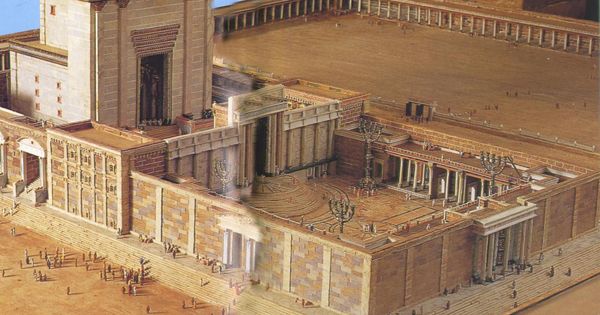
The lintel was a crossbeam over the doorway to the Holy of Holies in the Temple. The lintel stood atop pillars eight stories high which formed this doorway. The lintel was some thirty feet across and made of solid stone. It would have weighed about 30 tons! At the death of Yeshua there was an earthquake. This earthquake caused the lintel to split, breaking in the middle. It would have been no small event when the two pieces of this thirty ton lintel came crashing down eight stories! When the lintel broke it caused the veil to be rent in two from top to bottom.  (In the Jewish culture it is common for a father to morn the death of his son by renting his garment in just such a fashion.)  This collapse of the lintel seems to have damaged the hekel doors as well. The Talmud states:

[For] forty years before the Temple was destroyed…
the gates of the Hekel opened by themselves.
until Rabbi Yochanan Ben Zakkai rebuked them
saying “Hekel, Hekel, why alarm you us? We know
that you are destined to be destroyed. For of you
has prophesied Zechariah Ben Iddo (Zech. 11:1):
“Open your doors, O Lebanon and the fire shall
eat your cedars.”
(b.Yoma 39b)

So the original Hebrew/Aramaic reading behind both our canonical gospels and the Gospel according to the Hebrews can be seen in the Aramaic of the Old Syriac (and later Peshitta).

We need your financial support now more than ever! We must raise at least $300 by the end of the day today (3/17/25) or our account will go into the negative tonight and start a chain reaction of returned items and fees!

As you know we have been digging ourselves out of a budget shortfall.  As I have said to you many times, I look on this work as a co-operative one with me, and all of you combining our resources together in order to get the job done of helping to teach this great truth to all in the world who will listen. Thank you so much from the bottom of my heart for your continued support, you are the ones who make it all possible by your contributions and your prayers for our work. I truly appreciate your help in every way.

If you can make a one time donation of $500 or $1,000 dollars to support this work.

Donations can be sent by Paypal to donations@wnae.org or by Zelle or GoFundMe.

Click HERE to donate

The “Cochin” Hebrew Gospels – Hebrew Translation of the Peshitta

The “Cochin” Hebrew Gospels – Hebrew Translation of the Peshitta
By
James Scott Trimm

Some excitement has been recently generated around the “Cochin” Hebrew Gospels. In fact, in his book Messianic Church Arising (Sons of Zion vs Sons of Greece Volume Two) Dr. Miles R. Jones boldly declares “These Gospels have been ascertained to have come from a first century source!“ (p.265)

On page 262 Jones gives us his “Authentication of the Cochin Hebrew Gospels” in which he demonstrates a connection to the Gospel according to the Hebrews (Which he regularly refers to ambiguously as the “Hebrew Gospel” in his books).

We read in the Goodnews according to Matthew that at the death of Yeshua:

And, behold, the veil of the temple was rent in twain from the top to the bottom; and the earth did quake, and the rocks rent;
(Matthew 27:51)

The fourth century “Church Father” Jerome writes concerning The Gospel According to the Hebrews (a Gospel use by the ancient sect of the Nazarenes along side our familiar four):

“But in the Gospel which is written in Hebrew characters we read not that the veil of the Temple was rent, but that the lintel of the Temple of wondrous size was broken and even forced asunder.”
(Jerome; Letter 120 to Hedibia; Jerome on Mat. 27:51)

Also in the Historia passionis Domini we read likewise:

“Also in the Gospel of the Nazarenes we read that at the time of Messiah’s death the lintel of the Temple, of immense size, had split (Josephus says the same and adds that overhead awful voices were heard which said: ‘Let us depart from this abode’.”
(Historia passionis Domini; MS: Theolog. Sammelhandschrift 14th-15th Century, foll. 65r)

The lintel was a crossbeam over the doorway to the Holy of Holies in the Temple. The lintel stood atop pillars eight stories high which formed this doorway. The lintel was some thirty feet across and made of solid stone. It would have weighed about 30 tons! At the death of Yeshua there was an earthquake. This earthquake caused the lintel to split, breaking in the middle. It would have been no small event when the two pieces of this thirty ton lintel came crashing down eight stories! The veil hung from the lintel and the hekel doors were attached to the pillars. When the lintel broke it caused the veil to be rent in two from top to bottom.  (In the Jewish culture it is common for a father to morn the death of his son by renting his garment in just such a fashion.) 

Dr. Miles Jones maintains that the Cochin Gospels reflect this reading, and that this is their “authentication” by which he ascertains that they “come from a first century source”. As evidence Jones cites the Hebrew readings of Matthew 27:51; Mark 15:38 and Luke 23:45 from the Cochin Gospels (ibid page 262) He begins with Matthew 27:51 as follows:

ובמהרה פני הדלת של ההיכל נתבצע לשנים מן תחילתו עד םופו וארץ נזדעזע ואבנים נסתרו

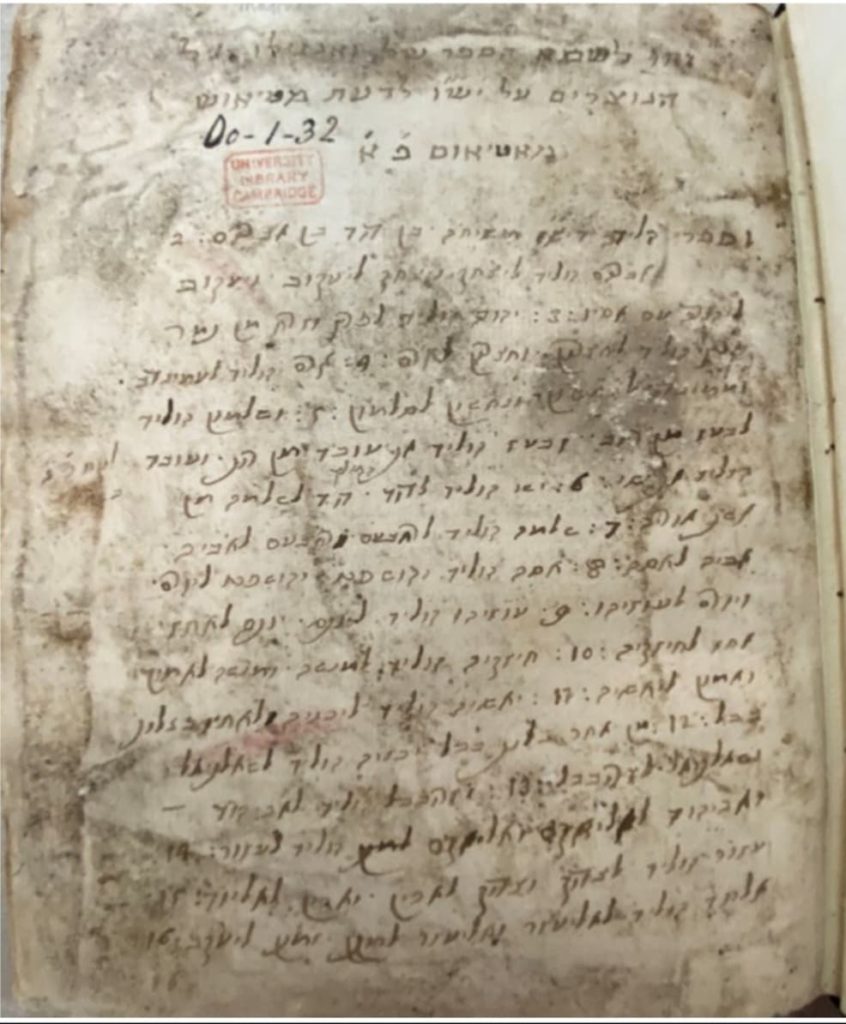
Which Jones translates:

“And suddenly the face of the entry to the Temple was split in two from the beginning until the end and the earth shook and the [heavens] were hidden.”

Jones then quotes Mark 15:38 and Luke 23:45 from the Cochin manuscript, each with the phrase פני הדלת which Jones renders “the entry of the Temple”. This is supposed to be proof of the first century origin of the text in the Cochin Gospels.

The truth is that this Hebrew phrase פני הדלת literally “the face of the door” is merely a literal Hebrew rendering of the Syriac Aramaic phrase found in these same passages in the Aramaic Syriac Peshitta אפי תרעא “the face of the door”. This word פני is used in the Torah to describe the place where the curtain was (Ex. 26:9). This phrase no more indicates the lintel than the veil. One could see where variant readings referring to a “veil” and to the “lintel” might have originated from this ambiguity, but the Cochin Gospel’s source is not the Hebrew Gospel itself, but the Syriac Peshitta (which itself is a revision of the Old Syriac version which was derived from a Western Aramaic or Hebrew original. (the Old Syriac also has this reading).

In fact the Cochin Gospels are replete with unique Peshitta readings. For example, in Luke 2:1 where the Greek has πᾶσαν τὴν οἰκουμένην “all of the world” the Peshitta has כלה עמא דאוחדנה “all the people of his dominion” which the Cochin Hebrew literally translates כל העם במקומותם “all the people of his dominion.” Many more examples could be given.

But one might ask, how do we know the direction of translation? Perhaps, one might argue, the Peshitta is a literal Syriac Aramaic translation of the Hebrew in the Cochin Gospels.

The direction of translation is clear. To begin with the Aramaic of the Peshitta is a revision of the older and more primitive of the Aramaic Old Syriac version, and the Cochin Hebrew agreed with the Peshitta against the Old Syriac (as in Luke 2:1 above, where the Old Syriac does not agree with the Peshitta.

The even more obvious evidence is in the fact that the Cochin Hebrew, at times, transliterates the Syriac of the Peshitta into it’s Hebrew text. For example in Matthew 1:1 the Cochin text retains the Aramaic ד prefixed to the name of Yeshua, despite the fact that this would not be used in Hebrew (but does appear in the Peshitta here). Even more obvious is to be found in Matthew 1:20 and 24 where the phrase “of the LORD” appears as the Syriac דמריא copied right out of the Syriac of the Peshitta. Again in Matthew 7:21 where we read “Lord, Lord” the Cochin Hebrew transliterates מרי מרי “Mari, Mari,” right out of the Aramaic of the Peshitta. So there can be no doubt that the Cochin Hebrew Gospels are a translation of the Syriac Aramaic Peshitta, and not vice versa.

It should come as no surprise to us that these Hebrew Gospels, found in India, are merely Hebrew translations of the Peshitta, since the Peshitta has long been the standard text of the so called “St. Thomas Christians of Malabar”.

I should add that my comparisons have concluded that the entire text of the books of the Cochin Hebrew New Testament, are simply a translation of the Syriac Aramaic of the books of the Peshitta canon (as far as that canon goes).

We need your financial support now more than ever!

As you know we have been digging ourselves out of a budget shortfall.  As I have said to you many times, I look on this work as a co-operative one with me, and all of you combining our resources together in order to get the job done of helping to teach this great truth to all in the world who will listen. Thank you so much from the bottom of my heart for your continued support, you are the ones who make it all possible by your contributions and your prayers for our work. I truly appreciate your help in every way.

If you can make a one time donation of $500 or $1,000 dollars to support this work.

Donations can be sent by Paypal to donations@wnae.org

Or click HERE to donate

Why Do We Ask for Financial Support?

Today I received this private message:

Sir, I don’t understand why such a talented man and the compiler of so many study aids is having such a hard time financially. Don’t you have books you can sell? I am embarrassed for you constantly asking for money. Brother, go to the Throne Room, you have that right. I am close to where you are and I will never ask men for help. I will always plead my case before my Father. Please stop!

Here is my response:

Believe me, I would rather spend less time fund raising, and more time with my “nose in the scrolls” doing this great work.

I am a literal laborer in His Word. Am I not worthy of my wage? Should I be ashamed of such? The tithe belongs to YHWH, men are merely it’s custodians. Now if you are a full tither, then that is very good. But if you are not, isnt’t this reaction akin to expecting me to make bricks without straw? And if you do not feel my labor in the word is worthy of support, then please find one that is, and tithe there. And to the degree that I am poor and asking for tzadikah, in Judaism this means I am blessing you by giving you the opportunity to preform a mitzvah. AT the end of the day, no one is forced to donate. But, it would be foolish of me to starve and become homeless and no longer be in a position to do this great work, simply because I did not tell people of the need. Then people would say “why didn’t you tell us, if we had only known, we would have helped.

BTW I have published about twenty books, all total their sales bring in 100 to 150 dollars a month. My translation of Jasher took three months of full time work, and its sales over nearly fifteen years have never even paid me minimum wage for the time spent translating it. I have found a much more successful model is to publish material freely on the internet, with the endeavor paid for by tithes, freewill offerings and tzadikah of those who wish to support the effort. It is also more successful at getting more information out to more people than if I was selling it.

Our rent is due in about ten days, and right now we do not have it!

As I have said to you many times, I look on this work as a co-operative one with me, and all of you combining our resources together in order to get the job done of helping to teach this great truth to all in the world who will listen. Thank you so much from the bottom of my heart for your continued support, you are the ones who make it all possible by your contributions and your prayers for our work. I truly appreciate your help in every way.

If you can make a one time donation of $500 or $1,000 dollars to support this work.

Donations can be sent by Paypal to donations@wnae.org

Or click HERE to donate