The Great Apostasy and the Restoration of Nazarene Judaism

🔥 What If the “Church” Isn’t What You Think?

For generations, people have spoken of returning to the “New Testament Church.” But what most fail to realize is that the original followers of Yeshua never called themselves Christians—and they certainly never spoke of a “church.” They were known as the Nazarenes (Netzarim)—a Torah-observant Jewish sect who followed Yeshua as the promised Messiah and walked in the ancient paths of Israel’s covenant.

They prayed in Hebrew and Aramaic. They taught from the Hebrew Scriptures. They continued to observe the Sabbath, the festivals, and the dietary laws. They were a restoration movement within Judaism—not the founders of a new religion.

But over time, that original faith was lost, suppressed, and replaced by foreign ideologies. What began as a restoration of the ancient faith of Israel became something else entirely—blended with Greco-Roman philosophy, stripped of Torah, and rewritten in Greek.

This was the Great Apostasy—a falling away from the original faith once delivered to the saints.


📉 The Fall: Apostasy Foretold by the Prophets

This departure from truth was not unforeseen. The Scriptures speak plainly of a time when the covenant would be broken, the Torah forgotten, and the people would stumble.

⚖️ Testimonies from Scripture:

  • Isaiah 24:5 — “The earth is defiled under its inhabitants, because they have transgressed the laws, changed the ordinance, broken the everlasting covenant.”
  • Amos 8:11–12 — “Behold, the days come, says YHWH, that I will send a famine… not a famine of bread… but of hearing the words of YHWH.”
  • Jeremiah 2:13 — “My people have committed two evils: they have forsaken Me, the fountain of living waters, and hewed out cisterns, broken cisterns that can hold no water.”
  • Matthew 24:12 — In the Old Hebrew Matthew (DuTillet), this verse reads:
    “Because of the increase of פֶּשַׁע (apostasy), the love of many will grow cold.”
    The Greek manuscripts use ἀνομία (“lawlessness”), but the Hebrew reveals something deeper: not just immoral behavior, but a deliberate rebellion against the covenant.
  • Acts 20:29–30 — “After my departure shall grievous wolves enter in among you… also of your own selves shall men arise, speaking perverse things…”
  • 2 Thessalonians 2:3 — “That day shall not come, except there come a falling away [ἀποστασία] first…”
    This “apostasia” is not a minor drift—it is a wholesale turning from the truth.

These are not isolated warnings—they are a pattern. A time of deception, distortion, and forgetting was foretold. And history confirms it. The original Nazarene faith was forced underground, while a new faith—disconnected from Torah and Hebrew roots—emerged in its place.


🏗️ The Restoration: Rebuilding the Lost Altar

Yet the story doesn’t end in apostasy. The prophets also foretold a restoration—a return to the ancient ways. A rebuilding of the broken altar.

This is the prophetic work now unfolding: the restoration of Nazarene Judaism—not as a new religion, but as the revival of the original faith of Yeshua and his disciples.

🧱 A Prophetic Pattern: 1 Maccabees 4:44–46

When the altar in the Temple was defiled, the Maccabees dismantled it stone by stone and stored it away, waiting for a prophet to reveal what should be done. In the meantime, they built a new altar and rededicated it to YHWH.

In the same way, the faith of the Nazarenes was broken down—its teachings scattered, its language suppressed, its practices outlawed. Now, in our generation, the stones are being gathered once more. The altar is being rebuilt.

🌅 A Vision of Restoration: Rebuilding the Lost Altar

This restoration is not theoretical. It is not abstract. It is real—and for me, it began with a dream.

I was just eighteen when I had it, but it left a mark on my soul. In the dream, I stood in the ruins of an ancient stone altar. It had been broken down—its stones scattered, weathered by time and neglect. But I began to rebuild it, placing each stone carefully in its place.

When the final stone was set, the altar burst forth with a radiant light—brighter than the sun, too brilliant to behold. From above, shafts of blue light descended from the heavens—pure, powerful, unmistakably divine.

Behind me stood the Messianic synagogue I attended at the time. I ran inside to tell my friends, to bring them out to witness the wonder—but most were indifferent. Only a few stepped outside to see the light.

At the time, I did not fully understand the meaning. Now I do:

  • The broken altar represented the original Nazarene faith—shattered by persecution, assimilation, and apostasy.
  • The act of rebuilding represented the restoration of that faith in our time.
  • The light represented the revealed truth of Elohim.
  • The shafts of blue light were divine confirmation.
  • The indifference of the crowd foreshadowed how few would be willing to step outside the comfort of tradition to witness the true restoration.

📜 The Restoration Foretold

The idea of a restoration is not new. It is deeply rooted in the words of the prophets. And it is unfolding now before our eyes.

🏔️ Isaiah 2:3

“And many peoples shall go and say, ‘Come, let us go up to the mountain of YHWH, to the house of the Elohim of Jacob, that He may teach us His ways and that we may walk in His paths.’ For out of Zion shall go forth the Torah, and the word of YHWH from Jerusalem.”

This is not a prophecy of a new religion, but a return to the Torah of Zion. It is a restoration of the covenant path that Yeshua walked—the ancient faith of the Nazarenes.


🌿 The Olive Tree and the Sealed Book

The restoration is not just about practices and traditions—it is also about truth, about recovering what was lost or hidden.

📖 Romans 11 and Isaiah 29

Paul describes the restoration of Israel using the metaphor of an olive tree. Some natural branches (Judah) were cut off, and wild branches (the nations) were grafted in. But he foresees a time when the natural branches will be grafted in again—“life from the dead” (Romans 11:15).

In the same chapter, Paul quotes Isaiah 29:10 to explain why this restoration was necessary:

“As it is written: ‘Elohim has given them the spirit of deep sleep, eyes that should not see, and ears that should not hear; unto this day.’”
— Romans 11:8 // Isaiah 29:10

And what does Isaiah 29 go on to say?

📕 Isaiah 29:11–14

“The vision of all is become unto you as the words of a sealed book… Because this people draws near me with their mouth, and with their lips do honor me, but have removed their heart far from me, and their fear toward me is taught by the precept of men: therefore, behold, I will proceed to do a marvelous work among this people, even a marvelous work and a wonder.”

This sealed book—this hidden vision—is now being unsealed. The “precepts of men” are being cast down. The Torah is going forth from Zion again, and the original Hebrew and Aramaic Scriptures of the Nazarenes are being restored.

This is not merely a spiritual renewal—it is a recovery of language, texts, halacha, and covenant identity.


✨ The Restoration Is Now

The Great Apostasy obscured the original faith. But now the ancient stones are being gathered again. The altar is being rebuilt. And just like in the days of the Maccabees, a remnant is rising to rededicate it—not with Greek doctrines, but with the light of Torah and the testimony of Yeshua.

The vision has been sealed for generations—but now, the scroll is opening.

🙏 Join the Restoration

We are witnessing the fulfillment of prophecy in our time. The faith of the Nazarenes is rising again—rooted in Torah, centered on Messiah, and written in Hebrew and Aramaic.

You are invited to join this great work:

  • 📜 Help restore the original texts of the New Testament in Hebrew and Aramaic.
  • 🕎 Reclaim the ancient halachic traditions of the Nazarenes.
  • 🌍 Spread the message of Torah and Messiah to the scattered of Israel.

But to keep this work going, we need your help today.

We are currently facing a financial shortfall and must raise at least $450 by the end of the day today to cover critical bills that are hitting our account tonight. This is urgent—and your support can make the difference.

🔗 Support the Restoration: nazarenespace.com/blog/donate

The altar is being rebuilt. The covenant is being renewed. The prophetic restoration of Nazarene Judaism is alive and moving forward.

Will you be part of the restoration? Will you stand with us now?

Unveiling the Original: Why the New Testament’s Hebrew and Aramaic Roots Matter More Than Ever

For nearly two thousand years, the world has read the New Testament through the lens of Greek. But what if that lens itself is a distortion—an echo of an original voice, long forgotten but still whispering beneath the surface?

After forty years of rigorous research, I am proud to release my magnum opus:
📘 Unveiling the Hebrew and Aramaic Origins of the New Testament
➡️ 444 pages of in-depth linguistic, textual, and historical analysis
➡️ A lifetime’s work, now available to the public:
👉 Order the book here


The Problem: Lost in Translation

The question at the heart of this work is simple, yet revolutionary: Was the New Testament originally written in Hebrew and Aramaic—not Greek?

The implications are enormous. If the Gospels and Epistles were composed in the Semitic languages of Yeshua and his followers, then the Greek versions we’ve inherited are not originals—but translations. And with any translation, meaning can be lost, idioms can be distorted, and theology can shift subtly, or even dramatically.


Evidence Beneath the Greek Surface

The internal clues are compelling. Here are just a few highlights from the book:

🔹 Matthew 26:6 / Mark 14:3 – “Simon the Leper”?
The Greek calls him λεπρός (leper), but the Aramaic root garba could just as easily mean “jar-maker” or “potter.” Considering the presence of an alabaster jar in the story, the context points clearly to “Simon the jar merchant”—not a leper, who would not have hosted a dinner (cf. Lev. 13–14).

🔹 Mark 9:49 – “Salted with fire”?
A baffling phrase in Greek, but perfectly natural in Hebrew if we reconstruct it as “everything decaying shall be salted.” The Hebrew word ba’ash (to rot) may have been confused with ba’esh (with fire) due to the lack of vowels in early manuscripts.

🔹 Matthew 19:24 – “Camel through the eye of a needle”?
The Aramaic word gamla means both “camel” and “thick rope.” The more natural metaphor? “It’s easier for a thick rope to pass through the eye of a needle”—a clear case of mistranslation through homonym confusion.

🔹 Acts 4:25 – Greek confusion reveals an Aramaic base
The Greek is a jumble: “Who by the Holy Spirit through the mouth of our father David Your servant said…” But the reconstructed Aramaic reads smoothly:
“That which our father David, your servant, said by the command of the Holy Spirit…”

🔹 Matthew 11:19 – “Justified by her children” or “her deeds”?
Greek manuscripts differ, but the Old Syriac Aramaic has b’nayah, which can be read as either “children” (beneh) or “deeds” (binah) depending on vocalization. A textbook example of a Greek translator misunderstanding unpointed Aramaic.


Why This Matters

This isn’t merely academic curiosity. If we want to understand the teachings of Yeshua (Jesus) and his emissaries with clarity and authenticity, we must hear their words as they were first spoken—in their native tongues.

When we strip away the Greek veneer and uncover the Semitic heart of the text, we find a message far more rooted in the Torah, the Prophets, and Jewish idiom than traditional theology has allowed. We reconnect not only with historical truth, but with spiritual integrity.


Join the Restoration Effort

This book is just one part of a larger mission: to restore the original Hebrew and Aramaic New Testament and make it accessible to the world.

If you believe this work matters—if you see the value in reconnecting with the authentic words of the Messiah—please consider supporting this restoration project.

Right now we are working on projects like: Restoring the Jewish Western Aramaic and Hebrew behind the Old Syriac Aramaic Gospels and Restoring the original Hebrew behind the Greek of the Book of Revelation, and much, much, more!

We must raise at least $1,000 this coming week to cover bills hitting our account! Donate today!

🙏 Donate today: http://nazarenespace.com/blog/donate/

Together, we can recover the lost voices of the apostles, hear the words of Yeshua in the language he spoke, and let the original message rise again with clarity and power.

—
James Scott Trimm
Author, The Hebrew and Aramaic Origin of the New Testament
Order Now on Amazon

Lost in Translation: Two Verses That Prove the Gospels Were First Written in Hebrew

For years, we’ve been saying that the Gospels were originally written in Hebrew and later translated into Aramaic—and only after that into Greek. Today, we want to show you two powerful examples that drive this point home.

These examples don’t just prove a theory—they help us recover the original words of Yeshua and preserve the true meaning of His teachings. And they show why our work matters right now.

Example One: The Lost Sheep—In the Mountains or the Wilderness?

Let’s begin with a small detail from the parable of the lost sheep. In Matthew 18:12, the Greek reads:

“…does he not leave the ninety and nine, and go into the mountains (εἰς τὰ ὄρη) to seek that which is gone astray?”

But in Luke 15:4, the same parable says something quite different:

“…does he not leave the ninety and nine in the wilderness (័ν τῇ ័ρΎΟῳ) and go after that which is lost?”

So which is it—mountains or wilderness?

The answer lies in the Old Hebrew Matthew, preserved in the DuTillet and Munster manuscripts, which read:

במדבר — “in the wilderness”

This matches Luke 15:4 and likely reflects the original Hebrew text of Matthew. So where did the Greek Matthew get “mountains”?

The trail leads through Aramaic. In Old Syriac Matthew 18:12, the Aramaic word is בטורא (b’tura). In Jewish Western Aramaic—the dialect likely used in the first-century Aramaic version Gospel—טורא could mean open country, desert, or wilderness. But in later Syriac Aramaic usage, טורא means “mountain.”

The Greek translator, unfamiliar with the Jewish Western Aramaic sense, misunderstood טורא as mountains and rendered it εἰς τὰ ὄρη. Luke, however, preserved the sense accurately as ἐν τῇ ἐρήμῳ—“in the wilderness.”

And the original Hebrew is preserved in the Old Hebrew Version of Matthew as preserved in the DuTillet and Munster texts.

This small difference offers powerful evidence for the transmission sequence:
Hebrew → Aramaic → Greek.

Example Two: Matthew 11:13 — A Word That Changes Everything

Another verse that confuses many readers is Matthew 11:13:

“For all the prophets and the law prophesied until John.”
(KJV)

This verse has been misused in multiple ways—by antinomians who claim the Torah ended with John, by sects like the Campbellites who claim all prophecy was fulfilled before him, or by those who argue prophecy ceased entirely with his ministry. All of these views fall apart under scrutiny.

The real solution again lies in the Old Hebrew Version.

The Garza-Trimm Hebrew manuscript of Matthew (another witness to the Old Hebrew Version) reads differently than the DuTillet and Munster texts. Instead of עד (‘ad, “until”) John, it reads על (‘al, “concerning”) John.

These two words are visually similar in Hebrew and could easily have been confused by later scribes. But the reading “concerning John” fits the context far better. Just one verse earlier, Yeshua quotes Malachi 3:1 and applies it to John. Earlier still, in Matthew 3:3, he references Isaiah 40:3, also about John.

Thus, the Torah and Prophets did not end with John—they spoke of John.

This simple correction removes the confusion and restores the clear meaning of Yeshua’s words. Once again, Hebrew makes sense of a passage that seems obscure in Greek.


Why This Matters—and Why We Need Your Help Today

These are just two examples—but there are many more. And they all tell the same story: the words of Yeshua were first spoken and recorded in Hebrew, then translated into a now-lost Jewish Western Aramaic version, and finally into Greek.

Every step away from the original language introduced ambiguity and potential mistranslation. That’s why our work—restoring the original Hebrew Gospels and exposing their authentic meaning—is so vital.

We’re working hard every day to recover these texts, compare the manuscripts, and teach the truth—but we can’t do it without your help.

We urgently need to raise $250 today to meet bills hitting our account.

If you’ve found value in our research and teaching, and if you believe it’s important to recover the original words of the Messiah, please consider making a donation—large or small—to help us meet this need.

You can donate securely here:
👉 Donate Today by Clicking Here!

Thank you for standing with us in this mission. Together, we are rebuilding the ancient foundations and restoring the voice of Yeshua in His own words.

Rebuilding the Altar: Why Nazarene Judaism Matters Today

For generations, many sincere believers have sought to return to the roots of their faith. You’ve probably heard it said: “We need to get back to the New Testament Church.” But here’s the truth—what most call the “New Testament Church” never existed the way we’ve imagined it.

The first followers of Yeshua were not part of a new religion called Christianity. They were Jews. They were Torah-observant. They were called the Nazarenes—Netzarim in Hebrew—and they believed that Yeshua was the long-awaited Jewish Messiah. Their movement wasn’t a break from Judaism; it was its fulfillment. They followed the same Torah, kept the same Sabbath, prayed in the same language, and read from the same Scriptures—in Hebrew and Aramaic.

So what happened?

History took a detour. Greco-Roman Christianity arose and gradually erased the Jewishness of the faith. The Nazarenes were scattered, persecuted, and cursed in synagogues and churches alike. Their books were lost or suppressed. Their name was nearly forgotten. But now—now the stones are being gathered once more. The altar is being rebuilt.

The Dream of Restoration

As a young man, I had a vivid dream. I stood among the ruins of an ancient stone altar—broken and scattered. One by one, I rebuilt it. When the last stone was set, the altar shone with a brilliance too great to behold. Beams of light poured down from the heavens. I ran to tell others, but only a few came to see.

That dream was prophetic.

The broken altar was Nazarene Judaism. The rebuilding is the work we are called to now—reviving the original faith of Yeshua within its Jewish context, unmixed with pagan philosophy, unburdened by centuries of distortion. The beams of light? They were truth. Revelation. Divine confirmation.

Why Now?

Because the time has come. The Scriptures foretell a day when the scattered people of Israel—both houses—will remember who they are (Baruch 2:30–35). We are living in that day. From the hills of Judea to the nations of exile, the voice is calling: “Return to the ancient paths.”

The rebirth of Nazarene Judaism is not an invention—it is a restoration. This is not about replacing Christianity or Rabbinic Judaism. It is about reviving the faith of the original Jewish followers of Yeshua. The faith that embraced Torah, honored the Sabbath, taught immersion, walked in righteousness, and confessed the Messiah without compromise.

What Makes Nazarene Judaism Distinct?

  • It is fully Jewish—unapologetically rooted in Torah, Shabbat, the Feasts, and Hebrew Scripture.
  • It recognizes Yeshua as the Messiah—not as a Greco-Roman figure, but the Jewish Redeemer of Israel.
  • It does not blend Torah with tradition or cancel it with grace. It magnifies the Torah as Yeshua did (Isaiah 42:21).
  • It seeks not only the restoration of Ephraim (the lost tribes) but also Judah—the original Nazarene sect within Judaism.

Will You Be One of the Builders?

The altar is being rebuilt. But not all will see it. Most will remain inside, unaware. A few will step out into the light. A few will take up the stones, one by one, and begin the work of restoration.

If you are reading this, perhaps you are being called.

Nazarene Judaism is more than theology. It is prophecy fulfilled. It is the living testimony of YHWH’s faithfulness. And it needs your hands, your heart, and your voice.

Join the Restoration

If this message resonates with your spirit, I invite you to go deeper. Study. Pray. Reclaim your roots. And if you’re ready to take the next step, consider starting or joining a Nazarene Torah study group. The harvest is plentiful, but the workers are few.

And yes—this work needs support. If your heart is stirred to help rebuild the altar, we invite you to contribute to this mission. We are preserving and translating ancient texts, teaching Torah-centered discipleship, and planting communities of authentic Nazarene faith.

🔥 Help us restore what was lost. Be a part of rebuilding the altar.

We need your help today! We must raise at least $460 by the end of the day today to prevent our account from plunging into the negative and starting a cascade of returned items and fees!

👉 [Support the Work of Scripture Restoration – Click Here to Donate Today]

May the ancient paths become your path. May the light that shone from that altar in my dream shine upon you. And may you, too, be counted among those who remember the way of their fathers.

— James Scott Trimm

Rediscovering the Old Hebrew Gospel of Matthew- And Why It Matters Now More Than Ever

For centuries, scholars have debated what language the books of the New Testament were originally written in. While most academic consensus defaults to Greek, there have always been voices—both ancient and modern—that testify to an original Hebrew Gospel of Matthew.

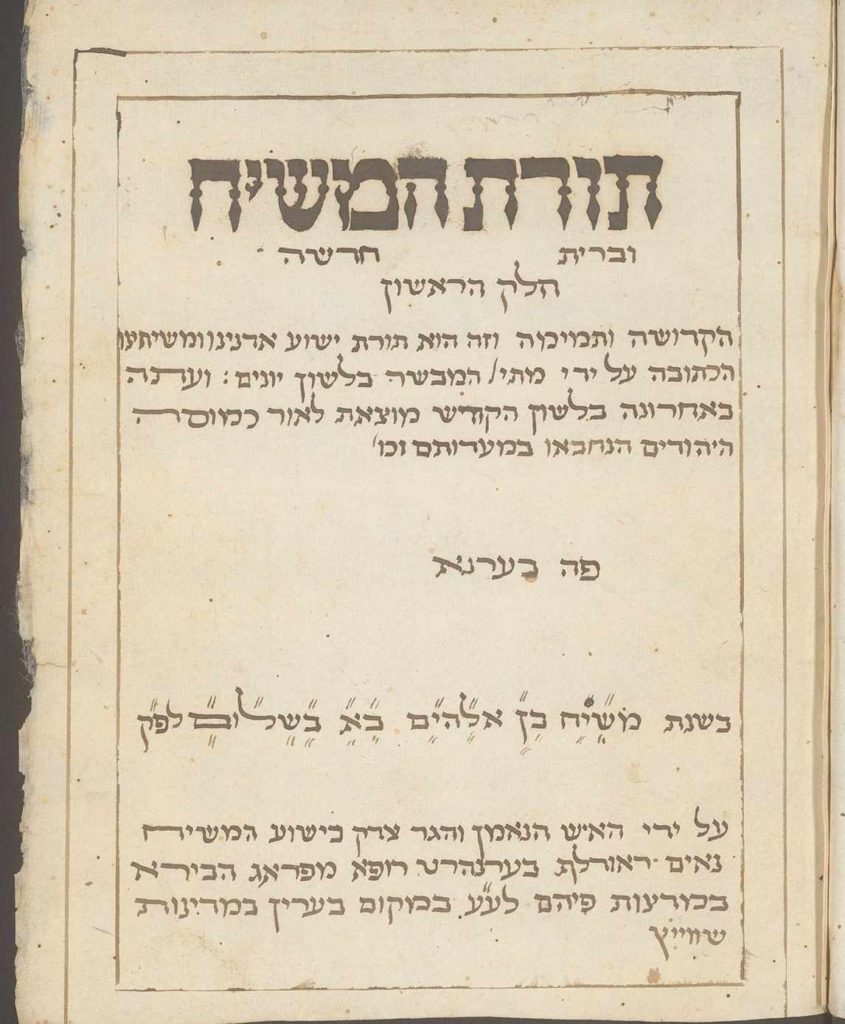
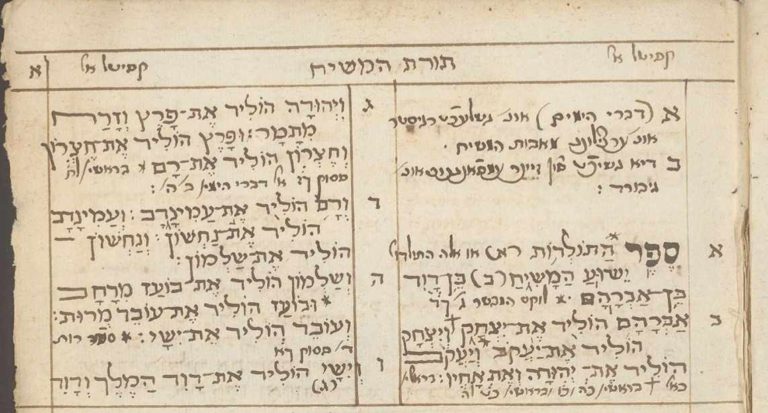
Among the most powerful witnesses to that possibility is the DuTillet Hebrew Matthew, a complete Gospel manuscript confiscated from Jews in Rome in 1553 and preserved today in the Bibliothèque Nationale in Paris. This manuscript is written entirely in Hebrew—not medieval Rabbinic Hebrew, not a translation from Greek, but something linguistically, textually, and theologically rooted in an ancient Semitic world.

Unlike later Christian translations, the DuTillet text preserves names, expressions, and even grammatical structures that echo the Hebrew Bible itself. For example, it includes the missing fourteenth name in Yeshua’s genealogy (Matthew 1:13), uses the Tetragrammaton (יהוה) in place of “Lord,” and aligns frequently with early Gospel traditions such as the Old Syriac, Old Latin, and even the now-lost Gospel according to the Hebrews—used by the earliest followers of Yeshua, who still saw themselves not as Christians, but as Torah-faithful Jews of the “sect of the Nazarenes.”

We are not just talking about a translation curiosity. This is nothing less than a thread of historical DNA linking us to the earliest Gospel as it would have been heard by first-century Jewish ears. Through this Hebrew lens, familiar teachings come alive in ways that are deeper, clearer, and often more faithful to Yeshua’s original voice and intent.

But the DuTillet text is only one strand. Other Hebrew witnesses of this same “Old Hebrew” version include the Munster, Cinquarbres, and Garza-Trimm manuscripts—all preserving different facets of the same Semitic tradition. When we compare them—side by side, word by word—a fuller picture emerges: one that powerfully confirms that the New Testament was not born in Rome or Byzantium, but in Jerusalem, in Hebrew and Aramaic, among the Jewish people.

Why This Work Matters

In our time, we have the technology, the scholarship, and the calling to restore the original Hebrew and Aramaic text of the New Testament—faithfully, verse by verse. But this work is painstaking, and it takes time, dedication, and resources.

We’re not just translating ancient texts. We’re restoring history, healing distortions, and bringing the words of Yeshua back into their original light.

If you’ve ever been moved by the teachings of the Messiah…
If you’ve ever wanted to know what he really said—how he really spoke, taught, prayed, and fulfilled the Torah…
If you believe that the truth is worth preserving…

Then please, partner with us.

The Scripture Restoration Project is committed to recovering, preserving, and publishing the Hebrew and Aramaic texts of the New Testament for generations to come. But we cannot do it alone.

🙏 We need your help.
Your donation supports the research, transcription, translation, and publication of these sacred texts—ensuring that they are never again forgotten, obscured, or dismissed.

▶️ Give today, and be part of restoring the Gospel to its original voice.

Emergency Alert! We must raise at least $425 by the end of the day today, or our account will plunge into the negative and start a chin reaction of returned items and fees.

With gratitude and hope,
James Scott Trimm
Founder, Scripture Restoration Project


Donate by Clicking Here