Another Lost Saying of Yeshua

I was meditating upon one of the fragments of this lost Gospel, as preserved by the Latin “Church Father” Jerome. Jerome’s citation reads:

As also we read in the Hebrew Gospel that the Lord spoke to his disciples: ‘And never (he said) be joyful except when you look on your brother with love.’ (Latin: et numquam (inquit) laeti sitis, nisi cum fratrem uestrum uideritis in caritate.)
(Jerome, Commentary on Ephesians 5:4)

As I began restoring the original Hebrew behind this Latin citation, I began to meditate on the full meaning of these lost words of Yeshua. To begin with, the words are clearly an expansion on the Torah command to “love your neighbor as yourself” (Lev. 19:18). But I asked myself, does the passage mean that I can be joyful at no other time than when I am actively looking on my brother with love? What if I am not actively thinking about my brother, one way or another, while experiencing joy? Is that prohibited by this directive? As I pondered these words, I realized that what the saying was truly conveying is the message that one should never derive joy from hating one’s fellow man. This has to do with control over anger and the malicious spirit that comes with anger. Anger is an attempt to turn pain into pleasure. It “feels good” to be angry at someone whom we perceive has harmed us. We want to get back at them, and we entertain a malicious spirit in our hearts. We take joy in hating them… even in hurting them back. This is what Yeshua us addressing.

This brought to my mind another passage Jerome cites from the Gospel according to the Hebrews:

And in the Gospel according to the Hebrews, which the Nazaraeans are accustomed to read, one of the greatest sins is ‘He who grieves the spirit of one’s brother. ” (Latin: qui fratis sui spiritum contristaurit.)
(Jerome; Commentary on Ezekiel 18:7)

Suddenly, in a flash of insight, it was revealed to me that these two passages originally went together, as two parts of a single saying. The original Hebrew of the passage read:

לֹא תִּשְׂמַּח בִּלְתִּי אִם רָאִיתָה אֶת אָחִיךָ בְּאַהֲבָה

כִּי הַמַּאֲבִיל אֶת רוּחַ אָחִיו חָטָא חַטַּאת גָּדוֹלָה מְאוֹד

“Never rejoice except when you behold your brother with love; for he who grieves the spirit of his brother has sinned a very great sin.”

(“Never” is implied in לא likewise, Jerome uses Latin numquam (never) for Hebrew לא in Ex. 34:10 in the Latin Vulgate)

This is a beautiful elaboration by the Messiah on the teaching in the Torah:

You shall not avenge, nor bear any grudge against the children of your people, but you shall love your neighbor as yourself: I am YHWH. (Lev. 19:18)

This work takes hours of my time. As many of you know, my wife is very ill, and I spend most of my time at home as her caretaker. I work at a desk less than six feet from her bed. So I am in a position to dedicate many hours to this important work that I have been directed to do.

But I also realize that it is not the activity of James Trimm alone who is responsible to do this work, it is all of us together who are charged with the responsibility of accomplishing this work. I very much look on the efforts of this restoration work as a cooperative one with each one of you. We are all joint heirs with Messiah and should always be about our Father’s business. I am honored to be able to be partnered with truth seekers as this restoration of Scripture moves forward in fulfillment of prophecy.

Urgent Help Needed

As many of you know, my wife lives with chronic illness and constant pain due to a disability. This Tuesday, she is scheduled for a surgical procedure that will help relieve some of that pain. We’re hopeful this will bring her some much-needed relief.

We’re not yet sure what the copay will be, but the last time this same surgery was scheduled (and unfortunately canceled), the copay was $240. We need to raise that amount by Tuesday.

However, our current situation is even more urgent—our bank balance is $576 short, and rent is due next Thursday.

We could truly use your help—today and in the days to come. Any amount makes a difference. If you’re able to contribute or share this post, it would mean the world to us. Thank you for your prayers, your support, and your kindness.

Donations can be sent by Paypal to donations@wnae.org or by the ling below thru Paypal, Zelle, GoFundMe

Click HERE to donate

Lost Saying of Yeshua Recovered in Aramaic

Lost Saying of Yeshua Recovered in Aramaic
By
James Scott Trimm

More than thirty years ago, when I first began my work on restoring the ancient sect of the Nazarenes, I undertook the task of collecting every surviving quotation from the Gospel once used by that community—always striving to find them in the earliest available language. This meant consulting either Greek or Latin, depending on the language in which a particular Church Father had written. But one quotation continued to escape my reach in its original form. For decades, I was limited to an English translation that had appeared in various scholarly lists and had been accepted largely without question.

This elusive quotation appears in Theophania, a work by Eusebius of Caesarea, the fourth-century Church Father who wrote in Greek. Though Theophania was originally composed in Greek, it survives in full only in an ancient Syriac version—a dialect of Aramaic—preserved in manuscripts dating back to the fifth century.

For many years, I lacked access to this Syriac text and was therefore unable to verify the original wording. I was stuck with the standard English version:

“I choose for myself the most worthy: for the most worthy are those whom my Father in heaven has given me.”

I was finally able to locate the Syriac Theophania and discover the original Aramaic quotation:

דאגבא לי הנין שפירא שפירא הנון דיהב לי אבי דבשמא

This is, for all practical purposes, the recovery of a lost saying of Yeshua. The commonly accepted English translation was a poor approximation. A much more accurate rendering of the Aramaic—both into English and into literal Biblical Hebrew—reveals something richer and more profound.

Literal English Translation:

“I gather to myself those who are good. The good are they whom my Father who is in heaven has given me.”

Literal Hebrew Translation:

אֶאֶסְפָה אֵלַי אֶת־הַטּוֹבִים. הַטּוֹבִים הֵם אֲשֶׁר נָתַן־לִי אָבִי אֲשֶׁר בַּשָּׁמַיִם.

Eusebius introduces this quotation in the context of explaining Matthew 10:34–36, a passage which itself references Micah 7:6:

“[34] Think not that I am come to send peace on earth: I came not to send peace, but a sword.
[35] For I am come to set a man at variance against his father, and the daughter against her mother, and the daughter in law against her mother in law.
[36] And a man’s foes shall be they of his own household.”
(Matthew 10:34–36, KJV)

Eusebius prefaces the quote with the words:

“He (Messiah) himself taught the reason for the separations of souls that take place in houses (as described in Matthew 10:34–36 and Micah 7:6), as we have found somewhere in the Gospel that is spread abroad among the Jews in the Hebrew tongue, in which it is said…”

This recovered saying also harmonizes beautifully with the parables of Matthew 13, many of which focus on gathering that which is good: the good seed in the parable of the wheat and the tares (13:24–30, 36–43); the precious pearl (13:45–46); and the good fish gathered in the parable of the dragnet (13:47–50). In every case, the theme of Yeshua as one who gathers the good resounds with clarity.

This is the kind of work we are doing—recovering and restoring the lost voice of the original Nazarenes, preserving the words of our Master as they were first spoken and understood in their Semitic context.

If this work resonates with you, I humbly ask for your support. Research like this takes time, resources, and access to rare manuscripts and texts. Your donation—no matter the amount—helps make discoveries like this possible and helps keep alive the vital task of restoration.

Please consider making a donation today to support this ongoing work of truth, faith, and historical recovery.

We must raise at least $680 by the end of the day today to keep our account from plunging into the negative and starting a chain reaction of returned items and fees.

Donations can be sent by Paypal to donations@wnae.org or by the ling below thru Paypal, Zelle, GoFundMe

Thank you—and may the One who gathers the good remember your generosity.

Click HERE to donate

Why Revelation was Written in Hebrew not Aramaic (or Greek)

Why Revelation was Written in Hebrew not Aramaic (or Greek)
By
James Scott Trimm

After forty years of research, I am prepared to announce my conclusion that the Book of Revelation was originally written in Hebrew, not Aramaic and definitely not Greek.

Today I was working on my Magnum Opus on the Hebrew and Aramaic origin of the New Testament, titled “Uncovering the Hebrew and Aramaic Foundations of the New Testament“. In my previous work, I theorized an Aramaic origin for this book, following the theories of Charles Cutler Torrey.

While preparing my chapter on the internal evidence in the Greek text or Revelation, I was comparing the views of R.B.Y. Scott, who proposed a Hebrew origin in his 1928 paper The Original Language of the Apocalypse and Charles Cutler Torrey who proposed Aramaic in his 1951 paper The Language and Date of the Apocalypse found in his book Documents of the Primitive Church.

Having spent over 35 years studying their papers, and studying the matter in depth myself, I have come to the conclusion that R.B.Y. Scott was correct.

1. The Linguistic Evidence Skews Toward Hebrew Over Aramaic

While both Hebrew and Aramaic exhibit Semitic grammatical features (e.g., construct chains, verb-initial clauses, lack of case endings), many of the specific anomalies in the Greek of Revelation align more precisely with Biblical Hebrew syntax rather than Galilean or Syriac Aramaic.

For example:

Construct phrases like “shame of your nakedness” (Rev. 3:18) reflect a Hebrew genitive chain, not Aramaic’s typical prepositional phrasing.

The distributive idiom אחד אחד (“one by one”) appears clearly in Hebrew texts (e.g., Daniel 8:3), while its use is less common in Aramaic with the same force.

Several mistranslations of Hebrew words (e.g., תרעם being read as “shepherd” rather than “break”) result from vowel ambiguities that are most plausible in unpointed Biblical Hebrew, not Aramaic where the forms differ more significantly.

2. Hebrew Is the More Likely Language of Early Jewish Apocalyptic Composition

Many of the apocalyptic writings from the Second Temple Period (e.g., portions of 1 Enoch, 4 Ezra, the Dead Sea Scrolls’ War Scroll and Hodayot) were written in Hebrew, not Aramaic. While Aramaic was the common spoken language, Hebrew remained the language of religious, legal, and apocalyptic texts—particularly in priestly and prophetic contexts.

Since Revelation is heavily apocalyptic and temple-themed, its alignment with Hebrew apocalyptic tradition suggests a Hebrew original, especially if one assumes it was originally written by or for a Jewish audience deeply immersed in Scripture.

3. The Nature of the Mistranslations Reflects Unpointed Hebrew, Not Aramaic

The most compelling internal evidence for a Hebrew Vorlage is in the mistranslation patterns:

The confusion between תְּרֹעֵם (“you shall break”) and תִּרְעֵם (“you shall shepherd”) is only possible in Hebrew.

Relative pronoun confusion (e.g., אשר → οἵτινες) shows a misreading of Hebrew syntactical structure.

The rendering of Hebrew idioms like נתן בלב (“to give into the heart”) reflects literal Hebrew phraseology, not typical Aramaic constructs.

4. The Glosses Refer to “Hebrew” — Not Aramaic

Passages like Revelation 16:16 refer to a place being named “in the Hebrew tongue,” not Aramaic. While this could mean “Jewish language” generically, the author (or translator) clearly identified the base language as Hebrew rather than Aramaic—even if modern scholars sometimes blur the distinction.

Conclusion: Aramaic Is Present, But Hebrew Best Fits the Evidence

To be fair, some features—like the possible use of the term κατήγωρ (accuser) from Rabbinic Hebrew/Aramaic, or general Semitic grammar—could come from either language. But the balance of the specific mistranslations, idioms, canonical intertexts, and historical context more strongly supports Hebrew as the original language of Revelation.

Was there an Aramaic “Layer” Between the Hebrew and the Greek?

Was the Hebrew translated to Aramaic and then to Greek, so that there would be an Aramaic “layer” between the two?

Based on the internal evidence in Revelation and the broader textual tradition, there is no strong reason to assume an intermediate Aramaic layer between the original Hebrew and the extant Greek.

1. Most Features in the Greek Point Directly to Hebrew, Not Aramaic

The Greek anomalies and mistranslations align most directly with:

Unpointed Biblical Hebrew (e.g., mistranslation of תרעם)

Hebrew idioms and syntax (e.g., construct chains, waw-consecutive)

Literal Hebrew phrasing (e.g., נתן בלב → “give into the heart”)

These examples do not require an Aramaic intermediary to explain them. If there were an Aramaic version, we would expect:

Aramaic grammar (e.g., more heavy use of the emphatic state)

Aramaic idioms (which differ from Hebrew in recognizable ways)

Aramaic loanwords or calques into Greek But those are largely absent or explainable as general Semiticisms.

2. No Surviving Textual Tradition Points to an Aramaic Revelation

We have:

Greek manuscripts (from early centuries)

But no ancient Aramaic manuscript or early patristic claim that Revelation existed in Aramaic. Those Aramaic versions that we do have are late, and the Peshitta canon does not include Revelation.

Contrast this with books like Matthew or John, where Aramaic may be proposed because of both internal evidence and external traditions or early versions (e.g., Peshitta, Old Syriac).

3. An Aramaic Layer Would Add, Not Solve, Problems

If Revelation had first been translated from Hebrew into Aramaic and then from Aramaic into Greek, we would expect to see:

A “smoothing” or reinterpretation of Hebrew idioms into Aramaic

Aramaic expressions misrendered in Greek

Evidence of two layers of mistranslation

But the evidence suggests direct misreading of Hebrew into Greek, such as:

Misidentification of Hebrew relative particles (אשר)

Confusion of homographs in Hebrew (תרעם) These are first-layer errors. There’s no need to posit a second translation step via Aramaic.

4. Theological and Literary Features Are Rooted in Hebrew Tradition

The imagery, apocalyptic motifs, and intertextual references in Revelation align best with:

Hebrew Tanakh (esp. Zechariah, Ezekiel, Daniel, Isaiah)

Hebrew prophetic diction

Temple-centered, judgment-oriented Hebrew idioms

This supports a Hebrew-speaking author, not one composing in Aramaic and relying on Targumic or midrashic Aramaic sources.

Conclusion:

The most parsimonious and textually justified model is:

Revelation was originally composed in Hebrew, and later translated—often mechanically—into Greek.

There is no strong textual or linguistic need to posit an Aramaic intermediary.

Of course, this does not deny that the author may have been bilingual or familiar with Aramaic (as most Jews were). But the translation into Greek came directly from Hebrew, not via Aramaic.

I can also announce that based on the line by line notes I have taken as I have studied this text for some forty years, I am confident that I can restore the original Hebrew of this book. I can see the Hebrew very clearly behind the Greek. Therefore I have now started work on a restoration of the original Hebrew of the Book of Revelation with a literal English translation and verse by verse notes explaining how I saw the Hebrew behind the Greek.

As many of you know, as I am getting older, I am focusing on writing my forty years of research into my Magnum Opus books. I am taking my thousands of pages of notes and compiling these into book. These are books I have literally been writing for forty years. I am preparing each of these books for sale on Amazon.

In the last thirty days I have published the following:

Returning to the Way: The Rebirth of Nazarene Judaism – This is my 500 page Magnum Opus the the restoration of Nazarene Judaism, the original Jewish followers of Yeshua as the Jewish Messiah of Judaism. This has been my life’s work.

The Mind of Shalom: The Lost Philosophy of Jewish Stoicism – This is my Magnum Opus on the ancient Jewish Stoics. To my knowledge it is the only book ever published on the subject.

Revised Book of Enoch Study Edition This is the book quoted by Jude 1:14-15. This is translated, wherever possible, from the Aramaic fragments found at Qumran and has hundreds of scholarly footnotes. 2Enoch is included in an appendix.

Revised Book of Jasher Study Edition – This is the Lost book of the Bible cited in Joshua 10:13 and 2Sam. 1:18. This is a fresh translation from the original Hebrew, with hundreds of scholarly footnotes.

If you live outside the US check your own country’s Amazon cite.

Other books I am working on right now:

The Complete Commentary to the Book of Enoch – Right now this is over 350 8 1/2 x 11 pages. It will be much, much longer in a trade paperback size. The rough draft is complete and I am cleaning it up.

Uncovering the Hebrew and Aramaic Foundations of the New Testament – This will be my Magnum Opus on the Hebrew and Aramaic origin of the New Testament.

The Original Hebrew of the Book of Revelation Restored– In this book I will restore the original Hebrew of the Book of Revelation, with a literal English translation, an verse by verse notes, explaining the restoration process.

If this work resonates with you—if the preservation and restoration of the ancient Nazarene faith, the study of sacred Hebrew and Aramaic manuscripts, and the uncovering of the true origins of the New Testament matter to your heart—please consider supporting this mission. Every gift, large or small, helps us continue this vital research, publish lost truths, and awaken a deeper understanding of our spiritual heritage.

Partner with us in restoring what was once forgotten.

Donations can be sent by Paypal to donations@wnae.org or by the ling below thru Paypal, Zelle, GoFundMe

Thank you for standing with us.

Click HERE to donate

The Chronology of Yeshua’s Last Passover: A Nazarene Perspective

The Chronology of Yeshua’s Last Passover:
A Nazarene Perspective
By
James Scott Trimm

Over the past twenty years, I’ve seen many voices on the internet confidently declare that they have finally solved the “Passion Week puzzle” — claiming airtight timelines for Yeshua’s Last Supper, crucifixion, burial, and resurrection. After studying this issue in depth for over 35 years, I’ve come to a different conclusion: most of these solutions overlook critical variables. In many cases, those who proclaim absolute certainty aren’t even aware that some of the variables exist.

In this blog, I will walk through some of those overlooked issues — and show how a careful reading of the Hebrew and Aramaic texts, along with historical context and halachic understanding, gives us a clearer (if more complex) picture of the Passion chronology.

Variable #1: When Is the “First Day” of Unleavened Bread?

Exodus 12:16 says the “first day” and “seventh day” of Unleavened Bread are annual Sabbaths. But the Hebrew phrase yom rishon can mean more than just “first” — it can also mean “before” or “foremost,” as seen in Numbers 6:12, Joshua 8:33, and 1 Kings 13:6. So there’s a valid halachic debate: is the annual Sabbath on the 15th of Nisan, or the 14th?

Variable #2: Is Passover a Day, a Meal, or Both?

Some ancient interpretations saw the 14th of Nisan as the day of offering the Passover lamb, while the 15th was the festival. Others considered the 14th to be the start of the feast, making the entire observance an eight-day event. By the first century, the whole period was often called “Passover,” blurring distinctions.

Variable #3: What Does “Erev” Mean?

The Hebrew word erev (evening) is a zero-dimensional moment marking the boundary between two days. That means the 14th of Nisan technically has two erevs — one marking its start and one marking its end. This leads to differing interpretations of when the Passover meal was supposed to occur.

Variable #4: “Between the Evenings” and Halachic Differences

The Torah commands that the lamb be slaughtered “between the evenings” (Ex. 12:6). This phrase has multiple interpretations in rabbinic tradition, leading to different practices. Moreover, were Yeshua and his disciples following the halacha of the Temple priesthood, or a different tradition (such as the Essenes or other Pharisaic groups)?

Variable #5: Was the Calendar the Same?

Yeshua and his disciples may not have followed the same calendar as the Temple authorities. Some sects (like the Qumran community) used a solar calendar. Others differed on the definition of the new moon — whether it began with the dark moon or the first crescent. A one-day shift would make a huge difference in determining which night was the true seder night.

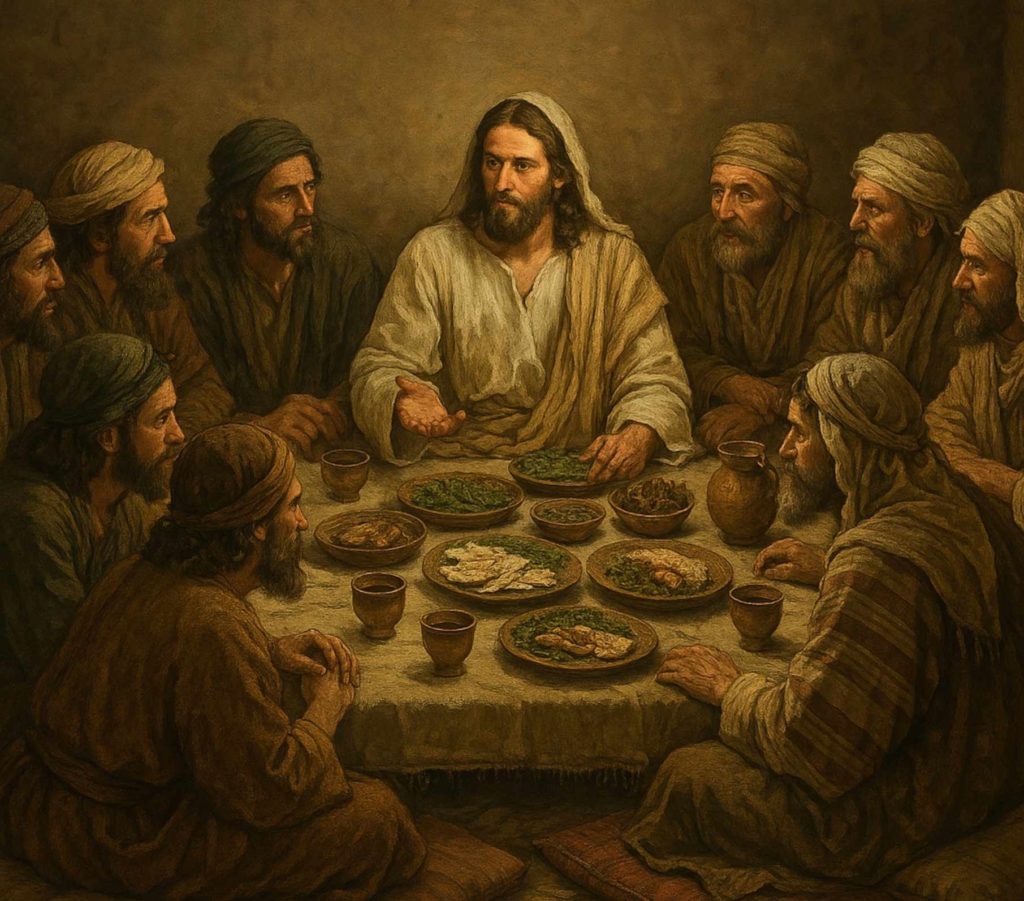
Was the “Last Supper” a Passover Seder?

Some argue that the Last Supper couldn’t have been a Passover meal because the Greek word artos (artuo) appears in Matthew 26:26 and elsewhere, implying leavened bread. But this is a misunderstanding.

Artuo can refer to any bread — leavened or unleavened — or even to food in general (Luke 15:17, 2 Thess. 3:8). In fact, artos is used in the LXX to translate lechem, the Hebrew word used in the Passover blessing: Hamotzi lechem min haaretz — over unleavened bread.

Synoptics vs. John: Same Supper or Different Meals?

The Synoptics say the Last Supper was on “the first day of Unleavened Bread” (Matt. 26:17; Mark 14:12; Luke 22:7), while John 13:1 says it happened “before” the feast of Passover. Some say this means John records a different meal.

But the DuTillet Hebrew Matthew uses וביום הרשון, which Hugh Schonfield translated “on the day before.” The Aramaic Gospels use קדמיא, which also has this dual meaning of “first” or “foremost.” In context, all four gospels are describing the same event — a Passover Seder, each phrased differently based on the ambiguity of the original language.

When Was Yeshua Crucified?

Tradition says Friday. Some claim Wednesday. But the Scriptures point to Thursday.

Luke 24:21 tells us “Today is the third day since these things happened,” on a Sunday. Counting backwards:

Sunday = third day

Saturday = second day

Friday = first day

Thursday = the day of crucifixion

This fits best with both a plain reading and inclusive counting traditions.

When Was Yeshua Risen?

Luke 23:54 in the Old Syriac Aramaic says, “And it was the day of preparation and the Sabbath was dawning [nogah].” But nogah can also mean “as it was getting dark” — in other words, Friday night.

Torrey and Jastrow both confirm that nogah can refer to the night or evening. This reinforces that the burial was late on Thursday or early Friday, before the annual Sabbath began that evening.

When Was He Buried and the Tomb Visited?

The Gospel texts vary slightly, especially in Greek. But Hebrew and Aramaic versions clarify:

The DuTillet Hebrew Matthew says “in the evening of Shabbat.”

The Old Syriac Mark 16:1 says “when the Sabbath had passed,” using avra (עברא), which could be misread in Hebrew as erev (ערב) “evening” as it appears in the DuTillet Hebrew Matthew.

This suggests a scribal error in transmission from Semitic to Greek.

It also supports the conclusion that Yeshua was buried late Thursday, and the tomb was found empty early Sunday.

Conclusion: A Complex but Coherent Picture

The timing of Yeshua’s Last Passover cannot be understood with a rigid, one-size-fits-all timeline. Any sound chronology must weigh:

Variations in calendar systems

Halachic ambiguities in defining days and observances

Linguistic flexibility in Hebrew and Aramaic terms

Internal harmony among the Gospels — including Synoptic and Johannine

The evidence, when all these variables are taken into account, points toward a Thursday crucifixion following a legitimate Passover Seder — all within the rich halachic and linguistic context of Second Temple Judaism.

And perhaps that’s the real takeaway: that Yeshua’s Passion did not occur in a vacuum, but within the living, breathing halachic and spiritual traditions of Israel — traditions that Nazarene Judaism continues to honor and study to this day.

Help Us Keep the Vision Alive

If this message stirred something in your heart—if you believe, like we do, that the voices of the ancient Nazarenes deserve to be heard again—we invite you to partner with us.

Your support helps us research, write, and share these forgotten treasures with a new generation. Whether it’s uncovering lost texts, translating forgotten sources, or creating educational resources rooted in the original faith of Yeshua, every gift makes a difference.

Please consider making a donation today. Together, we can restore the ancient paths and light the way for those seeking the truth.

We Need your help today! We must raise at least $450 by the end of the day today, or our account will plunge into negative anf create a chain reaction of returned items and fees!

Thank you for standing with us!

Donations can be sent by Paypal to donations@wnae.org or by the ling below thru Paypal, Zelle, GoFundMe, Bitcoin or Ethereum.

Click HERE to donate