What Do You Mean…. New Covenant?

What Do You Mean…. New Covenant?
By
James Scott Trimm

Many of us have missed an important truth. The New Covenant has been in the Torah all along! And this amazing truth is a major key in understanding the writings of Paul. There are in fact two covenants in the Torah and two Mosaic Covenants.

The first Mosaic Covenant was made at Mt. Sinai at Horev.

The Second Mosaic Covenant was made at Mt. Nebo at Mo’av. This was a second covenant which YHWH made with the people of Israel through Moses which was made shortly before the death of Moses and the entry of Israel into the Land. This covenant was made near the end of the Torah:

“These are the words of the covenant which YHWH
commanded Moshe to make with the children of Yisra’el in the land of
Mo’av, beside the covenant which He made with them in Horev.”


(Deuteronomy 28:69 / 29:1)

Note that this Covenant at Mo’av was made besides the Covenant made at Sinai.

Rashi makes an important comment about the significance of this word “besides”:

“Besides the covenant [Namely,] the curses [which appear] in Lev. (26: 14-39), which were proclaimed at [Mount] Sinai.”

(Rashi on Deuteronomy 28:69)

Rashi sees that these are two different covenants and that the word besides is intended to distinguish the Covenant at Sinai, characterized by “the curses” with this new Covenant made at Mo’av which is characterized not just by curses (Deuteronomy 29:16-29) but by blessings as well.

This covenant was centered around repentance (30:2, 8) and its rewards included a promise of a regathering of Israel from among the nations (30:3-4) a circumcised heart (30:2, 6) Israel would be his people and He would be their Elohim (29:13); a promise of land (30:5) and life (30:6, 15, 19).

This Covenant also includes Torah observance:

“If you shall hearken to the voice of YHWH your
Elohim, to keep His commandments and His statutes which are written in
this Book of the Torah; if you turn unto YHWH your Elohim with all your
heart, and with all your soul.”


(Deuteronomy 30:10)

Jeremiah and the New Covenant

In Jeremiah 11, the prophet Jeremiah was sent by YHWH to the people of Israel saying:

“Hear you the words of this covenant, and speak unto
the men of Y’hudah, and to the inhabitants of Yerushalayim: and say you
unto them: Thus says YHWH, the Elohim of Yisra’el: Cursed be the man
that hears not the words of this covenant, which I commanded your
fathers in the day that I brought them forth out of the land of Egypt…”


(Jeremiah 11:2-4a)

Here Jeremiah is quoting from the Torah (Deut. 27:26) and to the curse that was upon those who would fails to give heed to the covenant given at Sinai. He is warning the people of Judah that this curse is about to come upon them.

Ultimately Jeremiah prophesied to Israel that this curse would come upon them in the form of the seventy year Babylonian captivity:

” ‘Behold, I will send and take all the families of
the north,’ says YHWH, ‘and I will send unto N’vukhadretzar the king of
Bavel, My servant, and will bring them against this land, and against
the inhabitants thereof, and against all these nations round about; and I
will utterly destroy them, and make them an astonishment, and a
hissing, and perpetual desolations. …And this whole land shall be a
desolation, and a waste; and these nations shall serve the king of Bavel
seventy years. And it shall come to pass, when seventy years are
accomplished, that I will punish the king of Bavel, and that nation,’
says YHWH, “for their iniquity, and the land of the Chaldeans; and I
will make it perpetual desolations.’ “


(Jeremiah 25:9, 11-12)

“Then will I make this house like Shiloh, and will
make this city a curse to all the nations of the earth. So the cohanim
and the prophets and all the people heard Yirmeyah speaking these words
in the House of YHWH.”


(Jeremiah 26:6-7)

But Jeremiah also prophesied to the people that at the end of this seventy year curse, he would bring them back into the land:

“For thus says YHWH: ‘After seventy years are
accomplished for Bavel, I will remember you, and perform My good word
toward you, in causing you to return to this place.”


(Jeremiah 29:10)

In connection with this return Jeremiah speaks of a New Covenant:

” ‘Behold, the days come,’ says YHWH, ‘that I will
make a renewed covenant with the House of Yisra’el, and with the House
of Y’hudah; not according to the covenant that I made with their fathers
in the day that I took them by the hand to bring them out of the land
of Egypt; forasmuch as they broke My covenant, although I was a husband
over them,’ says YHWH. ‘But this is the covenant that I will make with
the House of Yisra’el after those days,’ says YHWH, ‘I will put My Torah
in their inward parts, and in their heart will I write it; and I will
be their Elohim, and they shall be My people; and they shall teach no
more every man his neighbour, and every man his brother, saying: “Know
YHWH”; for they shall all know Me, from the least of them unto the
greatest of them,’ says YHWH; ‘for I will forgive their iniquity, and
their sin will I remember no more.”


(Jeremiah 31:31)

(Throughout this article I will refer to this covenant as the “New Covenant” as it is commonly called, however the Hebrew is better understood as I have translated it above, as “renewed covenant”.)

But one important thing that many of us have missed is that this “New Covenant” is the Covenant made at Mo’av. As we have already seen, there are two Mosaic Covenants in the Torah. The first Covenant was made at Sinai but there is also a second “new” covenant in the Torah which was mad at Mo’av. When we compare these two covenants it is clear that the Covenant at Mo’av is the New Covenant.

Covenant at Mo’av Compared to the New Covenant

“These are the words of the covenant which YHWH
commanded Moshe to make with the children of Yisra’el in the land of
Mo’av, besides the covenant which he made with them in Horev.”


(Deuteronomy 28:69 / 29:1)

” ‘Behold, the days come,’ says YHWH, ‘that I will
make a renewed covenant with the House of Yisrael, and the House of
Y’hudah; not according to the covenant that I made with their father in
the day that I took them by the hand to bring them out of the land of
Egypt; forasmuch as they broke My covenant, although I was a husband
over them,’ says YHWH.”


(Jeremiah 31:31-32)

“And shall return unto YHWH your Elohim, and hearken
to His voice according to all that I command you this day, you and your
children, with all your heart, and with all your soul;…And YHWH your
Elohim will circumcise your heart, and the heart of your seed, to love
YHWH your Elohim with all your heart, and with all your soul, that you
may live.”


(Deuteronomy 30:2, 6)

“But this is the covenant that I will make with the
House of Yisra’el after those days, says YHWH, I will put My Torah in
their inward parts, and in their heart will I write it;… “


(Jeremiah 31:22a)

“…and I will put My fear in their hearts, that they shall not depart from Me.”

(Jeremiah 32:40b)

“…that He may establish you this day unto Himself for a
people, and that He may be unto you a Elohim, as He spoke unto you, and
as He swore unto your fathers, to Avraham, to Yitz’chak and to
Ya’akov.”


(Deuteronomy 29:12 / 29:13)

“…and I will be their Elohim, and they shall be My people;”

(Jeremiah 31:33b)

“…and they shall be My people, and will be their Elohim;”

(Jeremiah 32:38)

“…that then YHWH your Elohim will turn your captivity,
and have compassion upon you, and will return and gather you from all
the peoples, where YHWH your Elohim has scattered you. If any of you
that are dispersed be in the uttermost parts of heaven, from there will
YHWH your Elohim gather you, and from there will He fetch you.”


(Deuteronomy 30:3-4)

“Behold, I will gather them out of all the countries,
where I have driven them in My anger, and in My fury, and in great
wrath;…”


(Jeremiah 32:37a)

“And YHWH your Elohim will bring you into the land
which your fathers possessed, and you shall possess it; and He will do
you good, and multiply you above your fathers.”


(Deuteronomy 30:5)

“…and I will bring them back unto this place, and I will cause them to dwell safely;…”

(Jeremiah 32:37b)

Now if the Covenant at Mo’av is the New Covenant, then the Covenant at Sinai is an “Old Covenant”. Both the Old Covenant and the New Covenant are in the Torah. But this “New Covenant” is Torah based, as the Covenant itself states “…you shall hearken to the voice of YHWH your Elohim, to keep His commandments and His statutes which are written in this Book of the Torah…” (Deut. 30:10). This New Covenant is an “everlasting covenant” (Jeremiah 32:40) which gives us “life” (Deuteronomy 30:6, 15, 19). An everlasting covenant which gives life, must by implication, give “everlasting life”.

Daniel and the New Covenant

At the end of this seventy year curse we reach the time of Daniel chapter nine. Here Daniel has been studying these prophecies of Jeremiah and he knew the seventy years were over:

“In the first year of his reign I Daniel meditated in
the books, over the number of the years, whereof the word of YHWH came
to Yirmeyah the prophet, that He would accomplish for the desolations of
Yerushalayim seventy years.”


(Daniel 9:2)

Daniel knew that the curses mentioned in the Torah had come upon Israel:

“As it is written in the Torah of Moshe, all this evil
is come upon us; yet have we not entreated the favour of YHWH our
Elohim, that we might turn from our iniquities, and have discernment in
Your truth.”


(Daniel 9:13) (see Leviticus 26:14; Deuteronomy 28:15)

Daniel also knew that the Torah tells us that if after these curses come upon us, we still do not repent, Elohim would punish us seven times more:

“And if you will not yet for these things hearken unto Me, then I will chastise you seven times more for your sins.”

(Leviticus 26:18, see also verses 21, 24, 28)

In Daniel 9 Daniel prays for mercy for Israel, because he knows Israel has failed to repent, and he knows that seven times seventy is 490 years, and he does not want Israel to now fall under a 490 year curse. Unfortunately Gavri’el (El is Severe) comes with Elohim’s reply. Israel would indeed fall into a 490 year curse:

“Seventy weeks are decreed upon your people and upon
your set-apart city, to finish the transgression, and to make an end of
sin, and to make reconciliation for iniquity, and to bring in
everlasting righteousness, and to seal vision and prophecy, and to
anoint the most Set-apart. Know therefore and discern, that from the
going forth of the word to restore and to build Yerushalayim unto
Messiah, a prince, shall be seven weeks, and threescore and two weeks,
it shall be built again, with broad place and moat, but in troublous
times. And after threescore and two weeks shall Messiah be cut off, but
not for himself; and the people of a prince that shall come shall
destroy the city and the sanctuary; and the end thereof shall be with a
flood; and unto the end of the war desolations are determined. And he
shall make a firm covenant with many for one week; and in the midst of
the week he shall cause the sacrifice and the offering to cease; and
upon the wing of detestable things shall be that which causes appalment;
and that until the extermination wholly determined be poured out upon
that which causes appalment.”


(Daniel 9:24-27)

This 490 year curse was made up of seventy “weeks”. The Hebrew word here for “weeks” actually only refers to “a period of seven” and does not have to refer to seven days, in fact here it refers to blocks of seven year periods. These are not just any seven year periods, these are seven year cycles of the Sabbath of the land. It was the failure to keep these Sabbaths of the land each seventh year that was the final straw resulting in the seventy year curse:

“To fulfil the word of YHWH by the mouth of Yirmeyah,
until the land had been paid her sabbaths; for as long as she lay
desolate she kept sabbath, to fulfil threescore and ten years.”


(2 Chronicles 36:21)

483 years into this 490 years the Messiah comes along and is “cut off, but not for himself”:

“And after threescore and two weeks shall Messiah be
cut off, but not for himself; and the people of a prince that shall come
shall destroy the city and the sanctuary; and the end thereof shall be
with a flood; and unto the end of the war desolations are determined.”


(Daniel 9:26)

Why does the Messiah come seven years before the end of the 490 year curse?

Because the Land must have its seventh year Sabbath (2 Chronicles 36:21).

In order for the curse to end, the people of Israel would have to repent and turn back to Torah. Since the decisive issue had been the Sabbath of the Land, this repentance would need to manifest itself by the keeping of the Sabbath of the Land, but in order to do this, the people would need a seven year head start, they would have to start keeping a complete Sabbath of the Land cycle 483 years into the 490 year curse if they were to enter the New Covenant at the end of the 490 years. Thus YHWH in his infinite mercy was to send Messiah after 483 years to call the people to repentance.

Ramban: Messiah and the New Covenant

Ramban (Rabbi Moshe ben Nachman) (1194-1270 C.E.) wrote one of the most authoritative Torah commentaries in Rabbinic Judaism. His comments connecting the Covenant of Mo’av with the “New Covenant” of Jeremiah 31 and connecting these with the “days of the Messiah” that I am giving his lengthy comments on Deuteronomy 30:6 in totol, along with some interspersed comments of my own:

“And YHWH your Elohim will circumcise your heart
(Deuteronomy 30:6) It is this which the Rabbis have said, “If someone
comes to purify himself, they assist him” [from on High]. The verse
assures you that you will return to Him with all your heart and He will
help you.”

“This following subject is very apparent from
Scripture: Since the time of Creation, man has had the power to do as he
pleased, to be righteous or wicked. This [grant of free will] applies
likewise to the entire Torah period, so that people can gain merit upon
choosing the good and punishment for preferring evil. But in the days of
the Messiah, the choice of their [genuine] good will be natural; the
heart will not desire the improper and it will have no craving whatever
for it. This is the “circumcision” mentioned here, for lust and desire
are the “foreskin” of the heart, and circumcision of the heart means
that it will not covet or desire evil.”

Note that Ramban sees the ultimate fulfillment of the Covenant at Mo’av as taking place “in the days of the Messiah”.

“Man will return at that time to what he was before
the sin of Adam, when by his nature he did what should properly be done,
and there were no conflicting desires in his will, as I have explained
in Seder Bereshit.”

This recalls to mind the words of Paul “For if because of the error of one [Adam], death reigned, much more those who receive the abundance of favor and of the gift and of righteousness will rein in life by way of one, Yeshua the Messiah.” (see Romans 5:14-19; 1 Corinthians 15:22, 45).

“It is this which Scripture states in [the Book of]
Jeremiah 31:30], ‘Behold, the days come,’ says YHWH, ‘that I will make a
new covenant with the house of Israel, and with the house of Judah; not
according to the covenant that I made with their fathers ..etc. But
this is the covenant that I will make with the house of Israel after
those days, says the Eternal, I will put my Law in their inward parts,
and in their heart will I write it.”

Here Ramban identifies the Covenant of Mo’av with Jeremiah’s “New Covenant”.

“This is a reference to the annulment of the evil
instinct and to the natural performance by the heart of its proper
function. Therefore Jeremiah said further, and I will be their Elohim,
and they shall be My People; and they shall teach no more every man his
neighbor, and every man his brother, saying: ‘Know YHWH; ‘for they shall
all know Me, from the least of them to the greatest of them.’

Now, it is known that the imagination of man’s heart
is evil from his youth and it is necessary to instruct them, but at that
time it will not be necessary to instruct them [to avoid evil] for
their evil instinct will then be completely abolished. And so it is
declared by Ezekiel, ‘A new heart will I also give you, and a new spirit
will I put within you; and I will cause you to walk in My statutes.’ ”
(Ezekiel 36:26)

Here Ramban ties the New Covenant to the gift of the Ruach HaKodesh.

“The new heart alludes to man’s nature, and the [new]
spirit to the desire and will. It is this which our Rabbis have said :
“And the years draw nigh, when you shall say: I have no pleasure in
them; these are the days of the Messiah, as they will offer opportunity
neither for merit nor for guilt,” for in the days of the Messiah there
will be no [evil] desire in man but he will naturally perform the proper
deeds and therefore there will be neither merit nor guilt in them, for
merit and guilt are dependent upon desire.”


(Ramban on Deuteronomy 29:6)

Yeshua and the New Covenant

Now the 483 year period mentioned in Daniel begins with “the word to restore to build Yerushalayim” (Dan. 9:25) which was the Artaxerxes decree (Ezra 7:11-16) given in 457 B.C.E.. The 483 year period ends with the appearance of Messiah on the scene (Daniel 9:25). If we add 483 years to 457 B.C.E. we come to 27 C.E. (although 457 + 27 = 484 one must subtract a year whenever crossing the line between BCE and CE on the timeline, since there is no zero point year on the calendar.) Now there is good evidence that Yeshua was born, not in 1 C.E. but in 3 B.C.E.. At the age of thirty (in 27 C.E.) Yeshua first began his ministry (Luke 3:23).

Shortly after Yeshua began his ministry he returned to his home synagogue in Nazareth where he did the haftorah reading (Luke 4:16-20). He stood and read from Isaiah 61:1-2:

“The spirit of the Adonai YHWH is upon me; because
YHWH has anointed me to bring good tidings unto the humble; He has sent
me to bind up the broken-hearted, to proclaim liberty to the captives,
and the opening of the eyes to them that are bound; To proclaim the year
of YHWH’s good pleasure, and the day of vengeance of our Elohim; to
comfort all that mourn;”


(Isaiah 61:1-2)

“Then Yeshua proclaimed ‘Today this Scripture is fulfilled in your ears.’ “

(Luke 4:21)

The “year of YHWH’s good pleasure” in which the captives have liberty proclaimed to them is the seventh year Sabbath of the Land. The Anointed one is the Messiah as depicted in Daniel 9:24-27.

Moreover the haftorah readings were originally instituted at a time when it was illegal to read the Torah in public. As a result the weekly Torah readings were substituted by readings from the Prophets which were intended to bring to mind the corresponding Torah readings. After it became legal again to read the Torah in public, the haftorah readings were retained. The Torah reading which this haftorah reading is supposed to call to mind is Nitzavim (Deuteronomy 29:9-30:20) which is the Covenant of Mo’av.

Yeshua was telling the synagogue that these passages were being fulfilled.

Isaiah 60:22 tells us that YHWH will either “hasten” the restoration of the Kingdom of Israel, or let it come about “in its [due] time”, all depending on the New Covenant requirement of repentance (Deuteronomy 30:1-6.) This offer to repent began in the days of Yochanan the immerser (John the Baptist), as we read in Matthew 11:12:

“Only from the days of Yochanan the immerser until now the Kingdom of Heaven is constricted and the forceful despoil it.”

(Matthew 11:12 from the DuTillet Hebrew ms.)

And in Luke 16:16 we read:

“The Torah and the prophets were until Yochanan
henceforth the Kingdom of Eloah is announced but everyone treats it with
violence.”


(Luke 16:16 from Old Syriac & Peshitta Aramaic)

Yochanan had been announcing, “Repent you of your lives, for the Kingdom of Heaven is near to come” (Matthew 3:2 DuTillet.) And as soon as his work began, Yeshua proclaimed, “Turn you, turn you, in repentance: for the Kingdom of Heaven is near.” (Matthew 4:17 DuTillet = Mark 1:14-15) Now the word for “near” here in the DuTillet and ShemTob Hebrew versions is karavah, in the Aramaic of the Old Syriac and Peshitta the Aramaic equivalent appears. The phrase “Kingdom of Elohim” is a variation of the phrase in the Tanak “Kingdom of YHWH” (1 Chronicles 28:5; 2 Chronicles 13:8) a term used to describe the Kingdom of Israel. After studying the “Kingdom of Elohim” with the Messiah for forty days (Acts 1:3) the emissaries wanted to know if the Kingdom would be restored to Israel “at this time”, Yeshua answers that it is not for them to know the time (Acts 1:6-7). The truth is that the Kingdom of Elohim is the restored Kingdom of Israel (see Jeremiah 23:5-6; Isaiah 9:6-7; 11 with 1 Chronicles 28:5; 2 Chronicles 13:8). The Hebrew text of Matthew 3:2 & 4:17 = Mark 1:14-15 does indicate that the Kingdom was right there, available, if they would just repent.

Yeshua continued to proclaim this offer throughout his career (Matthew 12:28 = Luke 11:20; Mark 12:34; Luke 10:9, 11; 17:21) even sending out his emissaries with the same proclamation (Matthew 10:7.) This is the meaning of the passage, “…if you are willing to receive it (the New Covenant), he (Yochanan) is Elijah who is to come.” (Matthew 11:14, see 11:12).

Despite the fact that the New Covenent was being offered as early as the service of Yochanan (John) the immerser, repentance was required for it to be realized (Matthew 3:2-3; Mt.4:17 = Mark 1:14-15; Deuteronomy 30:1-6). However, from the time of Yochanan forward, the Kingdom was being rejected, “plundered” and “treated with violence” (Matthew 11:12 DuTillet; Luke 16:16 Old Syriac & Peshitta.) Yeshua compared this rejection to those who would not dance for flute players (Matthew 11:12, 16-19.)

At Yeshua’s so-called “Last Supper” which was a Passover Sader, Yeshua holds up the third cup of the Passover Sader known as the “cup of redemption” and said:

“Drink you all of it, for this is my blood of the New
Covenant, which is shed for many to atone for sinners. And I tell you,
hereafter I will not drink of the fruit of the vine, until that day when
I drink it with you in the Kingdom of my Father which is in heaven.”


(Matthew 26:27-29)

Here Yeshua tells us that the “cup of redemption” which represents the blood of the Passover lamb, represents his own blood which will be the ratifying blood of the New Covenant.

The New Covenant Offer Extended

It would seem that the New Covenant offer was extended beyond the crucifixion. In his discourse at the Temple in Acts 3:12-26 Kefa repeated the Kingdom offer saying:

“Repent therefore, and be restored so that your sins
be blotted out and times of rest come to you from the presence of YHWH,
And he send to you him who was prepared for you, Yeshua the Messiah, Who
it is required for heaven to receive until the fullness of the times of
all those things that Eloah spoke by the mouth of his set-apart
prophets of old.”


(Acts 3:19-21)

Thus it would appear that if the people of Israel had entered a national repentance, even then, the Messiah would have returned to restore the Kingdom to Israel right then and there.

This Kingdom offer seems to have continued throughout the entire Acts period, until it expired at the end of the Book of Acts. In Acts 28 “Paul called the leaders of the Jews together… to whom he explained and solemnly testified of the Kingdom of Eloah, persuading them concerning Yeshua…” (Acts 28:17, 23). once again a corporate repentance did not occur “… some disbelieved. So they did not agree among themselves.” (Acts 28:24b-25a). At this time Paul made known that the Kingdom offer had ended saying “…the salvation of Eloah has been sent to the Gentiles, and they will hear it!” (Acts. 28:28)

Paul and the New Covenant

This new understanding of the nature of the New Covenant sheds new light on the teachings of Paul which so many have misunderstood.

In Romans 2:27-29 Paul contrasts those with the “circumcision of the heart by the spirit” with those who have a circumcision “in the flesh [alone] … by the letter [only]”. Of course the “circumcision of the heart by the spirit” is an element of the New Covenant of Moab. Paul is contrasting this with the Siniatic Covenant alone which is “in the flesh [alone]…” and “…by the letter [only]….”

In Romans 7:6 Paul contrasts “the renewal of the spirit” of the New Covenant” with the “oldness of the writing” of the Sianiatic Covenant alone. In this section of Romans (Romans 7-8) Paul contrasts the two Mosaic Covenants. He calls the Covenant of Mo’av the “Torah of Eloah” which he contrasts with the “law of sin” (7:25) He calls walking by the Siniatic Covenant alone as “of the flesh” but the New Covenant as “of the spirit” (8:4-5) He associates the Siniatic Covenant alone with “death” but the Covenent of Mo’av with “life” (8:6) just as the Torah also does (Deuteronomy 30:6, 15, 19).

In Romans 10:4-8 Paul contrasts the “righteousness that is by the Torah” (10:5) which he characterizes by quoting Lev. 18:5 with the “righteousness that is by faith” (10:6-8) which he characterizes by quoting from the Covenant at Mo’av:

“And the righteousness that is by faith, [he] thus
says: Do not say in your heart: who has ascended to heaven and brought
down the Messiah? And who has descended to the depth of She’ol and
brought up the Messiah from among the dead? But what does it say? The
answer is near to you, to your mouth and to your heart, which is the
word of faith that we proclaim.”


(Deuteronomy 30:11-14)

Paul goes on to say that this same covenant is the “word of faith that we proclaim” (10:8). Paul goes on to identify this covenant at Mo’av with the covenant of Messiah by which we are saved:

“And if you confess with your mouth our Adon Yeshua,
and you believe in your heart that Eloah raised him from the dead, you
will have life. For the heart that believes in him is made
righteousness, and the mouth that confesses him has life. For the
scripture has said that anyone who believes in him will not be
humiliated. And in this it does not discriminate, either against Jews or
against Aramaeans, for YHWH of all of them is one who is rich with all
who call on him. For all who will call on the name of YHWH have life.”


(Romans 10:9-13)

In 2 Corinthians 3:3-6 Paul refers to the “New Covenant” (3:6) when he contrasts the “letter” of the Torah which is “written on tablets of stone” with the “spirit” of the Torah which is written “on tablets of the heart of flesh”. Paul says “the letter kills but the spirit gives life”. Here again Paul is comparing the Siniatic Covenant alone with the New Covenant of Mo’av.

In Galatians 3 Paul alludes to the two Covenants. He tells us that Messiah redeemed us from the “curse of the law” (3:10-13) just as we noted earlier that Rashi tells us that the word “besides” in Deuteronomy 28:69 distinguishes the Covenant of Mo’av from the “curse” of the Law.

In Galatians 4:21-31 Paul plainly compares the two covenants of Torah saying “for these are the two covenants, one from Mount Sinai genders bondage…”

Hebrews is filled with references to these two covenants as well. The author of Hebrews (whom I believe to be Paul) tells us that chapter 8:1f begins “the main point of what we are saying” and then quotes all of Jeremiah 31:30-33 (31:31-34) regarding the “New Covenant” in Hebrews 8:8-11. Throughout this book Paul compares “the first covenant” with the second (covenant) (8:6, 7, 13; 9:1, 15; 10:9). Paul points out that this second covenant differed from the first covenant. While the first covenant had been ratified by the blood of bulls, the second ovenant was actually ratified by the blood of Messiah. Moreover while the Greek text of Hebrews states:

“For the priesthood being changed, there is made of necessity a change also of the law.”

(Hebrews 7:12 KJV)

However the Torah cannot be changed (see Deuteronomy 4:2; 12:32 & Matthew 5:17). The Hebrew text of Hebrews, however, actually reads:

“It is saying that according to which there is a
repetition of the office of the priesthood of necessity, it is saying
there is a repetition of the Torah.”


(Hebrews 7:12 HRV)

The Torah was not “changed” by the New Covenant of Mo’av, but it was repeated with better promises. The fact that the “second” or “new” covenant of Hebrews is the Covenant made at Mo’av is further reinforced by the fact that Paul draws a strong parallel in Hebrews 3:7-4:10 between the “rest” we enter into and the entry into the Land which took place at the death of Moses at the end of the forty years immediately after the making of the Covenant of Mo’av.

It is beyond the scope of this article to fully explore all of the ramifications of this important truth to the writings of Paul. Nearly every word that Paul writes becomes pregnant with deeper meaning when we read them in light of this truth. We find that amazingly Paul is saying much the same things that Rashi and Ramban were saying about the curse of the law and the new covenant.

It all Comes Back to Mo’av

Finally we find an amazing prophecy found, not in the canon, but in one of the books known as the “Apocrypha”. In 2 Maccabees 2:1-8 we read:

“One finds in the records that Jeremiah the prophet
ordered those who were being deported to take some of the fire, as has
been told, and that the prophet after giving them the law instructed
those who were being deported not to forget the commandments of the
Lord, nor to be led astray in their thoughts upon seeing the gold and
silver statues and their adornment. And with other similar words he
exhorted them that the law should not depart from their hearts. It was
also in the writing that the prophet, having received an oracle, ordered
that the tent and the ark should follow with him, and that he went out
to the mountain where Moses had gone up and had seen the inheritance of
God. And Jeremiah came and found a cave, and he brought there the tent
and the ark and the altar of incense, and he sealed up the entrance.
Some of those who followed him came up to mark the way, but could not
find it. When Jeremiah learned of it, he rebuked them and declared: “The
place shall be unknown until God gathers his people together again and
shows his mercy. And then the Lord will disclose these things, and the
glory of the Lord and the cloud will appear, as they were shown in the
case of Moses, and as Solomon asked that the place should be specially
consecrated.”


(2 Maccabees 2:1-8 RSV)

Here there is an allusion to Jeremiah and the new covenant which places the Torah in our hearts. This becomes tied again to Mo’av where Moshe had made the Covenant of Mo’av just before his death on Mount Nebo. According to this book the Tabernacle, the alter of incense and the Ark of the Covenant are all hidden inside Mount Nebo at Mo’av and at the time of the regathering (another allusion to the New Covenant of Mo’av) they will reveal their own position to the world. All of this will end where it began, we will finally enter the New Covenant Kingdom right there at Mo’av!

Conclusion

There are two covenants in the Torah, and the Torah is very much a part of both of them. Both Rashi and Paul tell us that the covenant of Mo’av or “new covenant” is distinguished from the “curse” of the first covenant. Both Ramban and Paul tell us that the New Covenant is tied to the work of Messiah, involves a change of a persons heart and inner desires and involves the implanting of the Spirit of YHWH to guide us in an inner desire to observe Torah. This Covenant has been offered to Israel collectively on at least three occasions: upon entering the Land (Deuteronomy 29-30); upon returning to the Land (Jeremiah 29:10; 31:30f) and at the first coming of Messiah (Matthew 26:27-29). While Israel may not collectively enter this covenant until Messiah returns, we as individuals may enter it early, becoming citizens of a Kingdom not yet established. This profound understanding of the nature of the New Covenant will radically improve our understanding of Scripture. This article is not the end of that process, it is only intended to serve as a modest beginning.

We must raise at least $1,000 by the end of the day tomorrow (1/21/2020) or our account will go into the negative and bills will bounce!

As you know we have been digging ourselves out of a budget shortfall.  As I have said to you many times, I look on this work as a co-operative one with me, and all of you combining our resources together in order to get the job done of helping to teach this great truth to all in the world who will listen. Thank you so much from the bottom of my heart for your continued support, you are the ones who make it all possible by your contributions and your prayers for our work. I truly appreciate your help in every way.

If you can make a one time donation of $500 or $1,000 dollars to support this work.


Donations can be sent by paypal to donations@wnae.org.
Bring Your Jug of Wine

There is an old Jewish story of a couple about to be married. They lived in a small village and had invited everyone from the village to their wedding. Each guest was asked to bring a jug of wine for the celebration. Each jug of wine would be poured into a giant vat to be shared by everyone. As the wedding day approached, each member of the village thought, “If I do not bring my jug of wine, it will not be missed among so many other jugs.”

The wedding day arrived and the couple were married and everyone was excited. But as the tap of the vat was opened, not a drop of wine flowed from it, for everyone had been sure that someone else would provide their share.
Do not count on someone else to do your part, you do your part.

Is this work worthy of your support? What other ministry provides this kind of teaching?

As I have said to you many times, I look on this work as a co-operative one with me, and all of you combining our resources together in order to get the job done of helping to teach this great truth to all in the world who will listen. Thank you so much from the bottom of my heart for your continued support, you are the ones who make it all possible by your contributions and your prayers for our work. I truly appreciate your help in every way.

We must raise at least $1,000 by the end of the day tomorrow (1/21/2020) or our account will go into the negative and bills will bounce!

As you know we have been digging ourselves out of a budget shortfall.  As I have said to you many times, I look on this work as a co-operative one with me, and all of you combining our resources together in order to get the job done of helping to teach this great truth to all in the world who will listen. Thank you so much from the bottom of my heart for your continued support, you are the ones who make it all possible by your contributions and your prayers for our work. I truly appreciate your help in every way.

If you can make a one time donation of $500 or $1,000 dollars to support this work.


Donations can be sent by paypal to donations@wnae.org.
The Time of Messiah’s Birth Revealed

The Time of Messiah’s Birth Revealed
By
James Scott Trimm

The Talmud states:

The Targum of the Prophets was composed by Jonathon ben Uzziel under the guidance of Haggai, Zechariah and Malachi… and a Bat Kol (voice from heaven) came forth and exclaimed, “Who is this that has revealed My secrets to mankind?”… He further sought to reveal by a Targum the inner meaning of the Ketuvim, but a bat kol went forth and said, “Enough!”. What was the reason?– Because the date of the Messiah is foretold in it.
(Babylonian Talmud; b.Megillah 3a)

Now the only prophetic book of the Ketuvim is Daniel and this is also a book of the Ketuvim for which no Targum was ever made.

Josephus wrote of the Book of Daniel: 

We believe that Daniel conversed with God; for he did not only prophecy of future events, as did the other prophets, but also determined the time of their accomplishment.
(Josephus; Antiquities 10:11:7)

Now the Qumran community found just this information (the time of the Messiah) in the Book of Daniel:

The visitation is the Day of Salvation that He has decreed through Isaiah the prophet concerning all the captives, inasmuch as Scripture says, “How beautiful upon the mountains are the feet of the messenger who announces peace, who brings good news, who announces salvation, who says to Zion “Your ELOHIM reigns”.” (Isaiah 52;7)

This scriptures interpretation : “the mountains” are the prophets, they who were sent to proclaim God`s truth and to prophesy to all Israel. “The messengers” is the Anointed of the spirit, of whom Daniel spoke; “After the sixty-two weeks, a Messiah shall be cut off” (Daniel 9;26, from 11Q13)

So now we have learned that there is good reason to believe that the time of Messiah is found in Daniel 9:24-27.

1: In the first year of Darius the son of Ahasuerus, of the seed of the Medes, which was made king over the realm of the Chaldeans;
2: In the first year of his reign I Daniel understood by books the number of the years, whereof the word of the LORD came to Jeremiah the prophet, that he would accomplish seventy years in the desolations of Jerusalem.

Daniel has been doing some Tanak study. He has been reading Jeremiah 25:11-12; 29:10. He has read about the seventy year exile.

The reason for a seventy year captivity had been that YHWH was punishing us for having forsaken the Torah. He punished us with the curses of Deuteronomy 28-29 and Leviticus 26 as the Torah had warned us. The key issue here was that of the violation of the Sabbath of the Land (Exodus 21:2; 23:11; Leviticus.
25:2, 20; 26:2, 34; Deuteronomy 15:1)

According to the Torah, if we as a people did not keep the sabbath of the land every seven years we would be cursed (Leviticus 26:34)

3: And I set my face unto the Lord God, to seek by prayer and supplications, with fasting, and sackcloth, and ashes:
4: And I prayed unto the LORD my God, and made my confession, and said, O Lord, the great and dreadful God, keeping the covenant and mercy to them that love him, and to them that keep his commandments;
5: We have sinned, and have committed iniquity, and have done wickedly, and have rebelled, even by departing from thy precepts and from thy judgments:
6: Neither have we hearkened unto thy servants the prophets, which spake in thy name to our kings, our princes, and our fathers, and to all the people of the land.
7: O Lord, righteousness belongeth unto thee, but unto us confusion of faces, as at this day; to the men of Judah, and to the inhabitants of Jerusalem, and unto all Israel, that are near, and that are far off, through all the countries whither thou hast driven them, because of their trespass that they have trespassed against thee.
8: O Lord, to us belongeth confusion of face, to our kings, to our princes, and to our fathers, because we have sinned against thee.
9: To the Lord our God belong mercies and forgivenesses, though we have rebelled against him;
10: Neither have we obeyed the voice of the LORD our God, to walk in his laws, which he set before us by his servants the prophets.
11: Yea, all Israel have transgressed thy law, even by departing, that they might not obey thy voice; therefore the curse is poured upon us, and the oath that is written in the law of Moses the servant of God, because we have sinned against him.
12: And he hath confirmed his words, which he spake against us, and against our judges that judged us, by bringing upon us a great evil: for under the whole heaven hath not been done as hath been done upon Jerusalem.
13: As it is written in the law of Moses, all this evil is come upon us: yet made we not our prayer before the LORD our God, that we might turn from our iniquities, and understand thy truth.
14: Therefore hath the LORD watched upon the evil, and brought it upon us: for the LORD our God is righteous in all his works which he doeth: for we obeyed not his voice.
15: And now, O Lord our God, that hast brought thy people forth out of the land of Egypt with a mighty hand, and hast gotten thee renown, as at this day; we have sinned, we have done wickedly.
16 O Lord, according to all thy righteousness, I beseech thee, let thine anger and thy fury be turned away from thy city Jerusalem, thy holy mountain: because for our sins, and for the iniquities of our fathers, Jerusalem and thy people are become a reproach to all that are about us.
17: Now therefore, O our God, hear the prayer of thy servant, and his supplications, and cause thy face to shine upon thy sanctuary that is desolate, for the Lord’s sake.
18 O my God, incline thine ear, and hear; open thine eyes, and behold our desolations, and the city which is called by thy name: for we do not present our supplications before thee for our righteousnesses, but for thy great mercies.
19: O Lord, hear; O Lord, forgive; O Lord, hearken and do; defer not, for thine own sake, O my God: for thy city and thy people are called by thy name.

Daniel is very concerned. It has been seventy years and he wants to go home! He is a very old man by now. But he has worried because he knows his Torah. He knows that the Torah warns that if Israel still does not repent after the curse is inacted that Israel will have the punishment multiplied by seven (Lev. 26:18) Daniel is hoping that YHWH will not be enacting the next level punishment. For that would mean 70 * 7 or another 490 years!

20: And whiles I was speaking, and praying, and confessing my sin and the sin of my people Israel, and presenting my supplication before the LORD my God for the holy mountain of my God;
21: Yea, whiles I was speaking in prayer, even the man Gabriel, whom I had seen in the vision at the beginning, being caused to fly swiftly, touched me about the time of the evening oblation.
22: And he informed me, and talked with me, and said, O Daniel, I am now come forth to give thee skill and understanding.
23: At the beginning of thy supplications the commandment came forth, and I am come to shew thee; for thou art greatly beloved: therefore understand the matter, and consider the vision.
24: Seventy weeks are determined upon thy people and upon thy holy city, to finish the transgression, and to make an end of sins, and to make reconciliation for iniquity, and to bring in everlasting righteousness, and to seal up the vision and prophecy, and to anoint the most Holy.

Daniel learns that there will indeed be at least another 490 years of curses for Israel. The “weeks” here are not seven DAYS but seven YEARS. In fact the Hebrew word here actually just means “seven [somethings]”

25: Know therefore and understand, that from the going forth of the commandment to restore and to build Jerusalem unto the Messiah the Prince shall be seven weeks, and threescore and two weeks: the street shall be built again, and the wall, even in troublous times.

7 “weeks” here would be 49 years (a Jubilee cycle) plus theeescore and two weeks (3*20+2=62) is 69 “weeks” or 483 years.

But remember we are not counting years here but actual sabbath year cycles which are specific seven year blocks. In other words this is actually a count of how many sabbath year cycle blocks fall between these two points.

Our starting point is “the going forth of the commandment to restore and to build Jerusalem” which is Ezra 7:11-16 and gives us a start date of 457 BCE. Between that date and the Messiah 69 sabbath year cycle blocks would fall.

26: And after threescore and two weeks shall Messiah be cut off, but not for himself: and the people of the prince that shall come shall destroy the city and the sanctuary; and the end thereof shall be with a flood, and unto the end of the war desolations are determined.

Messiah is cut off after ther 62 “weeks” which follow the 7 weeks. This elaboration allows us to see that the division of these two blocks (the 7 weeks and the 62 weeks) was to show that after the 7 weeks “the street shall be built again, and the wall” but the Messiah would not come until after the 62 week block following that.

The Messiah would be “cut off” at that time. This is an idiom meaning that he would be executed. He would not be executed for himself, but for others. Then the people of a prince destroy Jerusalem after that time.

27: And he shall confirm the covenant with many for one week: and in the midst of the week he shall cause the sacrifice and the oblation to cease, and for the overspreading of abominations he shall make it desolate, even until the consummation, and that determined shall be poured upon the desolate.

Remember there were 490 years or 70 “weeks” but we have so far covered only 483 (or 69 “weeks”).

This is because the big test of our trust in YHWH is the Sabbath of the land. This is where Israel SHOWS our trust in YHWH by trusting him to provide. The curse would not end until we reinstitute the sabbath of the land (2 Chronicles 36:21).

So YHWH in his infinite mercy would send the Messiah seven years BEFORE the 490 years would end to call us to repent and return to Torah in time to reinstitute the sabbath of the land BEFORE the 490 years are over.  

The curse will not end until we as a people repent and show that by reinstituting the sabbath of the land. When we do that we will finally kick off the last seven years of the curse we have lived with all of this time.

There is so much to learn from this chapter. Including the nature of the Kingdom offer and the layout of the last seven years. But most importantly is the time that the Messiah would come and be “cut off”.

Now if our start point is 457 BCE and 69 “weeks” must fall between this point and the death of Messiah, then Messiah would have to be executed sometime in a window from 26 C.E. to 40 C.E. (depending on how the sabbath year cycles fall).

So if Yeshua was NOT the Messiah that would be “cut off, but not for himself” during that window… then who was?

Messaih would be executed in a window of time somewhere between 26 and 44 C.E.. And he would arive in accordance to the completion of a series of sabbath-year-cycles and jubilee cycles. Now these cycles indicate “the year of release”. So lets look for more clues about this Messiah who is cut off at such a time.

Lets look at Isaiah 60:22-61:2.

“A little one shall become a thousand, and a small one a strong nation: I YHWH will hasten it in its time.”
(Isaiah 60:22)

“A little one shall become a thousand, and a small one a strong nation:” is the Kingdom represented by a stone in Daniel 2:34-35, 45 which “became a great mountain and filled the whole earth” (Daniel 3:35).

“I YHWH will hasten it in its time.” refers to the “Kingdom offer”.

“The Spirit of Adonai YHWH is upon me; because YHWH has anointed me to proclaim good tidings to the meek; he has sent me to bind up the broken hearted, to proclaim liberty to the captives, and the opening of the prison to them that are bound. To proclaim the acceptable year of YHWH, and the day of vengeance of our ELOHIM, to comfrort all who mourn.”
(Isaiah 61:1-2)

Here we have an anointed one, a “Messiah” who comes in accordance with the jubilee and seven year cycles to proclaim liberty to captives. It is also significant as we will soon find that he makes this proclamation to “Zion” (Isaiah 61:3). This Messiah comes to REDEEM.

Lets see if Isaiah speaks any more about this figure who makes a proclamation of redemption to Zion. In Isaiah 52:7 we also read about a figure who also proclaims good tidings to Zion. This proclamation appears in Isaiah 53 and also involves one who comes to redeem (Isaiah 53:4-5, 11-12) and is cut off, but not for himself (53:8; 53:4-5, 11-12) just like the figure in Daniel. The figure must be the Messiah of Daniel 9 and Isaiah 61.

I wonder how this Messiah dies? Perhaps the prophets give me some clue. Zechariah writes:

“…they shall look upon me whom they have pierced…”
(Zechariah 12:10)

According to both the Talmud (b.Sukkot 52a) and the Targum, this “pierced one” is the Messiah. Now Zechariah 12:10 takes place at the coming of Messiah as king, but they notice that he was the same one whom they had “pierced” or “thrust through”. Lets read on and see if Zechariah gives us any clues as to who this is and just how he was pierced. As we read further Zechariah 12:10-14 speaks of the people mourning over having pierced this guy. Zechariah 13:1-4 takes place at the intiation of the Messianic age. The Messiah is judging idolaters and false prophets. No wonder they are now mourning over this pierced one! Then in verses 5-6 we get a detailed scene of one of these judgements:

“And he shall say, ‘I am no prophet, I am a husbandman; for a man taught me to keep cattle from my youth.’ And he

shall say to him [Messiah], ‘What are these wounds in your hands?’ Then he [the Messiah] shall answer: ‘Those with which I was wounded in the house of my friends.’ “ Zechariah 13:5-6

Zechariah 13:6 points us back to 12:10 regarding how they mourn when they see he is the pierced one.

So now we have a Messiah who would be “cut off” sometime between 26 and 44 C.E. not for himself but to redeem others. This execution would involve having his hands pierced.

Now lets look at Zechariah 13:2. Notice that this guy will “cut off the names of the idols out of the land” (13:2). Sounds like the same guy about whom Micah 5:13 says “Your graven images also will I cut off”. This guy is born in Beit-Lechem (Bethlehem) according to Micah 5:2 (and the Targum to Micah 5:2 says this is Messiah).

This passage points us to various other prophecies about this figure which also tell us that he is born in Beit-Lechem, and executed by having his hands pierced.

Who could this be?

In these trying economic times donations are way down while prices are all way up! We need your help today!

As you know we have been digging ourselves out of a budget shortfall.  As I have said to you many times, I look on this work as a co-operative one with me, and all of you combining our resources together in order to get the job done of helping to teach this great truth to all in the world who will listen. Thank you so much from the bottom of my heart for your continued support, you are the ones who make it all possible by your contributions and your prayers for our work. I truly appreciate your help in every way.

If you can make a one time donation of $500 or $1,000 dollars to support this work.


Donations can be sent by Paypal to donations@wnae.org

Or click HERE to donate

And don’t forget to join the conversations at the NazareneSpace Social Network

The Ram and the Goat

The Ram and the Goat

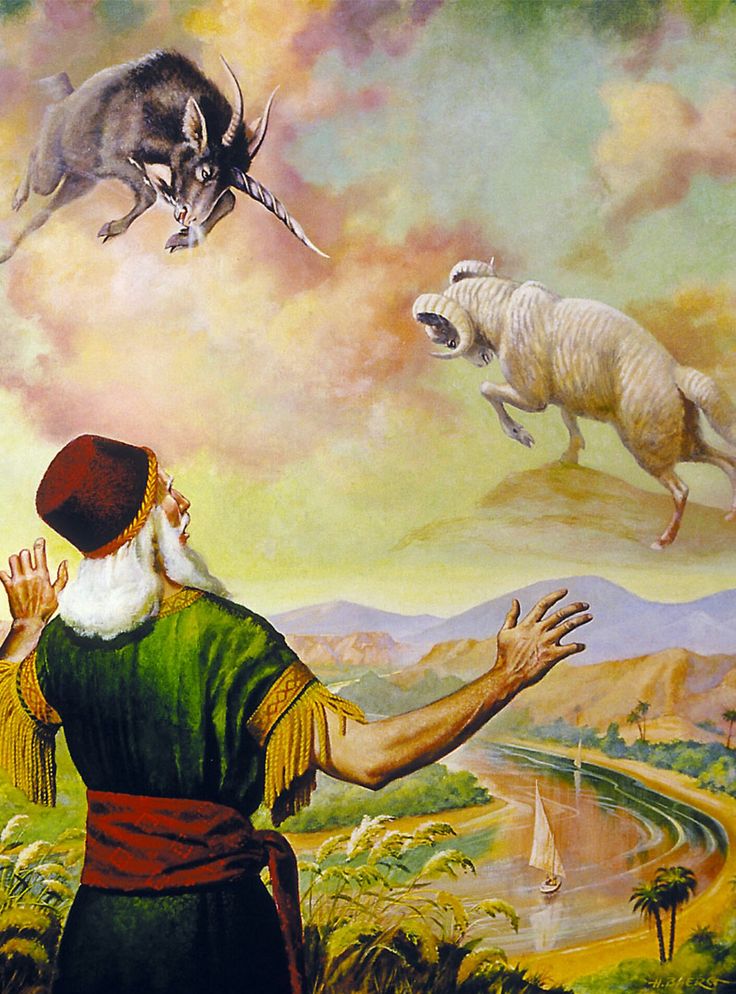
Let us begin by looking at Daniel’s vision of the ram and the goat.

Daniel’s vision is as follows:

Then Daniel is told the meaning of this vision in verses 20-27.

Now lets examine this vision to see what it can teach us:

1 In the third year, of the reign of king Beltshatzar, a vision appeared unto me–even unto me, Daniel; after that, which appeared unto me at the first.

2 And I saw in the vision: now it was so that when I saw, I was in Shushan the castle, which is in the province of Elam. And I saw in the vision, and I was by the stream Ulai.

3 And I lifted up my eyes and saw, and behold, there stood before the stream, a ram which had two horns. And the two horns were high, but one was higher than the other, and the higher came up last.

4 I saw the ram, pushing westward, and northward, and southward. And no beasts could stand before him, neither was there any that could deliver out of his hand: but he did according to his will, and magnified himself.

5 And as I was considering, behold, a he goat came from the west, over the face of the whole earth, and touched not the ground. And the goat had a conspicuous horn between his eyes.

6 And he came to the ram that had the two horns, which I saw standing before the stream, and ran at him in the fury of his power.

7 And I saw him come close unto the ram, and he was moved with choler against him: and smote the ram, and broke his two horns, and there was no power in the ram to stand before him. But he cast him down to the ground, and trampled upon him, and there was none that could deliver the ram out of his hand.

8 And the he goat magnified himself exceedingly, and when he was strong, the great horn was broken: and instead of it, there came up the appearance of four horns, toward the four winds of heaven.

9 And out of one of them, came forth a little horn, which waxed exceeding great: toward the south, and toward the east, and toward the beauteous land.

10 And it waxed great, even to the host of heaven: and some of the host and of the stars, it cast down to the ground, and trampled upon them.

11 Yes, it magnified itself–even to the prince of the host, and from him the continual burnt-offering was taken away, and the place of his sanctuary was cast down.

12 And the host was given over to it, together with the continual burnt-offering through transgression. And it cast down truth to the ground: and it wrought, and prospered.

13 Then I heard a Set-Apart-One speaking, and another Set-Apart-One said unto that certain one who spoke, How long shall be the vision, concerning the continual burntoffering, and the transgression that causes appallment: to give both the sanctuary and the host, to be trampled under foot?

14 And he said unto me, Unto two thousand and three hundred evenings and mornings; then shall the sanctuary be victorious.

(Dan. 8:1-14 HRV)

3 And I lifted up my eyes and saw, and behold, there stood before the stream, a ram which had two horns. And the two horns were high, but one was higher than the other, and the higher came up last.

4 I saw the ram, pushing westward, and northward, and southward. And no beasts could stand before him, neither was there any that could deliver out of his hand: but he did according to his will, and magnified himself.

The Ram is the partnership of the Medo-Persian Empire (Dan. 8:20). The horns represent Medes and Persians respectively, the Persian Empire being larger than that of the Mede Empire and having arisen later.

5 And as I was considering, behold, a he goat came from the west, over the face of the whole earth, and touched not the ground. And the goat had a conspicuous horn between his eyes.

6 And he came to the ram that had the two horns, which I saw standing before the stream, and ran at him in the fury of his power.

7 And I saw him come close unto the ram, and he was moved with choler against him: and smote the ram, and broke his two horns, and there was no power in the ram to stand before him. But he cast him down to the ground, and trampled upon him, and there was none that could deliver the ram out of his hand.

8 And the he goat magnified himself exceedingly, and when he was strong, the great horn was broken: and instead of it, there came up the appearance of four horns, toward the four winds of heaven.

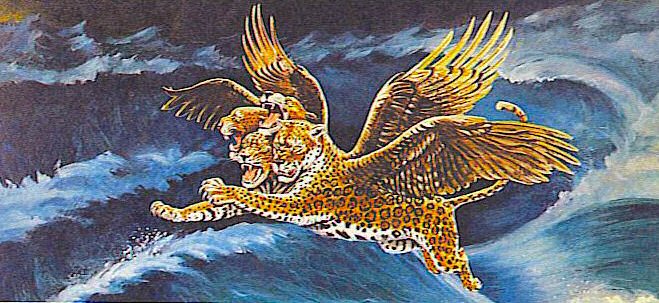
The goat represents the Greek Empire (Dan. 8:21-22) established by Alexander the Great, but just before his death it was divided by four of his generals into four kingdoms. For this reason the Greek Empire had been represented as a leopard with four heads in Daniel 7. 1st Maccabees describes these things this way:

1: And it happened, after that Alexander son of Philip, the Macedonian, who came out of the land of Chettiim, had smitten Darius king of the Persians and Medes, that he reigned in his stead, the first over Greece,

2: And made many wars, and won many strong holds, and slew the kings of the earth,

3: And went through to the ends of the earth, and took spoils of many nations, insomuch that the earth was quiet before him; whereupon he was exalted and his heart was lifted up.

4: And he gathered a mighty strong host and ruled over countries, and nations, and kings, who became tributaries unto him.

5: And after these things he fell sick, and perceived that he should die.

6: Wherefore he called his servants, such as were honourable, and had been brought up with him from his youth, and parted his kingdom among them, while he was yet alive.

7: So Alexander reigned twelves years, and then died.

8: And his servants bare rule every one in his place.

9: And after his death they all put crowns upon themselves; so did their sons after them many years: and evils were multiplied in the earth.

(1Macc. 1:1-9)

9 And out of one of them, came forth a little horn, which waxed exceeding great: toward the south, and toward the east, and toward the beauteous land.

10 And it waxed great, even to the host of heaven: and some of the host and of the stars, it cast down to the ground, and trampled upon them.

This refers to Antiochus Epiphanies, who is the antagonist of the Channukah story. The name Epiphanies, which he took for himself means “god manifest”. As we read in 1st Maccabees:

10: And there came out of them a wicked root Antiochus surnamed Epiphanies,…

16: Now when the kingdom was established before Antiochus, he thought to reign over Egypt that he might have the dominion of two realms.

17: Wherefore he entered into Egypt with a great multitude, with chariots, and elephants, and horsemen, and a great navy,

18: And made war against Ptolemee king of Egypt: but Ptolemee was afraid of him, and fled; and many were wounded to death.

19: Thus they got the strong cities in the land of Egypt and he took the spoils thereof.

20: And after that Antiochus had smitten Egypt, he returned again in the hundred forty and third year, and went up against Israel and Jerusalem with a great multitude,

(1Macc. 1:10, 16-20)

11 Yes, it magnified itself–even to the prince of the host, and from him the continual

burnt-offering was taken away, and the place of his sanctuary was cast down.

12 And the host was given over to it, together with the continual burnt-offering through

transgression. And it cast down truth to the ground: and it wrought, and prospered.

This is fulfilled in 1st Maccabees as follows:

21: And entered proudly into the sanctuary, and took away the golden altar, and the candlestick of light, and all the vessels thereof,

22: And the table of the shewbread, and the pouring vessels, and the vials. and the censers of gold, and the veil, and the crown, and the golden ornaments that were before the temple, all which he pulled off.

23: He took also the silver and the gold, and the precious vessels: also he took the hidden treasures which he found.

24: And when he had taken all away, he went into his own land, having made a great massacre, and spoken very proudly.

25: Therefore there was a great mourning in Israel, in every place where they were;

54: Now the fifteenth day of the month Casleu, in the hundred forty and fifth year, they set up the abomination of desolation upon the altar, and builded idol altars throughout the cities of Juda on every side;

55: And burnt incense at the doors of their houses, and in the streets.

56: And when they had rent in pieces the books of the law which they found, they burnt them with fire.

57: And whosoever was found with any the book of the testament, or if any committed to the law, the king’s commandment was, that they should put him to death.

58: Thus did they by their authority unto the Israelites every month, to as many as were found in the cities.

59: Now the five and twentieth day of the month they did sacrifice upon the idol altar, which was upon the altar of God.

(1Macc. 1:21-25, 54-59)

Daniel’s vision continues:

13 Then I heard a Set-Apart-One speaking, and another Set-Apart-One said unto that

certain one who spoke, How long shall be the vision, concerning the continual burntoffering, and the transgression that causes appallment: to give both the sanctuary and the host, to be trampled under foot?

14 And he said unto me, Unto two thousand and three hundred evenings and mornings;

then shall the sanctuary be victorious.

In other words the Temple would remain polluted until 2,300 evening and morning offerings (see Exodus 29:38-43) had been missed, or in other words 1,150 days, about three and a half years. This prophecy was fulfilled as recorded in 1st and 2nd Maccabees (1Macc. 4:36-61 & 2 Macc. 10:1-9) and the Talmud (b.Shabbat 21b).

1: Now Maccabeus and his company, the Lord guiding them, recovered the temple and the city:

2: But the altars which the heathen had built in the open street, and also the chapels, they pulled down.

3: And having cleansed the temple they made another altar, and striking stones they took fire out of them, and offered a sacrifice after two years, and set forth incense, and lights, and shewbread.

4: When that was done, they fell flat down, and besought the Lord that they might come no more into such troubles; but if they sinned any more against him, that he himself would chasten them with mercy, and that they might not be delivered unto the blasphemous and barbarous nations.

5: Now upon the same day that the strangers profaned the temple, on the very same day it was cleansed again, even the five and twentieth day of the same month, which is Casleu.

6: And they kept the eight days with gladness, as in the feast of the tabernacles, remembering that not long afore they had held the feast of the tabernacles, when as they wandered in the mountains and dens like beasts.

7: Therefore they bare branches, and fair boughs, and palms also, and sang psalms unto him that had given them good success in cleansing his place.

8: They ordained also by a common statute and decree, That every year those days should be kept of the whole nation of the Jews.

9: And this was the end of Antiochus, called Epiphanes.

(2 Macc. 10:1-9)

Thus Daniel’s vision of the ram and the goat in Daniel chapter 8 is a prophecy of the Channukah story…. But wait, Gabriel comes to shed light on this vision in the next few verses:

15 And it came to pass, when I, even I Daniel, had seen the vision, that I sought to understand it: and behold, there stood before me, as the appearance of a man.

16 And I heard the voice of a man, between the banks of Ulai, who called, and said, Gavri’el, make this man to understand the vision.

17 So he came near where I stood. And when he came, I was terrified and fell upon my face. But he said unto me, Understand, O son of man, for the vision belongs to the time of the end.

18 Now as he was speaking with me, I fell into a deep sleep, with my face toward the ground: but he touched me, and set me upright.

19 And he said, Behold, I will make you know what shall be–in the latter time of the indignation–for it belongs to the appointed time of the end.

(Dan. 8:15-19 HRV)

So this teaches us that despite the fact that these prophecies were fulfilled by events of the Channukah story, they also have another fulfillment to come at “the appointed end of time”.

We must raise at least $500 ASAP to cover our electric bill!

As you know we have been digging ourselves out of a budget shortfall.  As I have said to you many times, I look on this work as a co-operative one with me, and all of you combining our resources together in order to get the job done of helping to teach this great truth to all in the world who will listen. Thank you so much from the bottom of my heart for your continued support, you are the ones who make it all possible by your contributions and your prayers for our work. I truly appreciate your help in every way.

If you can make a one time donation of $500 or $1,000 dollars to support this work.


Donations can be sent by paypal to donations@wnae.org.
Free Online Class: Thru the Book of Galatians

Home study group in Australia going thru the Thru the Book of Romans class, soon to being Thru the Book of Galatians.

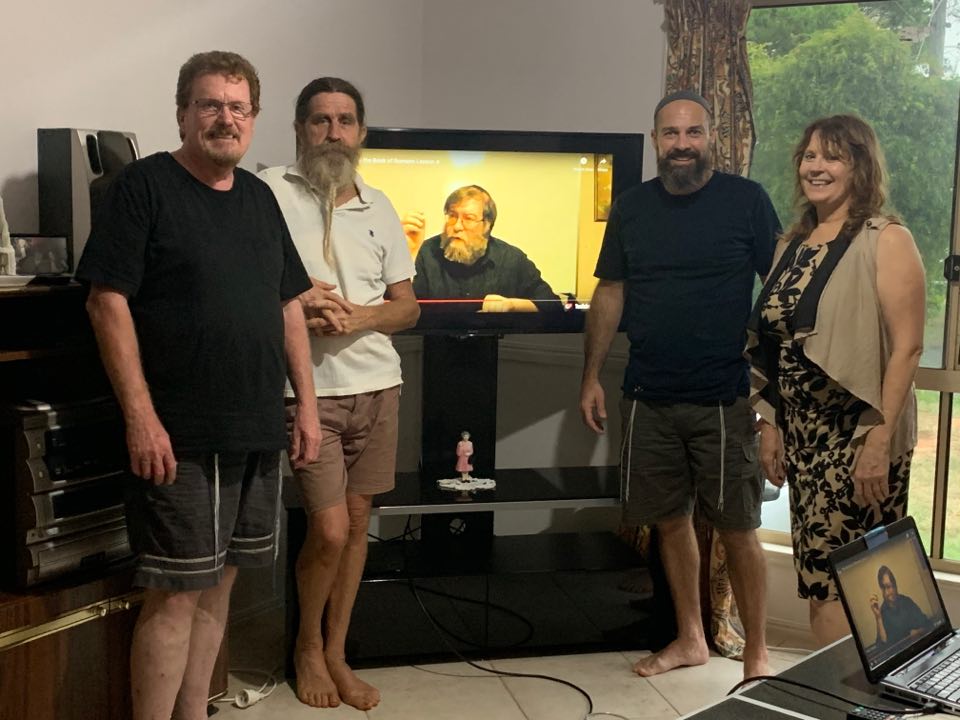
Pictured above is a home study group in Australia which has been going line by line thru Romans, and will soon be going line by line thru Galatians with the Thru the Book of Galatians class with James Trimm, complete with PDF class handouts! Check out this Free Three part class on Galatian! and be sure to share it with your friends! Its all part of the NEW NazareneSpace!

Click Here: Thru the Book of Galatians

We must raise at least $500 ASAP to cover our electric bill!

As you know we have been digging ourselves out of a budget shortfall.  As I have said to you many times, I look on this work as a co-operative one with me, and all of you combining our resources together in order to get the job done of helping to teach this great truth to all in the world who will listen. Thank you so much from the bottom of my heart for your continued support, you are the ones who make it all possible by your contributions and your prayers for our work. I truly appreciate your help in every way.

If you can make a one time donation of $500 or $1,000 dollars to support this work.


Donations can be sent by paypal to donations@wnae.org.
And don’t forget to join the conversations at the NazareneSpace Social Network

Are You Sealed and Ready for the Prophetic Beast?

Are You Sealed and Ready for the Prophetic Beast?
By
James Scott Trimm


And after this, I saw four angels standing on the four corners of the earth, and holding the four winds so that the wind would not blow on the earth, and not on the sea, and not on any tree.
(Rev. 7:1 HRV)


The land represents Israel, commonly known simply as “The Land,” the sea in the Scriptures generally represents the Gentile nations, and the trees generally represent men (as in Ezkl. 20:45-21:7 where were wicked men are dry trees and good men are green trees).

What are these four winds?  What happens with they are let loose?  Let us look to Daniel chapter 7:

2 Daniel spoke and said, I saw in my vision by night, and behold, the four winds of the
heaven, broke forth upon the great sea.
3 And four great beasts came up from the sea; diverse one from another.
(Daniel 7:1-2 HRV)

The first beast was like a lion with eagle’s wings:

The first was like a lion, and had eagle’s wings: I beheld, till the wings thereof were
plucked off. And it was lifted up from the earth, and made stand upon two feet as a man, and a man’s heart was given to it.
(Dan. 7:4 HRV)

The second was like a bear:

And behold, another beast, a second, like to a bear: and it raised up itself on one side,
and it had three ribs in its mouth between its teeth. And it was said thus unto it, Arise;
devour much flesh.
(Dan. 7:5 HRV)

The third was like a leopard:

After this I beheld, and behold another, like a leopard, which had upon the sides of it,
four wings of a fowl: the beast had also four heads, and dominion was given to it.
(Dan. 7:6 HRV)

Finally Daniel sees a fourth beast:

7 After this, I saw in the night visions: and behold a fourth beast–dreadful and terrible, and strong exceedingly, and it had great iron teeth. It devoured and broke in pieces, and stamped the residue with its feet. And it was diverse from all the beasts that were before it, and it had ten horns.
(Dan. 7:7 HRV)

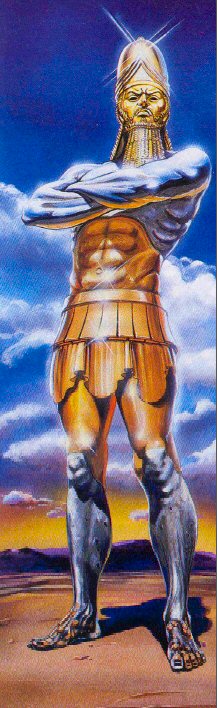
Now verse 17 tells us that these four beasts represent four kingdoms.  This vision parallels a prophetic dream revealed in Daniel chapter two.  In this dream, Nebuchadnezzar sees “a great image” with a head made of gold, chest and arms of silver, belly and thighs of brass and legs of iron.  After the legs come feet with ten toes made partly of iron and partly of clay.  This image is demolished by a stone that was cut out of a mountain without human hands.  This stone grows into a great kingdom that shall reign forever.  This Kingdom, my friend, will finally bring about the world peace that has eluded the leaders of this world and their kingdoms for so long!

In Daniel 2:37-38 Daniel tells us that the first of these kingdoms was the kingdom of Babylon.  Babylon is symbolized by a winged lion, the ancient symbol of Babylon.  It is symbolized by gold, because the ancients associated gold with the Sun and the Babylonians worshiped the Sun God.

Babylon was overcome by the Medo-Persian Empire.  Medo-Persia is represented by a bear and with silver because the Persians worshiped the Moon God and the ancients associated silver with the Moon.

Medo-Persia was overcome by the Greek Empire of Alexander the Great which is symbolized by a leopard with four heads because after the death of Alexander, his kingdom was divided among four of his generals.  It is symbolized by bronze.  Bronze is a copper alloy and in Hebrew there is only one word for copper or a copper alloy like bronze.  That word is NACHASH.  Copper was associated by the ancients with Venus or Aphrodite and the Greeks were great worshippers of Aphrodite.

The Greek Empire was overcome by the Roman Empire which is symbolized by a “great and terrible beast” and by iron.  Iron was associated by the ancients with Mars, and the Romans were dedicated to the war god Mars.

The next kingdom partially carries forward the Roman Empire, but also replaces it.  It is characterized by ten horns and by ten toes.  This ruling power rules the world from the time it overcomes the Roman Empire to the time that the Messianic Kingdom is set up and finally brings about World Peace!

Daniel 2:28 tells us that this prophecy pertains to the last days.  Who are these “ten toes” of Daniel 2 and ten horns of Daniel 7?

The Roman Empire partially continues into this kingdom of the “ten toes” which correspond with the “ten horns” of the fourth beast of chapter seven.  Who were the ten toes?  Who are the ten horns?  Who were these barbarians of Europe who took over the Roman Empire?

After the time of Solomon the Kingdom of Israel split into two kingdoms known as the two Houses of Israel.  The Southern Kingdom became known as the Kingdom of Judah.  The Northern Kingdom became known as the Kingdom of Israel.  This Northern Kingdom was also often called “Ephraim” after its most prominent tribe.  2Kings 17 tells us of how the Assyrian king Sargon II took the ten tribes of the Northern Kingdom captive in 723 BCE and resettled them so that “none was left except the tribe of Judah” (17:18).  These came to be known as “the Lost Ten Tribes of Israel”.  They were divorced by YHWH (Jer. 3:8 ) but there was yet a promise of an eventual reunion of the two houses of Israel ( Is. 11:11-12; Jer. 3:6-18; Hosea 1-3; Amos 9:8-10; Obad. 15-21; Micah 2:12-13; 5:3-15; Zech. 8:13; 9 & 10; Ezekiel 34-37 esp. 37 ).

The greater part of these lost ten tribes migrated into Europe and became European peoples with a lost Israelite identity.  They became the barbarians of Europe who overthrew the Roman Empire and dominate the world to this very day.

Ezra saw this fourth culminating beast as an eagle with three heads:

1: Then saw I a dream, and, behold, there came up from the sea an eagle, which had twelve feathered wings, and three heads.
2: And I saw, and, behold, she spread her wings over all the earth, and all the winds of the air blew on her, and were gathered together.
(2Esdras 11:1-2)

Later it is revealed to Ezra:

10: And he said unto me, This is the interpretation of the vision:
11: The eagle, whom you saw come up from the sea, is the kingdom which was seen in the vision of your brother Daniel.
12: But it was not expounded unto him, therefore now I declare it unto you.
13: Behold, the days will come, that there shall rise up a kingdom upon earth, and it shall be feared above all the kingdoms that were before it.
(2Esdras 12:10-13)


Could this eagle with three heads represent the USA and its three branches of government?

In this vision the three heads of the eagle come into conflict with one another.  One of the heads dies in its sleep, another head is slain by the other, and the final head remains until it is slain.  We are also told that a Lion (which Ezra is told represents Messiah) speaks to the eagle, but the eagle will not listen to him.  Then the eagle is no more.

Could this represent the present and growing conflicts between the branches of government with a president writing executive orders and going around congress, and a Supreme Court that legislates from the bench?

In the Book of Revelation we see the culmination of Daniel’s four beasts:


1: And I stood upon the sand of the sea, and saw a beast rise up out of the sea, having seven heads and ten horns, and upon his horns ten crowns, and upon his heads the name of blasphemy.
2: And the beast which I saw was like unto a leopard, and his feet were as the feet of a bear, and his mouth as the mouth of a lion: and the dragon gave him his power, and his seat, and great authority.
3: And I saw one of his heads as it were wounded to death; and his deadly wound was healed: and all the world wondered after the beast.
4: And they worshipped the dragon which gave power unto the beast: and they worshipped the beast, saying, Who is like unto the beast? who is able to make war with him?
 (Rev. 13:1-4)

This beast is a composite of four prophetic “beasts” which the prophet Daniel saw in his vision.

Now lets return to Revelation 7:

1 And after this, I saw four angels standing on the four corners of the earth, and holding the four winds so that the wind would not blow on the earth, and not on the sea, and not on any tree.
2 And I saw another angel who ascended from the rising of the sun, and he had the seal of the Living Eloah. And he cried aloud with a loud voice to the four angels–those to whom it was given to harm the earth and the sea.
3 And he said, Do not harm the earth nor the sea, not even the trees, until we seal the servants of Eloah between their eyes.
4 And I heard the number of those sealed, one hundred and forty-four thousand from all the tribes of Yisra’el.
(Rev. 7:1-4 HRV)

So here we see that the rise of the beast is being held back by the “angel who ascended from the rising of the sun” and who has “the seal of the Living Eloah” who is calling to four other angels to restrain these four winds until the 144,000 can be sealed “between their eyes”.

Moreover the vision recorded in the Book of Jasher parallels prophecies and visions given to the prophet Daniel in Daniel Chapters 2 and 7 which point forward to the coming of Messiah.


1 And it was in the night that Abram was born, that all the servants of Terah, and all the wise men of Nimrod, and his conjurors came and ate and drank in the house of Terah, and they rejoiced with him on that night.
2 And when all the wise men and conjurors went out from the house of Terah, they lifted up their eyes toward heaven that night to look at the stars, and they saw, and behold one very large star came from the east and ran in the heavens, and he swallowed up the four stars from the four sides of the heavens.
3 And all the wise men of the king and his conjurors were astonished at the sight, and the sages understood this matter, and they knew its import.
4 And they said to each other, This only betokens the child that has been born to Terah this night, who will grow up and be fruitful, and multiply, and possess all the earth, he and his children for ever, and he and his seed will slay great kings, and inherit their lands.
5 And the wise men and conjurors went home that night, and in the morning all these wise men and conjurors rose up early, and assembled in an appointed house.
6 And they spoke and said to each other, Behold the sight that we saw last night is hidden from the king, it has not been made     known to him.
7 And should this thing get known to the king in the latter days, he will say to us, Why have you concealed this matter from me, and then we shall all suffer death; therefore, now let us go and tell the king the sight which we saw, and the interpretation thereof, and we shall then remain clear.
8 And they did so, and they all went to the king and bowed down to him  to the ground, and they said, May the king live, may the king live.
9 We heard that a son was born to Terah the son of Nahor, the prince of thy host, and we yesternight came to his house, and we ate and drank and rejoiced with him that night.
10 And when thy servants went out from the house of Terah, to go to our respective homes to abide there for the night, we lifted up our eyes to heaven, and we saw a great star coming from the east, and the same star ran with great speed, and swallowed up four great stars, from the four sides of the heavens.
11 And thy servants were astonished at the sight which we saw, and were greatly terrified, and we made our judgment upon the sight, and knew by our wisdom the proper interpretation     thereof, that this thing applies to the child that is born to Terah, who will grow up and multiply greatly, and become powerful, and kill all the kings of the earth,
and inherit all their lands, he and his seed forever.
12 And now our lord and king, behold we have truly acquainted thee with what we have seen concerning this child.
13 If it seemeth good to the king to give his father value for this child, we will slay him before he shall grow up and increase in the land, and his evil increase against us, that we     
and our children perish through his evil.
14 And the king heard their words and they seemed good in his sight, and he sent and called for Terah, and Terah came before the king.
(Jasher 8:1-14)

In Daniel Chapter 2 the King of Babylon has a dream.  He calls his “magicians, enchanters and sorcerers”.  He does not tell them his dream (if he had, they might have connected it to the vision seen by their forefathers in the days of Avraham, and correctly interpreted the vision).  In the dream N’vukhadnetzar sees the image of a man, broken down into parts representing four kingdoms.  The head of the image is the head of the King of Babylon.  In Daniel 2 a stone cut out of a mountain without human hands destroys all four kingdoms and grows itself into a great kingdom.

The Torah is the stone that was cut out of Mt. Sinai without human hands.

In Daniel 7 Daniel sees four beasts representing four living beings who are all overcome by the son of man who comes riding upon the clouds.

Both of these visions in the Book of Daniel parallel the vision seen by the Babylonian “wise men and conjurers” in the days of Nimrod.  The ultimate fulfiment of the vision in the Book of Jasher would be fulfilled by the Messiah, represented by the “great stat coming from the east” that “swallowed up four great stars”.

Now the sealing of Revelation 7 recalls another prophecy from the Tanak:

1 Then he called in my ears with a loud voice, saying: Cause you them that have charge over the city, to draw near: every man with his destroying weapon in his hand.
2 And behold six men came, from the way of the upper gate, which lies toward the north; every man with his weapon of destruction in his hand: and one man in the midst of them, clothed in linen with a writer’s inkhorn on his side. And they went in and stood beside the brazen altar.
3 And the glory of the Elohim of Yisra’el was gone up from the cheruv, whereupon it was, to the threshold of the house. And He called to the man clothed in linen, who had the writer’s inkhorn on his side.
4 And YHWH said unto him: Go through the midst of the city, through the midst of Yerushalayim, and set a mark upon the foreheads of the men that sigh, and that cry, for all the abominations that are done in the midst thereof.
5 And to the others, He said in my hearing: Go you through the city after him and smite; let not your eye spare, neither have you pity.
6 Slay utterly: the old man, the young man, and the maiden, and little children and women: but come not near any man upon whom is the mark, and begin at My sanctuary.  Then they began at the elders that were before the house.
7 And He said unto them: Defile the house, and fill the courts with the slain; go you forth. And they went forth, and smote in the city.
8 And it came to pass while they were smiting, and I was left, that I fell upon my face and cried, and said, Ah Adonai YHWH! Will You destroy all the residue of Yisra’el, in Your pouring out of Your fury upon Yerushalayim?
9 Then said He unto me: The iniquity of the House of Yisra’el and Y’hudah is exceeding great, and the land is full of blood, and the city full of wresting of judgment. For they say, YHWH has forsaken the land, and YHWH sees not.
10 And as for Me also, My eye shall not spare, neither will I have pity, but I will bring their way upon their head.
11 And behold, the man clothed in linen, who had the inkhorn on his side, reported, saying, I have done, according to all that You have commanded me.
(Ezek. 9:1-11 HRV)

So here we have a significant event that must happen before the four winds are released and the anti-Messiah arises to power, there takes place a purification of the Assembly of Israel.  The man clothed in linen with the writers inkhorn on his side is certainly the angel with the seal in Revelation 7.

Elsewhere in Revelation we read:

1 And the fifth sounded, and I saw a star that fell from heaven upon the earth: and the key of the pit of the abyss was given to him.
2 And smoke went up from the pit, as the smoke of a great furnace that is burning: and the sun and the air were darkened because of the smoke of the pit.
3 And from the smoke, locusts went out upon the earth: and the authority that is to the scorpions of the earth, was given to them.
4 And it was told to them that they should not harm the grass of the earth, or any herb; not even the trees: but only the sons of men who did not have the seal of Eloah between their eyes.
(Rev. 9:1-4 HRV)

Notice that the locusts have no power to harm those with the seal.  This must precede the rise of the anti-Messiah who wages war with Elohim’s people (Rev. 12:17).

Who is sealed?  The answer is simple, those who “sigh and cry” because of the “abominations” that they see taking place in these last days (those in Ezekiel 8 relate to Easter).

Those being protected in Ezekiel 9 are those who sigh and cry over the “abominations” of Ezekiel 8. The abominations of Ezekiel 8 are all related to Easter and that those who “sigh and cry because of the [Easter] abominations” do so because they have made Passover “a memorial between your eyes” (Ex. 13:9) and thus have received the mark/seal of YHWH on their foreheads.

The tefillin are two black leather boxes containing scrolls of parchment inscribed with certain biblical verses (Ex. 13:1-16; Deut. 6:4-9; 11:13-21). The arm-tefillin, is worn on the upper arm, while the head-tefillin is placed above the forehead in literal fulfillment of the following passages from the Torah:

And you shall bind them for a sign upon your hand,
and they shall be for frontlets between your eyes.
(Deut. 6:8; 11:18; Ex. 13:9; 13:16 HRV)

This custom was followed not only by Pharisees, but by Essenes as well. As several sets of Teffillin were found at Qumran.

The wearing of the Tefillin is mentioned by Yeshua:

And so all their works they do
that they may be seen by the sons of men,
for they make broad the straps of their t’ffila,
and enlarge the corners of their mantles,
(Mt. 23:5 HRV)

Here he does not suggest that wearing Tefillin should not be done, but that one should not broaden the straps to make a big show of using Tefillin. In fact, one cannot follow this rule not to broaden the straps of one’s Teffilin, if one does not use them. This rule from Yeshua presupposes that one is using Teffilin.

We read in the Zohar:

 Prayer which is not whole-hearted is pursued by numbers of destructive angels, according to the Scriptural expression: “all her pursuers have overtaken her, etc.” (Lam. I, 3).Therefore it is well to preface one’s prayer with the verse, “but he is merciful and forgiveth iniquity, etc.” (Ps. LXXVIII, 38). The word “iniquity” signifies Samael, who is the serpent; “he will not destroy” signifies the destroyer; “he turneth his anger away” refers to the demon Af (anger); “and doth not stir up all his wrath” refers to the demon Hemah (wrath). To these powers are attached many destructive angels, which are under seven chiefs with seventy under-chiefs, dispersed in every firmament, and under them are myriads of others. When an Israelite wearing tzitzit and tefilln prays with devotion, then the words of the Scripture are fulfilled: “All the peoples of the earth shall see that the name of the Lord is called upon thee and they shall fear thee” (Deut. 28:10). We have agreed that “the name of the Lord” refers to the tefillin of the head; and when the destructive angels see the name of YHWH on the head of him who is praying, they at once take to flight, as it is written, “a thousand shall fall at thy side” (Ps. 91:7).
(Zohar 1:23b)

Two of the passages concerning the wearing of Tefillin tell us that Tefillin are specifically worn as a remembrance of Passover:

Seven days you shall eat unleavened bread, and in the seventh day shall be a feast to YHWH.
Unleavened bread shall be eaten throughout the seven days; and there shall no leavened bread be seen with you, neither shall there be leaven seen with you, in all your borders.
And you shall tell your son in that day, saying: It is because of that which YHWH did for me when I came forth out of Egypt.
And it shall be for a sign unto you upon your hand, and for a memorial between your eyes, that the Torah of YHWH may be in your mouth; for with a strong hand has YHWH brought you out of Egypt.
You shall therefore keep this ordinance in its season from year to year.
And it shall be when YHWH shall bring you into the land of the Kena’anites, as He swore unto you and to your fathers, and shall give it you,
that you shall set apart unto YHWH all that opens the womb; every firstling that is a male, which you have coming of a beast, shall be YHWH’s.
And every firstling of an ass you shall redeem with a lamb; and if you will not redeem it, then you shall break its neck; and all the first-born of man among your sons shall you redeem.
And it shall be when your son asks you in time to come, saying: What is this? that you shall say unto him: By strength of hand YHWH brought us out from Egypt, from the house of bondage;
and it came to pass, when Pharaoh would hardly let us go that YHWH slew all the firstborn in the land of Egypt, both the first-born of man, and the first-born of beast; therefore I sacrifice to YHWH all that opens the womb, being males; but all the first-born of my sons I redeem.
And it shall be for a sign upon your hand, and for frontlets between your eyes; for by strength of hand YHWH brought us forth out of Egypt.’
(Ex. 13:6-16 HRV)

Notice that the 144,000 are the “firstfruits”/“firstborn” (the same word in Hebrew) redeemed by the Passover Lamb:

1 And I looked, and behold, a Lamb was standing on the mountain of Tziyon, and with him [were] one hundred forty-four thousand, who had His Name, and the Name of His Father, written between their eyes.
2 And I heard a sound from heaven like the sound of many waters, and as the sound of great thunder. The sound that I heard was like a harpist who strums his harps.
3 And they were singing as it were, a new song before the throne, and before the four beasts, and before the elders. And no man was able to learn the song, except the one hundred and forty-four thousand, purchased from the earth.
4 These are they, who have not defiled themselves with women: for they are virgins– these who followed the Lamb everywhere He would go. These were purchased from among men–the firstfruits to Eloah, and to the Lamb;
5 In whose mouth, falsehood was not found, for they are without blemish.
(Rev. 14:1-5 HRV)

The other two passages concerning the Tefillin tie them closely to the Mezuzah:

And you shall bind them for a sign upon your hand, and they shall be for frontlets between your eyes.
And you shall write them upon the door-posts of your house, and upon your gates.
(Deut. 6:8-9; 11:18-20 HRV)

The Mezuzah is a piece of parchment normally contained in a decorative case and affixed to the doorpost of a Jewish home. I is inscribed with verses from the Torah (Deuteronomy 6:4-9 and 11:13-21).

The practice of affixing a Mezuzah to the doorpost seems to have been kept by not only Pharisees, but Essenes as well, in fact a Mezuzah parchment containing portions of Deut. 10:1-11:1 was found at Qumran.

The connection of the Mezuzah with Passover is obvious. Like the Mezuzah the blood of the Passover lamb was placed on the doorpost so that the “angel of death” would Passover the home.

Similarly the Mezuzah and Tefillin is seen as a guardian of a Jewish home, keeping the demons outside:

R. Eliezer b. Jacob said, Whosoever has the tefillin on his head,
the tefillin on his arm, the tzitzit on his garment,
and the mezuzah on his doorpost, is protected.
He will not fall into sin, for it is written,
And a threefold cord is not quickly broken;(Eccl. 4:12)
and it is also written, The angel of YHWH encamps
round about them that fear Him, and delivers them. (Ps. 34:8).
(b. Menachot 43b)

In fact the Greek word for “tefillin” is “phylactery” which is a Greek word meaning “guardian”. The head tefillin symbolizes for us the helmet of salvation while the hand teffilin symbolizes the shield of faith.

This judgment is a purification of the Assembly of Elohim that will take place before the rise of the anti-Messiah.  This is a judgment that will begin with the “elders that were before the house” (Ezekiel 9:6), it will begin with the leadership and work its way out.

We read in Ephesians:

11 And we were chosen in Him, even as He marked us out beforehand, and He desired:
He who performs everything according to the purpose of His will,
12 That we, those who first hoped in the Messiah, should be to the esteem of His glory.
13 In Him also, you heard the word of truth, which is the Good News of your life,
and in Him, you believed and were sealed with the Ruach HaKodesh which was
promised,
14 Which is the token of our inheritance, unto the redemption of those who have life,
and unto the glory of His honor.
(Ephesians 1:11-14 HRV)

Are you sealed with Elohim’s seal?  Do you sigh and cry because of the abominations that you see?

As you know we have been digging ourselves out of a budget shortfall.  As I have said to you many times, I look on this work as a co-operative one with me, and all of you combining our resources together in order to get the job done of helping to teach this great truth to all in the world who will listen. Thank you so much from the bottom of my heart for your continued support, you are the ones who make it all possible by your contributions and your prayers for our work. I truly appreciate your help in every way.

If you can make a one time donation of $500 or $1,000 dollars to support this work.


Donations can be sent by paypal to donations@wnae.org.
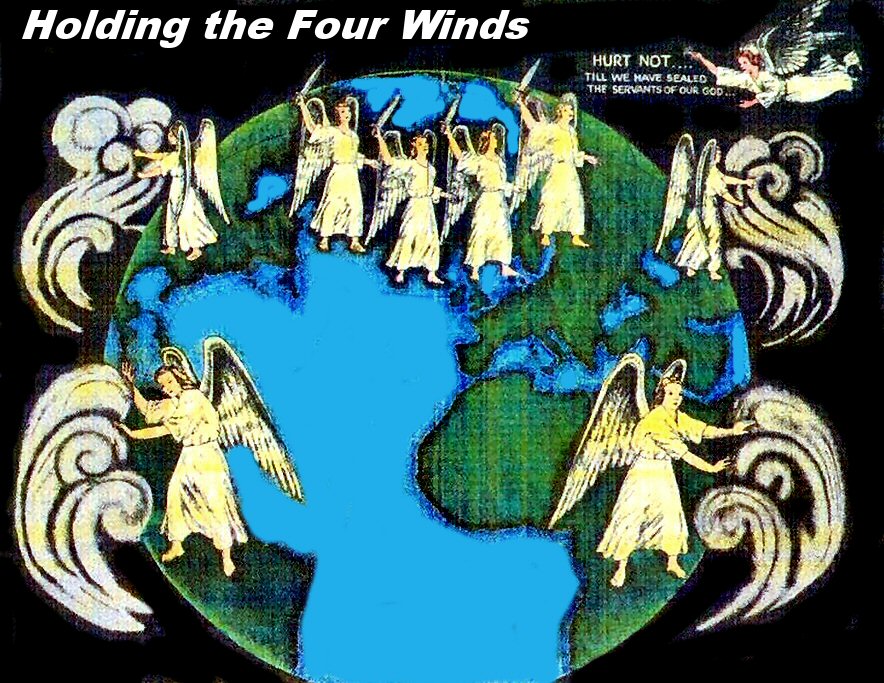
And don’t forget to join the conversations at the NazareneSpace Social Network

Understanding the Parable of the Vinedressers

Understanding the Parable of the Vinedressers
By
James Scott Trimm

One of the most misunderstood of Yehsua’s parables is the parable of the vinedressers in the vineyard.  Yeshua gives this parable as follows:

33 Hear you another parable: There was a man that was a householder: which planted a vineyard, and surrounded it with a hedge, and dug a winepress in it, and built a tower, and delivered it to vinedressers to cultivate it, and went abroad.
34 And when the time of the fruit came near, he sent his servants to the vinedressers, to receive the fruit.
35 But the vinedressers seized his servants: and beat one, and slew another, and another they stoned.
36 Again he sent other servants more than the first, and they did to them likewise.
37 But at last he sent to them his son, saying, Perhaps they will honor my son.
38 But the vinedressers, when they saw the son, said among themselves, This is the heir. Come, let us kill him, and his inheritance will be ours!
39 And they seized him, and brought him outside the vineyard, and slew him.
40 Think for yourselves, when the master of the vineyard has come, what will he do to these vinedressers?
41 And they answered Him and said, He will destroy the wicked vinedressers in their wickedness: and will hire out his vineyard to another, which will render him the fruit in its seasons.
(Mt. 21:33-41)

Christians generally misinterpret this parable to mean that the vinedressers represent the wicked Jews who reject and kill the prophets and ultimately the Messiah thus the master of the vineyard then rejects the Jews and replaces Israel with the Church.

This is a completely false understanding of Yeshua’s parable.  Lets start by looking at Matt. 21:33-34

33 Hear you another parable: There was a man that was a householder: which planted a vineyard, and surrounded it with a hedge, and dug a winepress in it, and built a tower, and delivered it to vinedressers to cultivate it, and went abroad.
34 And when the time of the fruit came near, he sent his servants to the vinedressers, to receive the fruit.
(Mt. 21:33-34)

Yeshua here is paraphrasing Isaiah 5:1-2:

…my well-beloved had a vineyard in a very fruitful hill; and he digged it, and cleared it of stones, and planted it with the choicest vine, and built a tower in the midst of it, and also hewed out a vat therein; and he looked that it should bring forth grapes, and it brought forth grapes.
(Isaiah 5:1-2)

What does the parable mean “built a tower in it”  This is the Temple, as the Targum to this section of Isaiah paraphrases “I built a sanctuary in their midst”.

Thus the parable of the vineyard in Matt. 21:33-46 is an expansion to the parable of the vineyard in Isaiah 5.  This is very helpful information in “decoding” the parable because Isaiah tells us flatly:

For the vineyard of YHWH Tzva’ot is the House of Yisrael,
and the men of Y’hudah the plant of his delight…
(Is. 5:7)

The context of Isaiah 5 is that the “vineyard” (House of Israel) and the “plant of his delight” (the men of Y’hudah) are made vulnerable when YHWH takes down the fence around the vineyard and allows it to be trodden down (Is. 5:5)  This represents the Babylonian captivity (Is. 5:13).  The “workers” sent into the vineyard are not the Jews, the Jews are the “plant of his delight” in the vineyard.  YHWH turned the “plant of his delight” over to the Gentiles.  These are the vinedresser of Matt. 21:33-46.  These gentiles rejected Moses and the prophets and kill the son so that the vineyard (“House of Israel”) would be their own (replacement theology).  YHWH comes and brings judgment upon the gentiles and gives the vineyard (“House of Israel”) to others (non-Gentiles, i.e. “Jews”)

“And therefore I tell you: the Kingdom of Elohim will be taken away from you, and given to people who will bring forth the fruits thereof.”
(Matt 21:43)

The Aramaic L’AM is ambiguous and can be translated either “to a nation” or “to a people”.  This verse tells us that the Kingdom would be taken from the vinedressers (Gentiles) and given “to a nation” bearing its fruits (the fruits being repentance, see Mt. 3:2, 8).

Our rent is due in just ten days and we do not have it. We need your help today!

As you know we have been digging ourselves out of a budget shortfall.  As I have said to you many times, I look on this work as a co-operative one with me, and all of you combining our resources together in order to get the job done of helping to teach this great truth to all in the world who will listen. Thank you so much from the bottom of my heart for your continued support, you are the ones who make it all possible by your contributions and your prayers for our work. I truly appreciate your help in every way.

If you can make a one time donation of $500 or $1,000 dollars to support this work.


Donations can be sent by Paypal to donations@wnae.org or by Zelle or Go Fund Me.

Click HERE to donate


And don’t forget to join the conversations at the NazareneSpace Social Network

Free Online Class: Thru the Book of Romans

Study Group in Australia has been going thru the Book of Romans class together each Sabbath.

Pictured above is a home study group in Australia which has been going line by line thru Romans with the Thru the Book of Romans class with James Trimm, complete with PDF class handouts! Check out this Free Five part class on Romans! and be sure to share it with your friends! Its all part of the NEW NazareneSpace!

Click Here: Thru the Book of Romans

As you know we have been digging ourselves out of a budget shortfall.  As I have said to you many times, I look on this work as a co-operative one with me, and all of you combining our resources together in order to get the job done of helping to teach this great truth to all in the world who will listen. Thank you so much from the bottom of my heart for your continued support, you are the ones who make it all possible by your contributions and your prayers for our work. I truly appreciate your help in every way.

If you can make a one time donation of $500 or $1,000 dollars to support this work.


Donations can be sent by paypal to donations@wnae.org.
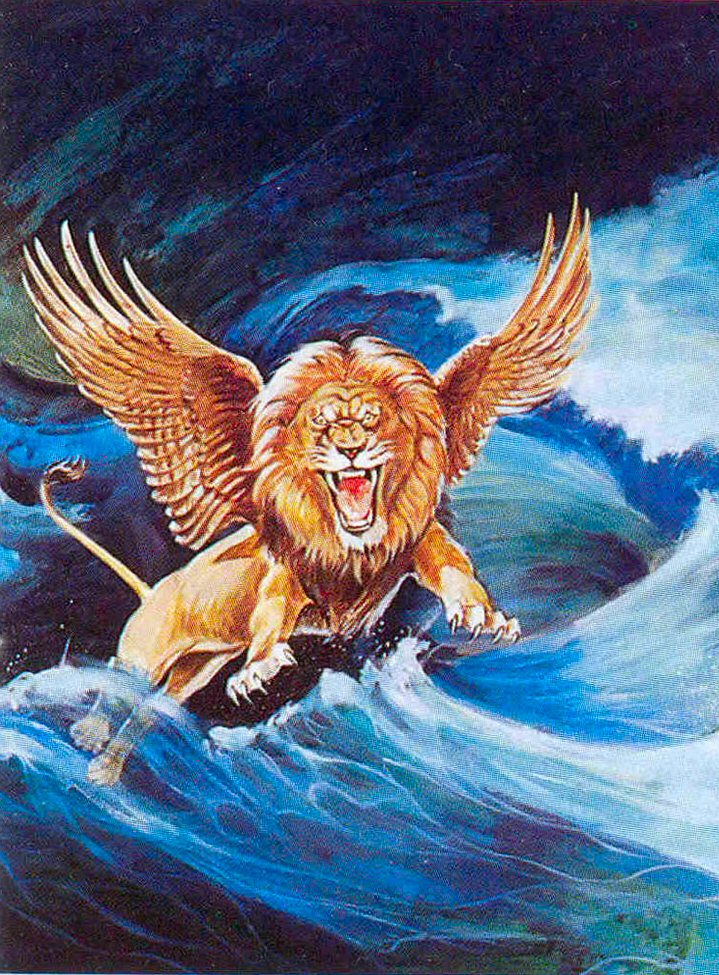
And don’t forget to join the conversations at the NazareneSpace Social Network

The Lunar Sabbath Error

The Lunar Sabbath Doctrine is a teaching that has taken root among many in the Hebraic-Roots movement in the last fourteen years.  This false doctrine seeks to replace the repeating weekly seventh day Sabbath with a floating Lunar based Sabbath, which could occur any day of the week.  This Lunar Sabbath theory teaches that one begins counting the day after each new moon such that the 8th, 15th, 22nd and 29th days are Sabbaths.


The Anti-Semitic Origin of the Lunar Sabbath Theory

The so-called “Lunar Sabbath” theory was an invention that came out of Anti-Semitic Groups with ties to the Ku Klux Klan.

Jonathan David Brown is credited with being the first so-called “sabbath keeper” in this century (actually ever) to begin the practice of counting the Sabbath from the New Moon day rather than using the modern seven day week.  Brown published the book Keeping Yahweh’s Appointments in 1998, which explained the practice, which has since spread like a virus.

Brown is a noted ant-Semite who has been convicted for his connection to a 1990 Synagogue shooting.  In 1992, Brown was sentenced to a 27-month federal prison term and fined $10,000 for accessory after the fact to a conspiracy to violate civil rights under 18 U.S.C. 3 and 241 (so-called Hate-Crimes), and for perjury under 18 U.S.C. 1623a. It was established in Court that Brown helped Damion Patton, described by Nashville police as a juvenile “skinhead”, and Leonard William Armstrong, the Grand Dragon of the Tennessee White Knights of the Ku Klux Klan hide from authorities and disguise their car after Patton and Armstrong carried out a pre-dawn drive-by shooting of a synagogue in Nashville, Tennessee on June 10, 1990.

Lunar Sabbath founder Jonathan David Brown at Nazi event, giving Nazi salute (seated on far left)

In court it was revealed that in the evening of June 9, 1990, Brown attended a meeting of an anti-Semitic white supremacists which Patton and Armstrong were also attending.  At 1:00 a.m. on June 10, Patton drove past the West End Synagogue in Nashville and Armstrong fired several shots through its windows with a TEC-9 assault pistol.  Fortunately the building was unoccupied so no one was injured.  Brown’s apartment was searched under warrant on June 15th as police looked for Patton.  As a result of this search, authorities seized items belonging to Mr. Brown, which indicated his membership in the Ku Klux Klan and other white supremacist groups. In the days following the shooting incident, Brown helped Patton evade authorities by lying to police regarding Patton’s whereabouts, by hiding him at his farm in Pleasantville, and by helping Patton change the color of his car from white to black with spray paint.  Brown gave Patton a license plate from one of his trucks and supplied Patton with enough money to drive to Las Vegas and stay there.  Some five months later, Brown allowed Patton to live again on his farm for a month. In September 1991, the FBI arrested Patton who plead guilty to his part in the synagogue shooting.

In 1994 Brown sought to overturn his convictions the United States Court of Appeals for the Sixth Circuit.  Brown argued that the synagogue was owned by a corporation and not by citizens, and thus could not be covered by 42 U.S.C. Sec. 1982 (1988) which he argued applied solely to the property rights of citizens.  Brown also challenged as unwarranted the seizure of his personal property. The three-judge court upheld Brown’s convictions on March 21, 1995.

Three years after these events Brown published his Lunar Sabbath theory which he claimed to have received by direct revelation, and it has spread like a virus.

The so-called floating “Lunar Sabbath” is a recent invention. There is no evidence that anyone ever followed it until recent times. To the contrary the historical evidence proves that the ancient Hebrews (Including Yeshua himself) kept the Seventh day of the week (“Saturday”) and not a so-called floating “Lunar Sabbath”.


An Unbelievable Conspiracy Theory

The Lunar Sabbath theory presupposes that at some point in time, the Sabbath was changed from a floating so-called Lunar Sabbath, to the weekly Sabbath.  So when did this alleged change take place?

 Yeshua and the Pharisees clearly agreed as to what day the Sabbath was.  While at times they disagreed, at times, over what activities were permitted on the Sabbath, but they never disagreed over what day the Sabbath was.

As a result most Lunar Sabbath Proponents maintain that their floating Lunar Sabbath was kept at least until the first century, and that the alleged “change” to the weekly Sabbath came after that time.

This creates certain problems, because it means that Lunar Sabbatarians must place this change well within recorded history, and this created several problems.

To begin with this alleged change would have to have been made without any historical record of the change itself taking place.  This “change” also would have to have been somehow agreed to by both Jews, Christians, and even Samaritans, all over the world.  These groups who were at odds with one another, would have to have agreed to make this change together, without making any historical record of the change, and without leaving behind any dissident sects in any of these movements that rejected the change.  This would include Jews and Christians all over the world, as far south as Ethipoia, as far east as Japan, as far north as Armenia,  to institute this change worldwide without the benefit of modern methods of rapid communication.  Any gradual change would even more certainly have left historical footprints and dissident groups behind.  This is simply unbelievable.

Another problem this creates for the Lunar Sabbath Theory is that by placing this supposed change well within the reach of history, it is a simple matter to reach beyond this period, to show that a Lunar Sabbath was not used in or before the first century.


Authors of Confusion

Many Lunar Sabbath proponents use loaded terminology and misleading claims intended to confuse the real issue.

For example many will refer to the weekly Sabbath with the term “Gregorian” so as to wrongly imply that the seven day week is somehow unique to the rather late Gregorian calendar, or to wrongly imply that the long count of days of the week was disrupted in the change from the Julian to the Gregorian Calendar.  In fact there was no disruption in the count of the days of the week in this calendar change.  Others will refer to the Weekly Sabbath and the long count of the days of the week as “Roman” as if to wrongly imply that these were unique to the Roman calendar.  Others will seek to create confusion based on other Roman methods of long counting weeks, none of which impact the actual long count of weeks going from the present, back into antiquity.    Yet others will seek to create confusion with references to the changes of the Hillel II calendar.  The Hillel II calendar included no revisions in relation to the weekly Sabbath, and only impacted Rabbinic Judaism.  The changes of the Hillel II calendar are only brought up by Lunar Sabbatarians to confuse the real issue.


Six Days of Work

There are always more than seven days between the twenty-nineth day of a lunar month and the eighth day of the next lunar month.  As a result the lunar sabbath teaching violates the mitzvah often repeated in Scripture, and indeed even referenced in the Ketuvim Netzarim:

Six days you shall labor and do all your work,
but the seventh day is a sabbath of YHWH your Elohim.


The Essenes and the Dead Sea Scrolls

There are a multitude of calendar texts which have been found among the Dead Sea Scrolls and which demonstrate clearly that the Essenes did not keep a so-called floating Lunar Sabbath.  The material is far to extensive to present here, and totally unnecessary, since I do not know of any Lunar Sabbath proponents who take issue with this fact.

I will add that Josephus writes of the Essenes:

Moreover, they are stricter than any other of the Jews in resting from their labors on the seventh day; for they not only get their food ready the day before, that they may not be obliged to kindle a fire on that day, but they will not move any vessel out of its place, nor go to stool thereon.
(Wars 2:8:9)  

If the Essenes kept a different Sabbath from the other Jews, it would seem very odd for Josephus not to mention that here.  This would certainly lead us to the conclusion that the Jews of the Second Temple Era did not keep the so-called Lunar Sabbath.


Back to Back Sabbaths

Under the Lunar Sabbath Theory, back-to-back Sabbath’s are impossible.  This is because all of the annual Sabbaths under this theory, would occur on days that would already be Sabbaths. However in the Second Temple Era, back-to-back Sabbaths were very much a possibility and there was much debate on just how to deal with these occasions.

Mishna Besah 2:1-2 deals with halachah surrounding what to do when back-to-back sabbaths occur due to a festival Sabbath falling the day before or the day after a weekly Sabbath (which can never happen in the Lunar Sabbath system):

2:1 “On a festival which coinsides with the eve of the Sabbath [Friday]- a person should not do cooking to begin with the festival day [Friday] for the purpose of the Sabbath.
But he prepares food for the festival day, and he leaves something over, he has lefts it over for use on the Sabbath.
And he prepares a cooked dish on the eve of the festival day [Thursday] and relies on it [to prepare food on Friday] for the Sabbath as well.
The House of Shammai says, “Two dishes.”
And the House of Hillel says, “A single dish.”
But they concur in the case of fish and the egg [cooked] on it, that they constitute two dishes.
[If] one ate [the dish intended for the Sabbath] or it was lost, one should not cook another in its stead in the first instance.
But if he left over any amount at all of it, he relies on it for the Sabbath.
2:2  [If the festival day] coincided with the day after the Sabbath [Sunday],
The House of Shammai says, “The immerse everything before the Sabbath.”
The House of Hillel says, “Utensils [are to be immersed] before the Sabbath.
But man [may immerse] on the Sabbath [itself].”
(m.Besa 2:1-2)

Hillel and Shammai taught when Yeshua was a child, and the Mishna was codified around 250 CE.

Another example of back-to-back Sabbaths is found in the Mishna discussion about how to deal with a Sabbath that falls on the sixteenth of Nisan (the fifteenth being an annual Sabbath):

The bones, and the sinews, and the nothar of the paschal lamb are to be burnt on the sixteenth. If the sixteenth falls on the Sabbath, they are to be burnt on the seventeenth, because they do not override either the Sabbath or the festival.
(m. Pesachim 7:10)

Of course the sixteenth of Nisan could never be a Sabbath under the Lunar Sabbath theory.


A Sabbath that Falls on the First Day of Tabernacles

The Mishna also discusses how mal offerings were handled when the First Day of Tabernacles (the 15th of Tishri) falls on a Sabbath:

A man may offer a meal-offering consisting of sixty tenths and bring them in one vessel if a man said, I take upon myself to offer sixty tenths, he may bring them in one vessel. But if he said, I take upon myself to offer sixty-one tenths, he must bring sixty in one vessel and the one in another vessel; for since the congregation bring on the first day of the feast of tabernacles when it falls on a Sabbath sixty-one tenths as a meal-offering, it is enough for an individual that his meal-offering be less by one tenth than that of the congregation.
(m.Menachot 12:4)

Of course this passage must be speaking of events that took place prior to 70 CE (when the Temple still stood).  Of course under the Lunar Sabbath theory the Sabbath always falls on the 15th of the month, making this discussion meaningless.


The Ninth of Av

The Ninth of Av is a fast which commemorates the destruction of both the First Temple and Second Temple in Jerusalem, which occurred about 655 years apart, but on the same Hebrew calendar date.  According to the Lunar Sabbath theory, the ninth of Av could never fall on a Sabbath, yet the Talmud discusses the issue of what to do when a Sabbath falls on the Ninth of Av as follows:

It was in fact taught: If the Ninth of Av fell on a Sabbath and, similarly, if the eve of the Ninth of Av fell on a Sabbath a man may eat and drink as much as he requires and lay on his table a meal as big as that of Solomon in his time. If the Ninth of Av fell on the Sabbath eve [food] of the size of an egg must be brought and eaten [before the conclusion of the day] so that one does not approach the Sabbath in a state of affliction’.
(b.Eruvin 41a)


New Moon on a Sabbath

The Talmud also discusses the issue of what to do when a New Moon falls on a Sabbath, and records a debate which took place between the House of Hillel and the House of Shammai on the issue:

R. Zera replied: The New Moon is different from a festival – Since its mention is included in the benediction on the sanctity of the day in the morning and evening prayers it is also included in that of the additional prayer. But do Beth Shammai uphold the view that the mention of the New Moon is to be included? Was it not in fact taught: If a New Moon falls on a Sabbath, Beth Shammai ruled: One recites in his additional prayer eight benedictions and Beth Hillel ruled: Seven? This is indeed a difficulty.
(b.Eruvin 40b)

However with the Lunar Sabbath theory, such a debate would not have occurred at all.
Yeshua’s Last Days

One of the biggest gaping holes in the Lunar Sabbath system is Yeshua’s final week on earth… his crucifixion was on the eve of a Sabbath and his resurrection was on the first day “when the sabbath had passed” (Mk. 16:1) and he was in the grave three days…

Now there is much debate over how these days are laid out.  Some argue that Yeshua was crucified on a Wednesday and resurrected at the very end of the Sabbath (Saturday night).  Others (myself included) argue that Yeshua was crucified on a Thursday, and resurrected the morning after the Sabbath (Sunday morning).

But no matter how you slice it you have here either back to back Sabbaths (Friday being the first day of Unleavened Bread and thus an annual Sabbath)  or two Sabbaths with a non-sabbath in between (Thursday being the first day of Unleavened Bread and thus an annual Sabbath).  Neither of these possibilities is possible with a Lunar Sabbath System. With a Lunar Sabbath system, if Yeshua was crucified on the eve of the the sabbath [i.e. the first day of Unleavened Bread- an annual Sabbath] and resurrected on the morning after the Sabbath [since following the Lunar Sabbath System those are the same day] he would have only been in the grave for one day, not three.
Which Sabbath was the Firstfruits Offering?

The well known debate between Pharisees and Sadducees over which day was the first fruits  offering (As recorded in b.Men. 65a-66a) also disproves the Lunar Sabbath System .  It is impossible to debate whether firstfruits is the day after the weekly Sabbath of the day after the annual sabbath if those are the same day.  The Pharisees and Sadducees disagreed on that point, and since there were no Sadducees after the first century, during the first century the Jews of Yeshua’s day definitely recognized these as different days, and therefore could not have been keeping the Lunar Sabbath system.


The Reward Offer

Lunar Sabbath proponent Arnold Bowen has for many years offered “a $10,000 reward to anyone who can pinpoint a weekly Sabbath on any other day than by the moon.”  Specifically “on the 8th, 15th, 22nd, and 29th.”

On August 16th, 2012 I laid claim to this reward when I was able to pinpoint the 14th of Nisan (Abib) in 30 BCE (Saturday, March 28th, 30 BC) as a Sabbath. Bowen never paid the reward.

Hillel the Great became Nasi if the Sanhedrin one hundred years before the destruction of the Temple (b.Shabbat 15a).  The Temple was destroyed in 70 CE, so this means Hillel became Nasi in 30 BCE.

Hillel’s ascension to the office of Nasi took place in a year which the 14th of Nisan (Passover) occurred on a Sabbath.  This situation did in fact occur in 30 BCE.  At the time there was a controversy as to whether the Passover lamb should be slaughtered on the Sabbath or not. Thereupon Hillel proved by argument and tradition that it was permissible, upon which the Bene Bathyra (Sons of Bathyra), the then heads of the Jews of Judea, voluntarily resigned their leadership in his favor.  The account appears in the Talmud in tractate Pessachim on page 66a.  The discussion begins with a section of Mishnah (Pessachim 6:1-2) which states that many Passover duties override the Sabbath.  The Gemara then recounts the story of the problem that Hillel resolved which led to his being made Nasi (president of the Sanhedrin):

THESE THINGS IN [CONNECTION WITH] THE PASSOVER OFFERING OVERRIDE THE SABBATH: ITS SHECHITAH AND THE SPRINKLING OF ITS BLOOD AND THE CLEANSING OF ITS BOWELS AND THE BURNING OF ITS FAT. BUT ITS ROASTING AND THE WASHING OF ITS BOWELS DO NOT OVERRIDE THE SABBATH. ITS CARRYING AND BRINGING IT FROM WITHOUT THE TEHUM AND THE CUTTING OFF OF ITS WART DO NOT OVERRIDE THE SABBATH. R. ELIEZER SAID: THEY DO OVERRIDE [THE SABBATH]. SAID R. ELIEZER, DOES IT NOT FOLLOW A FORTIORI: IF SHECHITAH, WHICH IS [USUALLY FORBIDDEN] AS A LABOUR, OVERRIDES THE SABBATH, SHALL NOT THESE, WHICH ARE [ONLY FORBIDDEN] AS A SHEBUTH, OVERRIDE THE SABBATH? R. JOSHUA ANSWERED HIM, LET FESTIVAL[S] REBUT IT, WHEREIN THEY PERMITTED LABOUR AND FORBADE A SHEBUTH. SAID R. ELIEZER TO HIM, WHAT IS THIS, JOSHUA, WHAT PROOF IS A VOLUNTARY ACT IN RESPECT OF A PRECEPT! R. AKIBA ANSWERED AND SAID, LET HAZA’AH PROVE IT, WHICH IS [PERFORMED] BECAUSE IT IS A PRECEPT AND IS [NORMALLY FORBIDDEN ONLY] AS A SHEBUTH, YET IT DOES NOT OVERRIDE THE SABBATH; SO YOU TOO, DO NOT WONDER AT THESE, THAT THOUGH THEY ARE [REQUIRED] ON ACCOUNT OF THE PRECEPT AND ARE [ONLY FORBIDDEN] AS A SHEBUTH, YET THEY DO NOT OVERRIDE THE SABBATH. SAID R. ELIEZER TO HIM, BUT IN RESPECT OF THAT [ITSELF] I ARGUE: IF SHECHITAH, WHICH IS A LABOUR, OVERRIDES THE SABBATH, IS IT NOT LOGICAL THAT HAZA’AH, WHICH IS [ONLY] A SHEBUTH, OVERRIDES THE SABBATH! (m.Pessachim 6:1-2)

GEMARA. Our Rabbis taught: This halachah was hidden from [i.e., forgotten by] the Bene Bathyra. On one occasion the fourteenth [of Nisan] fell on the Sabbath, [and] they forgot and Passover, R. Akiba holds that the haza’ah must not be performed, though the man is thereby prevented from joining in the Passover sacrifice. did not know whether the Passover overrides the Sabbath or not. Said they, ‘Is there any man who knows whether the Passover overrides the Sabbath or not?’ They were told, ‘There is a certain man who has come up from  Babylonia, Hillel the Babylonian by name, who served the two greatest men of the time, and he knows whether the Passover overrides the Sabbath or not [Thereupon] they summoned him and said to him, ‘Do you know whether the Passover overrides the Sabbath or not?’ ‘Have we then [only] one Passover during the year which overrides the Sabbath?’ replied he to them, ‘Surely we have many more than two hundred Passovers during the year which override the Sabbath! Said they to him, ‘How do you know it?’ He answered them, ‘In its appointed time’ is stated in connection with the Passover, and ‘In its appointed time’ is stated in connection with the tamid; just as ‘Its appointed time’ which is said in connection with the tamid overrides the Sabbath, so ‘Its appointed time’ which is said in connection with the Passover overrides the Sabbath. Moreover, it follows a minori, if the tamid, [the omission of] which is not punished by kareth, overrides the Sabbath, then the Passover,[neglect of] which is punished by kareth, is it not logical that it overrides the Sabbath! They immediately set him at their head and appointed him Nasi [Patriarch] over them, and he was sitting and lecturing the whole day on the laws of Passover. He began rebuking them with words. Said he to them, ‘What caused it for you that I should come up from Babylonia to be a Nasi over you? It was your indolence, because you did not serve the two greatest men of the time, Shemaiah and Abtalyon.’ Said they to him, ‘Master, what if a man forgot and did not bring a knife on the eve of the Sabbath?’ ‘I have heard this law,’ he answered, ‘but have forgotten it. But leave it to Israel: if they are not prophets, yet they are the children of prophets!’ On the morrow, he whose Passover was a lamb stuck it [the knife] in its wool; he whose Passover was a goat stuck it between its horns. He saw the incident and recollected the halachah and said, ‘Thus have I received the tradition from the mouth[s] of Shemaiah and Abtalyon.’
(b.Pesachim 66a)


Now this section of Mishnah and Talmud makes it clear that the 14th of Nisan (Passover) could occur on a Sabbath, and in fact did occur on the Sabbath as early as the days of Hillel the Great, who was elderly in the days of Yeshua’s youth.

Now as I have said before, Yeshua and the Pharisees clearly agreed as to what day the Sabbath was.  They disagreed, at times, over what activities were permitted on the Sabbath, but they never disagreed over what day the Sabbath was.  So if we can demonstrate that the first century Phraisees kept the weekly “Saturday” Sabbath, we would also be demonstrating that Yeshua kept the weekly “Saturday” Sabbath. And if we could show that the first century Pharisees did not keep a so-called floating lunar Sabbath, we would be showing also that Yeshua did not keep such a lunar Sabbath, and thus that such a lunar Sabbath was not valid.

Now this section of Mishnah and Talmud reveal that on occasion the 14th of Nisan could and did happen to fall on the Sabbath as reckoned by the first century Pharisees, and therefore by Yeshua as well.  This is impossible with the so-called Lunar Sabbath System, in which the 8th, 15th, 22nd, and 29th of a Lunar Month were Sabbaths and the 14th could NEVER be a Sabbath.

Philo of Alexandria

The Lunar Sabbatarians have looked far and wide for ancient support for their theory. The problem is that there is none. However in their zealousness they have misappropriated certain quotations from Philo which they wrongly claim support a Lunar Sabbath. The fact is that not only does Philo not teach a Lunar Sabbath, but Philo makes statements that plainly conflict with the Lunar Sabbath Theory, and makes one of the oldest, clearest description of the  Sabbath as the seventh day of a continuous repeating seven day week.

The first quotation Lunar Sabbatarians appropriate from Philo is as follows:

“For it is said in the Scripture: On the tenth day of this month let each of them take a sheep according to his house; in order that from the tenth, there may be consecrated to the tenth, that is to God, the sacrifices which have been preserved in the soul, which is illuminated in two portions out of the three, until it is entirely changed in every part, and becomes a heavenly brilliancy like a full moon, at the height of its increase at the end of the second “week”…
(ON MATING WITH THE PRELIMINARY STUDIES, X1X (102))

The fact is that this passage simply refers to a fourteen day period as “two weeks” just as we do today. A fourteen day period may be called “two weeks” regardless of which day it begins and ends, even if it actually is made up of one complete week and parts of two other weeks.

The next quote often used is as follows:

“9. (Ex. xii. 6a) Why does He command (them) to keep the sacrifice until the fourteenth (day of the month)? (Consisting of) two Sabbaths, it has in its nature a (special) honour because in this time the moon is adorned. For when it has become full on the fourteenth (day), it becomes full of light in the perception of the people. And again through (another) fourteen (days) it recedes from its fullness of light to its conjunction, and it wanes as much in comparison with the preceding Sabbath as the second (waxes) in comparison with the first. For this reason the fourteenth (day) is pre-festive, as though (it were) a road leading to festive rejoicings, during which it is incumbent upon us to meditate”.
(On page 17 of Ralph Marcus’ translation of Philo’s work entitled “Questions and Answers, Exodus, Book 1”)

This parallels Younge’s translation in The Decalogue:

“The fourth commandment has reference to the sacred seventh day, that it may be passed in a sacred and holy manner. Now some states keep the holy festival only once in the month, counting from the new moon, as a day sacred to God; but the nation of the Jews keep every seventh day regularly, after each interval of six days; and there is an account of events recorded in the history of the creation of the world, comprising a sufficient relation of the cause of this ordinance; for the sacred historian says, that the world was created in six days, and that on the seventh day God desisted from his works, and began to contemplate what he had so beautifully created; therefore, he commanded the beings also who were destined to live in this state, to imitate God in this particular also, as well as in all others, applying themselves to their works for six days, but desisting from them and philosophising on the seventh day,”
(The Decalogue ch. 26)

The wording here is obscure. Philo may be referring to the fact that any fourteen day period will contain two Sabbaths, or he may be referring to the fact that the first and last days of Unleavened Bread are annual Sabbaths.

The final two passages Lunar Sabbatarians cite from Philo is as follows:

(161) But to the seventh day of the week he has assigned the greatest festivals, those of the longest duration, at the periods of the equinox both vernal and autumnal in each year; appointing two festivals for these two epochs, each lasting seven days; the one which takes place in the spring being for the perfection of what is being sown, and the one which falls in autumn being a feast of thanksgiving for the bringing home of all the fruits which the trees have produced. And seven days have very appropriately been appointed to the seventh month of each equinox, so that each month might receive an especial honour of one sacred day of festival, for the purpose of refreshing and cheering the mind with its holiday.
(Philo; Decalogue 30, 161)

And the next refers back to this one:

“Again the beginning of this feast is appointed for the fifteenth day of the month on account of the reason which has already been mentioned respecting the Spring season might receive special honor of one sacred day of festival.”
(THE TENTH FESTIVAL XXXIII. (210))

Now while some have tried to use this to support the Lunar Sabbath, to the contrary this statement conflicts with the Lunar Sabbath Theory. Philo here says that the two longest Torah feasts (Unleavened Bread and Tabernacles) differ from all other festivals because, being seven days long, they always include a weekly sabbath (any seven day period will include a weekly Sabbath). However if one follows the Lunar Sabbath theory, virtually all annual Feasts coincide with Sabbaths, which would render Philo’s statement meaningless. Philo makes the nature of the Sabbath clear when he writes:

(56) But after this continued and uninterrupted festival which thus lasts through all time, there is another celebrated, namely, that of the sacred seventh day after each recurring interval of six days, which some have denominated the virgin, looking at its exceeding sanctity and purity…
(Special Laws 2, 56)

Philo clearly did not teach the so-called Lunar Sabbath Theory, but instead taught the repeating weekly Sabbath based on a continuous count of seven day “weeks” going back to the first Sabbath at creation.

Conclusion

Well when I began writing this blog, it was my intent to write an exhaustive treatment of the Lunar Sabbath doctrine and its errors.  However the evidence against the Lunar Sabbath is so overwhelming, it has become clear to me that if I ever write an exhaustive treatment, it will fill a book, not just a blog.  None-the-less I believe enough information has been documented in this short treatment to completely disprove the Lunar Sabbath theory.

As you know we have been digging ourselves out of a budget shortfall.  As I have said to you many times, I look on this work as a co-operative one with me, and all of you combining our resources together in order to get the job done of helping to teach this great truth to all in the world who will listen. Thank you so much from the bottom of my heart for your continued support, you are the ones who make it all possible by your contributions and your prayers for our work. I truly appreciate your help in every way.

If you can make a one time donation of $500 or $1,000 dollars to support this work.


Donations can be sent by Paypal to donations@wnae.org

And don’t forget to join the conversations at the NazareneSpace Social Network

The Woman Caught in Adultery and the Torah

The Woman Caught in Adultery and the Torah
By
James Scott Trimm


The Scriptures relate a well known event involving a woman alleged to have been caught in adultery:

53 Then each of them went to his house
1 And Yeshua went to the Mount of Olives.
2 And in the morning he came again to the Temple and all the people
came to him. And while he was sitting, he was teaching them.
3 And the scribes and P’rushim brought a woman who was caught in
adultery. And placing her in the midst,
4 They said to him, Teacher, this woman was caught in the open in
the act of adultery.
5 Now in the Torah of Moshe, he commanded that we stone those who
are like these. Now, what do you say?
6 They said this testing him so that they would have a reason to
accuse him. But Yeshua, after he had stooped down, wrote on the ground.
7 And when they continued asking him, he straightened himself and
said to them, Whichever one of you is without sin may cast the first
stone at her .
8 And again after he had stooped down, he was writing on the ground.
9 And when they heard [it], they went out one by one having begun
with the elders. And the woman was left by herself being in the midst.
10 And after Yeshua straightened himself he said to the woman, Where
are they? Does no man condemn you?
11 And she said, No man, Adon. And Yeshua said, Neither do I condemn
you. Go, and from now on do not sin again.
(John 7:53-8:11)

The story of the alleged adulteress (John 7:53-8:11) does not actually appear in many of the most ancient manuscripts. It does not appear in the Aramaic Peshita or the Aramaic Old Syraic texts. Those Greek manuscripts which do contain it place it in various places some after Luke 21:38 and some after John 7:36 or after 7:52 or even after 21:24.

According to the “church father” Papias the story also appeared in the Gospel According to the Hebrews (Papias quoted in Eccl. Hist. iii, 39, 17) An apocryphal gospel which was used by the ancient Nazarenes.

But let us look at what this narrative acvtually teaches, John 8:7 says:

Whichever one of you is without sin may cast the first stone at her –

Yeshua was not contradicting the Torah. The Torah required that the witnesses cast the first stone:

At the mouth of two witnesses, or three witnesses,
shall he that is to die be put to death.
The hand of the witnesses shall be first upon him to death,
and afterward the hand of all the people.
So you shall put away the evil from the midst of you.
(Deut. 17:6-7).

According to a Halachah found in the Dead Sea Scrolls:

No one who has knowingly violated a single word of the
commandment will be considered a reliable witness against
his fellow until he is considered fit to return to full fellowship.
(Damascus Document 4Q270 frag. 9 col. 10 lines 2-3)

And in the Mishna we read:

And these are those who are invalid [to serve as witnesses or judges]:
(1) He who plays dice; (2) he who loans money on interest; (3) those who race pigeons; (4) and those who do business in the produce of the Seventh Year. Said Rabbi Simeon, “In the beginning they called them “Those who gather Seventh Year produce.” When the oppressors became many [who collected taxes in the Seventh Year], they reverted to calling them, “Those who do business in the produce of the Seventh Year.” Said Rabbi Judah. “Under what circumstances?” When [the aforenamed] have only that as their profession, but if they have a profession other than that, they are valid.
(m.Sanhedrin 3:3)

And in the Gemara to this passage (24b-27b) we read that Rabba says:

“the Torah said: Do not accept the wicked as witness”
(b.San 25a)

Yeshua seems to have been agreeing with this Halachic precept regarding witnesses. Without witnesses a case of adultery could only be tried by the trial of bitter waters:

[12] Speak unto the children of Israel, and say unto them, If any man’s wife go aside, and commit a trespass against him,
[13] And a man lie with her carnally, and it be hid from the eyes of her husband, and be kept close, and she be defiled, and there be no witness against her, neither she be taken with the manner;
[14] And the spirit of jealousy come upon him, and he be jealous of his wife, and she be defiled: or if the spirit of jealousy come upon him, and he be jealous of his wife, and she be not defiled:
[15] Then shall the man bring his wife unto the priest, and he shall bring her offering for her, the tenth part of an ephah of barley meal; he shall pour no oil upon it, nor put frankincense thereon; for it is an offering of jealousy, an offering of memorial, bringing iniquity to remembrance.
[16] And the priest shall bring her near, and set her before the LORD:
[17] And the priest shall take holy water in an earthen vessel; and of the dust that is in the floor of the tabernacle the priest shall take, and put it into the water:
[18] And the priest shall set the woman before the LORD, and uncover the woman’s head, and put the offering of memorial in her hands, which is the jealousy offering: and the priest shall have in his hand the bitter water that causeth the curse:
[19] And the priest shall charge her by an oath, and say unto the woman, If no man have lain with thee, and if thou hast not gone aside to uncleanness with another instead of thy husband, be thou free from this bitter water that causeth the curse:
[20] But if thou hast gone aside to another instead of thy husband, and if thou be defiled, and some man have lain with thee beside thine husband:
[21] Then the priest shall charge the woman with an oath of cursing, and the priest shall say unto the woman, The LORD make thee a curse and an oath among thy people, when the LORD doth make thy thigh to rot, and thy belly to swell;
[22] And this water that causeth the curse shall go into thy bowels, to make thy belly to swell, and thy thigh to rot: And the woman shall say, Amen, amen.
[23] And the priest shall write these curses in a book, and he shall blot them out with the bitter water:
[24] And he shall cause the woman to drink the bitter water that causeth the curse: and the water that causeth the curse shall enter into her, and become bitter.
[25] Then the priest shall take the jealousy offering out of the woman’s hand, and shall wave the offering before the LORD, and offer it upon the altar:
[26] And the priest shall take an handful of the offering, even the memorial thereof, and burn it upon the altar, and afterward shall cause the woman to drink the water.
[27] And when he hath made her to drink the water, then it shall come to pass, that, if she be defiled, and have done trespass against her husband, that the water that causeth the curse shall enter into her, and become bitter, and her belly shall swell, and her thigh shall rot: and the woman shall be a curse among her people.
[28] And if the woman be not defiled, but be clean; then she shall be free, and shall conceive seed.
[29] This is the law of jealousies, when a wife goeth aside to another instead of her husband, and is defiled;
[30] Or when the spirit of jealousy cometh upon him, and he be jealous over his wife, and shall set the woman before the LORD, and the priest shall execute upon her all this law.
[31] Then shall the man be guiltless from iniquity, and this woman shall bear her iniquity.
(Num. 5:12-31 KJV)


This could only be done if the matter was pushed forward by the husband. (This was the only type of case that could be brought without witnesses ) This is the meaning of “does no man condemn you” (verse 10) as the word “man” in Hebrew can also mean “husband”.

In Jn. 8:8 it says that Yeshua was “writing on the ground”.  Yeshua was is writing in the dust of the Temple floor of which was used to judge an alleged unfaithful bride (Numbers 5:12-31). He probably fulfilled the prophecy when he “wrote their names in the dust” (Jer. 17:13) by writing the names of the unrighteous witnesses in this very same dust:


O YHWH, the hope of Israel, all that forsake thee shall be ashamed, and they that depart from me shall be written in the earth, because they have forsaken YHWH, the fountain of living waters.
(Jer. 17:13)

Our rent is due in just nine days and we don’t yet have it!

As you know we have been digging ourselves out of a budget shortfall.  As I have said to you many times, I look on this work as a co-operative one with me, and all of you combining our resources together in order to get the job done of helping to teach this great truth to all in the world who will listen. Thank you so much from the bottom of my heart for your continued support, you are the ones who make it all possible by your contributions and your prayers for our work. I truly appreciate your help in every way.

If you can make a one time donation of $500 or $1,000 dollars to support this work.


Donations can be sent by Paypal to donations@wnae.org or by Zelle or Go Fund Me!

Click HERE to donate

And don’t forget to join the conversations at the NazareneSpace Social Network

As you know we have been digging ourselves out of a budget shortfall.  As I have said to you many times, I look on this work as a co-operative one with me, and all of you combining our resources together in order to get the job done of helping to teach this great truth to all in the world who will listen. Thank you so much from the bottom of my heart for your continued support, you are the ones who make it all possible by your contributions and your prayers for our work. I truly appreciate your help in every way.

If you can make a one time donation of $500 or $1,000 dollars to support this work.


Donations can be sent by paypal to donations@wnae.org.

Or click HERE to donate

And don’t forget to join the conversations at the NazareneSpace Social Network